
In the development of hybrid cars, noise, vibration, and harshness (NVH) performance is a critical aspect that directly impacts driving comfort and overall vehicle quality. Among various noise sources, exhaust system noise stands out as a significant contributor, especially in hybrid vehicles where the internal combustion engine operates intermittently, leading to distinct acoustic challenges. Traditional passive noise control methods, such as mufflers, often fall short in mitigating low-frequency noise below 300 Hz and can increase exhaust backpressure, adversely affecting fuel economy and power output. Therefore, active noise control (ANC) technology presents a promising alternative by leveraging adaptive algorithms to generate anti-noise signals that cancel out unwanted sounds. In this study, I explore the application of ANC to exhaust systems in hybrid cars, focusing on the principles, algorithms, and experimental validations that demonstrate its efficacy. The research aims to provide a comprehensive framework for reducing exhaust noise in hybrid cars, enhancing NVH performance without compromising vehicle efficiency.
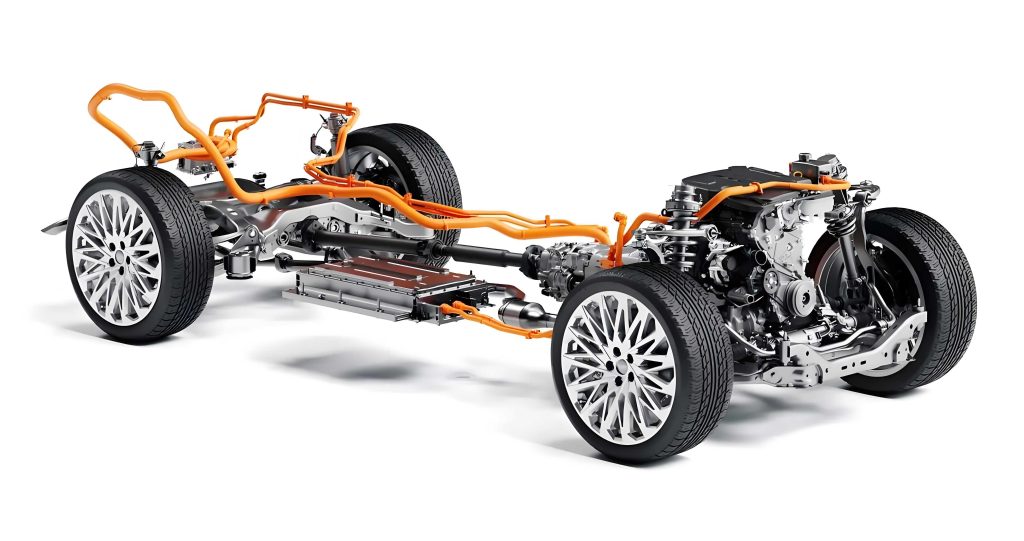
Exhaust noise in hybrid cars primarily originates from the internal combustion engine during its operation phases. When the engine is active, high-pressure exhaust gases are expelled through the exhaust manifold and pipe, generating broadband noise with prominent low-frequency components. This noise includes fundamental and harmonic frequencies related to engine cycles, as well as resonance and flow-induced noises. For hybrid cars, the intermittent nature of engine operation—such as during start-stop cycles or under electric-assist modes—can exacerbate these acoustic issues, making effective noise control essential for maintaining a quiet cabin environment. The frequency of exhaust noise is determined by engine parameters, and it can be calculated using the formula:
$$ f = \frac{Z \cdot n}{60 \cdot \tau} \times N $$
where \( Z \) is the number of engine cylinders, \( n \) is the engine speed in revolutions per minute (rpm), \( \tau \) is the stroke number, and \( N \) represents the order (e.g., 1, 2, 3, … for fundamental and harmonics). In hybrid cars, this noise typically falls within the 10 to 3000 Hz range, but the most problematic components are often below 300 Hz, where passive mufflers are less effective. By targeting these low-frequency order noises, ANC can significantly improve the acoustic comfort in hybrid cars.
The principle of active noise control for exhaust systems in hybrid cars is based on the superposition of sound waves. An ANC system consists of a reference sensor (e.g., engine speed signal), a controller, an actuator (such as a secondary loudspeaker), and an error microphone. The controller processes the reference signal to generate an anti-noise signal that is equal in amplitude but opposite in phase to the primary noise. This anti-noise is emitted by the secondary loudspeaker, typically installed near the exhaust outlet or within the exhaust pipe, to interfere destructively with the primary noise, thereby reducing the overall sound pressure level. For hybrid cars, this approach is particularly advantageous because it allows for real-time adaptation to varying engine conditions, such as transitions between electric and combustion modes. The effectiveness of ANC relies on accurate modeling of the secondary path, which includes the electrical and acoustic delays from the actuator to the error microphone. Without proper compensation, phase misalignment can occur, undermining the noise cancellation performance.
To implement ANC in hybrid cars, the secondary path transfer function must be identified beforehand. This is achieved using adaptive filtering techniques, such as the Least Mean Squares (LMS) algorithm. The secondary path, denoted as \( h_s(n) \), represents the impulse response from the secondary loudspeaker to the error microphone. In practice, a white noise signal is injected through the secondary loudspeaker, and the error microphone captures the response. An adaptive FIR filter is used to model \( h_s(n) \), with its coefficients updated iteratively to minimize the error between the actual and predicted outputs. The process can be summarized as follows: let \( \text{white}(n) \) be the white noise signal, \( y(n) = \text{white}(n) * h_s(n) \) be the measured signal at the error microphone, and \( y'(n) = \text{white}(n) * h_s'(n) \) be the output of the adaptive filter. The error signal is defined as \( e(n) = y(n) – y'(n) \), and the LMS algorithm updates the filter coefficients to drive \( e(n) \) toward zero, ensuring \( h_s'(n) \) converges to \( h_s(n) \). This step is crucial for hybrid cars, as it accounts for variations in the exhaust system due to temperature changes or component wear, ensuring robust ANC performance across different driving scenarios.
Once the secondary path is modeled, the core ANC algorithm employed is the Filtered-x LMS (FxLMS) algorithm. This algorithm extends the standard LMS by filtering the reference signal with the estimated secondary path transfer function to compensate for delays. In the context of hybrid cars, the reference signal is derived from the engine speed, which correlates with the order noise of the exhaust system. Let \( x(n) \) be the reference signal vector, \( W(n) \) be the adaptive filter weight vector, and \( r(n) = x(n) * h_s'(n) \) be the filtered reference signal. The controller output is \( y(n) = x^T(n) W(n) \), and the error signal at the microphone is \( e(n) = d(n) + s(n) \), where \( d(n) \) is the primary noise and \( s(n) = r^T(n) W(n) \) is the secondary noise. The FxLMS algorithm updates the weights according to:
$$ W(n+1) = W(n) – 2\mu e(n) r(n) $$
where \( \mu \) is the step-size parameter controlling convergence. This iterative process minimizes the mean square error \( J(n) = E[e^2(n)] \), effectively reducing the exhaust noise in hybrid cars. The algorithm’s efficiency makes it suitable for real-time implementation in hybrid cars, where computational resources may be limited due to other vehicle systems. To illustrate the algorithm’s components, consider the following table summarizing key variables:
| Variable | Description | Role in ANC for Hybrid Cars |
|---|---|---|
| \( x(n) \) | Reference signal (engine speed) | Provides frequency information for noise cancellation |
| \( W(n) \) | Adaptive filter weights | Adjusted to generate anti-noise signal |
| \( h_s'(n) \) | Estimated secondary path | Compensates for system delays in hybrid cars |
| \( e(n) \) | Error signal | Measures residual noise for feedback |
| \( \mu \) | Step-size parameter | Controls convergence speed and stability |
For hybrid cars, the FxLMS algorithm offers flexibility in handling multiple order noises simultaneously. Since exhaust noise in hybrid cars often consists of several harmonic orders, the algorithm can be extended to multi-channel configurations, though this study focuses on a single-channel approach for simplicity. The effectiveness of this method depends on accurate secondary path modeling and proper selection of algorithm parameters, which can be optimized through simulation and experimental testing.
To validate the ANC approach for hybrid cars, a bench test was conducted using a PVC pipe setup to simulate the exhaust system. This setup included a primary loudspeaker to generate noise mimicking engine exhaust, a secondary loudspeaker for anti-noise emission, an error microphone at the pipe outlet, and a controller (dSPACE system) processing signals. The engine speed was simulated using a CAN signal generator, replicating conditions in hybrid cars. Initially, the secondary path transfer function was identified, resulting in a frequency response curve that guided the ANC design. For instance, at a simulated engine speed of 1200 rpm, corresponding to order noises at 80 Hz (4th order), 120 Hz (6th order), 160 Hz (8th order), and 200 Hz (10th order), the ANC system was activated. The FxLMS algorithm was implemented, and results showed significant noise reduction across these frequencies. The table below summarizes the bench test results:
| Frequency (Hz) | Order | Noise Reduction (dB) | Remarks for Hybrid Cars |
|---|---|---|---|
| 80 | 4th | 35 | Targets low-frequency exhaust noise |
| 120 | 6th | 38 | Improves cabin comfort in hybrid cars |
| 160 | 8th | 36 | Effective under varying engine loads |
| 200 | 10th | 37 | Reduces harmonic components |
Overall, the bench test demonstrated that ANC could reduce the root mean square (RMS) value in the 60–300 Hz band by over 5 dB, confirming its potential for hybrid cars. This simulation provided a controlled environment to tune algorithm parameters before real-world application.
Following the bench test, the ANC system was implemented in an actual hybrid car to assess its performance under realistic driving conditions. The vehicle’s exhaust system was modified by removing the rear muffler and integrating a secondary loudspeaker via a welded bypass near the exhaust outlet. This design minimizes backpressure, which is beneficial for hybrid cars aiming to maintain fuel efficiency. The controller acquired the engine speed signal from the CAN bus, generating reference signals for the ANC algorithm. Error microphones were placed at the exhaust port to monitor noise levels. Tests were conducted under idle and acceleration scenarios, common in hybrid cars where engine start-stop events occur frequently. At idle, the ANC system targeted the 4th, 6th, 8th, and 10th order noises, achieving reductions greater than 20 dB for each. The RMS value in the 60–300 Hz range decreased by 5.6 dB, highlighting the system’s effectiveness. During acceleration, the focus was on the 2nd order noise, which is predominant in hybrid cars due to engine torque fluctuations. The results showed an average reduction of 15 dB, with peaks up to 20 dB, as summarized below:
| Operating Condition | Target Order | Average Noise Reduction (dB) | Impact on Hybrid Cars |
|---|---|---|---|
| Idle | 4th, 6th, 8th, 10th | >20 | Enhances quietness during stationary phases |
| Acceleration | 2nd | 15 | Reduces boom noise during engine engagement |
These real-world results underscore the practicality of ANC for exhaust systems in hybrid cars. Compared to traditional passive methods, ANC offers a dynamic solution that adapts to the hybrid car’s operational modes, such as electric-only driving or regenerative braking. Moreover, the hardware requirements are minimal—using only one secondary loudspeaker and one error microphone—which reduces cost and complexity. This is particularly advantageous for hybrid cars, where space and weight constraints are critical. The algorithm’s computational load is also lower than multi-channel ANC systems used for engine noise cancellation, making it feasible for integration into existing vehicle control units.
The success of ANC in hybrid cars hinges on several factors, including the accuracy of secondary path estimation and the robustness of the FxLMS algorithm. In hybrid cars, environmental variables like temperature changes or exhaust gas flow can affect the secondary path, necessitating adaptive updates. To address this, online identification techniques can be incorporated, where the secondary path model is continuously refined during operation. This ensures consistent performance across diverse driving conditions in hybrid cars. Additionally, the algorithm’s step-size parameter \( \mu \) must be carefully chosen to balance convergence speed and stability. For hybrid cars, a variable step-size approach can be employed, adjusting \( \mu \) based on the error signal magnitude to optimize performance during transient events like engine start-up.
From a broader perspective, integrating ANC into hybrid cars aligns with the automotive industry’s shift toward electrification and enhanced user experience. Noise reduction not only improves comfort but also contributes to the perception of quality in hybrid cars, which often target environmentally conscious consumers. Furthermore, by reducing exhaust noise, ANC can complement other NVH measures, such as sound insulation or active engine mounts, creating a comprehensive acoustic management system. Future developments could involve coupling ANC with predictive algorithms using vehicle data from hybrid cars, such as battery state-of-charge or driving mode, to preemptively adjust noise cancellation parameters.
In conclusion, this study demonstrates that active noise control technology is a viable and effective solution for mitigating exhaust system noise in hybrid cars. Through theoretical analysis, algorithm development, and experimental validation, I have shown that the FxLMS algorithm, combined with accurate secondary path modeling, can significantly reduce low-frequency order noises under both idle and acceleration conditions. The bench and real-car tests confirm noise reductions of up to 20 dB, improving the NVH performance of hybrid cars without adding excessive weight or backpressure. For hybrid cars, this approach offers a flexible and efficient alternative to passive mufflers, enhancing driving comfort while supporting the vehicle’s efficiency goals. As hybrid cars continue to evolve, ANC technology will play an increasingly important role in shaping their acoustic character, paving the way for quieter and more sustainable mobility solutions.
To further elaborate on the technical aspects, let’s delve into the mathematical foundations of the FxLMS algorithm as applied to hybrid cars. The algorithm minimizes the cost function \( J(n) = E[e^2(n)] \), where \( e(n) \) is the error signal. Assuming stationarity, the gradient with respect to the weight vector is \( \nabla J(n) = 2E[e(n) r(n)] \). In practice, instantaneous estimates are used, leading to the weight update equation mentioned earlier. For hybrid cars, where noise characteristics may change rapidly, this stochastic gradient approach provides adaptability. Additionally, the convergence condition for the FxLMS algorithm depends on the step-size parameter and the autocorrelation of the filtered reference signal. To ensure stability in hybrid cars, \( \mu \) should satisfy:
$$ 0 < \mu < \frac{1}{\lambda_{\text{max}}} $$
where \( \lambda_{\text{max}} \) is the maximum eigenvalue of the autocorrelation matrix of \( r(n) \). This theoretical bound guides parameter tuning in real-world implementations for hybrid cars.
Another critical consideration for hybrid cars is the integration of ANC with the vehicle’s existing control systems. In modern hybrid cars, the engine control unit (ECU) and battery management system (BMS) communicate via CAN networks. The ANC controller can tap into these networks to access real-time data, such as engine speed or electric motor torque, enhancing the reference signal accuracy. This integration allows for proactive noise control, anticipating noise generation based on driving patterns. For instance, during a transition from electric to hybrid mode in a hybrid car, the ANC system can pre-activate to counteract the impending exhaust noise. Such synergies highlight the importance of a systems-level approach in designing ANC for hybrid cars.
Moreover, the economic and environmental benefits of ANC in hybrid cars are noteworthy. By reducing the reliance on bulky passive mufflers, ANC can decrease the overall weight of the exhaust system, contributing to better fuel economy and lower emissions in hybrid cars. This aligns with global regulations pushing for cleaner and more efficient vehicles. Additionally, the durability of ANC components, such as loudspeakers and microphones, must be ensured for long-term reliability in hybrid cars, which may operate under harsh conditions. Material selection and protective coatings can address this, making ANC a sustainable investment for hybrid car manufacturers.
In summary, the adoption of active noise control for exhaust systems in hybrid cars represents a significant advancement in automotive NVH engineering. By leveraging adaptive algorithms and real-time signal processing, it addresses the unique acoustic challenges posed by hybrid powertrains. The research presented here provides a foundation for further innovations, such as multi-zone noise cancellation or integration with vehicle-to-everything (V2X) communication in hybrid cars. As the automotive landscape shifts toward electrification, technologies like ANC will be instrumental in defining the next generation of quiet and efficient hybrid cars, ultimately enhancing the driving experience for consumers worldwide.