
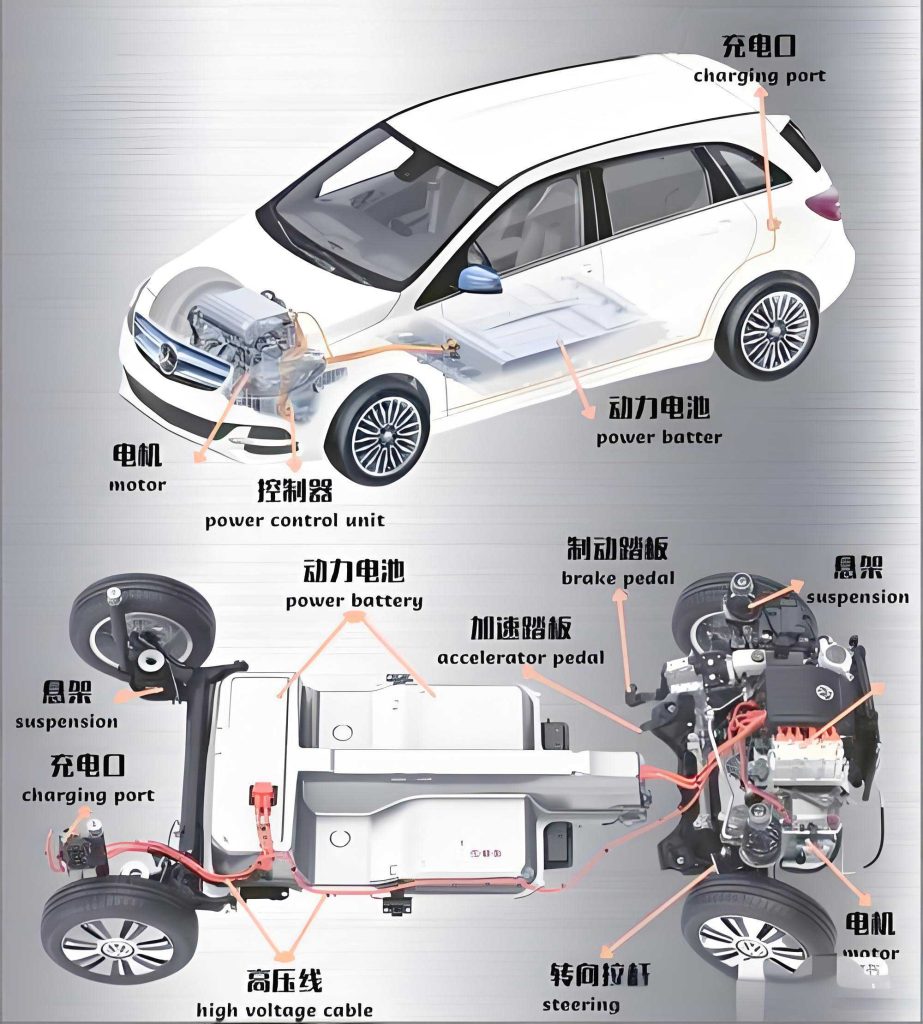
The widespread adoption of battery electric car technology has fundamentally altered the automotive acoustic landscape. The dominant internal combustion engine noise is replaced by a suite of new noise sources, with the electric motor emerging as a primary contributor under many driving conditions. In a battery electric car, the permanent magnet synchronous motor (PMSM), prized for its high power density and efficiency, generates tonal harmonic noise due to electromagnetic forces, structural resonances, and non-ideal operational conditions. While overall sound pressure levels in a battery electric car are often lower than in conventional vehicles, the absence of masking engine noise makes these tonal components, often perceived as whining or buzzing, particularly salient and subjectively annoying to occupants. This poses a significant challenge to the perceived quality and comfort of the battery electric car. Therefore, moving beyond mere noise reduction to the holistic optimization of sound quality has become a critical research and development frontier for the battery electric car industry.
Traditional Active Noise Control (ANC) systems, particularly narrowband feedforward configurations, have proven effective at attenuating periodic tonal noise by generating an anti-phase acoustic wave to cancel the primary disturbance. However, these systems are designed with the singular objective of minimizing the physical sound pressure level (SPL), typically measured by a error microphone. This physical metric does not necessarily correlate with human perceptual judgments. A sound with lower energy can sometimes be perceived as more annoying than one with higher energy if its spectral content or temporal characteristics are unfavorable. This limitation of conventional ANC underscores the need for a paradigm shift towards Active Sound Quality Control (ASQC), where the control objective is directly linked to psychoacoustic metrics that better predict human subjective response.
This article presents a novel adaptive control methodology that seamlessly integrates ANC with ASQC specifically for motor noise in a battery electric car. The core innovation lies in defining the control target as the minimization of Psychoacoustic Annoyance (PA), a comprehensive metric derived from several foundational psychoacoustic parameters. The system actively manipulates “annoyance factors” for dominant motor harmonic orders, guided by a real-time PA detector and a dynamically adjusted adaptation step-size. The subsequent sections detail the characteristics of motor noise, the proposed control framework, the psychoacoustic foundation, the adaptive algorithm, and present comprehensive simulation and experimental validation results demonstrating the significant improvement in the acoustic comfort of a battery electric car.
Motor Noise Characteristics in Battery Electric Cars
The acoustic signature of a traction motor in a battery electric car is predominantly deterministic and order-based. The noise is characterized by discrete tonal components at frequencies that are integer multiples (orders) of the fundamental electrical frequency, which is directly proportional to motor speed. The primary excitation sources are:
- Electromagnetic Forces: Radial and tangential forces generated in the air gap between the stator and rotor, including slotting harmonics and torque ripple harmonics.
- Structural Dynamics: Resonance of the stator core, housing, and other mechanical components excited by the electromagnetic forces.
- Power Electronics: Switching harmonics from the inverter can induce current distortions, leading to additional force components.
These vibrations are transmitted through the motor mounts and vehicle structure, ultimately radiating into the cabin as airborne noise. The most problematic components are often mid-to-high frequency harmonics (e.g., 500 Hz to 4000 Hz) where human hearing is most sensitive. The following table summarizes the typical characteristics and sources of prominent motor orders in a battery electric car.
| Order (Multiple of Fundamental Frequency) | Typical Frequency Range | Primary Source / Phenomenon | Subjective Perception |
|---|---|---|---|
| 2, 4, 6, … (Even) | 100 – 1000 Hz | Radial electromagnetic forces, Stator deformations | Low-frequency drone, boom |
| 1, 3, 5, … (Odd, related to slot/pole combination) | 500 – 2000 Hz | Slot harmonics, Torque ripple | Whining, humming |
| High Orders (e.g., 16, 24, 48) | 2000 – 5000 Hz | Switching frequency sidebands, Structural resonances | Buzzing, whistling, high-pitched whine |
For control purposes, the motor’s rotational speed signal (or a tachometer signal) is readily available in the vehicle’s control network. This allows for the precise synthesis of reference signals containing sinusoids at the target harmonic frequencies, making narrowband feedforward ANC an ideal starting point. The core challenge addressed here is to evolve this ANC framework to optimize for perception, not just pressure.
Proposed Active Sound Quality Control Framework
Foundation: Narrowband Feedforward ANC
The proposed ASQC system is built upon the well-established Filtered-x Least Mean Square (FxLMS) based narrowband feedforward ANC structure. For a single tonal component, the standard system uses a synthetic reference signal $x(n) = \sin(2\pi f_0 n T_s)$, where $f_0$ is the target frequency and $T_s$ is the sampling period. This signal drives an adaptive filter $W(z)$ whose output $y(n)$ drives a secondary loudspeaker. The cancelling sound propagates through the secondary path $S(z)$ (acoustic path from speaker to error microphone) and combines with the primary noise $d(n)$. The error microphone signal $e(n)$ is used to adapt the filter $W(z)$ to minimize the mean square error $E[e^2(n)]$. The FxLMS algorithm updates the filter weights $\mathbf{w}(n)$ as follows:
$$ \mathbf{w}(n+1) = \mathbf{w}(n) + \mu e(n) \mathbf{x}_f(n) $$
where $\mu$ is the convergence step-size, and $\mathbf{x}_f(n)$ is the reference signal vector filtered by an estimate of the secondary path, $\hat{S}(z)$.
Integration of Psychoacoustic Annoyance Control
The key modification for ASQC is the introduction of an “Annoyance Factor” $b$ ($0 \leq b \leq 1$) into the control loop. The block diagram for a single-frequency ASQC system is conceptually shown below (described in text). The secondary loudspeaker now produces a signal derived from $(1-b)y(n)$. Consequently, when the algorithm converges to minimize a modified error, the residual noise at the error microphone becomes approximately $e(n) \approx b \cdot d(n)$. The factor $b$ provides direct, linear control over the amplitude of the residual tonal component. When $b=0$, the system operates in full cancellation mode (traditional ANC). When $b=1$, the controller is off, and the primary noise is unaltered. By adjusting $b$ dynamically, we can control not the presence, but the perceived quality of the residual sound.
For the multi-harmonic noise typical of a battery electric car motor, the system is expanded to multiple parallel channels. Let $m$ be the number of dominant harmonic orders to be controlled. The overall ASQC system performs the following steps:
- Reference Signal Generation & Decomposition: A composite reference signal $x(n)$ containing the $m$ harmonic frequencies is generated from the motor speed. This signal is then passed through a bank of $m$ bandpass filters $H_1(z), H_2(z), …, H_m(z)$, each designed to isolate a single target harmonic $x_k(n)$ ($k=1,…,m$).
- Multi-Channel Adaptive Control: Each isolated reference signal $x_k(n)$ feeds a dedicated adaptive filter $W_k(z)$. The output of each filter is multiplied by a corresponding, independently adjustable annoyance factor $b_k$, yielding the channel’s contribution to the secondary signal: $(1-b_k) y_k(n)$.
- PA Detection & Feedback: The residual error signal $e(n)$ is continuously analyzed by a PA Detector module. This module computes the instantaneous Psychoacoustic Annoyance $PA(n)$ based on the psychoacoustic metrics of $e(n)$.
- Dynamic Annoyance Factor Optimization: The core of the ASQC is an outer optimization loop that adjusts each $b_k$ to minimize the overall $PA(n)$. This is achieved using a gradient-descent-like approach where the update for $b_k$ is governed by a dynamic step-size $q_k(n)$.
Psychoacoustic Annoyance (PA) as the Control Objective
The effectiveness of the proposed method hinges on the accurate calculation of Psychoacoustic Annoyance. PA is a composite metric designed to predict the subjective annoyance of a sound based on its psychoacoustic features. The model used in this work is based on the standardized approaches by Zwicker & Fastl and subsequent refinements. It incorporates four primary psychoacoustic parameters calculated from the time-frequency representation (e.g., using a hearing model like the time-varying loudness model per ISO 532-1) of the residual error signal $e(n)$:
- Loudness ($N$): The perceptual strength of sound (unit: sone). It is the most dominant factor.
- Sharpness ($S$): The perceived high-frequency content or “sharpness” of a sound (unit: acum). A sound with more high-frequency energy is judged as sharper and more annoying.
- Fluctuation Strength ($F$): The perception of amplitude modulations at low rates (up to ~20 Hz, unit: vacil).
- Roughness ($R$): The perception of amplitude modulations at higher rates (~20-300 Hz, unit: asper).
The total Psychoacoustic Annoyance $PA$ is computed through a nonlinear combination of these parameters. First, an intermediate annoyance factor $A$ is calculated, which accounts for the influence of sharpness, fluctuation, and roughness relative to loudness:
$$ N_S = N_5 \left( 1 + \sqrt{ \frac{s^2}{s^2_0} } \right) $$
$$ \omega_S = (S – 1.75) \cdot 0.25 \cdot \log_{10}(N_S + 10) $$
$$ \omega_{FR} = \frac{2.18}{(N_S)^{0.4}} (0.4F + 0.6R) $$
$$ A = \sqrt{ \omega_S^2 + \omega_{FR}^2 } $$
where $N_5$ is the 5th percentile loudness, and $s_0$ is a reference slope. Finally, the overall PA value is given by:
$$ PA = N_5 \left( 1 + \sqrt{ \gamma_1^2 + \gamma_2^2 } \right) $$
where $\gamma_1$ and $\gamma_2$ are functions of $A$ and $N_S$. For control purposes, a simplified yet perceptually relevant computation is implemented in the real-time PA detector to ensure feasibility. The goal of the ASQC algorithm is to find the set of annoyance factors $\{b_1, b_2, …, b_m\}$ that minimizes the time-averaged $PA$ of the residual noise $e(n)$.
Adaptive Algorithm with Dynamic Step-Size Adjustment
The update law for the annoyance factor $b_k$ for the $k$-th harmonic channel is crucial for convergence and performance. A simple fixed-step gradient descent is insufficient due to the nonlinear relationship between $b_k$ and $PA$. We propose a dynamic step-size mechanism where the update step $q_k$ is a function of the current annoyance level $PA$:
$$ b_k(i+1) = b_k(i) + q_k(i) $$
$$ q_k(i) = \beta \left(1 – e^{-\alpha \cdot PA(i)^2}\right) \cdot \text{sign}(-\nabla_{b_k} PA) $$
Here, $i$ denotes the iteration index of the outer loop (which runs at a slower rate than the inner FxLMS filter updates). $\beta$ is the maximum step-size, determining the upper bound of adjustment. $\alpha$ is a shape parameter controlling the sensitivity of the step-size to the $PA$ value. $\nabla_{b_k} PA$ is an estimate of the gradient of PA with respect to $b_k$, which can be approximated by perturbing $b_k$ and observing the change in $PA$ over a short window.
The logic of this step-size function is central to the method’s success:
- When PA is high: The term $(1 – e^{-\alpha \cdot PA(i)^2})$ approaches 1, so $q_k \approx \beta$. This allows for large adjustments to bring the system rapidly away from highly annoying states.
- As PA decreases: The exponential term grows, making $(1 – e^{-\alpha \cdot PA(i)^2})$ smaller. This reduces the step-size $q_k$, enabling fine-tuning and stable convergence near the optimal (minimum PA) point without overshoot.
The following table illustrates the effect of the parameter $\alpha$ on the step-size $q$ for a fixed $\beta=0.005$ and a representative range of PA values.
| PA Value | $\alpha = 10^{-8}$ | $\alpha = 10^{-7}$ | $\alpha = 10^{-6}$ | $\alpha = 10^{-5}$ | $\alpha = 10^{-4}$ |
|---|---|---|---|---|---|
| 150 | ~0.005 | ~0.005 | ~0.005 | ~0.005 | ~0.005 |
| 50 | ~0.005 | ~0.005 | ~0.005 | ~0.0049 | ~0.0044 |
| 10 | ~0.005 | ~0.005 | ~0.0049 | ~0.0040 | ~0.0005 |
| 5 | ~0.005 | ~0.0049 | ~0.0040 | ~0.0012 | ~0.00001 |
| 1 | ~0.0049 | ~0.0040 | ~0.0012 | ~0.00005 | ~$5\times10^{-9}$ |
This mechanism ensures a fast, coarse search initially, followed by a slow, precise optimization, making it highly suitable for real-time application in a battery electric car where conditions change gradually.
Simulation Results and Analysis
To validate the proposed ASQC method, a simulation was conducted based on real motor noise data from a battery electric car operating at a constant speed of 50 km/h. Three dominant harmonic orders were identified at frequencies $f_1=500$ Hz (2.5th order), $f_2=1000$ Hz (5th order), and $f_3=3200$ Hz (16th order). The simulation sampled at $f_s = 10240$ Hz. The composite reference signal was $x(n) = \sin(2\pi f_1 n T_s) + 0.8\sin(2\pi f_2 n T_s) + 0.95\sin(2\pi f_3 n T_s)$. The secondary path was modeled as a pure delay with attenuation. Parameters were set as $\beta=0.005$, $\alpha=10^{-6}$.
The performance was evaluated in terms of both spectral reduction and PA reduction. The following figure (described verbally) shows the spectrum of the primary noise $d(n)$ and the residual noise $e(n)$ after control. The ASQC system successfully attenuated the three target tones. More importantly, the analysis focused on the evolution of the Psychoacoustic Annoyance.
The optimization process proceeded iteratively:
- Initialization ($b_1=b_2=b_3=0$): This is equivalent to traditional ANC (full cancellation mode). The residual PA was calculated to be 72.7, a significant reduction from the primary noise PA of 178.1, but not optimal perceptually.
- First ASQC Iteration: The PA detector and step-size controller adjusted the annoyance factors. The factors became $b_1=0.0028, b_2=0.0016, b_3=0.0047$, and the residual PA dropped dramatically to 9.4.
- Second ASQC Iteration: Further fine-tuning occurred ($b_1=0.0028, b_2=0.0017, b_3=0.0060$), achieving the minimum residual PA of 7.5.
The table below provides a quantitative comparison between traditional ANC and the proposed ASQC method for this battery electric car motor noise scenario.
| Control Method | Primary Noise PA | Residual Noise PA | PA Reduction | Remarks |
|---|---|---|---|---|
| No Control | 178.1 | 178.1 | 0% | Base condition with prominent tonal annoyances. |
| Traditional ANC ($b_k=0$) | 178.1 | 72.7 | ~59.2% | Reduces sound energy but leaves significant psychoacoustic annoyance. |
| Proposed ASQC (Optimal $b_k$) | 178.1 | 7.5 | ~95.8% | Drastically reduces perceived annoyance by optimally shaping the residual sound. |
This simulation conclusively demonstrates that while ANC reduces physical energy, the ASQC system, by targeting the psychoacoustic metric directly, achieves a far superior outcome in terms of subjective sound quality for the battery electric car cabin.
Experimental Validation and Discussion
Complementing the simulation, experimental analyses were performed to assess the practical implications. The evaluation focused on comparing the trends in Sound Pressure Level (SPL) spectrum and the computed PA values under different control states relevant to a battery electric car application.
Spectral Analysis: The spectral plots (described verbally) confirm the core principle. The primary motor noise spectrum shows clear peaks at the harmonic frequencies. After applying ANC-based cancellation, these peaks are substantially reduced in amplitude, lowering the overall SPL. The ASQC-optimized spectrum shows a similar level of attenuation at the target frequencies. The key difference is not in the final SPL, but in the process that led there—ASQC arrived at this attenuation level because it minimized annoyance, not SPL. In some cases, ASQC might allow a slightly higher residual level at a particular frequency if doing so results in a better overall PA score (e.g., by avoiding a sharp, isolated residual tone).
PA Value Trajectory: The evolution of the PA metric over time during control activation is the most critical experimental result. The PA value starts at a high level corresponding to the untreated motor noise in the battery electric car. Upon activating the traditional ANC logic (initial step of ASQC), the PA drops sharply as the loudest tones are canceled. However, as the ASQC’s outer loop begins optimizing the annoyance factors $b_k$, the PA value decreases further and converges to a stable minimum significantly lower than the level achieved by ANC alone. This trajectory validates the dynamic step-size mechanism’s ability to first converge quickly and then refine the solution for optimal perceptual outcome.
The experimental findings align perfectly with the simulation, proving the feasibility and effectiveness of the concept. The proposed system provides a tangible and measurable improvement to the cabin sound quality of a battery electric car.
Conclusion
This article has presented a novel and effective Active Sound Quality Control methodology tailored for the mitigation of motor-induced tonal annoyance in battery electric car cabins. The method innovatively merges the physical noise cancellation capability of narrowband feedforward ANC with a perceptual optimization layer guided by Psychoacoustic Annoyance. By introducing and dynamically adjusting frequency-specific “annoyance factors” via an outer control loop with a context-aware step-size mechanism, the system successfully transitions the control objective from energy minimization to perceptually-driven sound shaping.
The key advantages of this approach for battery electric car applications are:
- Perceptual Superiority: It explicitly targets and minimizes a validated metric of human annoyance (PA), leading to superior subjective sound quality compared to traditional ANC, even if the final SPL reduction is similar.
- Adaptability: The dynamic step-size allows for robust performance across different operating conditions (motor speeds, load changes) common in a battery electric car.
- Practical Implementation: It builds upon existing, well-understood ANC hardware and software frameworks, requiring the addition of a real-time PA calculation module and the outer-loop optimizer, which is computationally manageable with modern digital signal processors.
Simulation and experimental analysis demonstrated a drastic reduction in Psychoacoustic Annoyance by up to 95.8%, far exceeding the reduction achieved by conventional ANC. This work provides a clear pathway for enhancing passenger comfort and the premium acoustic feel of battery electric cars, addressing a critical differentiator in the evolving automotive market. Future work may involve extending the framework to handle transient conditions more effectively and integrating it with broader vehicle sound design strategies.