
The rapid evolution of the electric vehicle market places immense importance on the performance, safety, and reliability of the EV battery pack. As the core energy component of an electric vehicle, the quality of the battery pack directly determines the vehicle’s range, safety, and overall customer satisfaction. In the context of our company’s digital transformation journey, we have accumulated significant experience in system development and digital tool application. Leveraging this foundation, we aimed to transcend the existing monitoring capabilities within our MEB EV battery pack production facility. Our goal was to establish a comprehensive, intelligent, and data-driven Quality Management System (QMS) platform. This platform is designed to implement full-process digital monitoring of quality characteristics, integrate information across all production stages, perform sophisticated correlation analysis, and develop robust interception functions to accurately identify product defects.
This initiative led to the design and implementation of a dedicated MEB EV battery pack quality management system platform. This platform addresses critical challenges in our quality management practice, such as the real-time monitoring of quality parameters, the extraction of value from systemic quality data, and the effective interception of defective products. By achieving quality status transparency through a one-stop data query, uncovering intrinsic data relationships via correlation analysis, and ensuring timely defect identification through a multi-gate interception model, this platform represents a significant leap forward in our production quality assurance. Developed independently by a cross-functional team, the platform utilizes a modern technology stack to deliver tangible improvements in First-Time-Through rate, cost optimization potential, management efficiency, and user experience.
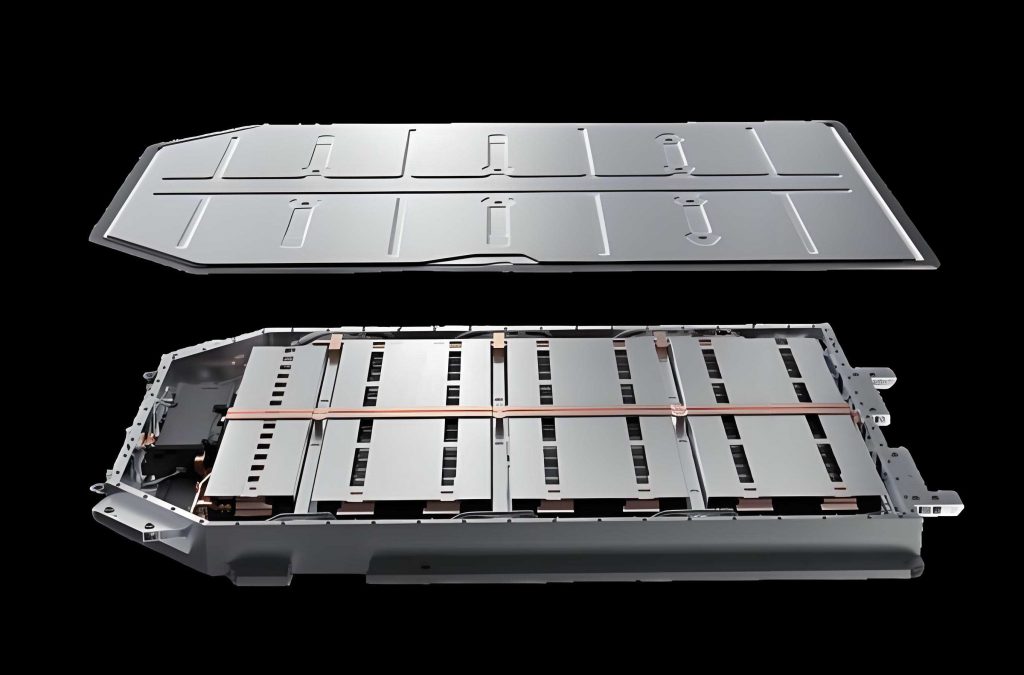
1. System Architecture and Functional Overview
Through benchmarking against industry best practices and conducting intensive internal requirement analysis, we formed a dedicated joint development task force. This team comprised production personnel, quality assurance experts, and members from the company’s big data department. Our objective was to achieve full business-chain autonomous development of the MEB EV battery pack QMS platform, spanning from business planning and architectural design to data governance, system development, and testing.
1.1 System Framework Design
The MEB EV battery pack QMS platform adopts a front-end and back-end separated architecture, ensuring scalability, maintainability, and high performance. The back-end service layer is built upon a robust framework, while the front-end utilizes the reactive VUE3 framework to deliver a dynamic and responsive user interface. For data persistence, we selected a high-performance relational database. Furthermore, the system integrates data from multiple sources, including document-oriented databases and low-code platform data. The architecture is logically layered into four distinct tiers:
| Architecture Layer | Core Components & Technology | Primary Function |
|---|---|---|
| Data Source Layer | MongoDB, DingTalk YiDa, MES, Test Equipment | Aggregates multi-source data from production, inspection, and after-sales. |
| Data Processing Layer | Python/Tornado Services, ETL Pipelines | Cleanses, transforms, and standardizes raw data for analysis. |
| Business Logic Layer | Java/Tornado Services, Analysis Algorithms | Implements core functions: query, correlation analysis, interception logic. |
| Presentation Layer | VUE3, ECharts, UI Components | Provides interactive dashboards, reports, and management interfaces. |
The data flows from the source layer through processing, where it is transformed and stored in the central database. The business logic layer then operates on this refined data to execute the platform’s intelligent functions, the results of which are finally rendered on the user-friendly front-end interface.
1.2 Core Functional Modules Development
1.2.1 One-Stop Data Query and Quality Transparency
To enable rapid traceability and holistic insight, we developed a one-stop data query function. This module integrates key data points from the entire lifecycle of an EV battery pack, from material intake and production processes to final inspection and post-market feedback. It breaks down data silos, ensuring seamless information flow across all manufacturing and quality control stations. This transparency allows managers to instantly access the complete quality history of any single EV battery pack or batch, providing a powerful foundation for data-driven decision-making. The integrated functional modules encompass:
- Production Data: Process parameters, equipment status, operator information, timestamps.
- Inspection & Test Data: Dimensional checks, electrical performance tests, sealing (leak) test results, insulation resistance.
- After-Sales & Warranty Data: Field failure reports, maintenance records, customer feedback linked to the battery pack serial number.
1.2.2 Correlation Analysis for Root Cause Investigation
Moving beyond simple monitoring, the platform employs advanced correlation analysis to unearth hidden relationships within the production data. This functionality performs deep data mining to identify potential root causes of quality issues. For instance, it can analyze how variations in screw torque during module assembly correlate with later failures in thermal performance, or how environmental humidity in the clean room affects adhesive curing and final sealing integrity. This provides a scientific basis for targeted process improvements. The analysis employs statistical methods like the Pearson correlation coefficient:
$$ r_{xy} = \frac{\sum_{i=1}^{n}(x_i – \bar{x})(y_i – \bar{y})}{\sqrt{\sum_{i=1}^{n}(x_i – \bar{x})^2 \sum_{i=1}^{n}(y_i – \bar{y})^2}} $$
Where \( x_i \) and \( y_i \) are data points from two different process parameters or quality metrics, and \( r_{xy} \) quantifies the strength and direction of their linear relationship. The system visualizes these correlations, enabling both forward tracing (from a cause to potential effects) and reverse tracing (from a defect to possible causes).
1.2.3 Multi-Gate Quality Interception Model
A cornerstone of the platform is its proactive, multi-layered quality interception model. Instead of relying solely on final inspection, this model deploys four intelligent “gates” throughout the production flow to identify and quarantine non-conforming products at the earliest possible stage. The gates are designed to catch different types of anomalies:
| Interception Gate | Detection Principle | Purpose & Action |
|---|---|---|
| 1. Threshold Violation Gate | Real-time comparison of measurement data against predefined specification limits (USL/LSL). | Catches immediate, blatant non-conformities. Triggers an automatic alarm and line stop if critical. |
| 2. Trend Analysis Gate | Statistical process control (SPC) charts to monitor for shifts, trends, or increased variation before exceeding limits. | Identifies gradual process degradation. Alerts engineers for preventive maintenance or adjustment. |
| 3. Sample-based Anomaly Gate | Applies pattern recognition on a sample unit’s full dataset (e.g., all weld signatures in a pack) against a golden sample. | Detects complex, multi-parameter failures that single-point checks might miss. Flags units for detailed review. |
| 4. AI-Predictive Gate | Machine learning models trained on historical data predict the probability of a future failure (e.g., field leak) based on current production data. | The most advanced gate. Intercepts units with high latent failure risk, enabling rework or analysis to prevent warranty issues. |
When any gate is triggered, the system initiates a predefined response protocol, ensuring the suspect EV battery pack is immediately identified, quarantined, and routed for review.
1.2.4 Scorecard Management with Cpk Analysis
To provide a holistic, quantitative assessment of EV battery pack quality and process health, the platform implements a digital scorecard management system. At its core is the calculation of the Process Capability Index (Cpk), a key statistical measure. Cpk evaluates how well a stable process performs within its specification limits, considering both the centering of the process mean and its natural variability. The formula used is:
$$ Cpk = \min\left( \frac{USL – \mu}{3\sigma}, \frac{\mu – LSL}{3\sigma} \right) $$
Where:
- \( USL \) and \( LSL \) are the Upper and Lower Specification Limits for a critical quality characteristic (e.g., pack voltage).
- \( \mu \) is the process mean.
- \( \sigma \) is the process standard deviation, estimated from controlled production data.
A higher Cpk value indicates a more capable and centered process with less risk of producing defects. The platform automatically calculates Cpk for key parameters across different production lines and time periods, presenting them in an executive scorecard. This offers an objective, reliable metric to benchmark quality performance, identify processes needing improvement, and direct optimization efforts effectively.
2. Technical Implementation Roadmap
The platform is a comprehensive data management and analytics system. Its implementation follows a clear, stepwise data pipeline designed to transform raw, multi-source data into actionable quality intelligence and automated control actions.
| Implementation Phase | Key Activities & Technologies | Output |
|---|---|---|
| 1. Data Source Integration | Developing connectors and APIs to pull structured/unstructured data from MongoDB (logs), DingTalk YiDa (work orders), MES (process data), PLCs (equipment data), and test benches. | A unified data ingestion stream. |
| 2. Data Cleansing & Transformation | Using back-end services to filter noise, handle missing values, correct outliers, and standardize formats (e.g., time zones, units). ETL jobs map data to a unified schema. | Clean, consistent, and reliable data stored in the central SQL database. |
| 3>Data Analysis & Mining | Executing correlation algorithms, calculating Cpk and SPC statistics, and running trained ML models for prediction. This occurs in the business logic layer and dedicated analytics modules. | Insights: correlation reports, capability scores, anomaly flags, risk predictions. |
| 4. Data Visualization & Reporting | Front-end frameworks (VUE3) and charting libraries (ECharts) render dashboards, real-time charts, interactive scorecards, and detailed drill-down reports. | Intuitive graphical interfaces for all user roles. |
| 5. Data-Driven Decision & Action | System triggers automated workflows: sending alerts via enterprise chat, creating non-conformance tickets, updating Andon systems, or signaling PLCs to divert a pallet. Insights guide engineering changes. | Closed-loop quality actions, optimized processes, and continuous improvement. |
3. Key Enabling Technologies解析
The platform is not a single application but a synthesis of several cutting-edge technologies that work in concert to enable full-chain quality management for the EV battery pack.
- Internet of Things (IoT) Technology: Sensors and smart devices on production equipment provide real-time data streams on parameters like temperature, pressure, torque, and displacement during the assembly of the EV battery pack. This forms the nervous system for live monitoring.
- Big Data Processing & Analytics: The platform handles high-volume, high-velocity data from the production line. Technologies like distributed computing frameworks (conceptually similar to Spark) enable real-time data capture, storage in data lakes/warehouses, and batch/stream processing to uncover optimization opportunities.
- Artificial Intelligence (AI) & Machine Learning (ML): AI is crucial for the predictive quality gate. Supervised learning models (e.g., Gradient Boosting, Neural Networks) are trained on historical data where the final quality outcome (pass/fail, leak rate) is known. These models learn complex, non-linear relationships between hundreds of input parameters and the final quality of the EV battery pack, enabling risk prediction.
- Cloud Computing: Provides the scalable infrastructure needed for massive data storage, intensive model training, and deployment of microservices. It also facilitates secure data sharing and collaboration across different plant locations and departments involved in the EV battery pack lifecycle.
- Closed-Loop Management System: This is the overarching operational philosophy embedded in the platform’s workflow. A problem detected at the AI-predictive gate is logged, a root-cause analysis is initiated, a corrective action is implemented in the process, and the system verifies the effectiveness by monitoring the subsequent Cpk trend. This ensures continuous learning and improvement.
- Automation & Control Systems: The platform is integrated with the Physical Production System. Through standardized interfaces (e.g., OPC UA), it can send commands to PLCs or robots to automatically divert a flagged EV battery pack to a rework station or trigger an Andon light, creating a smart, responsive production environment.
4. Application Case Study and Achieved Benefits
The deployment of the MEB EV battery pack QMS platform has delivered significant, measurable benefits across our production operations, transforming our approach to quality assurance from reactive to proactive and predictive.
| Benefit Category | Specific Impact & Metric | Description |
|---|---|---|
| Enhanced Product Quality | ~40% reduction in escapee defects; Near-100% interception of critical leaks. | The multi-gate model, especially the AI predictive gate, identifies latent defects (e.g., subtle sealing flaws) that traditional end-of-line tests could miss, preventing faulty EV battery packs from reaching customers. |
| Reduced Production Costs | ~15% decrease in scrap and rework costs; ~20% reduction in line downtime. | Early interception (at the trend or sample gate) catches issues when less value has been added, minimizing scrap. Predictive alerts enable planned maintenance, avoiding unplanned stoppages. Optimized processes reduce material waste. |
| Increased Operational Efficiency | ~60% faster root cause analysis; One-stop query saves >50% investigation time. | Correlation analysis tools quickly pinpoint related parameters, speeding up engineering investigations. The transparent data access eliminates hours spent manually collating logs from disparate systems for a single EV battery pack. |
| Improved Customer Satisfaction | Significant reduction in early field failure rates; Stronger brand reputation. | By preventing defective units from shipping, the platform directly increases the reliability of the EV battery pack experienced by the end-user. Faster analysis of field data also improves response to potential issues. |
| Accelerated Digital Transformation | Blueprint for smart factory adoption; Culture shift towards data-driven decisions. | The project serves as a tangible best-practice case for integrating IoT, Big Data, and AI in manufacturing. It demonstrates the value of data, fostering a culture where decisions are based on system analytics rather than intuition. |
The platform’s executive dashboard provides a real-time overview of the entire production quality health, while detailed parameter interfaces give engineers the deep dive capability needed for process tuning and troubleshooting.
5. Conclusion and Future Perspectives
This project successfully constructed and deployed an intelligent, data-driven quality management system platform for MEB EV battery pack production. By integrating one-stop data transparency, advanced correlation analytics, and a proactive multi-gate interception model, the platform achieves comprehensive lifecycle quality monitoring and optimization. The results have substantiated significant gains in product quality, cost efficiency, operational management, and customer satisfaction, providing a compelling return on investment and strengthening our competitive position in the electric vehicle market.
Looking forward, we plan to focus on several key areas for continuous advancement:
- Technological Evolution: Continuously integrate newer technologies such as edge computing for faster local analysis, digital twin simulations for virtual process optimization, and more sophisticated deep learning models to improve the accuracy of our predictive quality gates for the EV battery pack.
- Expansion of Application Scope: The underlying architecture and principles of this QMS platform are highly transferable. We plan to adapt and deploy similar systems for other critical automotive assemblies (e.g., electric drive units, power electronics) and explore applications in adjacent industries like energy storage systems.
- Enhanced Supply Chain Collaboration: Extending the platform’s visibility and data-sharing capabilities to key suppliers and partners. Creating a collaborative quality network would allow for better control of incoming material quality and faster joint problem-solving, elevating quality standards across the entire EV battery pack ecosystem.
We are committed to deepening our research and technological innovation to further refine the platform’s capabilities and intelligence level. Our goal is to contribute meaningfully to the sustainable development of the new energy vehicle industry by setting new benchmarks for quality and reliability in EV battery pack manufacturing.