
The pursuit of optimal fuel economy and refined driving experience represents a core challenge in the development of modern hybrid electric vehicles. Among the various operational modes, the engine start event is particularly critical. In conventional vehicles, engine starting is facilitated solely by a starter motor, a process often accompanied by significant fuel consumption peaks and perceptible vehicle vibration. The advent of parallel hybrid electric vehicle architectures presents a compelling alternative: utilizing the traction motor to crank and start the internal combustion engine. This study delves into a comparative analysis of these two starting methodologies, with a focus on quantifying their impact on instantaneous fuel consumption and vehicle vibration, thereby identifying an optimal control strategy for engine start in a parallel hybrid electric vehicle.
The fundamental advantage of a parallel hybrid electric vehicle lies in its dual powertrain configuration, where both the engine and the electric motor can independently or jointly provide propulsion torque to the driveline. This flexibility is key to optimizing energy usage. During low-power demand scenarios, such as urban creep or stop-and-go traffic, the hybrid electric vehicle can operate in pure electric mode, with the engine completely shut off. When increased power is required—for instance, during acceleration or high-speed cruising—the engine must be rapidly and smoothly reintegrated. This is where the starting strategy becomes paramount. The traditional starter-based method, while reliable, is inherently inefficient for frequent stop-start cycles typical of hybrid operation. The electric motor, being more powerful and directly connected to the driveline, offers the potential for faster, cleaner, and smoother engine starts, directly contributing to the overall efficiency and drivability of the hybrid electric vehicle.
The control logic for engine start is governed by the Vehicle Control Unit (VCU). For a starter-assisted start, the VCU assesses basic parameters like gear position, brake signal, and vehicle speed. Upon confirming start conditions, it energizes the starter relay. In contrast, the motor-assisted start strategy involves a more complex decision tree. The VCU must first verify the status of the high-voltage system, insulation, and other safety parameters. In a vehicle at standstill, it commands the activation of the high-voltage system before proceeding. During driving (where the high-voltage system is already active), the VCU coordinates clutch engagement and precisely controls the motor’s rotational speed to a target value, using its torque to crank the engine. The choice of this target speed is a crucial control variable, influencing the engine’s initial firing point, subsequent fuel injection quantity, and the resulting noise, vibration, and harshness (NVH) characteristics.
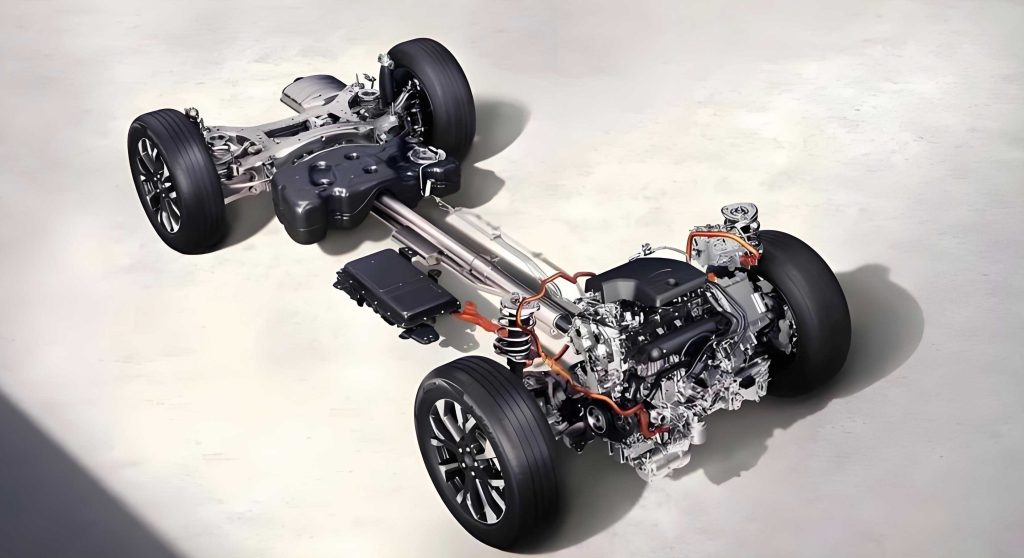
The core hypothesis of this investigation is that the motor-assisted start strategy, with a carefully calibrated target speed, can significantly reduce the instantaneous fuel consumption peak and minimize objectionable body shake compared to the conventional starter method. To test this, a rigorous experimental procedure was designed. The test subject was a parallel hybrid electric vehicle equipped with an 11.0L diesel engine and a 250 kW permanent magnet synchronous motor. Tests were conducted under controlled ambient conditions: temperature (25±2)°C, humidity (50±5)%, and a high-voltage battery state of charge (SOC) of (80±5)%. A critical parameter was engine coolant temperature, maintained at (70±2)°C to represent a typical warm-start condition, eliminating cold-start enrichment effects from the analysis. For each defined starting scenario, the engine was started ten times, with anomalous results discarded before calculating the mean values for analysis.
Analysis of Starter-Only Engine Start
In the conventional starting mode, the starter motor cranks the engine. Fuel injection typically commences when the engine speed reaches approximately 200 rpm. As the speed climbs due to combustion, the fuel injection quantity increases sharply to a peak before settling down to a stable idle value once the engine stabilizes around 600 rpm. Data collected from multiple start events revealed a highly variable and inefficient process. The peak instantaneous fuel consumption values ranged from a minimum of 7.5 L/h to a maximum of 13.3 L/h. The stabilized fuel flow at 600 rpm idle was consistently around 1.9 L/h. This high variability and the potential for very high peak consumption underscore the suboptimal nature of this method for the frequent start-stop cycles in a hybrid electric vehicle. The process can be described by the following relationship, where peak fuel consumption is not a function of a controlled parameter but rather a result of the transient combustion instability during cranking:
$$
\dot{m}_{fuel, peak}^{starter} = f(N_{cranking}, \theta, T_{coolant}) \quad \text{with high variance}
$$
Here, $\dot{m}_{fuel, peak}^{starter}$ is the peak fuel mass flow rate, $N_{cranking}$ is the cranking speed profile, $\theta$ is ignition timing, and $T_{coolant}$ is coolant temperature. The lack of precise speed control leads to significant cycle-to-cycle variation.
Analysis of Motor-Assisted Engine Start with Variable Target Speed
The motor-assisted start strategy introduces a critical control parameter: the target speed ($N_{target}$) at which the electric motor spins the engine before fuel injection and ignition. This study systematically evaluated this parameter across a range from 200 rpm to 1000 rpm.
Low Target Speed Range (200 – 600 rpm): When the motor cranked the engine to speeds between 200 and 600 rpm, the engine’s initial firing point (the speed at which sustained combustion begins) increased with the target speed. For $N_{target}$ = 200 rpm, firing began near 300 rpm. For $N_{target}$ = 600 rpm, it began near 536 rpm. Despite this, the average peak fuel consumption remained relatively constant at approximately 7.5 L/h. The stabilized idle fuel consumption was again 1.9 L/h. Crucially, across this entire range, the vehicle body exhibited no perceptible shake or vibration, indicating excellent NVH performance. This suggests that while smoother, the fuel consumption benefit at these lower target speeds is marginal compared to the best-case starter start.
Medium Target Speed Range (700 – 800 rpm): This range yielded the most promising results. At a $N_{target}$ of 700 rpm, the engine firing point was elevated to around 562 rpm. More importantly, the peak instantaneous fuel consumption plummeted. The lowest recorded peak value was 3.05 L/h, with the highest in the test series at 7.5 L/h, representing a substantial reduction in both best-case and average peak fuel use compared to previous methods. The vehicle stability remained excellent at 700 rpm, with no noticeable body shake. However, at 800 rpm, a slight degradation in NVH was observed, with reports of mild body shudder and greater fluctuation in the instantaneous fuel injection trace, indicating less stable combustion initiation.
High Target Speed (1000 rpm): Pushing the target speed to 1000 rpm resulted in the lowest recorded peak fuel consumption value of 1.85 L/h. However, this came at a severe cost to drivability. The engine speed would overshoot to 1000 rpm before falling back to idle, causing pronounced and objectionable body shake. Furthermore, the fuel injection quantity exhibited large fluctuations and took a significantly longer time to stabilize at the idle value, as shown in the data. This highlights a key trade-off: excessive cranking speed can improve mixture preparation but may lead to violent combustion initiation and poor NVH.
The relationship between target speed ($N_{target}$), peak fuel consumption ($\dot{m}_{fuel, peak}$), and an empirical NVH index ($I_{NVH}$) can be modeled for the motor-assisted start as:
$$
\dot{m}_{fuel, peak}^{motor} \approx \alpha \cdot e^{-\beta \cdot N_{target}} + \gamma \quad \text{for } N_{target} \leq N_{opt}
$$
$$
I_{NVH} \approx \kappa \cdot (N_{target} – N_{opt})^2
$$
where $\alpha, \beta, \gamma, \kappa$ are vehicle-specific constants, and $N_{opt}$ is the empirically determined optimal speed (700 rpm in this study). This illustrates the exponential decrease in fuel consumption with increasing speed up to an optimum, beyond which NVH deteriorates quadratically.
Comparative Data Summary
The following table consolidates the key quantitative findings from all tested start strategies. The parameters include the engine firing speed, the minimum and maximum observed peak instantaneous fuel consumption, and a qualitative assessment of body shake. This tabular format allows for a clear, direct comparison of the performance metrics critical to evaluating hybrid electric vehicle start-stop functionality.
| Start Method | Control / Target Speed (rpm) | Engine Firing Point (rpm) | Min. Peak Fuel Rate (L/h) | Max. Peak Fuel Rate (L/h) | Body Shake (Qualitative) |
|---|---|---|---|---|---|
| Starter Only | N/A | ~200 | 7.5 | 13.3 | Moderate to High |
| Motor-Assisted | 200 | 288 | 6.25 | 7.5 | None |
| 300 | 452 | 7.5 | 8.2 | ||
| 400 | 480 | 7.5 | 8.3 | ||
| 500 | 522 | 6.25 | 7.5 | ||
| 600 | 536 | 5.0 | 6.25 | ||
| Motor-Assisted | 700 | 562 | 3.05 | 7.5 | None |
| 800 | 568 | 2.25 | 6.25 | Slight | |
| 1000 | 612 | 1.85 | 2.5 | Severe |
Synthesis and Optimal Strategy Definition
The data unequivocally demonstrates the superiority of the motor-assisted start strategy over the traditional starter method in the context of a parallel hybrid electric vehicle. The electric motor provides precise control over the cranking phase, enabling optimization of parameters that are inherently variable in a passive starter system. The analysis reveals a clear optimum at a target speed of 700 rpm. At this setpoint, the dual objectives of the hybrid electric vehicle start strategy are simultaneously satisfied:
- Minimized Instantaneous Fuel Consumption: The peak fuel flow is drastically reduced, with a minimum observed value of 3.05 L/h. This represents a potential reduction of over 50% compared to the average peak consumption of the starter method and even the lower-speed motor-assisted starts. This directly translates to improved fuel economy over countless start events in the vehicle’s lifecycle.
- Excellent Drivability and NVH: The start process is executed without inducing perceptible body shake or vibration. This seamless integration of the engine is crucial for maintaining the refined driving experience expected in modern vehicles, especially in a hybrid electric vehicle where the transition between power sources should be imperceptible to the occupant.
The mechanism behind this optimum can be explained thermodynamically and chemically. A higher cranking speed (700 rpm vs. 200-600 rpm) improves air-fuel mixing, increases charge temperature due to more rapid compression, and reduces the time for heat losses. This leads to more robust and faster flame kernel development, allowing for stable combustion with a leaner initial mixture, thus lowering the required fuel injection quantity. However, exceeding this optimum (e.g., 1000 rpm) can cause excessive turbulence or lead to ignition timing challenges that result in erratic combustion and the observed NVH issues.
Therefore, the recommended control law for the Vehicle Control Unit in a parallel hybrid electric vehicle during a warm-start condition (coolant ~70°C) is defined as follows:
IF High-Voltage System Status = AVAILABLE
AND Engine Start Request = TRUE
THEN Execute Motor-Assisted Start Strategy
SET Motor Target Cranking Speed $N_{target}^* = 700 \text{ rpm}$
CONTROL Clutch Engagement & Motor Torque to achieve $N_{target}^*$
COMMENCE Fuel Injection & Ignition at ~560 rpm
ELSE (HV System Fault)
Execute Conventional Starter Start Strategy (Fallback Mode)
Conclusion and Implications for Hybrid Electric Vehicle Design
This investigation provides a quantified, data-driven framework for optimizing one of the most frequent and critical events in a parallel hybrid electric vehicle’s operation: the engine start. By leveraging the inherent capabilities of the electric drivetrain, significant improvements in both efficiency and refinement are achievable. The identified optimal control strategy—using the traction motor to crank the engine to a precise 700 rpm before ignition—strikes the ideal balance between minimizing instantaneous fuel consumption and ensuring a vibration-free start. This strategy directly contributes to the core value propositions of a hybrid electric vehicle: reduced emissions and superior drivability. Future work could explore the optimization of this target speed across a wider range of engine temperatures and battery SOC levels to develop a fully adaptive, map-based start control strategy, further enhancing the performance and efficiency of the next generation of parallel hybrid electric vehicles.