
The automotive industry is undergoing a significant transformation driven by the dual demands for superior performance and environmental sustainability. Within this evolution, four-wheel drive (4WD or AWD) vehicles have consistently been prized for their enhanced handling, stability, and traction. Concurrently, the global push to address energy shortages and environmental degradation has propelled the development of electrified powertrains. While pure electric vehicles (EVs) have been a focal point, market dynamics, including adjustments to governmental subsidy policies, have highlighted the resilient value proposition of the hybrid car. A hybrid car, particularly in a four-wheel drive configuration, offers a compelling balance: it delivers the efficiency and low-emission benefits of electrification in frequent start-stop city driving while alleviating range anxiety associated with a lack of charging infrastructure. Consequently, the four-wheel drive hybrid car is poised to become a mainstream vehicle archetype, merging the advantages of all-terrain capability with hybrid efficiency.
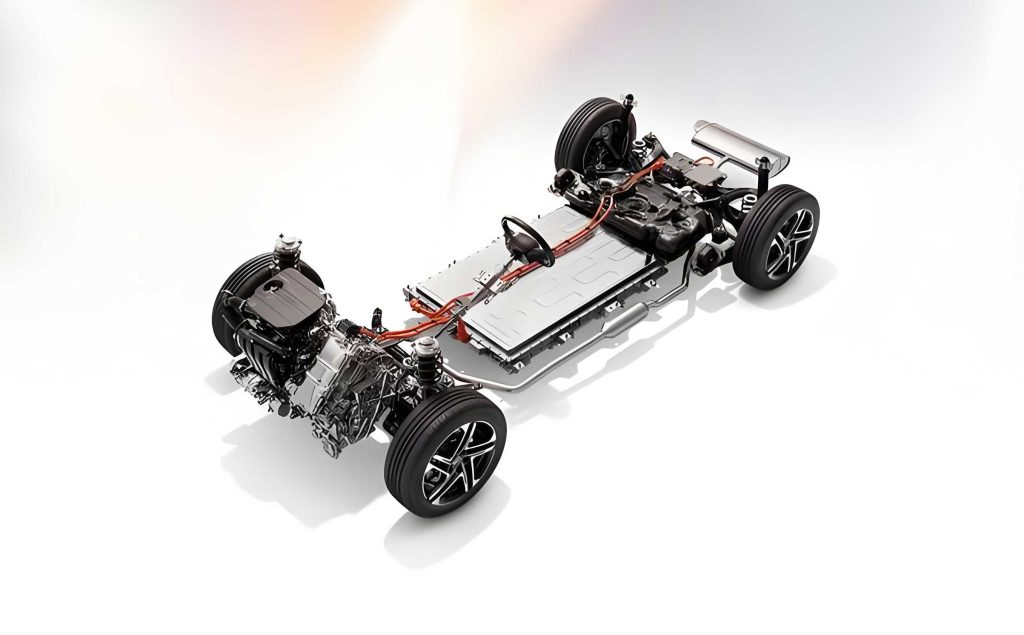
The commercialization of this vehicle type is already evident, with models like the BYD Tang, Changan CS75, and Great Wall WEY P8 hybrid variants available in the market. Internationally, major automotive corporations such as Nissan, Toyota, Ford, and Hyundai have been actively securing intellectual property (IP) related to powertrain control technologies for such vehicles. This intense patent activity underscores the strategic importance of control methodologies in realizing the full potential of a four-wheel drive hybrid car. This article provides a comprehensive patent analysis of control methods for the power system of four-wheel drive hybrid cars over the past two decades, offering insights into technological trends, key players, and core innovations.
1. Patent Search Methodology for 4WD Hybrid Car Powertrain Control
This analysis is based on patents retrieved from the Derwent World Patents Index (DWPI) database. The study focuses on invention patents filed within the last 20 years, aligning with the standard patent term. The search strategy was built around key conceptual elements: Four-Wheel Drive, Hybrid, Vehicle, Power System, Control, and Method.
1.1 Search Terms and Patent Classifications
A comprehensive list of search terms was compiled for each element to ensure recall. The terms were connected using adjacency (ADJ), Boolean (AND, OR), and proximity (NEAR) operators.
| Search Element | English Search Terms (Examples) |
|---|---|
| Four-Wheel Drive | all wheel drive, four wheel drive, 4WD, AWD |
| Hybrid | hybrid, hybrid electric, HEV, PHEV |
| Vehicle | vehicle, car, automobile, automotive |
| Power System | powertrain, drivetrain, power transmission system, driveline |
| Control | control, regulate, manage, command |
| Method | method, strategy, means, technique |
Relevant International Patent Classifications (IPC) were also incorporated to refine the search:
$$ AIC = (B60K \cup B60L \cup B60W \cup H02P \cup F02D \cup F16H \cup G06F) $$
Where:
- B60K: Arrangement or mounting of propulsion units or transmissions in vehicles.
- B60L: Electric equipment or propulsion of electrically-propelled vehicles.
- B60W: Conjoint control of vehicle sub-units; control systems specially adapted for hybrid vehicles.
- H02P: Control or regulation of electric motors, generators, or converters.
- F02D: Controlling combustion engines.
- F16H: Gearing, transmissions.
- G06F: Electric digital data processing.
1.2 Search Strategy and Result Refinement
An initial broad search was conducted to avoid missing relevant patents. This was followed by a refined search strategy that eliminated uncommon or irrelevant terms and optimized proximity operators. The final, refined search query yielded 1,563 patent documents. After a rigorous filtering process—removing lapsed patents, merging patent families, and discarding marginally relevant documents—a core set of 272 highly relevant patent families was established for in-depth analysis. This refined dataset forms the basis for the panoramic and technical analysis presented in the following sections.
2. Panoramic Analysis of 4WD Hybrid Car Powertrain Control Patents
2.1 Patent Application Volume and Geographic Distribution
The annual trend of global patent applications for control methods in four-wheel drive hybrid cars shows significant activity beginning around 1999. Application numbers generally increased, peaking in 2013 with approximately 117 filings. This peak coincides with global policy shifts emphasizing electric mobility, which may have spurred broad innovation in electrified powertrains, including hybrid systems. After 2013, application numbers entered a declining phase, potentially due to a reallocation of R&D resources towards pure battery electric vehicles. The trend in China closely mirrors the global trajectory, albeit starting later (first filing in 2003) and reaching its zenith in 2014. Data for 2018-2019 is incomplete due to publication delays.
The geographic distribution of these patents reveals the primary markets and R&D hubs for this technology.
| Rank | Country/Region | Number of Patent Families | Percentage of Global Total |
|---|---|---|---|
| 1 | Japan (JP) | 246 | 28.15% |
| 2 | China (CN) | 197 | 22.54% |
| 3 | United States (US) | 163 | 18.65% |
| 4 | European Patent Office (EP) | 102 | 11.67% |
| 5 | World Intellectual Property Org. (WO) | 39 | 4.46% |
| 6 | South Korea (KR) | 37 | 4.23% |
Japan’s leading position underscores its traditional strength in both hybrid technology and vehicle dynamics. China and the United States follow, indicating strong market interest and substantial R&D investment in the four-wheel drive hybrid car sector. The significant filings at the EP and WO also highlight the importance of broad, international patent protection for this technology.
2.2 Key Patent Assignees and Their Distribution
The landscape is dominated by established automotive manufacturers. The top 15 assignees are primarily vehicle OEMs, with Japanese and American companies leading in both the volume and geographic breadth of their patent portfolios.
| Rank | Assignees | Number of Patent Families | Key Filing Regions |
|---|---|---|---|
| 1 | Nissan Motor Co., Ltd. | 224 | JP, CN, US, EP, WO, KR, etc. |
| 2 | Toyota Motor Corporation | 142 | JP, US, CN, EP, WO, etc. |
| 3 | General Motors Company | 73 | US, CN, EP, WO, etc. |
| 4 | Honda Motor Co., Ltd. | 44 | JP, US, EP, etc. |
| 5 | Hyundai Motor Company | 31 | KR, US, CN, etc. |
| 13 | Chery Automobile Co., Ltd. | 17 | CN, WO |
| 14 | BYD Company Limited | 15 | CN, US, EP, WO |
Nissan and Toyota exhibit exceptionally wide global coverage, filing in over 10 major jurisdictions. In contrast, leading Chinese automakers like BYD and Chery, while active, have a more focused filing strategy, primarily covering China and key international offices. This disparity highlights the global IP maturity of the incumbent leaders versus the growing but more regionally concentrated IP activity from newer players in the four-wheel drive hybrid car field.
3. Technical Analysis of Core Automakers’ Patents
3.1 Technology Clusters and Filing Trends
Analyzing the patent portfolios of core companies—Nissan, Toyota, General Motors (GM), and BYD—reveals distinct technological focuses. Theme mapping indicates that patents cluster around specific control challenges inherent to a four-wheel drive hybrid car.
- Nissan: Patents concentrate on driving mode control (low-gear travel, 4WD state, EV mode), start-stop control, brake energy regeneration, and sophisticated sensor-based management.
- Toyota: Focus areas include operational mode selection, transmission control, torque distribution among multiple power sources, and integrated starter-generator (ISG) systems.
- General Motors: Technology is centered on power electronics, specifically inverter and converter control for efficient current and power transfer within the hybrid system.
- BYD: Key patents address dynamic torque vectoring and power distribution between axles, particularly for traction and stability control.
The annual filing trends for these companies show that Nissan and Toyota began their IP buildup early (2000-2002), with Nissan peaking in 2013. GM and BYD entered later, with GM showing strong activity around 2008-2012 and BYD having notable filings in 2006 and 2014-2015. The overall decline in filings post-2013 across all core companies reflects the broader industry trend.
3.2 Technical Deep Dive: Exemplary Patents and System Architectures
A review of key patents reveals common technical themes and preferred system architectures for the four-wheel drive hybrid car.
Core Technical Objectives:
The primary control goals can be mathematically framed as optimization problems. A fundamental objective is to meet driver demand while minimizing energy consumption (or maximizing efficiency):
$$ \min_{T_e, T_{m,f}, T_{m,r}, \omega_{eng}, SOC} \int_{t_0}^{t_f} \dot{m}_{fuel}(T_e, \omega_{eng}) \, dt $$
Subject to constraints:
$$ T_{driver} = (T_e + T_{m,f}) \cdot \eta_{fdrv} + T_{m,r} \cdot \eta_{rdrv} $$
$$ SOC_{min} \leq SOC(t) \leq SOC_{max} $$
$$ \omega_{eng}^{min} \leq \omega_{eng} \leq \omega_{eng}^{max} $$
Where:
- $T_e$, $T_{m,f}$, $T_{m,r}$ are engine, front motor, and rear motor torques.
- $\omega_{eng}$ is engine speed.
- $SOC$ is the battery state of charge.
- $\eta_{fdrv}$, $\eta_{rdrv}$ are front and rear driveline efficiencies.
Exemplary Patent Innovations:
| Company | Exemplary Focus | Technical Description |
|---|---|---|
| Nissan | Clutch Engagement & Motor Control | Patents describe smooth transition during launch by controlling motor/generator speed to manage input speed to a starting clutch, minimizing jerk while enabling generation. |
| Nissan | Start-up Sequence | Control logic maintains capacitor voltage above a critical threshold during external fast-charging (with ignition off) to ensure immediate starter-motor engine start capability. |
| Toyota | Drive Mode Efficiency | Systems reduce the operational zone of 4WD when an “EV mode priority” switch is activated, forcing more frequent 2WD operation to save energy in the hybrid car. |
| Toyota | Torque Split Optimization | The controller distributes drive torque between multiple electric machines based on their individual efficiency maps and required total torque to maximize overall motor system efficiency. |
| GM | Inverter Switching Control | Methods modulate the switching frequency of a dual-mode inverter, keeping it above a dynamic lower limit for effective motor control while reducing it at high torque commands to lower losses. |
| BYD | Dynamic Torque Re-distribution | Anti-slip control recalculates front and rear axle target torque based on real-time inter-axle slip ratio, enabling stable traction recovery on low-friction surfaces for the hybrid car. |
Dominant System Architectures:
Analysis indicates a prevalence of “through-the-road” or electric four-wheel drive (e-AWD) architectures in patented systems for hybrid cars. Two primary configurations emerge:
1. P0/P2/P4 Configuration: This is a sophisticated setup.
- Front Axle: Powered by an internal combustion engine (ICE) coupled to a P0 starter-generator (BSG/ISG) and a P2 traction motor (often via a clutch).
- Rear Axle: Powered by a separate P4 traction motor.
This architecture allows for:
- Engine decoupling (via the clutch) for pure electric drive.
- Engine braking and efficient generation via the P0/P2 motors.
- Independent torque vectoring to the rear wheels.
The system’s operation mode can be determined by an energy management strategy (EMS) function:
$$ Mode = EMS(T_{req}, v, SOC, \theta_{road}) $$
where $T_{req}$ is driver torque request, $v$ is vehicle speed, and $\theta_{road}$ is road gradient.
2. P0/P4 Configuration: A simpler, cost-effective solution.
- Front Axle: Powered solely by the ICE with a P0 starter-generator for stop-start and energy recovery.
- Rear Axle: Powered by a P4 traction motor.
This layout benefits from:
- Reduced complexity and cost.
- Lighter weight and easier packaging.
- Pure electric rear-wheel drive capability.
The torque distribution is simpler:
$$ T_{rear} = f(T_{req}, v, SOC) $$
$$ T_{front} = T_{req} – T_{rear} \quad \text{(when engine is on)} $$
4. Conclusion and Strategic Implications
This patent landscape analysis of control methods for four-wheel drive hybrid car powertrains reveals a mature yet evolving field. Key findings include:
- Market & IP Leaders: Japan, China, and the US are the primary jurisdictions, with Japanese automakers (Nissan, Toyota) holding dominant, globally-dispersed patent portfolios. Chinese automakers are active but with more regionally concentrated IP.
- Technology Trajectory: Patenting activity peaked around 2013, influenced by global electrification policies. The subsequent dip may reflect a shift in focus towards pure EVs, but the robust foundational IP for the hybrid car remains strategically valuable.
- Technical Focus: Innovations are centered on optimizing the unique complexities of a hybrid car with multiple power sources and driven axles. Core areas are:
- Energy Management & Mode Control: Intelligently switching between EV, hybrid, 4WD, and 2WD modes.
- Torque Vectoring & Distribution: Dynamically splitting torque between the engine and multiple motors, and between axles, for performance and efficiency.
- Component-Level Control: Advanced management of clutches, inverters, and starter-generators to enable seamless system operation.
- Regenerative Braking Optimization: Maximizing energy recovery in a multi-source drivetrain.
- Preferred Architectures: Electrified four-wheel drive systems (e-AWD), particularly P0/P2/P4 and P0/P4 configurations, are the focus of most patented solutions, balancing capability with packaging and cost.
Strategic Recommendations:
For automotive companies and R&D institutions aiming to compete or innovate in the four-wheel drive hybrid car segment, the following areas present opportunities for further development and patent protection:
- Developing next-generation predictive and adaptive energy management strategies that utilize connectivity and navigation data for optimal power source utilization.
- Advancing real-time, nonlinear torque distribution algorithms that consider vehicle stability, tire slip, and energy efficiency simultaneously.
- Innovating in low-loss power electronics and thermal management systems specific to the high-load, multi-motor operation of a performance-oriented hybrid car.
- Creating novel system architectures or clutch control strategies that further reduce parasitic losses and enhance mode transition smoothness.
The convergence of off-road/performance demand with the imperative for efficiency ensures the continued relevance of the four-wheel drive hybrid car. A strong, strategically filed patent portfolio in its core control technologies remains a critical asset for any serious player in the future automotive landscape.