
As the global energy landscape shifts towards sustainability and carbon emission reduction, the widespread adoption of electric vehicles (EVs) demands advanced solutions in high-power battery systems and charging infrastructure. In this article, I explore the integration of high-power EV batteries with EV charging station technologies, addressing critical challenges such as energy transmission inefficiencies, safety risks, and protocol incompatibilities. By proposing systematic optimization strategies, I aim to enhance battery cycle life, improve the utilization of EV charging station facilities, and support the sustainable growth of the EV industry. The discussion covers theoretical foundations, integrated design approaches, and system optimizations, incorporating mathematical models and practical implementations to illustrate key concepts.
The transition to electric mobility is accelerating, driven by environmental goals and technological advancements. High-power batteries enable longer driving ranges and faster acceleration, but their full potential is hindered by limitations in EV charging station capabilities. Issues like slow charging times, thermal management problems, and inconsistent communication protocols often arise, leading to suboptimal performance. Through this work, I present a holistic framework that bridges gaps between battery and charging technologies, focusing on dynamic adaptation, power control, and thermal systems. By leveraging innovations in materials science, power electronics, and data analytics, this integration promises to revolutionize how EVs are powered and maintained, making EV charging station networks more reliable and efficient.
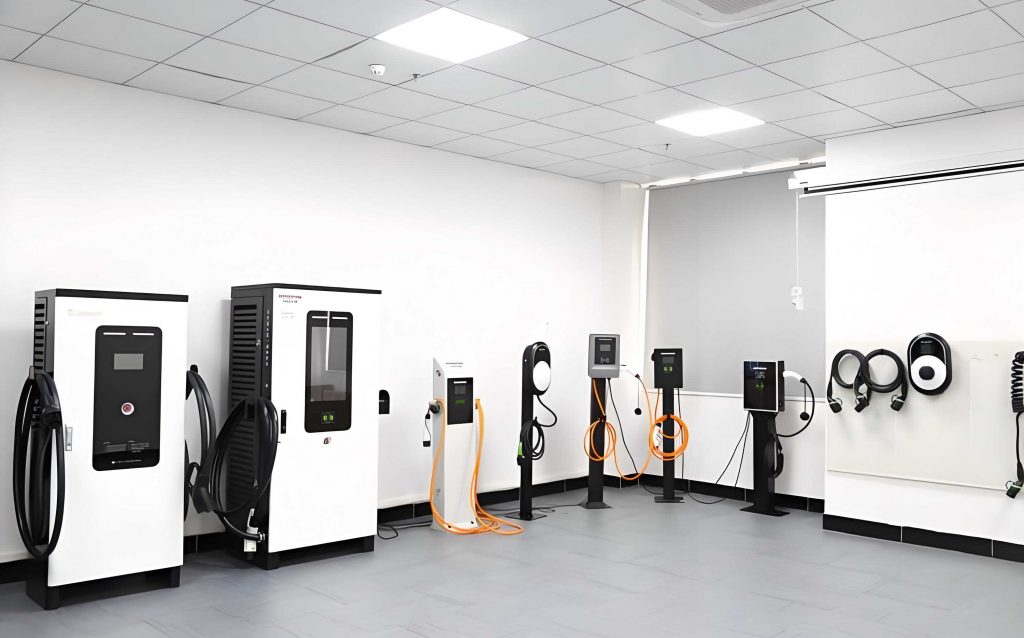
In the following sections, I delve into the theoretical underpinnings of EV power systems, high-power battery technologies, and EV charging station architectures. Subsequently, I detail integrated design methodologies and optimization strategies, supported by tables and equations to summarize complex relationships. The goal is to provide a comprehensive resource for researchers and practitioners, emphasizing the repeated importance of EV charging station innovations in achieving a seamless EV ecosystem.
Theoretical Foundations
The foundation of EV technology lies in the interplay between power systems, batteries, and charging infrastructure. An EV’s power system comprises the battery pack, power electronics, and motor drive, which collectively convert electrical energy into mechanical motion. High-power batteries, with their ability to deliver and accept large currents, are central to this process, while the EV charging station serves as the critical interface for energy replenishment. Understanding these components is essential for effective integration.
EV Power System
The EV power system is a complex network designed for efficient energy conversion and management. At its core, the high-power battery supplies electricity to the motor via power electronic converters, such as inverters and DC-DC converters. These components regulate voltage and current to match driving conditions, ensuring optimal performance and safety. The system’s efficiency can be modeled using power balance equations, where the output power $P_{\text{out}}$ relates to the input power $P_{\text{in}}$ and losses $P_{\text{loss}}$ as follows: $$P_{\text{out}} = P_{\text{in}} – P_{\text{loss}}$$ Here, $P_{\text{loss}}$ includes resistive losses in cables and switching losses in semiconductors, which are minimized through advanced materials and control strategies. The integration with an EV charging station requires seamless communication between the vehicle’s battery management system (BMS) and the charging infrastructure to manage power flow dynamically. For instance, during fast charging, the BMS provides real-time data on state of charge (SOC) and temperature, enabling the EV charging station to adjust parameters accordingly. This synergy is vital for preventing overcharging and thermal runaway, thereby extending battery life and enhancing safety.
| Component | Function | Impact on EV Charging Station Integration |
|---|---|---|
| Battery Pack | Stores electrical energy | Determines charging rate and compatibility with EV charging station |
| Power Electronics | Converts and controls power | Enables adaptive power transfer in EV charging station |
| Motor Drive | Converts electrical to mechanical energy | Indirectly influences charging demands on EV charging station |
| BMS | Monitors and manages battery health | Facilitates communication with EV charging station for safe charging |
Moreover, the power system’s design evolves towards lightweight and integrated architectures to improve overall vehicle efficiency. For example, the use of silicon carbide (SiC) transistors in power converters reduces switching losses, allowing for higher power densities and faster charging at an EV charging station. The relationship between power density $D_p$ and efficiency $\eta$ can be expressed as: $$\eta = \frac{P_{\text{out}}}{P_{\text{in}}} = 1 – \frac{P_{\text{loss}}}{P_{\text{in}}}$$ where higher $D_p$ often correlates with improved $\eta$ in modern systems. As EVs become more prevalent, the role of the EV charging station in supporting these advancements cannot be overstated; it must handle increased power levels while maintaining reliability and user convenience.
High-Power Battery Technologies
High-power batteries are characterized by their ability to deliver high currents rapidly, making them ideal for fast-charging applications. Key technologies focus on electrode materials, electrolyte formulations, and cell design to enhance power density and safety. For instance, lithium-ion batteries with nickel-manganese-cobalt (NMC) cathodes offer high specific power, but they require careful thermal management to prevent degradation. The power capability of a battery can be quantified by its C-rate, defined as: $$C_{\text{rate}} = \frac{I}{C}$$ where $I$ is the charge/discharge current and $C$ is the battery capacity in ampere-hours. High C-rates enable quicker charging at an EV charging station, but they also increase heat generation, necessitating robust cooling systems.
| Battery Type | Specific Power (W/kg) | Charging Time (to 80% SOC) | Compatibility with EV Charging Station |
|---|---|---|---|
| NMC Lithium-ion | 300-500 | 20-30 minutes | High |
| LFP Lithium-ion | 200-400 | 30-40 minutes | Moderate |
| Solid-State | 400-600 | 10-20 minutes | Emerging |
Innovations in battery chemistry, such as silicon-anode designs, further improve power performance by increasing ion diffusion rates. The internal resistance $R_{\text{int}}$ of a battery affects its efficiency during high-power charging at an EV charging station, as described by: $$P_{\text{loss}} = I^2 R_{\text{int}}$$ where $P_{\text{loss}}$ represents energy dissipated as heat. To mitigate this, batteries incorporate thermal management systems that interface with the EV charging station to monitor and control temperature. For example, liquid cooling loops in battery packs can be synchronized with the cooling mechanisms of an EV charging station, ensuring optimal thermal conditions during fast charging. This integration is crucial for maintaining battery health and achieving the full potential of high-power technologies.
EV Charging Station System
An EV charging station is a multifaceted system that converts grid power into a form suitable for vehicle batteries, encompassing power conversion, communication, and safety features. The core components include AC-DC rectifiers, DC-DC converters, and control units that manage the charging process. The power conversion efficiency $\eta_{\text{charge}}$ of an EV charging station can be modeled as: $$\eta_{\text{charge}} = \frac{P_{\text{battery}}}{P_{\text{grid}}}$$ where $P_{\text{battery}}$ is the power delivered to the battery and $P_{\text{grid}}$ is the power drawn from the grid. High-efficiency designs, such as those using gallium nitride (GaN) semiconductors, reduce energy losses and improve the overall sustainability of EV charging station networks.
Communication protocols, like ISO 15118, enable smart interactions between the EV and the EV charging station, allowing for authentication, billing, and dynamic power adjustment. The charging process involves a handshake sequence where the EV charging station verifies compatibility and sets parameters based on battery status. For example, the maximum charging power $P_{\text{max}}$ is determined by: $$P_{\text{max}} = V_{\text{battery}} \times I_{\text{max}}$$ where $V_{\text{battery}}$ is the battery voltage and $I_{\text{max}}$ is the maximum current supported by both the battery and the EV charging station. As EV adoption grows, the scalability of EV charging station infrastructure becomes critical, requiring innovations in grid integration and load management to prevent overloads.
| Parameter | Value Range | Description |
|---|---|---|
| Output Voltage | 50-1000 V DC | Adapts to different EV battery systems |
| Maximum Current | Up to 500 A | Determines charging speed |
| Communication Protocol | CCS, CHAdeMO, ISO 15118 | Ensures interoperability with various EVs |
| Efficiency | 90-95% | Measures energy conversion performance |
Furthermore, the EV charging station must address safety concerns, such as electrical faults and fire risks, through embedded protection mechanisms. For instance, ground fault detection and insulation monitoring are standard features that enhance reliability. The integration of renewable energy sources, like solar panels, into EV charging station designs also promotes green charging, aligning with broader environmental goals. In summary, the EV charging station is not just a power source but a smart node in a larger energy ecosystem, requiring continuous innovation to support high-power EV batteries.
Integrated Design of High-Power Batteries and EV Charging Station Technologies
The integration of high-power batteries with EV charging station technologies involves synergistic designs that enhance performance, safety, and user experience. I focus on three key areas: dynamic interface adaptation, power coordination, and thermal management. Each aspect addresses specific challenges in high-power charging, such as connector wear, energy fluctuations, and heat dissipation, ensuring that the EV charging station operates efficiently under varying conditions.
Dynamic Charging Interface Adaptation
Dynamic adaptation of the charging interface ensures physical and electrical compatibility between the EV and the EV charging station, even under misalignment or varying battery states. This is achieved through mechanical compensation systems and real-time parameter adjustment. For example, a multi-axis robotic arm in the EV charging station connector can correct positional errors using feedback from sensors, minimizing insertion forces and reducing wear. The alignment accuracy $\delta$ can be expressed as: $$\delta = \sqrt{(\Delta x)^2 + (\Delta y)^2 + (\Delta z)^2}$$ where $\Delta x$, $\Delta y$, and $\Delta z$ are deviations in spatial coordinates, and the system aims to keep $\delta$ below a threshold, such as 1 mm, for optimal connection.
Electrically, the EV charging station employs wide-range voltage converters that adapt to battery voltages from 50 V to 1000 V, based on BMS data. The adapter logic follows a state machine model, where the charging voltage $V_{\text{charge}}$ is set as: $$V_{\text{charge}} = f(SOC, T, V_{\text{nominal}})$$ where $SOC$ is the state of charge, $T$ is temperature, and $V_{\text{nominal}}$ is the battery’s nominal voltage. This dynamic adjustment prevents overvoltage and reduces energy losses, critical for high-power scenarios. Additionally, thermal sensors in the interface trigger cooling mechanisms, such as liquid loops or Peltier elements, to manage heat generated during high-current transfer. By integrating these features, the EV charging station maintains reliable connections, prolonging the lifespan of both the battery and the charging equipment.
Dynamic Power Coordination Control
Dynamic power coordination ensures that energy flow between the battery and the EV charging station is optimized for efficiency and stability. This involves hierarchical control architectures that use predictive algorithms and real-time data exchange. A central controller in the EV charging station communicates with the BMS via high-speed networks, adjusting power levels based on battery health and grid conditions. The power allocation problem can be formulated as an optimization: $$\min \sum_{i=1}^{n} (P_{\text{request},i} – P_{\text{allocated},i})^2$$ subject to constraints like $P_{\text{min}} \leq P_{\text{allocated}} \leq P_{\text{max}}$ and thermal limits, where $P_{\text{request}}$ is the desired power from the EV and $P_{\text{allocated}}$ is the power delivered by the EV charging station.
To achieve this, power electronic switches, such as SiC MOSFETs, are used for rapid switching with minimal losses. The switching frequency $f_{\text{sw}}$ influences efficiency, as higher frequencies reduce filter sizes but increase losses according to: $$P_{\text{sw,loss}} = k \cdot f_{\text{sw}} \cdot V_{\text{ds}} \cdot I_{\text{ds}}$$ where $k$ is a device-specific constant, and $V_{\text{ds}}$ and $I_{\text{ds}}$ are the drain-source voltage and current. In practice, the EV charging station implements model predictive control (MPC) to anticipate load changes and smooth power transitions. For instance, if a battery’s polarization voltage spikes, the system gradually reduces current to avoid damage. This coordination not only enhances charging speed but also balances grid loads, making the EV charging station a key player in smart energy management.
| Strategy | Description | Benefit |
|---|---|---|
| Model Predictive Control | Uses forecasts to optimize power flow | Reduces fluctuations and improves battery life |
| Dynamic Current Limiting | Adjusts current based on real-time data | Prevents overheating in high-power scenarios |
| Grid Interaction | Coordinates with utility for load balancing | Enhances scalability of EV charging station networks |
Thermal Management Coupling
Thermal management coupling involves integrated cooling systems that connect the battery and the EV charging station, addressing heat buildup during high-power charging. Batteries generate heat proportional to the square of the current, as per Joule’s law: $$Q = I^2 R t$$ where $Q$ is the heat energy, $I$ is current, $R$ is resistance, and $t$ is time. To dissipate this heat, liquid cooling plates with optimized flow paths are embedded in battery modules, while the EV charging station employs heat exchangers and phase-change materials (PCMs) for efficient thermal transfer.
The coupled system uses a distributed sensor network to monitor temperatures at critical points, such as battery cells and connector terminals. The temperature gradient $\nabla T$ is controlled to stay within safe limits, often below 50°C, using feedback loops that adjust cooling rates. For example, the heat removal rate $\dot{Q}_{\text{remove}}$ can be modeled as: $$\dot{Q}_{\text{remove}} = h A (T_{\text{surface}} – T_{\text{coolant}})$$ where $h$ is the heat transfer coefficient, $A$ is the surface area, and $T_{\text{surface}}$ and $T_{\text{coolant}}$ are temperatures of the battery surface and coolant, respectively. By synchronizing the battery’s cooling system with that of the EV charging station, thermal runaway risks are minimized, ensuring safe operation even during rapid charging sessions. This integration is essential for maintaining performance and extending the service life of high-power batteries and EV charging station components.
System Optimization for High-Power Battery and EV Charging Station Integration
Optimizing the integration of high-power batteries and EV charging station technologies requires a multifaceted approach that enhances safety, standardizes protocols, and improves maintenance. I propose strategies centered on layered security, protocol unification, and intelligent运维 management, all aimed at creating a resilient and efficient charging ecosystem. These optimizations ensure that the EV charging station can handle evolving demands while supporting sustainable EV adoption.
Safety Protection System Construction
Constructing a safety protection system involves a defense-in-depth architecture that addresses electrical, thermal, and data risks in the EV charging station. Electrically, arc fault detection circuits monitor current waveforms for anomalies, triggering disconnection within milliseconds if irregularities are detected. The detection logic can be based on harmonic analysis, where the total harmonic distortion (THD) is computed as: $$\text{THD} = \frac{\sqrt{\sum_{h=2}^{\infty} I_h^2}}{I_1} \times 100\%$$ where $I_h$ is the harmonic current and $I_1$ is the fundamental current. If THD exceeds a threshold, indicating potential arcing, the EV charging station interrupts power flow.
Thermally, redundant temperature sensors and fusible links provide overheat protection, while insulation monitoring networks check for leakage currents. The insulation resistance $R_{\text{insulation}}$ is critical for safety, with minimum values often set at 1 MΩ, calculated as: $$R_{\text{insulation}} = \frac{V_{\text{test}}}{I_{\text{leakage}}}$$ where $V_{\text{test}}$ is the test voltage and $I_{\text{leakage}}$ is the leakage current. Additionally, data security layers in the EV charging station use encryption algorithms, such as AES-256, to protect communication between the EV and the station. By implementing these measures, the EV charging station mitigates risks associated with high-power operations, ensuring user safety and system reliability.
| Layer | Function | Implementation Example |
|---|---|---|
| Electrical Protection | Prevents arcs and short circuits | Fast-acting circuit breakers and current sensors |
| Thermal Management | Controls temperature rises | Cooling systems and thermal fuses |
| Data Security | Encrypts communication channels | Dynamic key exchange and secure protocols |
Standardized Charging Protocol Integration
Integrating standardized charging protocols ensures interoperability between diverse EVs and the EV charging station, reducing compatibility issues. This is achieved through programmable gateways that support multiple protocols, such as Combined Charging System (CCS), CHAdeMO, and ISO 15118. The gateway uses pattern recognition to identify the protocol within 100 ms, based on signature waveforms or data frames. The recognition process can be described by a decision function: $$\text{Protocol} = g(S_{\text{signal}}, F_{\text{frame}})$$ where $S_{\text{signal}}$ is the signal characteristics and $F_{\text{frame}}$ is the frame structure.
Once identified, the EV charging station adapter translates commands into a common format, enabling seamless energy transfer. For example, the charging current $I_{\text{charge}}$ is set according to the protocol’s specifications, often following a curve like: $$I_{\text{charge}} = I_{\text{max}} \left(1 – e^{-\frac{t}{\tau}}\right)$$ where $t$ is time and $\tau$ is a time constant based on battery chemistry. Over-the-air (OTA) updates allow the EV charging station to incorporate new protocols, future-proofing the infrastructure. This integration not only simplifies user experience but also enhances the efficiency of EV charging station networks by reducing setup times and errors.
Operational Maintenance Technology System
An operational maintenance technology system leverages IoT and data analytics to monitor and manage the health of both batteries and the EV charging station. Sensors collect real-time data on parameters like voltage, current, temperature, and mechanical stress, which are analyzed using machine learning algorithms. For instance, a digital twin model simulates the EV charging station’s behavior, predicting failures before they occur. The degradation of a battery’s capacity $C_{\text{deg}}$ over cycles can be modeled as: $$C_{\text{deg}} = C_0 \left(1 – \alpha N^{\beta}\right)$$ where $C_0$ is initial capacity, $N$ is the number of cycles, and $\alpha$ and $\beta$ are degradation coefficients derived from historical data.
Maintenance actions, such as component replacement or software updates, are scheduled based on these predictions, minimizing downtime. Remote access tools enable technicians to diagnose issues and perform calibrations without physical presence, using secure connections. For example, the EV charging station might upload performance logs to a cloud platform, where analytics identify trends like increasing resistance in connectors. This proactive approach ensures that the EV charging station remains operational and efficient, supporting continuous service in high-demand environments. By integrating maintenance into the overall system, the lifecycle costs are reduced, and the reliability of EV charging station networks is enhanced.
| Metric | Description | Optimal Range |
|---|---|---|
| Uptime Percentage | Proportion of time operational | > 99% |
| Mean Time Between Failures | Average time between system failures | > 10,000 hours |
| Energy Efficiency | Ratio of delivered to drawn power | > 92% |
Conclusion
In this article, I have explored the integration of high-power EV batteries with EV charging station technologies, highlighting theoretical foundations, design methodologies, and optimization strategies. The dynamic adaptation of charging interfaces, coordinated power control, and coupled thermal management systems address key challenges in energy transmission and safety. Furthermore, the construction of safety layers, protocol standardization, and intelligent maintenance frameworks enhance the reliability and efficiency of EV charging station operations. These contributions support the broader goal of sustainable EV adoption by improving battery longevity and infrastructure utilization. As technology evolves, continued innovation in EV charging station designs will be crucial for meeting the demands of next-generation electric mobility.
The integration not only resolves existing issues but also paves the way for advancements such as vehicle-to-grid (V2G) capabilities and renewable energy integration. By fostering collaboration across disciplines, we can accelerate the development of smart, resilient EV charging station networks that empower a cleaner transportation future. Ultimately, the synergy between high-power batteries and EV charging station technologies will play a pivotal role in achieving global energy and environmental targets.