
As a researcher deeply involved in the development of next-generation powertrains, I have witnessed a profound transformation in the role of the internal combustion engine (ICE). The rise of the hybrid electric vehicle represents not merely an addition of an electric motor, but a fundamental re-architecting of the vehicle’s energy management and propulsion strategy. In this new paradigm, the internal combustion engine transitions from the sole, always-on primary power source to a highly specialized, on-demand auxiliary unit within a broader, more intelligent system. This shift brings immense opportunities for efficiency gains but simultaneously introduces a novel set of operational conditions and associated durability risks that were either absent or minimal in conventional vehicles. Understanding these shifts is critical for developing robust, cost-effective, and reliable hybrid electric vehicle powertrains. This article, based on extensive analysis of prevalent hybrid architectures, details the changing operational characteristics of engines in hybrid electric vehicles and systematically analyzes the potential failure modes that emerge as a direct consequence.
The propulsion system of a conventional vehicle is mechanically deterministic: the ICE generates torque, which is transmitted through a transmission (with possible decoupling via a clutch or torque converter) to the wheels. The relationship between engine torque and wheel torque is direct, governed by fixed gear ratios. In contrast, the hybrid electric vehicle decouples this rigid link through the strategic introduction of one or more electric machines (EMs). The common classifications—P0, P1, P2, P3, P4—describe the EM’s integration point relative to the engine and drivetrain, as illustrated below:
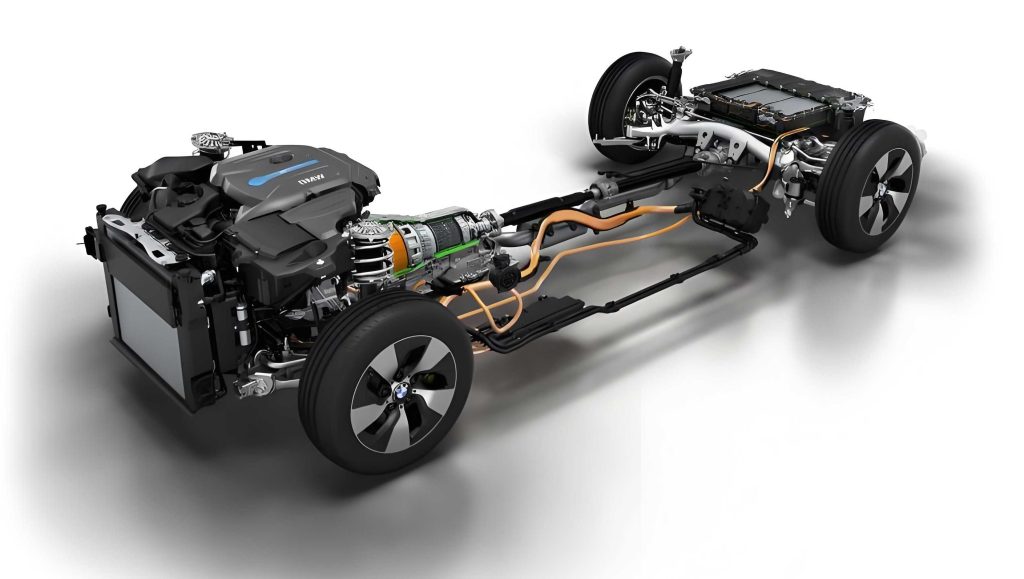
Modern hybrid electric vehicle systems are no longer based on a single EM position but are sophisticated combinations. Two architectures with demonstrated market success are the series (range-extender) and the series-parallel (power-split or multi-mode) configurations.
1. Deconstructing Hybrid Electric Vehicle Architectures and Engine Roles
The operating envelope and duty cycle of an ICE are dictated by the hybrid architecture. The choice of architecture fundamentally determines when, why, and under what load conditions the engine runs.
| Architecture | Configuration | Primary Engine Role | Engine-to-Wheel Mechanical Connection | Typical Operational Modes |
|---|---|---|---|---|
| Series (P1+P3) | Engine coupled directly to a generator (P1). A separate traction motor (P3) drives the wheels. | Electrical power generator for the battery and/or direct supply to the traction motor. | None. Purely electrical path. | Pure Electric, Series (Engine Generating), Battery Charging. |
| Series-Parallel (e.g., with DHT) | Engine, generator (P1), and traction motor(s) integrated via a dedicated hybrid transmission (DHT) with clutches. | Generator and/or direct mechanical drive source. Role changes dynamically. | Controllable via clutches. Can be disconnected or directly connected. | Pure Electric, Series, Parallel, Engine Direct Drive, Combined “Multi-Mode” Power. |
In a series hybrid electric vehicle, the engine is mechanically isolated from the driven wheels. Its sole purpose is to drive a generator to produce electricity. This allows the engine to operate almost exclusively within a narrow band of speed and load corresponding to its peak efficiency region, often referred to as its “Brake Specific Fuel Consumption (BSFC) sweet spot.” The engine operation can be described as a steady-state or slowly varying generator load:
$$ P_{\text{gen}} = \tau_{\text{eng}} \cdot \omega_{\text{eng}} \cdot \eta_{\text{gen}} $$
where \( P_{\text{gen}} \) is the electrical power output, \( \tau_{\text{eng}} \) is engine torque, \( \omega_{\text{eng}} \) is engine speed, and \( \eta_{\text{gen}} \) is the generator efficiency. The engine speed \( \omega_{\text{eng}} \) is controlled to track the optimal efficiency line, a function mapped during calibration:
$$ \omega_{\text{eng, target}} = f(P_{\text{gen, req}}, \text{BSFC}_{\text{map}}) $$
While excellent for urban driving, the series hybrid electric vehicle suffers from double energy conversion losses (mechanical->electrical->mechanical) during sustained high-speed cruising, reducing overall highway efficiency.
The series-parallel hybrid electric vehicle offers superior flexibility and efficiency across a wider range of driving scenarios. By using a clutch or planetary gearset, it can seamlessly switch between series and parallel modes. The engine’s operating point is no longer constrained to a single line but can be selected from a broader area to satisfy combined optimization goals (fuel economy, drivability, cabin heating, etc.). The system controller solves a real-time optimization problem. For instance, in a parallel mode where engine and motor torque are combined at the wheels:
$$ T_{\text{wheel, req}} = \left( T_{\text{eng}} \cdot R_{\text{gear}} + T_{\text{motor}} \right) \cdot R_{\text{final}} $$
The engine torque \( T_{\text{eng}} \) and motor torque \( T_{\text{motor}} \) are allocated to minimize a cost function \( J \), which typically includes fuel rate and battery state-of-charge (SOC) sustenance:
$$ J = \int \left( \dot{m}_{\text{fuel}}(T_{\text{eng}}, \omega_{\text{eng}}) + \alpha \cdot (SOC_{\text{target}} – SOC)^2 \right) dt $$
This dynamic allocation is what allows the engine’s operating region to be compressed away from inefficient zones.
2. The Transformed Start-Stop Profile of the Hybrid Electric Vehicle Engine
In a conventional vehicle, the engine starts once with the key and remains running until the destination is reached. The start event is relatively infrequent and predictable. In a hybrid electric vehicle, the engine becomes a “subservient” component, activated on-demand by the vehicle’s energy management supervisor. This leads to a dramatic increase in both the frequency and the diversity of start events. We can categorize the start demands in a hybrid electric vehicle:
| Trigger Type | Condition | Typical Characteristics | Engine Load Post-Start |
|---|---|---|---|
| Parking Generation | Low battery SOC while vehicle is stationary. | Rapid start to a fixed, elevated idle speed (e.g., 1200-1600 rpm). High thermal load at zero vehicle speed. | Constant, moderate load for battery charging. |
| On-the-Move Generation | Low battery SOC while driving (electric mode). | Very fast start (< 500ms) with rapid ramp-up (≥ 7000 rpm/s). May have a short pause for speed synchronization. | Load follows generator demand curve, often immediately high. |
| Direct Drive / Power Assist | High vehicle speed or high power demand (e.g., acceleration, hill climb). | Aggressive start to quickly match transmission input speed or provide boost torque. Highest dynamic stress. | Immediately enters medium-to-high load region of the engine map. |
The dynamic start in a series or parallel mode subjects the crankshaft and driveline to high torsional impulses. The angular acceleration \( \alpha \) during such a start can be modeled as:
$$ \alpha = \frac{d\omega}{dt} = \frac{(T_{\text{motor}} – T_{\text{friction}} – T_{\text{load}})}{J_{\text{equiv}}} $$
where \( J_{\text{equiv}} \) is the equivalent inertia of the rotating assembly. A high \( \alpha \) value, while beneficial for drivability and NVH (reducing the “engine start shudder” perception), imposes significant shear stresses on the oil film in bearings and on the timing drive components.
3. The Idealized Operating Envelope: Compression of the Engine Map
The core efficiency benefit of a hybrid electric vehicle stems from the strategic avoidance of the engine’s inefficient operating zones. The conventional engine operates across a wide swath of its speed-load map, including low-speed high-load (inefficient, knock-prone), maximum load line (high fuel consumption), and high-speed regions (high friction losses, poor NVH).
The hybrid electric vehicle controller, through torque blending, effectively compresses this operational area. The engine is prevented from operating in regions 3, 4, and 5 of the classic map, as described below:
- Low-Speed High-Load Region: Electric motor provides instantaneous torque, covering launch and low-speed acceleration.
- Peak Power (WOT) Region: Electric motor supplements engine torque, allowing the engine to operate at 80-90% of its maximum load, improving part-load efficiency.
- High-Speed Region: Vehicle cruising is managed either by the electric motor or by the engine at a lower, more efficient speed point through gear ratio selection in a DHT. The engine’s maximum usable speed is often capped at ~90% of its rated maximum.
Consequently, the engine’s operating points are concentrated along a “high-efficiency corridor” or band. This band is the locus of points with the minimum BSFC for a given power output. The optimization task for a hybrid electric vehicle engine designer shifts from chasing a single peak Brake Thermal Efficiency (BTE) point to flattening and broadening the high-efficiency plateau. The objective function for engine calibration changes to:
$$ \text{Maximize } \int_{\omega_{\text{min}}}^{\omega_{\text{max}}} \int_{L_{\text{min}}(\omega)}^{L_{\text{max}}(\omega)} \eta_{\text{bte}}(\omega, L) \cdot W(\omega, L) \, dL \, d\omega $$
where \( \eta_{\text{bte}} \) is the brake thermal efficiency, \( L \) is load, and \( W(\omega, L) \) is a weighting function representing the probability density of the engine operating at that point in the target hybrid electric vehicle application.
This fundamental shift necessitates a re-thinking of engine technology choices: Atkinson/Miller cycles for higher expansion ratio, elevated compression ratios, advanced combustion systems (e.g., high-tumble ports), and exhaust gas recirculation (EGR) strategies optimized for this narrow, high-efficiency band rather than for full-load performance.
4. Analysis of Potential Failure Modes and Mitigation Strategies
The new operational paradigm of the hybrid electric vehicle engine introduces unique durability challenges. Three critical areas demand focused attention.
4.1 High-Frequency Start-Stop and Boundary Lubrication
The frequent, often high-load starts lead to a dramatic increase in the number of engine revolutions operated under boundary or mixed lubrication conditions. Each start-stop cycle involves:
- Start: Momentary metal-to-metal contact until a full hydrodynamic oil film is established in the main bearings, big-end bearings, and between piston rings and cylinder liners.
- Shutdown: Drainage of oil from critical surfaces during extended off periods.
The cumulative wear \( W \) over N cycles can be modeled using an Archard-type formulation for boundary conditions:
$$ W = k \cdot \frac{F \cdot s}{H} $$
where, for a bearing, \( k \) is a wear coefficient (high for boundary lubrication), \( F \) is the load, \( s \) is the sliding distance during the boundary regime per start, and \( H \) is the material hardness. In a hybrid electric vehicle, \( N \) can be an order of magnitude higher than in a conventional vehicle with automatic start-stop.
Mitigation Strategies:
- Hardware: Use of diamond-like carbon (DLC) coatings on piston pins, followers, or chain components. Adoption of polymer-based or low-friction coatings on piston skirts. Optimized bearing materials and clearances.
- Lubrication: Development of low-viscosity oils (0W-16, 0W-12) with enhanced anti-wear (AW) and extreme pressure (EP) additive packages specifically formulated for hybrid electric vehicle service.
- Control Strategy: Implementing a “soft-start” algorithm where the electric motor smoothly ramps up engine speed, even if briefly, to ensure oil pressure build-up before applying significant generator or driveline load. This adds a slight delay but greatly reduces wear.
4.2 Severe Oil Dilution and Low-Temperature Operation
This is perhaps the most insidious failure mode in hybrid electric vehicles, particularly in cold climates. The problem is exacerbated by the combination of:
- Frequent, Short-Duration Operation: The engine starts, runs for a few minutes to generate power or assist, and shuts off before reaching full operating temperature (\( T_{\text{coolant}} > 85^\circ \text{C} \)).
- Cold Combustion Chamber Walls: Fuel impingement and incomplete evaporation lead to fuel “wash-down” past the piston rings into the crankcase (fuel dilution).
- Condensation in the Crankcase Ventilation System: Blow-by gases contain water vapor from combustion. In a cold, frequently cycled engine, this vapor condenses and mixes with the oil, leading to water contamination and potential emulsion formation.
The rate of fuel dilution \( \frac{d\phi_f}{dt} \) can be empirically related to engine wall temperature \( T_{\text{wall}} \) and load:
$$ \frac{d\phi_f}{dt} \propto \exp\left(-\frac{E_a}{R \cdot T_{\text{wall}}}\right) \cdot (1 – \eta_{\text{comb}}) $$
where \( \phi_f \) is the fuel mass fraction in oil, \( E_a \) is an activation energy, \( R \) is the gas constant, and \( \eta_{\text{comb}} \) is combustion efficiency. Low \( T_{\text{wall}} \) and low \( \eta_{\text{comb}} \) (typical of cold starts) exponentially increase the dilution rate.
The consequence is a drastic reduction in oil viscosity \( \mu \), which for a mixture can be approximated by the Refutas equation or simply observed to plummet:
$$ \mu_{\text{oil}} \downarrow \Rightarrow h_{\text{film}} \downarrow \quad \text{(from hydrodynamic theory)} $$
where \( h_{\text{film}} \) is the lubricating film thickness. Severe dilution (e.g., >10% fuel) coupled with water (>1%) leads to loss of lubricity, corrosion, and ultimately catastrophic bearing failure or seizure, as observed in field cases.
Mitigation Strategies:
- Aggressive Thermal Management: Integrating the engine cooling circuit with the battery and cabin heating loops. Using an electric heater or exhaust heat recovery to rapidly warm the engine block and oil sump after a cold start, minimizing the time below the fuel evaporation threshold.
- Strategy Intervention: Implementing an “Oil Maintenance Mode” in the vehicle software. The hybrid controller monitors cumulative engine run time below a temperature threshold. Upon exceeding a limit, it forces a prolonged engine run in the next driving cycle to boil off fuel and water contaminants.
- Hardware Sensing: Future systems may employ in-situ oil quality sensors (measuring permittivity/conductivity) to directly monitor dilution levels and trigger protective actions.
4.3 Long-Term Static Corrosion and “Dry” Friction
Plug-in hybrid electric vehicles (PHEVs) with substantial electric-only range (e.g., >50 miles) present a unique challenge: the engine may not operate for weeks or months during daily commutes, yet the vehicle is subjected to normal road vibrations. This leads to:
- Oil Drainage: Complete drainage of oil from upper cylinder liners, valvetrain, and certain bearings, leaving a non-protective residual film.
- Corrosion: In the presence of acidic combustion by-products and moisture, exposed ferrous surfaces (camshafts, lifter bores, timing chains) can develop surface rust.
- Vibration-Induced Fretting: Micro-motion between contacting surfaces (e.g., bearings in their housings, gear teeth) without adequate lubricant can cause fretting wear and false brinelling.
When the engine is finally called upon for a high-power demand (e.g., a highway merge), it starts abruptly and must immediately bear load with compromised lubrication, posing a high risk of scoring or seizure.
Mitigation Strategies:
- Material and Coating Selection: Extensive use of corrosion-resistant materials (stainless steel for components like camshafts, nitride treatments) and protective coatings.
- Lubricant Formulation: Oils with enhanced film strength additives and corrosion inhibitors designed for long dwell times.
- Periodic Engine Exercise: Programming the vehicle controller to automatically start and run the engine for a short period (e.g., 5-10 minutes) every few weeks if it has not been used, simply to circulate oil and coat internal components. This must be done judiciously to avoid annoying the customer.
- Enhanced Sealing: Preventing atmospheric moisture ingress during long static periods through improved crankcase and intake system seals.
5. Conclusion and Future Perspective
The integration of the internal combustion engine into a hybrid electric vehicle is a masterclass in systems engineering optimization. The engine is no longer designed and evaluated in isolation but as a sub-system whose operational profile is dynamically shaped by the overarching energy management strategy of the hybrid electric vehicle. This shift yields tremendous fuel economy benefits by confining engine operation to a high-efficiency corridor, but it simultaneously introduces severe and novel durability challenges centered around high-frequency dynamic loading, poor thermal conditions, and prolonged inactivity.
Addressing these challenges requires a holistic approach spanning advanced hardware design (coatings, materials, thermal architecture), specialized lubricants, and intelligent, predictive control software. The development process for a hybrid electric vehicle engine must incorporate validation tests specifically designed to accelerate these new failure modes, such as ultra-high-cycle start-stop durability tests, cold-cycle oil dilution accumulation tests, and long-term static vibration exposure tests.
As hybrid electric vehicle technologies evolve towards higher levels of electrification and smarter, connected powertrains, the role of the engine will become even more specialized. The future hybrid electric vehicle engine will likely be a ultra-lean, high-efficiency, and robustly packaged unit, designed from the ground up not for broad-range operation, but for flawless performance within its narrowly defined, yet critically important, duty cycle in the electrified vehicle ecosystem.