
In the rapidly evolving landscape of electric vehicles (EVs), the battery pack stands as the cornerstone of performance, safety, and range. As an integral component, the EV battery pack lower housing plays a critical role in protecting the battery modules, providing structural integrity, and influencing overall vehicle dynamics, including side-impact resistance and longevity. My extensive experience in automotive manufacturing has shown that the selection of production processes for this key part is paramount, dictating cost, weight, scalability, and ultimately market competitiveness. This article delves into a comprehensive analysis of mainstream production processes for EV battery pack lower housings, evaluating their merits and drawbacks to guide optimal selection in project development. I will explore steel stamping, high-strength steel roll forming, steel-aluminum hybrid, aluminum alloy extrusion, and aluminum alloy die-casting, incorporating tables and formulas to summarize key insights. The goal is to enhance production efficiency, reduce costs, and propel the EV industry forward.
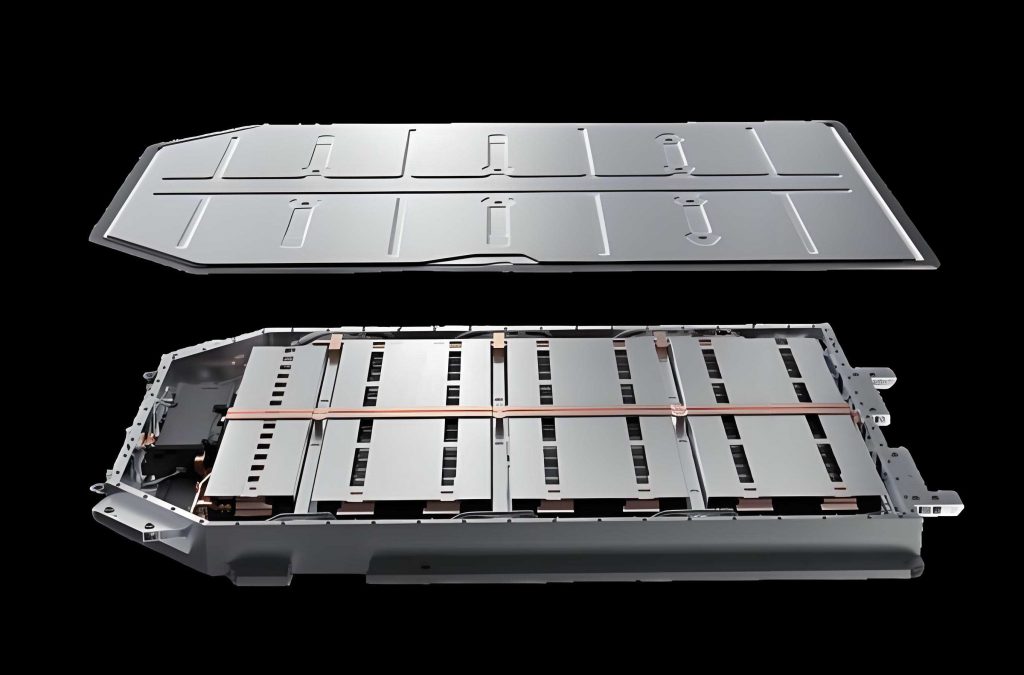
The global shift toward sustainable transportation has accelerated the adoption of EVs, with battery technology at its core. Within an EV battery pack, the lower housing serves as the foundational enclosure, safeguarding sensitive components from environmental hazards, mechanical shocks, and thermal events. Its design and manufacturing process directly impact the pack’s energy density, safety standards, and integration with the vehicle platform. In my analysis, I have identified five predominant production methods, each with distinct characteristics that cater to varying priorities such as lightweighting, cost-effectiveness, and platform flexibility. As the demand for EVs grows, optimizing the EV battery pack lower housing through advanced processes becomes essential for meeting stringent regulatory and consumer expectations.
To quantify the impact of process selection, consider the fundamental equation for weight reduction, a critical metric in EV design:
$$ \Delta W = \frac{W_{\text{traditional}} – W_{\text{new}}}{W_{\text{traditional}}} \times 100\% $$
Here, $\Delta W$ represents the percentage weight reduction achieved by adopting a new process or material for the EV battery pack lower housing. Lightweighting is vital for extending driving range, as every kilogram saved can improve energy efficiency. Similarly, cost modeling involves multiple factors:
$$ C_{\text{total}} = C_{\text{material}} + C_{\text{processing}} + C_{\text{tooling}} + C_{\text{assembly}} $$
where $C_{\text{total}}$ is the total cost per unit, $C_{\text{material}}$ is the raw material cost, $C_{\text{processing}}$ covers manufacturing expenses, $C_{\text{tooling}}$ accounts for initial模具 investment, and $C_{\text{assembly}}$ includes joining and finishing operations. Balancing these variables is key to selecting the right process for an EV battery pack.
Steel Stamping for EV Battery Pack Lower Housings
Steel stamping is a well-established metal-forming technique that uses dies and presses to shape sheet metal into desired geometries. For EV battery pack lower housings, this process typically involves forming a single steel plate into a shell, with additional stamped components for mounting features. Resistance spot welding and CO₂ welding are commonly employed for assembly, ensuring structural integrity. The material of choice is often SAPH440 or equivalent grades, offering a balance of ductility and strength. Post-processing, such as electrophoretic coating or galvanizing, is applied for corrosion resistance.
From my perspective, the advantages of steel stamping lie in its maturity and high production efficiency. The process benefits from decades of refinement in the automotive industry, leading to low per-unit costs and rapid throughput. However, challenges arise with large-scale parts common in EV battery pack applications. Issues like springback and cracking can occur, necessitating extensive simulation during development. Moreover, this approach lacks platform scalability; each new vehicle model may require significant retooling, increasing development time and expense. While suitable for compact EVs, its limitations in adaptability have led to a gradual decline in favor of more flexible solutions. The weight of a stamped steel EV battery pack lower housing can be estimated using:
$$ W_{\text{stamped}} = \rho_{\text{steel}} \times A \times t $$
where $\rho_{\text{steel}}$ is the density of steel, $A$ is the surface area, and $t$ is the material thickness. Typically, thickness ranges from 1.5 to 2.5 mm, resulting in moderate weight but higher mass compared to lightweight alternatives.
High-Strength Steel Roll Forming for EV Battery Pack Lower Housings
Roll forming involves progressively shaping high-strength steel strips through a series of rolls to create continuous profiles with constant cross-sections. This process is particularly effective for producing structural members like边框 and crossbeams in an EV battery pack lower housing. Materials such as DP1180 (with yield strengths up to 1200 MPa) enable significant thickness reduction to 1-1.2 mm, achieving weight savings of approximately 20% over conventional stamped steel. Assembly often combines laser welding for密封 joints and resistance spot welding for internal connections.
In my experience, the standout advantage of high-strength steel roll forming is its innate platform adaptability. Once a cross-sectional profile is developed, it can be easily extended or modified for different EV battery pack sizes across multiple vehicle platforms, slashing development costs. Additionally, the use of ultra-high-strength steels enhances vehicle crash performance, a critical safety factor for EVs. The lightweighting benefit directly translates to improved range, as shown by the energy consumption equation:
$$ E_{\text{consumption}} = k \times m \times d $$
where $E_{\text{consumption}}$ is the energy consumed, $k$ is a vehicle-specific constant, $m$ is the mass of the EV battery pack and vehicle, and $d$ is the distance traveled. Reducing $m$ lowers $E_{\text{consumption}}, extending range. However, initial investments in roll forming equipment and tooling are higher, but this is offset by long-term savings in material and platform reuse. The structural efficiency can be expressed as:
$$ \text{Efficiency} = \frac{\sigma_y}{\rho} $$
with $\sigma_y$ being the yield strength and $\rho$ the density. High-strength steels offer a favorable ratio, making them ideal for EV battery pack lower housings where strength-to-weight is paramount.
Steel-Aluminum Hybrid EV Battery Pack Lower Housings
This hybrid approach combines aluminum extruded profiles for边框 and crossbeams with a steel stamping for the底板, often integrating a liquid冷板 made from 3000-series aluminum. The aluminum components provide lightweighting, while the steel底板 adds durability against road debris and impacts. Joining techniques include friction stir welding for aluminum-to-aluminum seams and bolting for steel-aluminum interfaces, ensuring密封 and structural integrity.
I find that steel-aluminum hybrid designs strike an optimal balance between weight reduction and cost control. By leveraging aluminum for load-bearing structures and steel for protection, the EV battery pack lower housing achieves notable mass savings without the premium cost of full aluminum solutions. The integrated liquid冷板 enhances thermal management, crucial for battery performance and lifespan in EVs. However, the process complexity increases due to multi-material joining, requiring precise工艺 control to prevent galvanic corrosion and ensure durability. The overall weight can be modeled as:
$$ W_{\text{hybrid}} = W_{\text{Al}} + W_{\text{steel}} = \rho_{\text{Al}} V_{\text{Al}} + \rho_{\text{steel}} V_{\text{steel}} $$
where $V$ denotes volume. Typical weight reductions of 15-25% are achievable compared to all-steel designs, making this a popular choice for mid-range EVs. The cost equation incorporates additional factors for joining:
$$ C_{\text{hybrid}} = C_{\text{Al}} + C_{\text{steel}} + C_{\text{joining}} + C_{\text{insulation}} $$
where $C_{\text{joining}}$ covers welding and fastening, and $C_{\text{insulation}}$ addresses corrosion prevention between dissimilar metals.
Aluminum Alloy Extrusion for EV Battery Pack Lower Housings
Aluminum extrusion forces heated aluminum billets through a die to create elongated profiles with consistent cross-sections. For EV battery pack lower housings, this involves multiple extruded panels for the底板 and边框, often with integrated mounting ribs. Common alloys like 6063-T6 or 6061-T6 offer good strength and lightweight properties. Assembly relies heavily on friction stir welding (FSW) for main seams, supplemented by MIG or TIG welding for hard-to-reach areas.
Based on my observations, aluminum extrusion excels in lightweighting, contributing to higher energy density in the EV battery pack. The process benefits from low模具 costs and成熟 technology, allowing for quick prototyping and development. Advances like ultra-wide flat extrusions have enabled larger single-piece panels, reducing part count and assembly complexity. However, the primary drawback is material cost; aluminum prices are inherently higher than steel, impacting overall economics. Additionally, platform scalability is limited compared to roll forming, as profile changes often require new dies. The weight advantage is significant, with density $\rho_{\text{Al}} \approx 2.7 \, \text{g/cm}^3$ versus $\rho_{\text{steel}} \approx 7.8 \, \text{g/cm}^3$, leading to potential weight reductions of over 50% for equivalent volumes. The structural performance can be assessed using:
$$ \text{Stiffness} = E \times I $$
where $E$ is Young’s modulus and $I$ is the moment of inertia. Aluminum’s lower $E$ value necessitates careful design to maintain rigidity in the EV battery pack lower housing.
Aluminum Alloy Die-Casting for EV Battery Pack Lower Housings
Die-casting involves injecting molten aluminum under high pressure into a steel mold to produce near-net-shape parts. In the context of EV battery pack lower housings, this allows for complex, monolithic structures with integrated features like cooling channels and mounting bosses. Post-casting, CNC machining is used to achieve precise tolerances and threaded holes. The process gained attention after Tesla’s pioneering use of mega-casting for vehicle bodies.
I believe aluminum die-casting offers unparalleled design freedom and production efficiency for EV battery pack lower housings. It enables substantial part consolidation, reducing assembly steps and improving密封 integrity. Lightweighting is excellent, and the ability to form intricate geometries optimizes space utilization within the EV. Nonetheless, barriers include high initial costs for molds and casting machines, as well as potential defects like porosity and distortion during heat treatment. Emerging免热处理 alloys aim to mitigate these issues, but material costs remain elevated. The cost model highlights the trade-off:
$$ C_{\text{die-cast}} = C_{\text{Al, premium}} + C_{\text{tooling, high}} + C_{\text{machining}} $$
where $C_{\text{tooling, high}}$ dominates upfront investment. Die-cast EV battery pack lower housings can be 30-50% more expensive than steel counterparts, limiting adoption to premium EVs. However, for high-volume production, per-unit costs may decrease due to automation and speed. The weight savings follow a similar trend to extrusion, with additional benefits from topology optimization.
Comparative Analysis and Recommendations
To synthesize my findings, I have developed a comprehensive table comparing the five production processes for EV battery pack lower housings. This table evaluates key parameters such as weight reduction, cost, platform scalability, and suitability for different EV segments.
| Production Process | Weight Reduction Potential | Relative Cost (per unit) | Platform Scalability | Key Advantages | Key Disadvantages | Recommended EV Segment |
|---|---|---|---|---|---|---|
| Steel Stamping | 0-10% | Low | Poor | Mature, high efficiency, low cost | Limited scalability, higher weight | Compact/Micro EVs |
| High-Strength Steel Roll Forming | 15-25% | Medium-Low | Excellent | Good lightweighting, high strength, platform reuse | Higher initial tooling cost | Mainstream to Premium EVs |
| Steel-Aluminum Hybrid | 20-30% | Medium | Good | Balance of weight and cost, integrated cooling | Complex joining, corrosion risk | Mid-Range EVs |
| Aluminum Alloy Extrusion | 40-60% | Medium-High | Moderate | Excellent lightweighting, low tooling cost for prototypes | High material cost, limited platform flexibility | Performance/Luxury EVs |
| Aluminum Alloy Die-Casting | 50-70% | High | Good for specific designs | Design freedom, part consolidation, high production rate | Very high upfront cost, material issues | Premium/High-Volume EVs |
This table serves as a quick reference for project teams selecting an EV battery pack lower housing process. To further aid decision-making, I propose a scoring system based on weighted criteria:
$$ \text{Score} = w_1 \cdot S_{\text{weight}} + w_2 \cdot S_{\text{cost}} + w_3 \cdot S_{\text{scalability}} + w_4 \cdot S_{\text{safety}} $$
where $w_i$ are weights assigned to each criterion (e.g., weight reduction importance $w_1 = 0.4$, cost $w_2 = 0.3$, etc.), and $S$ are scores from 1 to 10 for each process. For instance, high-strength steel roll forming might score highly due to its balanced profile.
In terms of future trends, I anticipate that high-strength steel roll forming will gain dominance in the mass market for EV battery pack lower housings, driven by cost pressures and platform strategies. Meanwhile, aluminum processes will continue to evolve with new alloys and digital manufacturing techniques, catering to niche segments where performance outweighs cost. Hybrid approaches may see innovations in multi-material bonding, enhancing their viability.
Conclusion
In conclusion, the production process for an EV battery pack lower housing is a critical determinant of overall vehicle performance, cost, and market success. Through detailed analysis, I have highlighted the strengths and weaknesses of steel stamping, high-strength steel roll forming, steel-aluminum hybrid, aluminum extrusion, and aluminum die-casting. Each method offers distinct trade-offs in lightweighting, economics, and scalability. Currently, hybrid and extruded aluminum solutions are prevalent, but the rise of high-strength steel roll forming presents a compelling alternative for platform-based development. As the EV industry progresses toward carbon neutrality, optimizing these processes will be essential for meeting efficiency targets and consumer demands. By leveraging comparative tools like the provided table and formulas, engineers can make informed decisions that enhance the EV battery pack’s role in sustainable mobility.
Ultimately, the choice of process must align with specific project goals: whether prioritizing cost reduction for mass-market EVs or maximizing lightweighting for premium models. My experience underscores that a holistic view—considering material science, manufacturing capabilities, and lifecycle costs—is key to advancing EV battery pack technology. As innovations emerge, continuous evaluation will ensure that production methods evolve in tandem with the dynamic EV landscape.