
In the rapidly evolving automotive industry, the shift toward electric vehicles (EVs) has intensified the focus on lightweighting and integration to enhance driving range, performance, and sustainability. As an engineer specializing in vehicle body lightweighting, I have witnessed firsthand the transformative potential of advanced manufacturing techniques. Among these, integrated die casting stands out as a game-changer for producing large, complex components with significant weight savings. This article delves into my exploration of applying integrated die casting to an EV battery pack system, aiming to achieve substantial mass reduction while meeting rigorous performance standards. Through this study, I will detail the design, material selection, simulation analyses, and outcomes, emphasizing how this approach can revolutionize EV battery pack construction.
The drive for lightweighting in EVs stems from the direct correlation between vehicle mass and energy consumption. A lighter EV battery pack translates to extended range, improved efficiency, and reduced material usage. Traditional EV battery pack assemblies often rely on numerous stamped sheets, extruded aluminum profiles, and welded or bolted connections, leading to complex supply chains, high production costs, and added weight. Integrated die casting consolidates multiple parts into a single, monolithic casting, streamlining manufacturing and unlocking new design freedoms. For this project, I focused on reengineering a passenger car’s EV battery pack and underbody structure. The original design comprised over 90 individual components, including the battery enclosure, underbody panels, crossmembers, and various brackets, with a total mass of 127.3 kg. My goal was to integrate these into just two die-cast parts: an upper cover and a lower battery tray, targeting a lighter, stiffer, and more cost-effective EV battery pack solution.
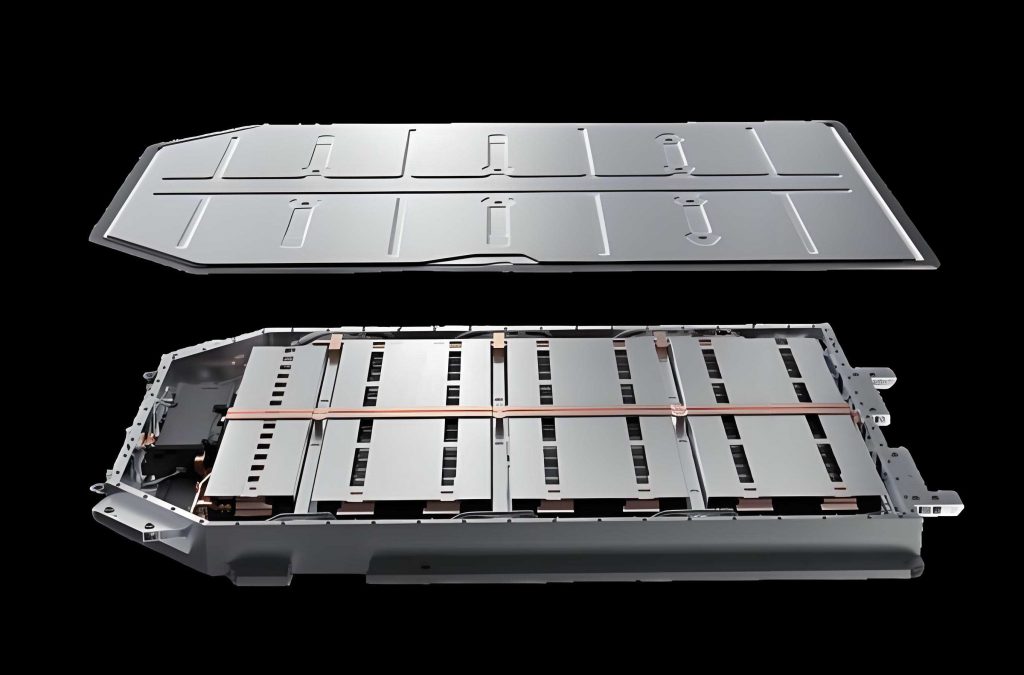
To appreciate the innovation, let’s first consider the conventional EV battery pack architecture. Typically, the battery enclosure is built from aluminum extrusions and stamped steel parts, assembled via welding and bolting. The underbody structure, including floor panels and reinforcement beams, is made from stamped steel sheets joined by hundreds of spot welds. This method, while proven, introduces inherent weaknesses: joint fatigue, dimensional variations, and weight penalties from overlapping materials and connectors. My integrated die casting approach seeks to overcome these by casting the entire EV battery pack structure as near-net-shape components, eliminating most joints and allowing optimized wall thicknesses and reinforcement ribs where needed.
The foundation of any successful die casting project lies in material selection. For large-scale integrated castings like an EV battery pack, the aluminum alloy must exhibit exceptional castability, high as-cast strength and ductility, good fluidity to fill thin sections, and compatibility with post-casting processes. Traditional die-casting alloys, such as Al-Si or Al-Mg systems, often require heat treatment to achieve desired properties, but this can induce distortions in large parts. Hence, I turned to non-heat-treatable (or self-aging) aluminum alloys specifically developed for mega-castings. These alloys incorporate elements like silicon, magnesium, manganese, iron, copper, and rare earths to enhance strength, toughness, and casting performance without subsequent heat treatment. After evaluating several options, I selected an alloy similar to JDA1b for this EV battery pack project, due to its balanced mechanical properties and proven performance in automotive applications. The key material requirements can be summarized as:
- High yield and tensile strength in the as-cast state to withstand structural loads.
- Excellent elongation to absorb energy during crashes.
- Superior fluidity to fill intricate, thin-walled geometries typical of an EV battery pack.
- Good tolerance to impurities and elemental variations for consistent production.
- Long-lasting modification effects to maintain microstructure stability.
The mechanical properties of common non-heat-treatable alloys for integrated die casting are compared below, highlighting their suitability for EV battery pack applications:
| Alloy Designation | Yield Strength (MPa) | Tensile Strength (MPa) | Elongation (%) |
|---|---|---|---|
| C611 | 117 – 132 | 228 – 268 | 10 – 14.1 |
| Castasil 37 | 107 – 150 | 261 – 300 | 8.7 – 14 |
| Aural 5S | 130 – 150 | 240 – 275 | 9 – 13 |
| Selected Alloy (JDA1b-type) | ≥ 120 | ≥ 260 | ≥ 12 |
These properties ensure the EV battery pack castings can meet the demanding static and dynamic loads encountered in vehicle service. The selected alloy’s tensile strength and elongation are particularly critical for crashworthiness, as the EV battery pack must deform controllably without brittle fracture.
With the material defined, I proceeded to the structural design of the integrated EV battery pack. The original assembly was dissected into functional zones: the upper section (integrating the battery cover and underbody floor) and the lower section (integrating the battery tray, side rails, crossmembers, and mounting points). Using CAD software, I redesigned these as two die-cast components. The design philosophy emphasized:
- Topology Optimization: Employing finite element analysis (FEA) to identify high-stress areas and add reinforcement ribs, while thinning low-stress regions to save weight. For instance, the battery tray floor incorporates a hexagonal honeycomb pattern of ribs to enhance bending stiffness without adding substantial mass.
- Wall Thickness Gradation: Transitioning wall thickness from 2.5 mm in highly loaded zones (e.g., around mounting points) to 2.0 mm in general areas, achieving an optimal balance between strength and weight.
- Feature Integration: Incorporating mounting bosses, cable routing channels, coolant line attachments, and sensor brackets directly into the casting, eliminating separate fasteners and secondary operations.
The contrast between the traditional and integrated approaches for the EV battery pack is stark, as summarized in the table below:
| Component | Integrated Die Casting Solution | Traditional Sheet/Extrusion Solution |
|---|---|---|
| Battery Tray Base | Single casting with honeycomb ribs; material: non-heat-treatable Al alloy; process: die casting; no joining needed. | Stamped steel panel; material: 1500 MPa steel; process: stamping; joined via 48 bolts and sealant foam. |
| Battery Frame | Integrated into lower casting; ribs and cross-braces cast-in. | Aluminum 6061 extrusions; process: extrusion and CNC machining; joined via 72 welds. |
| Mounting Brackets | Cast-in features with localized thickening. | Separate Al 6061 extrusions or stamped parts; joined via 25 welds and 8 bolts. |
| Underbody Structure | Integrated into upper casting; cross-ribs for stiffness. | Stamped 1500 MPa steel parts; joined via 193 spot welds and 18 bolts. |
| Total Part Count | 2 castings | 91 individual parts |
| Primary Joining | None (monolithic) | Welding, bolting, adhesive bonding |
| Estimated Production Efficiency | High (2 molds, fast cycle times) | Low (multiple lines, assembly labor) |
This consolidation drastically simplifies the EV battery pack assembly process, reducing tooling costs, assembly time, and potential failure points. The weight of the new integrated EV battery pack system was calculated at 113.6 kg (45.5 kg for the upper part and 77.2 kg for the lower part), achieving a 10.8% reduction from the original 127.3 kg. This lightweighting directly contributes to the EV’s range extension, a key performance metric.
However, mass reduction must not compromise safety or functionality. An EV battery pack is a critical structural and safety component, interfacing with the vehicle’s chassis, suspension, and crash management systems. It must satisfy stringent performance criteria, which I verified through comprehensive computer simulations. The key requirements for this EV battery pack include:
- NVH (Noise, Vibration, Harshness): The pack must have sufficient stiffness to avoid resonant vibrations that could fatigue components or generate unwanted noise. The first global bending mode (main frequency) should be above a threshold to prevent coupling with road excitations.
- Random Vibration Endurance: Simulating real-world road vibrations, the EV battery pack must withstand prolonged exposure to random vibrations without excessive stress that could lead to crack initiation.
- Mechanical Shock Resistance: The pack should survive high-intensity, short-duration shocks, such as driving over potholes, without plastic deformation or failure.
- Crash Safety (Lateral and Frontal Squeeze): In the event of a side or frontal collision, the EV battery pack must protect the battery cells from intrusion. Standard tests involve applying a progressive crush force until a specified threshold is reached, ensuring cell modules remain uncompromised.
These requirements were quantified into specific targets for simulation, as listed below:
| Performance Aspect | Condition | Target Value |
|---|---|---|
| Modal Analysis | First Global Mode (Main Frequency) | > 35 Hz |
| Random Vibration | Upper Cover 3σ RMS Stress | ≤ 136 MPa |
| Lower Tray 3σ RMS Stress | ≤ 136 MPa | |
| Module Support 3σ RMS Stress | ≤ 160 MPa | |
| Mechanical Shock | Upper Cover Max Stress | ≤ 277 MPa |
| Lower Tray Max Stress | ≤ 277 MPa | |
| Module Support Max Stress | ≤ 320 MPa | |
| Crash Squeeze (per GB 38031-2020) | X-direction: Force = 100 kN | No contact with cell modules |
| Y-direction: Force = 100 kN | No contact with cell modules |
The simulation setup involved constraining the EV battery pack at its mounting points to the vehicle body, applying appropriate boundary conditions, and using the material properties of the selected alloy. For stress and deformation calculations, linear elastic assumptions were initially used, with von Mises stress as the criterion. The fundamental relationship for stress is:
$$ \sigma = \frac{F}{A} $$
where $\sigma$ is the stress, $F$ is the applied force, and $A$ is the cross-sectional area. For dynamic analyses, such as random vibration, the power spectral density (PSD) inputs were used to compute the root mean square (RMS) stress responses. The 3σ value, covering 99.7% of the stress distribution, is calculated as:
$$ \sigma_{3\sigma} = 3 \times \sigma_{RMS} $$
where $\sigma_{RMS}$ is the RMS stress from the vibration analysis. This ensures a high confidence level in durability.
Beginning with modal analysis, I extracted the natural frequencies of the integrated EV battery pack assembly. The first global bending mode, which is most critical for NVH, was found at 79.61 Hz, well above the 35 Hz target. This indicates a stiff structure that will not easily resonate with typical road-induced vibrations, enhancing passenger comfort and component longevity for the EV battery pack.
Next, random vibration analysis was performed according to industry standards, with the PSD profiles applied in three orthogonal directions (X, Y, Z). The test conditions, representing severe road environments, are summarized below:
| Frequency (Hz) | X-direction PSD (g²/Hz) | Y-direction PSD (g²/Hz) | Z-direction PSD (g²/Hz) |
|---|---|---|---|
| 5 | 0.015 | 0.002 | 0.006 |
| 10 | – | 0.005 | – |
| 15 | 0.015 | – | – |
| 20 | – | 0.005 | – |
| 30 | – | – | 0.006 |
| 65 | 0.001 | – | – |
| 100 | 0.001 | – | – |
| 200 | 0.0001 | 0.00015 | 0.00003 |
| Overall RMS (g) | 0.50 | 0.45 | 0.64 |
The simulation results for the EV battery pack components under random vibration were promising. The 3σ RMS von Mises stress values were:
- Upper cover: 39.46 MPa (limit: 136 MPa)
- Lower tray: 9.37 MPa (limit: 136 MPa)
- Module support brackets: 3.67 MPa (limit: 160 MPa)
All values are significantly below their respective allowable limits, indicating ample fatigue margin. This robustness is crucial for the EV battery pack’s long-term reliability over thousands of driving hours.
For mechanical shock, I applied a half-sine pulse acceleration of 7g in the vertical (Z) direction with a 3 ms duration, as per GB 38031-2020. The maximum stresses induced in the EV battery pack components were:
- Upper cover: 7.63 MPa (limit: 277 MPa)
- Lower tray: 8.94 MPa (limit: 277 MPa)
- Module support brackets: 233.75 MPa (limit: 320 MPa)
Again, all stresses are within safe limits. The module supports experience higher stress due to inertial loads from the battery cells, but the design comfortably meets the requirement, ensuring the EV battery pack can withstand sudden impacts without damage.
The most critical assessment for an EV battery pack is its crash safety, particularly resistance to intrusion during side or frontal collisions. I conducted quasi-static squeeze simulations per GB 38031-2020, applying a rigid cylindrical indenter (ø 75 mm) progressively until a reaction force of 100 kN was reached. Two directions were analyzed: positive X (frontal) and negative Y (side). The key metric is whether the deformation encroaches on the space occupied by the battery cell modules. The results are summarized below:
| Squeeze Direction | Time to Reach 100 kN | Indenter Displacement | Battery Tray Deformation | Module Intrusion |
|---|---|---|---|---|
| X-positive (Frontal) | 50 ms | 49 mm | 44.42 mm | 0 mm (No contact) |
| Y-negative (Side) | 65.5 ms | 65.5 mm | 64.37 mm | 0 mm (No contact) |
The simulations confirm that even under severe crushing forces, the integrated EV battery pack structure deforms in a controlled manner, absorbing energy through plastic deformation of the aluminum casting without breaching the battery cell zone. This performance is vital for preventing thermal runaway and ensuring occupant safety in a crash. The deformation behavior can be partly understood through the plastic work equation:
$$ W_p = \int \sigma_y \, d\epsilon_p $$
where $W_p$ is the plastic work (energy absorbed), $\sigma_y$ is the yield strength of the material, and $\epsilon_p$ is the plastic strain. The high ductility of the selected alloy allows substantial plastic deformation, enhancing energy absorption for the EV battery pack.
Compiling all simulation outcomes, the integrated EV battery pack design not only meets but exceeds all performance targets, as shown in the comprehensive table below:
| Analysis Type | Component | Result | Limit | Pass/Fail |
|---|---|---|---|---|
| Modal | Lower Tray (Main Frequency) | 79.61 Hz | > 35 Hz | Pass |
| – | – | – | – | |
| Random Vibration (3σ RMS Stress) | Upper Cover | 39.46 MPa | ≤ 136 MPa | Pass |
| Lower Tray | 9.37 MPa | ≤ 136 MPa | Pass | |
| Module Supports | 3.67 MPa | ≤ 160 MPa | Pass | |
| Mechanical Shock (Max Stress) | Upper Cover | 7.63 MPa | ≤ 277 MPa | Pass |
| Lower Tray | 8.94 MPa | ≤ 277 MPa | Pass | |
| Module Supports | 233.75 MPa | ≤ 320 MPa | Pass | |
| Crash Squeeze | X-direction at 100 kN | No module contact | No contact | Pass |
| Y-direction at 100 kN | No module contact | No contact | Pass |
These results validate the structural integrity of the integrated die-cast EV battery pack, affirming that lightweighting does not come at the expense of safety or durability.
Beyond performance, the production advantages of integrated die casting for EV battery packs are substantial. By reducing the part count from 91 to 2, the assembly process is dramatically simplified. There is no need for welding robots, bolt tightening stations, or sealant application lines. Instead, two die-casting machines with large tonnage (e.g., 6000-ton or higher) can produce the upper and lower castings in cycles of a few minutes each. This consolidation reduces factory footprint, labor costs, and quality inspection points. Moreover, the dimensional accuracy of die casting minimizes gaps and mismatches, improving sealing integrity for the EV battery pack—a critical aspect for waterproofing and thermal management. The reduction in joints also enhances overall stiffness and reduces stress concentrations, contributing to the improved NVH and crash performance observed in simulations.
Looking at the broader implications, the success of this integrated EV battery pack project paves the way for further vehicle body integration. Future developments could see the entire underbody of an EV—including front and rear sections—cast as single pieces, connected via joinery techniques like adhesive bonding or flow drill screws. This would amplify weight savings and production efficiencies. Additionally, advancements in alloy development, such as high-silicon aluminum alloys with improved fluidity and strength, will enable even thinner walls and more complex geometries for EV battery packs, pushing the boundaries of lightweighting. Simulation tools will evolve to better predict microstructure formation and thermal stresses during solidification, optimizing casting parameters for defect-free parts.
In conclusion, my investigation into integrated die casting for EV battery packs demonstrates a compelling path forward for the automotive industry. By replacing a complex assembly of stamped and extruded parts with two monolithic castings, I achieved a 10.8% mass reduction (from 127.3 kg to 113.6 kg) while satisfying all structural, vibrational, and crash safety requirements. The use of a high-performance non-heat-treatable aluminum alloy ensured the necessary mechanical properties without post-casting heat treatment, simplifying production. Extensive simulations confirmed that the integrated EV battery pack design exceeds targets in modal frequency, random vibration endurance, mechanical shock resistance, and crashworthiness. This approach not only lightens the EV battery pack but also streamlines manufacturing, reduces costs, and enhances overall vehicle performance. As the demand for electric vehicles grows, such innovative manufacturing solutions will be crucial in making EVs more affordable, efficient, and sustainable. The integrated die-cast EV battery pack represents a significant step toward that future, proving that through clever engineering and advanced materials, we can build lighter, safer, and more efficient vehicles for tomorrow’s roads.