
In recent years, the rapid adoption of electric vehicles has underscored the critical role of EV charging stations in supporting sustainable transportation. As a key infrastructure component, the efficient operation and maintenance of EV charging stations directly impact user experience and the broader adoption of electric mobility. However, traditional maintenance approaches often struggle with timely fault detection and high operational costs, highlighting the need for innovative solutions. In this article, I explore how Internet of Things (IoT) technology can revolutionize real-time fault diagnosis for EV charging stations, leveraging data-driven methods to enhance reliability and efficiency. By integrating sensors, cloud computing, and intelligent algorithms, IoT enables continuous monitoring and rapid response to faults, ensuring that EV charging stations operate seamlessly. This discussion will cover the current challenges, IoT advantages, diagnostic methodologies, and future optimizations, with a focus on practical applications and theoretical foundations.
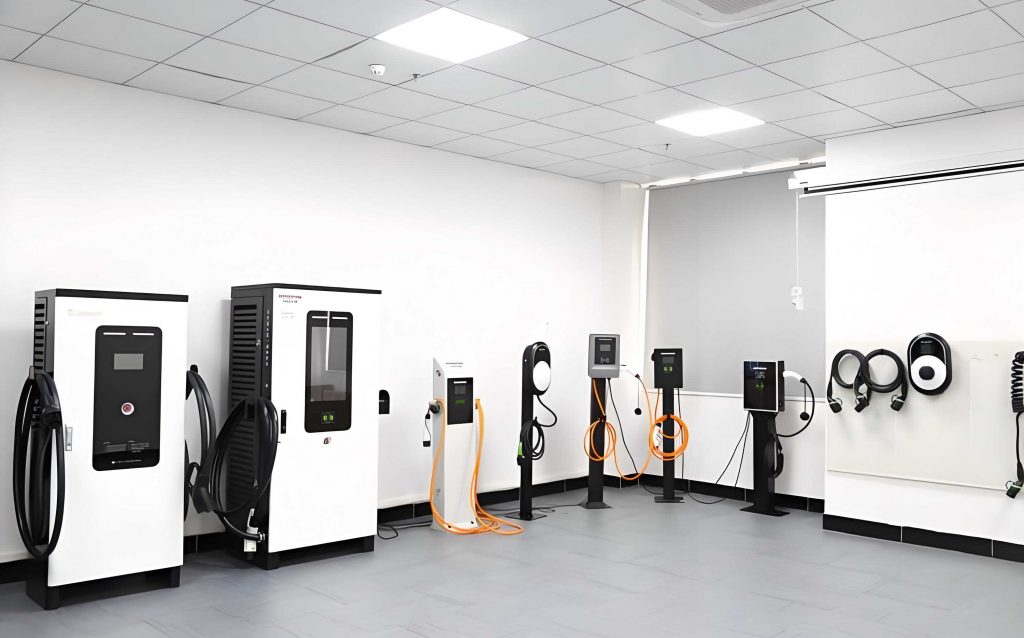
The complexity of maintaining EV charging stations arises from their diverse hardware, software, and power supply requirements. For instance, different manufacturers produce EV charging stations with varying communication protocols and technical standards, leading to interoperability issues. Traditional fault diagnosis methods, such as manual inspections, are not only inefficient but also prone to delays and inaccuracies. In contrast, IoT-based systems facilitate real-time data collection and analysis, allowing for proactive maintenance. I will delve into the specifics of data preprocessing, model construction, and feedback mechanisms that form the core of this approach. Furthermore, I address challenges like cybersecurity and standardization, proposing strategies to mitigate risks. Through this exploration, I aim to demonstrate how IoT can transform the management of EV charging stations, paving the way for smarter and more resilient infrastructure.
Current Challenges in EV Charging Station Maintenance
Maintaining EV charging stations involves a multifaceted approach that includes hardware upkeep, software updates, and power management. The diversity in EV charging station designs—ranging from AC to DC types—creates significant hurdles for unified management. For example, some EV charging stations use proprietary encryption for data transmission, while others adhere to open standards, complicating integration. This variability increases operational costs and delays fault resolution. Traditional diagnostic techniques, which rely on periodic checks and rule-based systems, often fail to address complex or novel faults. As a result, EV charging stations may experience prolonged downtime, negatively affecting user satisfaction and the overall growth of electric vehicle networks.
| Fault Type | Description | Traditional Diagnosis Issues |
|---|---|---|
| Overcurrent | Excessive current flow during charging | Relies on manual meter checks, leading to delayed detection |
| Voltage Fluctuation | Irregular voltage supply | Limited to preset thresholds, missing subtle anomalies |
| Communication Failure | Loss of data transmission between EV charging station and network | Requires physical inspection, increasing downtime |
| Temperature Overload | Overheating of internal components | Depends on periodic thermal scans, often missing real-time spikes |
To quantify the inefficiencies, consider the time required for manual fault identification in EV charging stations. If a fault occurs, it might take hours to locate and resolve, whereas IoT systems can reduce this to minutes. The limitations of traditional methods underscore the urgency for advanced diagnostics, which I will address in subsequent sections.
Advantages of IoT in Fault Diagnosis for EV Charging Stations
IoT technology offers transformative benefits for EV charging stations by enabling real-time data acquisition and intelligent analysis. Sensors embedded in EV charging stations—such as voltage, current, and temperature sensors—continuously monitor operational parameters. These devices collect data at high frequencies, transmitting it via 4G, 5G, or Wi-Fi networks to centralized platforms. For instance, a voltage sensor in an EV charging station can detect anomalies like sags or swells, while a temperature sensor identifies overheating risks. The real-time nature of this data allows for immediate fault detection, significantly reducing response times compared to traditional methods.
Moreover, IoT enhances data processing capabilities through cloud computing and big data analytics. Historical data from EV charging stations can be used to train models that predict failures before they occur. For example, by analyzing trends in current consumption, the system can forecast potential overcurrent events. This proactive approach not only improves reliability but also extends the lifespan of EV charging stations. The integration of IoT also supports scalable management, as thousands of EV charging stations can be monitored simultaneously from a single interface. In the following sections, I will detail the technical methodologies that leverage these advantages.
Methodology for Real-Time Fault Diagnosis
The proposed methodology for fault diagnosis in EV charging stations involves three key stages: data preprocessing, model construction, and result feedback. Each stage is critical for ensuring accurate and timely fault identification.
Data Preprocessing
Raw data from EV charging stations often contains noise, outliers, and inconsistencies due to environmental factors or sensor errors. Preprocessing is essential to clean and normalize this data for reliable analysis. Techniques such as filtering and smoothing are employed; for example, a moving average filter can reduce high-frequency noise. The mathematical representation of a moving average is given by:
$$ y_t = \frac{1}{n} \sum_{i=0}^{n-1} x_{t-i} $$
where \( y_t \) is the smoothed value at time \( t \), \( n \) is the window size, and \( x_{t-i} \) represents the raw data points. Additionally, min-max normalization scales data to a [0,1] range, which is crucial for model training. For an EV charging station, this ensures that parameters like voltage and current are comparable across different units. Data preprocessing not only enhances model performance but also reduces false alarms in fault detection.
| Technique | Application | Benefit |
|---|---|---|
| Moving Average Filter | Smoothing current and voltage readings | Reduces transient noise |
| Min-Max Normalization | Scaling sensor data to uniform range | Improves model convergence |
| Outlier Detection | Identifying erroneous temperature spikes | Prevents misleading diagnostics |
Fault Diagnosis Model Construction
Constructing robust fault diagnosis models for EV charging stations involves machine learning and deep learning algorithms. Support Vector Machines (SVM) are effective for classifying fault types based on historical data. The decision function for an SVM can be expressed as:
$$ f(x) = \text{sign} \left( \sum_{i=1}^n \alpha_i y_i K(x_i, x) + b \right) $$
where \( \alpha_i \) are Lagrange multipliers, \( y_i \) are class labels, \( K(x_i, x) \) is the kernel function, and \( b \) is the bias term. For EV charging stations, SVMs can distinguish between faults like communication failures and power issues. Deep learning models, such as Convolutional Neural Networks (CNNs) and Long Short-Term Memory (LSTM) networks, offer advanced capabilities. CNNs extract spatial features from data sequences, while LSTMs capture temporal dependencies in time-series data from EV charging stations. The LSTM update equations are:
$$ f_t = \sigma(W_f \cdot [h_{t-1}, x_t] + b_f) $$
$$ i_t = \sigma(W_i \cdot [h_{t-1}, x_t] + b_i) $$
$$ \tilde{C}_t = \tanh(W_C \cdot [h_{t-1}, x_t] + b_C) $$
$$ C_t = f_t \cdot C_{t-1} + i_t \cdot \tilde{C}_t $$
$$ o_t = \sigma(W_o \cdot [h_{t-1}, x_t] + b_o) $$
$$ h_t = o_t \cdot \tanh(C_t) $$
where \( f_t \), \( i_t \), and \( o_t \) are forget, input, and output gates, \( C_t \) is the cell state, and \( h_t \) is the hidden state. By training these models on diverse datasets from EV charging stations, the system learns to identify complex fault patterns, such as simultaneous failures in multiple components.
Diagnostic Results Output and Feedback
Once faults are diagnosed, the results are presented through intuitive visualizations, such as dashboards showing fault severity and location. For example, color-coded alerts can highlight critical issues in EV charging stations, enabling quick intervention. The feedback loop also includes automated actions; if an overcurrent fault is detected, the system can remotely disconnect power to prevent damage. This closed-loop mechanism minimizes human intervention and enhances the resilience of EV charging stations. By integrating diagnostic outputs with control systems, IoT ensures that faults are not only identified but also managed efficiently.
Challenges and Mitigation Strategies
Despite its benefits, implementing IoT in EV charging stations faces challenges like cybersecurity threats and device incompatibility. Cyberattacks, such as data breaches or malicious control, could disrupt operations. To counter this, encryption protocols like SSL/TLS secure data transmission between EV charging stations and management platforms. Additionally, role-based access control ensures that only authorized personnel can modify settings. For device compatibility, standardization efforts—such as adhering to IEC 61850 and GB/T 18487—promote interoperability among different EV charging station models. Developing universal middleware can translate proprietary protocols into standard formats, simplifying integration.
| Measure | Implementation | Impact |
|---|---|---|
| Encryption (e.g., AES-256) | Securing data in transit and at rest | Prevents unauthorized access |
| Multi-Factor Authentication | Requiring biometrics or codes for login | Reduces identity theft risks |
| Regular Vulnerability Scans | Automated checks for system weaknesses | Early detection of threats |
Optimization Directions for IoT-Based Diagnosis
To further enhance fault diagnosis for EV charging stations, multi-source data fusion and self-healing technologies represent promising avenues. By incorporating environmental data—such as humidity and ambient temperature—alongside operational parameters, models can better predict faults. For instance, high temperatures might correlate with increased failure rates in EV charging stations. Data fusion techniques, like Kalman filtering, combine these sources to improve accuracy. The Kalman filter equations are:
$$ \hat{x}_{k|k-1} = F_k \hat{x}_{k-1|k-1} + B_k u_k $$
$$ P_{k|k-1} = F_k P_{k-1|k-1} F_k^T + Q_k $$
where \( \hat{x} \) is the state estimate, \( P \) is the error covariance, \( F \) is the state transition matrix, and \( Q \) is the process noise covariance. This allows for dynamic weighting of sensor inputs in EV charging stations.
Moreover, advanced AI techniques like reinforcement learning can enable adaptive diagnostics. In reinforcement learning, an agent learns optimal actions through rewards; for an EV charging station, this could mean adjusting diagnostic thresholds based on real-time performance. Self-repair mechanisms, such as automatic reboots for network issues, reduce dependency on manual fixes. As IoT evolves, these optimizations will make EV charging stations more autonomous and reliable, supporting the broader adoption of electric vehicles.
Conclusion
In summary, IoT technology holds immense potential for revolutionizing real-time fault diagnosis in EV charging stations. By leveraging data preprocessing, intelligent models, and automated feedback, systems can achieve higher accuracy and efficiency in detecting and addressing faults. While challenges like security and standardization persist, proactive measures can mitigate these risks. The ongoing integration of multi-source data and self-healing capabilities will further enhance the resilience of EV charging stations. As the electric vehicle ecosystem expands, IoT-driven diagnostics will play a pivotal role in ensuring reliable and sustainable charging infrastructure, ultimately fostering a smoother transition to clean transportation.