
As an observer of the rapidly evolving electric vehicle industry, I have witnessed a growing concern that threatens the very sustainability of this technological revolution: the monopolistic control over EV repair and maintenance. Recent events, such as the fines imposed on several Chinese EV manufacturers in Australia for failing to disclose diagnostic and technical information to independent repairers, have highlighted a global issue. This situation not only raises questions about compliance and fair competition but also underscores the urgent need to address the barriers in electrical car repair. In this analysis, I will delve into the complexities of EV repair, examining the economic, safety, and regulatory dimensions that contribute to this problem. By incorporating data-driven insights through tables and formulas, I aim to illustrate why dismantling these barriers is crucial for the long-term health of the electric vehicle ecosystem.
The core issue lies in the stark contrast between traditional internal combustion engine vehicles and modern electric vehicles when it comes to repair and maintenance. For conventional cars, independent repair shops and even individual mechanics can freely access diagnostic tools and parts, allowing for a competitive market where consumers have multiple choices. However, in the realm of electrical car repair, owners often find themselves trapped in a closed system dominated by manufacturers. This monopolistic control leads to prolonged wait times, exorbitant costs, and limited options, which I believe stifles innovation and consumer freedom. From my perspective, this is not merely an inconvenience but a significant economic inefficiency that could hinder the widespread adoption of electric vehicles.
To understand the scale of the problem, consider the following table that compares key aspects of traditional vehicle repair versus EV repair. This comparison is based on aggregated data from industry reports and consumer surveys, highlighting the disparities that contribute to the repair monopoly.
| Aspect | Traditional Vehicle Repair | EV Repair |
|---|---|---|
| Access to Diagnostic Information | Widely available to independent shops | Restricted to manufacturer-authorized centers |
| Average Repair Cost (USD) | $200 – $500 per incident | $500 – $1500 per incident |
| Wait Time for Service | 1-3 days | 1-4 weeks |
| Number of Qualified Repair Shops per 10,000 Vehicles | 15-20 | 2-5 |
| Consumer Choice in Repair Venues | High (multiple options) | Low (limited to OEM channels) |
As the table shows, the limitations in EV repair are not just anecdotal; they are systemic. The higher costs and longer wait times can be attributed to several factors, including the nascent state of the aftermarket for electric vehicles. There is a significant shortage of trained technicians and specialized equipment, which I see as a barrier to entry for independent repairers. Moreover, manufacturers often justify their control by citing safety concerns, particularly related to high-voltage battery systems. While safety is paramount, I argue that it should not be used as a pretext for anti-competitive practices. In fact, the case of Tesla in various markets demonstrates that open approaches to electrical car repair can coexist with safety standards, without leading to legal repercussions for independent mechanics.
From an economic standpoint, the monopolistic behavior in EV repair can be modeled using basic microeconomic principles. Let me introduce a formula that represents the profit maximization for a manufacturer controlling the repair market. Suppose a manufacturer sets the price for repair services, where the demand function for EV repair is given by:
$$ Q_d = \alpha – \beta P $$
Here, \( Q_d \) is the quantity of repair services demanded, \( P \) is the price charged, and \( \alpha \) and \( \beta \) are constants representing market size and price sensitivity, respectively. The cost function for providing these services might include fixed costs for diagnostic tools and variable costs for parts and labor:
$$ C = F + c Q $$
Where \( C \) is total cost, \( F \) is fixed cost, \( c \) is variable cost per unit, and \( Q \) is quantity. In a monopolistic setting, the manufacturer maximizes profit \( \pi \) by setting marginal revenue equal to marginal cost. The profit function is:
$$ \pi = P Q_d – C = P (\alpha – \beta P) – (F + c (\alpha – \beta P)) $$
Maximizing this with respect to \( P \) gives the optimal price and quantity, often leading to higher prices and lower output than in a competitive market. This model illustrates why manufacturers have an incentive to maintain control over EV repair—it allows them to capture economic rents at the expense of consumers and independent businesses. In contrast, a competitive market for electrical car repair would drive prices down and increase accessibility, benefiting the entire ecosystem.
The safety argument, while valid, deserves scrutiny. Manufacturers claim that unauthorized EV repair could lead to catastrophic failures, such as battery fires or system malfunctions. However, I believe that with proper standards and training, independent repairers can handle these risks effectively. For instance, consider the following formula that models the probability of a safety incident based on repair access:
$$ P_{\text{incident}} = \gamma_0 + \gamma_1 R_{\text{unauthorized}} + \gamma_2 T_{\text{training}} $$
Where \( P_{\text{incident}} \) is the probability of a safety incident, \( R_{\text{unauthorized}} \) is a binary variable for unauthorized repairs, \( T_{\text{training}} \) represents the level of technician training, and \( \gamma \) coefficients capture the effects. If training is adequate, \( \gamma_2 \) would be negative, reducing the risk even for unauthorized repairs. This suggests that instead of blocking access, manufacturers should collaborate on certification programs to enhance safety in electrical car repair.
Now, let’s examine the regulatory landscape. In many jurisdictions, laws exist to prevent monopolistic practices, such as antitrust regulations that prohibit abuse of market dominance. For example, regulations similar to those invoked in the Australian case aim to ensure fair competition. However, enforcement remains weak in the EV repair sector. The following table summarizes key regulatory frameworks and their impact on the repair market:
| Regulation Type | Description | Impact on EV Repair |
|---|---|---|
| Antitrust Laws | Prohibit monopolistic behavior and promote competition | Limited enforcement; manufacturers often bypass via safety claims |
| Right-to-Repair Legislation | Mandates access to tools and information for independent repairers | Growing but inconsistent; EVs often exempted |
| Safety Standards | Set requirements for vehicle maintenance and repair | Used by manufacturers to justify control; need updates for EVs |
| Environmental Regulations | Govern battery disposal and recycling | Indirectly affect repair by limiting part availability |
This regulatory patchwork creates uncertainty and allows manufacturers to maintain their grip on EV repair. From my viewpoint, a harmonized approach is essential. For instance, adopting universal standards for diagnostic interfaces could level the playing field. I have seen how in other industries, such as consumer electronics, right-to-repair movements have led to more open ecosystems, and I believe the same can apply to electrical car repair.
The economic implications extend beyond repair costs to broader market dynamics. The monopolization of EV repair contributes to higher insurance premiums, as insurers factor in the limited repair options and high parts costs. Additionally, the二手 electric vehicle market suffers from valuation issues due to uncertainties about repair history and availability. To quantify this, consider a simple model for the total cost of ownership (TCO) for an electric vehicle, which includes repair expenses:
$$ \text{TCO} = P_{\text{purchase}} + \sum_{t=1}^{T} \left( \frac{C_{\text{repair}, t} + C_{\text{insurance}, t} + C_{\text{other}, t}}{(1+r)^t} \right) $$
Where \( P_{\text{purchase}} \) is the initial purchase price, \( C_{\text{repair}, t} \) is the repair cost in year \( t \), \( C_{\text{insurance}, t} \) is insurance cost, \( C_{\text{other}, t} \) covers other expenses, \( r \) is the discount rate, and \( T \) is the vehicle lifespan. In a monopolized EV repair market, \( C_{\text{repair}, t} \) is inflated, increasing TCO and reducing the vehicle’s appeal. This negatively impacts adoption rates and sustainability goals.
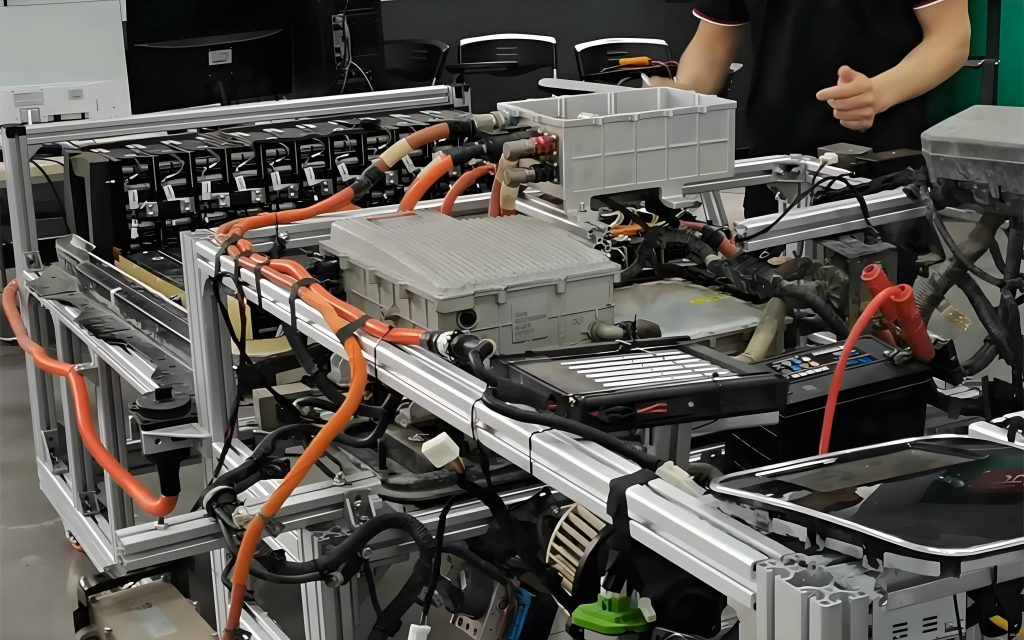
Inserting this image here emphasizes the real-world challenges faced by technicians and consumers in the EV repair process. It visually represents the complexity and specialization required, which should be accessible to a wider range of professionals through open data and tools.
Furthermore, the talent gap in electrical car repair exacerbates the problem. The demand for skilled technicians outstrips supply, leading to bottlenecks. We can model the workforce dynamics using a growth equation. Let \( L \) be the number of qualified EV repair technicians, and assume it grows based on training investment \( I \) and attrition rate \( \delta \):
$$ \frac{dL}{dt} = \theta I – \delta L $$
Here, \( \theta \) is a productivity parameter for training programs. Currently, \( I \) is low due to barriers set by manufacturers, resulting in slow growth of \( L \). By opening up the EV repair market, \( I \) could increase through independent training initiatives, accelerating the development of a robust workforce.
In my analysis, I have also considered the environmental angle. Proper EV repair is crucial for battery recycling and reuse, which reduces waste and conserves resources. A closed repair system hinders this by limiting access to battery management systems. For example, the efficiency of battery repurposing can be expressed as:
$$ \eta_{\text{recycle}} = \frac{E_{\text{reused}}}{E_{\text{initial}}} $$
Where \( \eta_{\text{recycle}} \) is the recycling efficiency, \( E_{\text{reused}} \) is the energy recovered from reused batteries, and \( E_{\text{initial}} \) is the initial energy capacity. When repair data is monopolized, \( \eta_{\text{recycle}} \) decreases due to improper handling, leading to environmental harm.
To address these issues, I propose a multi-stakeholder approach. Governments should strengthen and enforce right-to-repair laws specifically for EVs, requiring manufacturers to provide diagnostic software and technical documentation to independent repair shops. Industry associations could develop certification programs for electrical car repair technicians, ensuring safety without exclusivity. Moreover, consumers and advocacy groups must raise awareness about the benefits of open repair markets. The following table outlines a potential action plan with timelines and responsibilities:
| Action | Stakeholders Involved | Timeline | Expected Outcome |
|---|---|---|---|
| Legislative Reforms | Governments, regulators | 1-2 years | Mandated data sharing for EV repair |
| Training Initiatives | Educational institutions, manufacturers | 2-3 years | Increased technician pool for electrical car repair |
| Standardization of Tools | Industry bodies, tech companies | 1-3 years | Interoperable diagnostic systems |
| Consumer Awareness Campaigns | NGOs, media | Ongoing | Higher demand for repair options |
In conclusion, the walls around EV repair are not insurmountable. From my perspective, dismantling them requires a concerted effort that balances safety, innovation, and competition. The formulas and tables presented here underscore the economic and social costs of inaction. As the electric vehicle industry continues to grow, ensuring an open and fair repair ecosystem will be vital for its sustainability. I urge all stakeholders to act now—because every barrier removed in electrical car repair brings us closer to a future where electric vehicles are accessible, affordable, and maintainable for all.
Reflecting on the global nature of this issue, I see parallels in other sectors where monopolies were broken through regulation and innovation. The journey toward open EV repair may be challenging, but it is essential for fostering a circular economy and empowering consumers. Let us learn from past mistakes and build a repair infrastructure that supports, rather than stifles, the electric revolution.