
In recent years, the electric vehicle (EV) industry has experienced rapid growth, driven by global efforts to reduce carbon emissions and achieve sustainable transportation. A critical component of this ecosystem is the EV charging station infrastructure, which directly influences consumer adoption and operational efficiency. However, the development of EV charging stations involves complex interactions between manufacturers, particularly those with varying capabilities in battery production and charging infrastructure. We investigate the co-opetition strategies between two types of EV manufacturers: one with in-house battery production capabilities and another without, under different contractual frameworks. Specifically, we examine competitive, co-opetitive with independent pricing, and co-opetitive with negotiated pricing scenarios, focusing on how these strategies impact decisions to build extra EV charging stations. By employing Cournot competition models, Stackelberg games, and Nash bargaining, we derive equilibrium solutions and analyze the effects on pricing, profits, and infrastructure investment. Our findings highlight the role of bargaining power, product substitution, network efficiency, and cost differentials in shaping optimal strategies, offering managerial insights for industry stakeholders.
The proliferation of EV charging stations is essential for addressing range anxiety and enhancing the usability of electric vehicles. As governments and private entities invest in expanding charging networks, EV manufacturers must navigate competitive and collaborative relationships to optimize their market positions. We consider a system comprising two EV manufacturers: Manufacturer 1, which produces its own batteries, and Manufacturer 2, which relies on external suppliers. In competitive scenarios, both manufacturers operate independently, whereas in co-opetitive settings, they engage in battery supply agreements while competing in the EV market. The construction of extra EV charging stations is a strategic decision influenced by factors such as network effects, production costs, and contractual terms. Our analysis delves into how different contracts—specifically, those based on independent pricing versus negotiated pricing—affect the manufacturers’ incentives to invest in EV charging stations and their overall profitability.
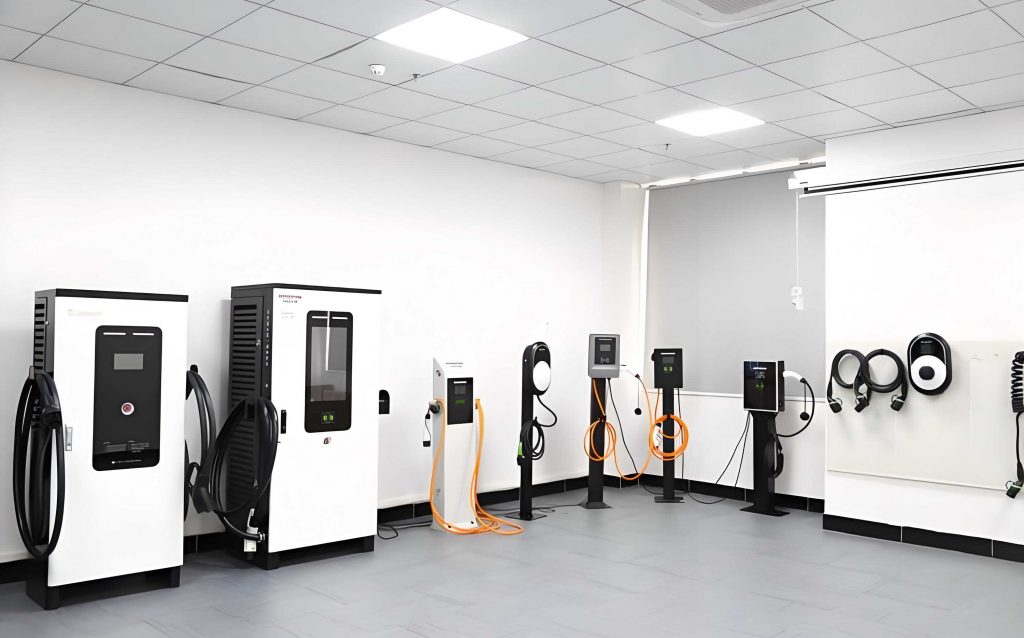
To model the interactions, we adopt a Cournot competition framework where manufacturers decide on production quantities and investments in EV charging stations. The demand function for each manufacturer is given by $$p_i = \alpha_i – q_i – \theta(q_i + q_j)$$ for \(i = 1, 2\) and \(j = 3-i\), where \(p_i\) is the price, \(q_i\) is the quantity, \(\theta\) represents the degree of substitution between EVs, and \(\alpha_i\) captures the base demand, which increases with investments in EV charging stations, i.e., \(\alpha_i = \alpha + \phi n_i\). Here, \(n_i\) denotes the number of extra EV charging stations built by manufacturer \(i\), and \(\phi\) is the network efficiency parameter. The cost of building EV charging stations is quadratic, expressed as \(\frac{\beta n_i^2}{2}\), reflecting diminishing returns to scale. The key parameters and their definitions are summarized in Table 1.
| Parameter | Definition |
|---|---|
| \(\alpha\) | Base market potential for EVs |
| \(\theta\) | Degree of substitution between EVs |
| \(c_1\) | Unit battery cost for Manufacturer 1 |
| \(c_2\) | Unit battery cost for Manufacturer 2 under competition |
| \(\Delta c\) | Cost difference, \(\Delta c = c_2 – c_1\) |
| \(m\) | Unit manufacturing cost for EVs |
| \(w\) | Wholesale price of batteries under co-opetition |
| \(q_i\) | Production quantity of manufacturer \(i\) |
| \(p_i\) | Price of EVs for manufacturer \(i\) |
| \(\delta_i\) | Net benefit parameter, \(\delta_i = \alpha – m – c_i(w)\) |
| \(\pi_i\) | Profit of manufacturer \(i\) |
| \(u\) | Bargaining power of Manufacturer 1, \(0 < u < 1\) |
| \(n_i\) | Number of extra EV charging stations built by manufacturer \(i\) |
| \(\beta\) | Cost coefficient for building EV charging stations |
| \(\phi\) | Network efficiency of EV charging stations |
| \(e\) | Efficiency parameter for EV charging station investment, \(e = \phi^2 / \beta\) |
Under the competitive strategy, both manufacturers operate independently. Manufacturer 1 produces batteries at cost \(c_1\), while Manufacturer 2 procures batteries at cost \(c_2\) from external suppliers. Their profit functions are:
$$\pi_1^n(q_1, n_1) = q_1 [\alpha + n_1 \phi – q_1 – \theta(q_1 + q_2) – m – c_1] – \frac{\beta n_1^2}{2}$$
$$\pi_2^n(q_2, n_2) = q_2 [\alpha + n_2 \phi – q_2 – \theta(q_1 + q_2) – m – c_2] – \frac{\beta n_2^2}{2}$$
Solving the Cournot equilibrium, we derive the optimal quantities, prices, and investments in EV charging stations. The results indicate that the cost difference \(\Delta c\) and substitution degree \(\theta\) significantly influence outcomes. For instance, a higher \(\Delta c\) reduces Manufacturer 2’s competitiveness, leading to lower quantities and profits. Moreover, investments in EV charging stations enhance demand but incur quadratic costs, balancing the network benefits against expenses.
In the co-opetition strategy with independent pricing, Manufacturer 1 supplies batteries to Manufacturer 2 at a wholesale price \(w^s\) determined unilaterally. This scenario follows a Stackelberg game, where Manufacturer 1 acts as the leader, setting \(w^s\), and Manufacturer 2 responds by choosing its quantity and EV charging station investment. The profit functions are:
$$\pi_1^s(q_1, n_1, w^s) = q_1 [\alpha + n_1 \phi – q_1 – \theta(q_1 + q_2) – m – c_1] – \frac{\beta n_1^2}{2} + q_2 (w^s – c_1)$$
$$\pi_2^s(q_2, n_2) = q_2 [\alpha + n_2 \phi – q_2 – \theta(q_1 + q_2) – m – w^s] – \frac{\beta n_2^2}{2}$$
The equilibrium analysis reveals that Manufacturer 1 sets \(w^s\) above its cost \(c_1\) but below \(c_2\) to capture additional profit while ensuring Manufacturer 2’s participation. The strategic interaction affects investments in EV charging stations; for example, when \(\Delta c\) is small, co-opetition leads to higher prices and reduced investments in EV charging stations by Manufacturer 2, whereas larger \(\Delta c\) results in lower prices and increased investments.
Under the co-opetition strategy with negotiated pricing, the wholesale price \(w^c\) is determined through Nash bargaining between the two manufacturers. This approach incorporates bargaining power \(u\) for Manufacturer 1 and \(1-u\) for Manufacturer 2. The Nash product is:
$$\max_{w^c} \rho(w^c) = [\pi_1^c(w^c)]^u [\pi_2^c(w^c)]^{1-u}$$
where the profit functions are similar to the independent pricing case but with \(w^c\) as the bargaining outcome. The solution involves solving a sequential game where manufacturers first bargain over \(w^c\) and then compete in quantities and EV charging station investments. The negotiated wholesale price \(w^c\) is lower than \(w^s\), reflecting the compromise between parties. This leads to different incentives for building EV charging stations; specifically, Manufacturer 2 increases its investment due to lower battery costs, while Manufacturer 1 may reduce its investment to mitigate competitive pressure.
We now present the equilibrium solutions for all three strategies in Table 2, which summarizes the optimal values for quantities, prices, EV charging station investments, wholesale prices, and profits. These results are derived through backward induction and optimization techniques, ensuring internal consistency across scenarios.
| Variable | Competition (\(k = n\)) | Co-opetition with Independent Pricing (\(k = s\)) | Co-opetition with Negotiated Pricing (\(k = c\)) |
|---|---|---|---|
| \(q_1^*\) | \(\frac{(\theta + 2 – e)\delta_1 + \theta \Delta c}{(\theta + 2 – e)(3\theta + 2 – e)}\) | \(\frac{(\theta + 4 – 2e)(3\theta + 2 – e)\delta_1}{(2\theta + 2 – e)(\theta^2 + 2\lambda_1)}\) | \(\frac{\{ \theta[(2-e)u – T] + 2[\theta + 2(2-e)](3\theta + 2-e) \}\delta_1}{2(2\lambda_1 + \theta^2)(2\theta + 2 – e)}\) |
| \(p_1^*\) | \((\theta – e + 1)q_1^{n*} + m + c_1\) | \((\theta – e + 1)q_1^{s*} + m + c_1\) | \((\theta – e + 1)q_1^{c*} + m + c_1\) |
| \(q_2^*\) | \(\frac{(\theta + 2 – e)\delta_2 – \theta \Delta c}{(\theta + 2 – e)(3\theta + 2 – e)}\) | \(\frac{(2 – e)\delta_1}{\theta^2 + 2\lambda_1}\) | \(\frac{[T + (2 – u)(2 – e)]\delta_1}{2(2\lambda_1 + \theta^2)}\) |
| \(p_2^*\) | \((\theta – e + 1)q_2^{n*} + m + c_2\) | \(\frac{\{\lambda_1 – [\theta(4 – e) + 2 – e]\}q_2^{s*}}{(2\theta + 2 – e)\beta} + m + w^{s*}\) | \(\frac{[\lambda_1 – \theta(2 – e)]q_2^{c*}}{2\theta + 2 – e} + m + w^{c*}\) |
| \(n_1^*\) | \(\frac{e[(\theta + 2 – e)\delta_1 + \theta \Delta c]}{\phi(\theta + 2 – e)(3\theta + 2 – e)}\) | \(\frac{e(\theta + 4 – 2e)(3\theta + 2 – e)\delta_1}{\phi(2\theta + 2 – e)(\theta^2 + 2\lambda_1)}\) | \(\frac{\{ \theta[(2-e)u – T] + 2[\theta + 2(2-e)](3\theta + 2-e) \}e\delta_1}{2(2\lambda_1 + \theta^2)(2\theta + 2 – e)\phi}\) |
| \(n_2^*\) | \(\frac{e[(\theta + 2 – e)\delta_2 – \theta \Delta c]}{\phi(\theta + 2 – e)(3\theta + 2 – e)}\) | \(\frac{(2 – e)e\delta_1}{\phi(\theta^2 + 2\lambda_1)}\) | \(\frac{[T + (2 – u)(2 – e)]\delta_1}{2(2\lambda_1 + \theta^2)\phi}\) |
| \(w^*\) | \(-\) | \(\frac{[3\theta^3 + (2 – e)(3\theta + 2 – e)^2]\delta_1}{(2\theta + 2 – e)(\theta^2 + 2\lambda_1)} + c_1\) | \(\frac{\{(2 – e)(\lambda_1 + \theta^2)(u – 2) + 2(\theta + 2 – e)(2\lambda_1 + \theta^2) + [\lambda_1 – \theta(2 – e)]T\}}{2(2\theta + 2 – e)(2\lambda_1 + \theta^2)} + c_1\) |
| \(\pi_1^*\) | \((\theta – e^2 + 1)(q_1^{n*})^2\) | \(\frac{\delta_1^2[3\lambda_1 – 4\theta(2 – e)]}{2(2\theta + 2 – e)(\theta^2 + 2\lambda_1)}\) | \(\frac{\delta_E^2 \{ 4[3\lambda_1 – 4\theta(2 – e)] + 2(2 – e)uT – u^2(2 – e)^2 – T^2 \}}{8(2\theta + 2 – e)(2\lambda_1 + \theta^2)}\) |
| \(\pi_2^*\) | \((\theta – e^2 + 1)(q_2^{n*})^2\) | \(\frac{\delta_1^2(2 – e)^2(\theta^2 + \lambda_1)}{2(\theta^2 + 2\lambda_1)^2(2\theta + 2 – e)}\) | \(\frac{\delta_E^2 (\lambda_1 + \theta^2)[T + (2 – u)(2 – e)]^2}{8(2\lambda_1 + \theta^2)^2(2\theta + 2 – e)}\) |
| \(\pi^*\) | \((\theta – e^2 + 1)[(q_1^{n*})^2 + (q_2^{n*})^2]\) | \(\frac{\delta_1^2 \{ 3\theta^2[27\lambda_1 – 4\theta(6\theta + 46 – 23e)] + (2 – e)^3(44\theta + 14 – 7e) \}}{2(\theta^2 + 2\lambda_1)^2(2\theta + 2 – e)}\) | \(\frac{\delta_1^2}{8(2\theta + 2 – e)(\theta^2 + 2\lambda_1)^2} \{ 2(2 – e)[\lambda_1 T – 2(2 – e)(\theta^2 + \lambda_1)] u – (2 – e)^2 \lambda_1 u^2 – T^2 \lambda_1 + 4(2 – e)(\theta^2 + \lambda_1) T + 4(2 – e)^3(44\theta + 14 – 7e) + 12\theta^2[27\lambda_1 – 4\theta(6\theta + 46 – 23e)] \}\) |
Note: In the table, \(\lambda_1 = \theta^2 + (2 – e)(4\theta + 2 – e)\), \(T = \sqrt{(2 – e)^2 u^2 + 4[3\lambda_1 – 4\theta(2 – e)](1 – u)}\), and \(\delta_E\) is a derived parameter for negotiated pricing.
Our analysis yields several key propositions. First, in competitive scenarios, higher substitution degrees \(\theta\) reduce profits for both manufacturers, as intensified competition erodes margins. Conversely, increased efficiency in EV charging station investment \(e\) boosts profits by enhancing demand through network effects. This underscores the importance of investing in EV charging stations to leverage positive externalities.
Second, under co-opetition with independent pricing, the strategic setting of the wholesale price \(w^s\) by Manufacturer 1 can lead to Pareto improvements when the cost difference \(\Delta c\) is sufficiently large. Specifically, for \(\Delta_c^S < \Delta c < \Delta_c^H\), both manufacturers achieve higher profits compared to competition, and consumer prices decrease due to reduced double marginalization. However, investments in EV charging stations exhibit contrasting patterns: Manufacturer 1 reduces its investment, while Manufacturer 2 increases it, reflecting the shift in competitive dynamics.
Third, in co-opetition with negotiated pricing, the bargaining power \(u\) plays a crucial role. When Manufacturer 1 has high bargaining power (\(u > u_e\)), the wholesale price \(w^c\) is set higher, leading to increased EV prices and reduced investments in EV charging stations by Manufacturer 2. Conversely, when bargaining power is balanced (\(u_c < u < u_e\)), negotiated pricing results in lower wholesale prices, which stimulate demand and encourage greater investments in EV charging stations. This strategy can achieve Pareto improvements under specific conditions, such as when \(\Delta_c^D < \Delta c < \Delta_c^H\) and \(u_f < u < \min(u_g, 1)\), benefiting both manufacturers and consumers through lower prices and enhanced infrastructure.
Comparing the two co-opetition strategies, we find that negotiated pricing generally leads to lower wholesale prices and EV prices than independent pricing, i.e., \(w^{c*} < w^{s*}\) and \(p_i^{c*} < p_i^{s*}\). This is because bargaining internalizes the joint profit maximization, reducing inefficiencies. Additionally, investments in EV charging stations differ: Manufacturer 1 invests less under negotiated pricing (\(n_1^{c*} < n_1^{s*}\)), while Manufacturer 2 invests more (\(n_2^{c*} > n_2^{s*}\)), due to the more favorable terms. From a profit perspective, Manufacturer 1 earns less under negotiated pricing (\(\pi_1^{c*} < \pi_1^{s*}\)), whereas Manufacturer 2 earns more (\(\pi_2^{c*} > \pi_2^{s*}\)), highlighting the trade-offs between individual and collective gains.
The optimal strategy selection depends on the interplay of bargaining power, cost differences, substitution degree, and EV charging station efficiency. We formalize this in Proposition 7: if \(0 < \Delta c < \Delta_c^S\) and \(0 < u < \max(u_q, u_c)\), competition is optimal; if \(\Delta_c^S < \Delta c < \Delta_c^H\) and \(0 < u < \max(u_j, u_c)\), co-opetition with independent pricing is preferred; otherwise, co-opetition with negotiated pricing is the best choice. This framework assists managers in tailoring their strategies based on market conditions and internal capabilities.
To illustrate, consider the impact of the substitution degree \(\theta\) on strategy selection. When \(\Delta c = 1\) (small cost difference), co-opetition with negotiated pricing dominates for most bargaining power levels, as it mitigates competitive pressures and promotes infrastructure development. As \(\theta\) increases, the region for negotiated pricing expands, emphasizing its robustness in highly substitutable markets. Similarly, for larger cost differences (\(\Delta c = 3\)), co-opetition with independent pricing becomes more attractive, especially when Manufacturer 1 has strong bargaining power, as it allows for greater profit extraction without sacrificing collaboration.
The efficiency of EV charging station investments \(e\) also influences strategy choice. Higher efficiency (e.g., \(e > 0.5\)) amplifies the benefits of co-opetition, particularly under negotiated pricing, by enhancing demand synergies. For instance, when \(\Delta c = 1\), increased \(e\) shifts the optimal strategy toward negotiated pricing, as the network effects from EV charging stations create shared value. Conversely, when \(\Delta c = 3\), higher \(e\) reinforces the advantage of independent pricing for Manufacturer 1, enabling it to leverage its cost advantage while controlling the wholesale price.
In practice, the deployment of EV charging stations is not only a strategic decision but also a response to regulatory policies and consumer preferences. Governments often incentivize the construction of EV charging stations through subsidies or mandates, which can alter the cost-benefit analysis. For example, if public funding reduces the effective \(\beta\), manufacturers might over-invest in EV charging stations, leading to suboptimal outcomes. Our model can be extended to incorporate such externalities, providing a foundation for policy analysis.
Furthermore, the dynamic nature of the EV market necessitates adaptive strategies. As technology evolves, the cost of batteries and EV charging stations may decrease, shifting the equilibrium. Manufacturers must continuously reassess their co-opetition agreements to maintain competitiveness. For instance, if Manufacturer 2 develops in-house battery capabilities, the basis for collaboration changes, potentially reverting to pure competition. Thus, long-term contracts should include flexibility clauses to accommodate such shifts.
In conclusion, our study demonstrates that co-opetition strategies, particularly those involving negotiated pricing, can enhance overall welfare by aligning incentives and promoting investments in EV charging stations. The key insights are: (1) bargaining power and cost differentials are critical determinants of optimal strategy; (2) co-opetition often leads to lower consumer prices and higher total profits compared to competition; (3) investments in EV charging stations are influenced by the contractual framework, with negotiated pricing encouraging greater participation from the battery-dependent manufacturer. For industry practitioners, these findings underscore the importance of collaborative approaches in scaling EV infrastructure. Future research could explore multi-period models, stochastic demand, or the role of digital platforms in facilitating co-opetition. Ultimately, the widespread adoption of electric vehicles hinges on a robust network of EV charging stations, and strategic partnerships among manufacturers can accelerate this transition.