
The evolution of the automotive industry is inextricably linked to the imperative of enhancing efficiency and reducing emissions. In this landscape, the hybrid car has emerged not merely as a transitional technology but as a sophisticated platform that synergistically combines the strengths of internal combustion engines and electric propulsion. My research and development focus centers on a critical component that dictates the performance of this synergy: the hybrid-dedicated transmission (DHT). The core challenge lies in formulating an intelligent shift strategy that can seamlessly orchestrate the complex interplay between multiple power sources and gear ratios. This strategy is paramount for unlocking the full potential of a hybrid car, ensuring that it delivers superior fuel economy, responsive power, and imperceptible drivability across all operating conditions. The formulation of such a strategy requires a deep, first-principles understanding of system efficiency maps, multi-parameter shift line modeling, and the dynamic arbitration between conflicting performance objectives.
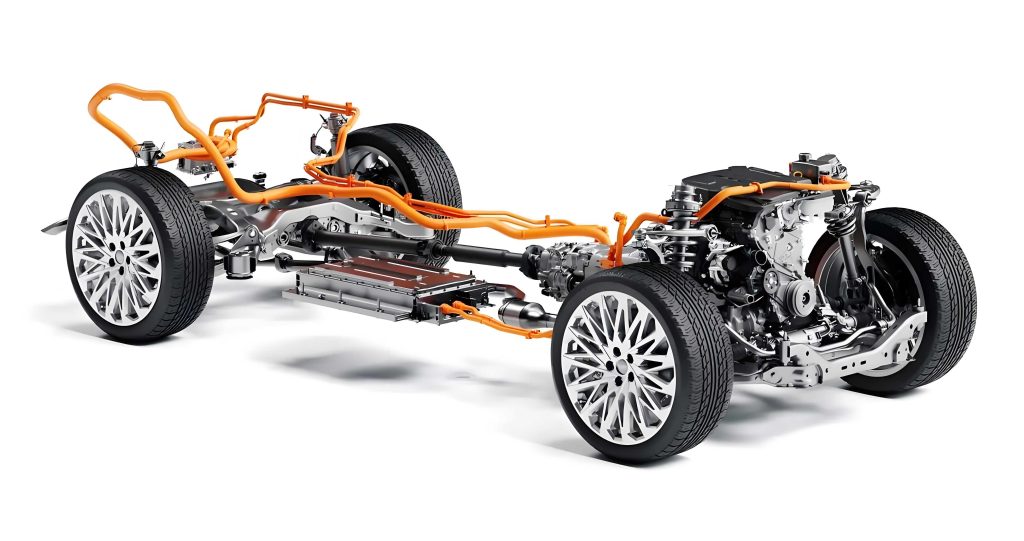
The modern hybrid car is a system of remarkable complexity, and its transmission is the central nervous system for power management. Unlike conventional automatic transmissions, a DHT must manage not just gear changes but also modal transitions between pure electric drive, series (range-extender) mode, parallel mode, and engine direct drive. The shift strategy, therefore, extends beyond simple throttle-speed maps; it becomes a multi-dimensional optimization problem. My work involves developing these strategies through rigorous modeling and simulation, with the goal of creating a controller that makes real-time decisions to keep the powertrain operating in its most efficient or most powerful state, as demanded by the driver and the situation. The performance of every hybrid car is profoundly dependent on the intelligence embedded within this shift logic.
The Trajectory of Hybrid-Dedicated Transmission Technology
The development of DHTs has followed a clear path toward greater integration, more gear ratios, and enhanced control sophistication. This evolution is driven by the need to expand the efficient operating range of both the engine and the electric motor(s) in a hybrid car.
1. Multi-Speed Architectures as the Dominant Trend: Early hybrid systems often employed single-speed transmissions or power-split devices (e.g., Toyota’s HSD, early versions of BYD’s DM-i). While elegant and smooth, they faced limitations in high-speed efficiency and peak power delivery for aggressive acceleration. The industry has decisively moved towards multi-speed DHTs. A two-speed design allows for one ratio optimized for low-speed launch and city driving, and a second, taller ratio for high-speed cruising, reducing engine RPM and fuel consumption. The three-speed DHT, the focus of my modeling work, offers a further refinement. It provides an even wider ratio spread, enabling more precise placement of the engine operating point into its highest efficiency region across a broader speed range and improving electric motor efficiency by preventing it from running at excessively high or low RPMs under high load. This is crucial for the overall energy efficiency of the hybrid car.
| Dimension | Single-Speed DHT (e.g., Basic e-CVT) | Two-Speed DHT | Three-Speed DHT (with Planetary Gearset) |
|---|---|---|---|
| Structural Complexity | Minimal | Moderate | High |
| Low-Speed Smoothness & EV Performance | Excellent | Very Good | Good |
| High-Speed Power & Responsiveness | Limited | Good | Excellent |
| High-Speed Fuel Economy | Lower | Good | Excellent |
| Full-Scenario Adaptability | Urban-Optimized | Balanced for Mixed Use | Best for Full-Speed-Range Demands |
2. Deep Integration and Intelligent Control: Modern DHTs are highly integrated units, often combining one or two electric motors, clutches or synchronizers, gear sets, and the control unit into a compact package. This integration is enabled by and necessitates advanced control software. The shift strategy in a contemporary hybrid car is no longer a static set of maps; it is a dynamic algorithm that processes inputs from over twenty vehicle parameters—including battery state of charge, driver demand, navigation data, and road gradient—to select the optimal gear and operating mode from a palette of possibilities (often 9 or more). The goal is to make the mode and gear transitions so smooth that they are virtually imperceptible, delivering a driving experience akin to a pure electric vehicle, even during complex power-split or parallel mode engagements.
3. Expansion and Future Directions: The technology is rapidly expanding from passenger vehicles into commercial applications like hybrid trucks and buses, where the fuel savings are even more significant. Future trends point toward cloud-connected control systems, where shift strategies can be optimized in real-time based on fleet learning and predictive route data. Furthermore, integration with other vehicle domains (chassis, thermal management) will enable even more refined control, such as momentarily adjusting active suspension damping during a shift event to cancel out driveline disturbance.
Foundational Data: Efficiency Maps as the Decision-Making Core
The cornerstone of any intelligent shift strategy for a hybrid car is a precise mathematical representation of the efficiency characteristics of its prime movers: the electric motor(s) and the internal combustion engine. These are visualized through efficiency maps, which serve as the fundamental look-up tables for the control system.
1. The Electric Motor Efficiency Map: For the electric drive system, the efficiency $\eta_{em}$ is defined as the ratio of mechanical output power to electrical input power. The output power is calculated from torque $T_{em}$ and speed $N_{em}$:
$$ P_{out} = \frac{T_{em} \cdot N_{em}}{9550} $$
where $P_{out}$ is in kilowatts (kW), $T_{em}$ is in Newton-meters (Nm), and $N_{em}$ is in revolutions per minute (RPM). The efficiency is then:
$$ \eta_{em} = \frac{P_{out}}{P_{in}} \times 100\% = \frac{T_{em} \cdot N_{em}}{9550 \cdot P_{in}} \times 100\% $$
with $P_{in} = V \cdot I$ being the DC bus input power. Through dynamometer testing across a matrix of torque-speed points, a three-dimensional map is constructed. The resulting contour plot reveals “islands” of high efficiency, typically in the mid-speed and mid-torque range. The control strategy for a hybrid car, particularly in EV and series modes, aims to keep the motor operating within this high-efficiency region as much as possible. Shifting gears in the transmission is a primary tool to achieve this, as it allows the motor to avoid low-efficiency zones at very high or low RPM for a given vehicle speed and power demand.
2. The Engine Brake Specific Fuel Consumption (BSFC) Map: For the internal combustion engine, the key metric is the Brake Specific Fuel Consumption, which represents the fuel efficiency of the engine itself in converting chemical energy into mechanical work. It is calculated as:
$$ BSFC = \frac{\dot{m}_f \times 3600}{P_e} $$
where $BSFC$ is in grams per kilowatt-hour (g/kWh), $\dot{m}_f$ is the fuel mass flow rate in grams per second (g/s), and $P_e$ is the engine’s effective power output in kilowatts (kW). The engine’s effective power is also derived from torque and speed:
$$ P_e = \frac{T_{ice} \cdot N_{ice}}{9550} $$
The BSFC map, or “fuel consumption hill,” is generated by testing the engine at a grid of steady-state speed and load points. The resulting contour lines connect points of equal BSFC. The map clearly shows a “sweet spot” or a valley of minimum fuel consumption. The overarching goal of the hybrid car’s energy management strategy is to orchestrate the system so that when the engine is required to operate, it does so within or as close as possible to this optimal BSFC region. The multi-speed transmission is critical here, as changing gears allows the engine to maintain a desired vehicle speed while operating at a more favorable speed-torque combination, thereby reducing fuel consumption.
Modeling Shift Lines: A Three-Parameter Optimization Framework
Traditional two-parameter shift schedules (based only on throttle pedal position and vehicle speed) are insufficient for the nuanced control required in a modern hybrid car. My approach involves developing three-parameter shift maps, where the third axis (Z-axis) represents the key optimization objective—either efficiency/metric for economy or acceleration/performance for power. The intersection of these 3D surfaces for adjacent gears defines the optimal shift point for that specific objective.
1. Shift Strategy for Electric-Dominant Modes (EV & Series): In modes where the electric motor is the primary or sole source of wheel torque, the shift logic focuses on motor efficiency and vehicle response.
- Economic Shift Line (Motor-Efficiency Optimal): A 3D map is created with axes for throttle position (X), vehicle speed (Y), and motor system efficiency (Z). For each gear (e.g., 1st, 2nd, 3rd), a surface plots the achievable efficiency for every throttle-speed combination. The line where the efficiency surfaces of two adjacent gears intersect represents the set of points where shifting up or down results in no net change in efficiency—shifting at this line keeps the motor in its highest possible efficiency band. Projecting this 3D intersection line onto the 2D throttle-speed plane yields the economic shift schedule for the hybrid car in electric mode.
- Dynamic Shift Line (Acceleration Optimal): Here, the Z-axis represents vehicle longitudinal acceleration capability. For each gear, a surface maps the available acceleration at different throttle and speed points. The intersection line of these surfaces defines the shift points that maximize acceleration performance (e.g., the ideal upshift point for maximum 0-100 km/h time). Its 2D projection is the power-oriented shift schedule.
- Synthesis into an Intelligent Shift Line: A pure economic line may feel sluggish at higher throttle demands, while a pure dynamic line may waste energy during gentle driving. The intelligent strategy dynamically blends these lines. At low throttle openings (e.g., <30%), it closely follows the economic line to maximize the range of the hybrid car in EV mode. As throttle demand increases, it progressively biases toward the dynamic line, ensuring the hybrid car delivers the expected powertrain response. This creates a single, adaptive schedule that balances efficiency and performance based on real-time driver intent.
2. Shift Strategy for Engine-Dominant Modes (Parallel & Direct Drive): When the internal combustion engine is directly connected to the wheels, the shift logic optimization target shifts to engine fuel consumption.
- Economic Shift Line (Engine BSFC Optimal): The three parameters are throttle, vehicle speed, and instantaneous fuel consumption rate (or a related metric like effective engine efficiency). The 3D surfaces for each gear represent the fuel consumption “landscape.” The intersection line of these landscapes indicates the shift points that minimize total fuel usage for a given driving trajectory. This is the fundamental economic shift schedule for hybrid car operation in engine modes.
- Dynamic Shift Line (Acceleration Optimal): This is constructed identically to the motor dynamic line but considers the combined torque of the engine and motor (in parallel mode) or engine alone (in direct drive). The intersection line defines the performance-optimal shift points.
- Synthesis into an Intelligent Hybrid Shift Line: The same principle of dynamic blending applies. Under light loads and steady cruising, the strategy adheres to the BSFC-optimal line to minimize the fuel consumption of the hybrid car. During overtaking or aggressive acceleration, the strategy temporarily prioritizes the acceleration-optimal line to deliver immediate power. The transition between these schedules is managed smoothly by the controller to avoid harsh or unexpected shift behavior.
The mathematical formulation for determining a shift point on an intersection line can be generalized. For two adjacent gears $i$ and $i+1$, let $O_i(T, V)$ and $O_{i+1}(T, V)$ be the objective functions (efficiency, acceleration, etc.) for gear $i$ and $i+1$ as functions of throttle $T$ and speed $V$. The set of potential shift points $(T_s, V_s)$ for an upshift is defined by:
$$ O_i(T_s, V_s) = O_{i+1}(T_s, V_s) $$
Solving this equation for $V_s$ across the domain of $T$ generates the raw shift line. Hysteresis bands are then applied to prevent shift cycling.
Implementation and System Integration
The final intelligent shift strategy for the hybrid car is a multi-layered software module within the Transmission Control Unit (TCU) or the overarching Hybrid Control Unit (HCU). It integrates several key functions:
- Mode Management: It receives input from the vehicle’s mode selector and the hybrid strategy controller to determine if the vehicle should be in EV, series, parallel, or engine drive mode.
- Shift Map Selection: Based on the active mode, it selects the corresponding pre-calculated and calibrated intelligent shift map (e.g., the blended EV map or the blended engine map).
- Real-Time Arbitration: It continuously monitors driver input (throttle pedal rate, current pedal position), vehicle state (speed, acceleration, battery SOC), and route data if available. It can apply dynamic offsets to the base shift maps. For example, if a rapid pedal depression is detected (“kick-down”), it will instantly command a downshift based on the dynamic shift line, regardless of the current economic schedule.
- Torque Coordination: During the shift event itself, the strategy coordinates with the engine and motor controllers to precisely manage torque hand-off—reducing drive source torque, engaging/disengaging clutches or synchronizers at the right moment, and reapplying torque smoothly. This coordination is vital for achieving the “imperceptible shift” quality expected in a premium hybrid car.
In conclusion, the development of an intelligent shift strategy for a hybrid-dedicated transmission is a complex, multi-disciplinary optimization task. It moves far beyond simple gear changes to become the central intelligence for managing the hybrid car’s multi-source energy flows. By rigorously modeling the efficiency characteristics of all prime movers, constructing three-parameter optimization maps for different driving objectives, and synthesizing them into adaptive, context-aware shift schedules, we can create systems that deliver uncompromising efficiency without sacrificing the dynamic response and smoothness that defines the modern driving experience. The continuous refinement of these strategies, potentially augmented by connectivity and cross-domain vehicle integration, will remain a key frontier in maximizing the performance and appeal of the hybrid car for years to come.