
In recent years, the rapid growth of the electric vehicle industry has underscored the critical need for advanced EV charging station infrastructure. As a researcher and educator in this field, I have observed a significant shortage of skilled professionals capable of designing, maintaining, and innovating EV charging station systems. To address this gap, I propose an interactive online teaching model specifically tailored for EV charging station education. This model integrates pre-class preparation, in-class interactions, and post-class practical activities to enhance students’ autonomous learning, teamwork, and hands-on skills. By leveraging big data analytics and artificial intelligence, the model personalizes learning experiences and provides real-time feedback, ultimately improving educational outcomes. The teaching evaluation combines formative and summative assessments to comprehensively measure student progress. Through practical application, this approach has demonstrated increased student engagement, interest, and academic performance, offering a valuable framework for online courses in EV charging station technology and supporting the broader electric vehicle industry’s talent development.
The design of this interactive teaching model for EV charging station courses begins with clear educational objectives. These objectives are categorized into knowledge, skills, quality, and ideological goals, ensuring a holistic development approach. For knowledge goals, students are expected to master the fundamental principles of EV charging station operation, including electrical structures and control systems. Key topics include the working mechanisms of EV charging station components, such as converters and communication modules, and an understanding of advanced technologies like wireless charging and vehicle-to-grid integration. In terms of skills, the model emphasizes problem-solving abilities, enabling students to simulate charging processes using software tools, diagnose faults in EV charging station systems, and design basic experimental setups. Quality goals focus on fostering teamwork, communication, and innovation through group projects and discussions, while ideological goals aim to instill a sense of social responsibility and national pride in contributing to sustainable energy solutions.
The curriculum content is structured around four core areas: principles and structure of EV charging station systems, charging control strategies, fault diagnosis and maintenance, and emerging trends and innovations. For instance, the principles section covers the electrical architecture of EV charging station units, using real-world examples to illustrate design concepts. Charging control strategies delve into algorithms like PID control, which optimizes charging efficiency and battery health. The fault diagnosis module teaches students to identify common issues in EV charging station operations, such as connectivity problems or power fluctuations, and implement effective solutions. Finally, the trends section explores cutting-edge developments, including the integration of IoT and AI in EV charging station networks, preparing students for future industry advancements.
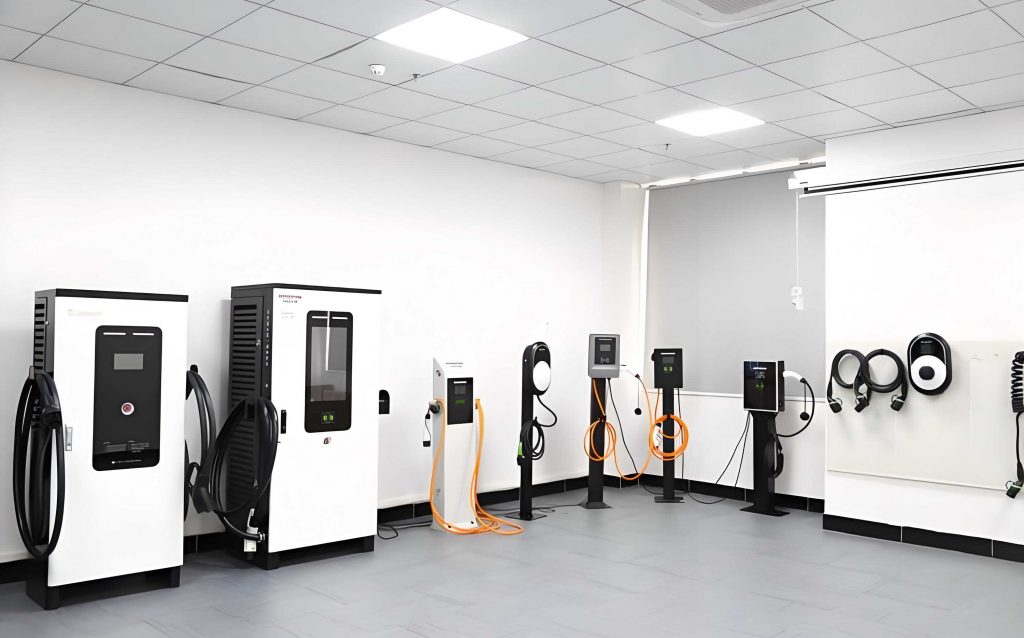
To facilitate effective learning, the teaching methodology incorporates case studies, task-oriented approaches, and a blend of online and offline activities. Case studies involve analyzing real-world scenarios, such as the performance of EV charging station systems under extreme weather conditions, to help students apply theoretical knowledge. Task-oriented learning assigns practical projects, like designing a mock EV charging station network, which encourages active inquiry and problem-solving. The online-offline combination utilizes resources such as MOOCs and virtual labs for flexible learning, complemented by hands-on sessions in laboratories or field visits to EV charging station installations. This multifaceted approach ensures that students gain both theoretical understanding and practical experience with EV charging station technology.
The implementation of this model relies on a robust online platform enhanced with big data and AI technologies. Big data analytics processes student data—including login frequency, interaction records, and assessment scores—to identify learning patterns and tailor instructional strategies. For example, by analyzing预习 test results, the system can pinpoint knowledge gaps and adjust lesson plans accordingly. AI-assisted teaching provides intelligent resource recommendations, automated Q&A support, and personalized tutoring based on individual student profiles. These technologies create a dynamic learning environment where EV charging station course content is continuously optimized for student needs.
The teaching process is divided into three phases: pre-class, in-class, and post-class. In the pre-class phase, students access customized materials, such as videos and readings on EV charging station fundamentals, and complete preliminary tests to gauge their understanding. AI tools offer suggestions for further study based on their performance. During in-class sessions, live interactions via video conferencing allow for real-time discussions and Q&A, with AI monitoring participation levels to ensure engagement. For instance, smart Q&A systems can instantly address queries about EV charging station control algorithms. In the post-class phase, students engage in group projects, such as developing a maintenance plan for an EV charging station, and receive personalized feedback from AI systems to refine their skills.
Evaluation in this model uses a combination of process-oriented and summative assessments. Process-oriented evaluation accounts for activities like online interactions, homework completion, group discussions, and practical tasks, with weights assigned to each component. The overall score is calculated using the formula: $$ S_p = \sum_{i=1}^{n} w_i \cdot s_i $$ where \( S_p \) is the process score, \( w_i \) is the weight for the \( i \)-th activity, and \( s_i \) is the score achieved. The weight distribution is summarized in the table below:
| Evaluation Item | Weight |
|---|---|
| Interaction Records | 0.20 |
| Homework Completion | 0.30 |
| Group Discussion | 0.25 |
| Post-class Practice | 0.25 |
Summative evaluation is based on final exams or major projects, assessing comprehensive application skills. The exam score is calculated as: $$ S_s = \frac{r}{R} \times 100\% $$ where \( r \) is the actual score and \( R \) is the maximum possible score. This dual evaluation approach ensures a balanced assessment of both continuous progress and final competency in EV charging station topics.
In a practical case study, the interactive model was applied to a 9-week online course titled “EV Charging Station System Principles and Applications,” delivered via an e-learning platform with 120 students. The course structure included weekly sessions covering EV charging station design, operation, and innovation. During the pre-class phase, students reviewed materials on EV charging station components and took quizzes to test their knowledge. In-class activities involved live demonstrations of EV charging station simulations and interactive debates on ethical considerations in charging infrastructure deployment. Post-class, students collaborated on projects such as designing an optimized EV charging station layout for urban areas, submitting detailed reports for evaluation.
The application results showed significant improvements in student engagement and performance. Data analytics revealed a 25% increase in platform logins and interaction frequency compared to traditional courses. Academic scores also improved, with the average exam score rising from 65 to 75 points. The score distribution before and after implementation is illustrated in the table below:
| Score Range | Pre-implementation (%) | Post-implementation (%) |
|---|---|---|
| 90-100 | 10 | 20 |
| 80-89 | 25 | 35 |
| 70-79 | 30 | 25 |
| 60-69 | 20 | 15 |
| < 60 | 15 | 5 |
A satisfaction survey indicated that 40% of students were “very satisfied” with the interactive approach, citing increased motivation and deeper understanding of EV charging station concepts. The teaching effectiveness improvement index was calculated as: $$ I_{TE} = \frac{\bar{S}_{post} – \bar{S}_{pre}}{\bar{S}_{pre}} \times 100\% = \frac{75 – 65}{65} \times 100\% \approx 15.38\% $$ where \( \bar{S}_{post} \) and \( \bar{S}_{pre} \) are the average scores after and before implementation, respectively. This quantifies the model’s positive impact on learning outcomes.
The integration of big data and AI technologies further enhanced the learning experience. In the pre-class phase, analytics enabled personalized content delivery for EV charging station topics, while AI-driven Q&A systems provided instant support during classes, reducing response times and increasing interaction quality. Post-class, AI tools offered tailored feedback on practical assignments, such as debugging EV charging station software, which strengthened students’ operational skills. Overall, these technologies fostered a more adaptive and engaging environment, contributing to the model’s success in EV charging station education.
In conclusion, the interactive teaching model for EV charging station online courses effectively addresses the skills gap in the electric vehicle sector by combining innovative pedagogies with advanced technologies. It promotes active learning, collaboration, and practical competence, supported by a comprehensive evaluation system. The positive results from implementation, including higher engagement and improved scores, validate its potential as a reference for educational reforms. Future work will focus on refining the model, expanding resource libraries for EV charging station training, and enhancing practical components to further elevate teaching quality and support the growth of the electric vehicle industry.