
As an expert in the field of electric vehicle (EV) repair, I have observed the rapid growth of the new energy vehicle industry and its critical role in promoting sustainable development. In this article, I will delve into the common issue of power battery voltage difference faults in electric vehicles, exploring their causes and effective repair techniques. The focus on EV repair and electrical car repair is essential for ensuring the longevity and reliability of these vehicles, which rely heavily on advanced battery systems. Through my experience, I have found that voltage imbalances can lead to significant performance degradation, and addressing them requires a comprehensive understanding of battery dynamics and maintenance protocols.
New energy vehicles, particularly electric cars, represent a shift from traditional internal combustion engines to systems powered by renewable energy sources. The heart of these vehicles is the power battery, which typically consists of multiple single cells connected in series to form a battery pack. This configuration allows for higher voltage outputs but introduces complexities in managing voltage differences, or “voltage delta,” among the cells. The voltage difference, denoted as ΔV, can be expressed mathematically as:
$$ ΔV = V_{\text{max}} – V_{\text{min}} $$
where \( V_{\text{max}} \) is the maximum voltage in the battery pack and \( V_{\text{min}} \) is the minimum voltage. If ΔV exceeds a certain threshold, it can cause inefficiencies, reduced range, and even safety hazards. In my work with EV repair, I have seen how crucial it is to monitor and control this parameter. For instance, a typical lithium-ion battery pack in an electric car might have a nominal voltage of 400 V, with individual cells varying by up to 0.1 V under ideal conditions. However, faults can cause variations to spike, leading to the need for specialized electrical car repair interventions.
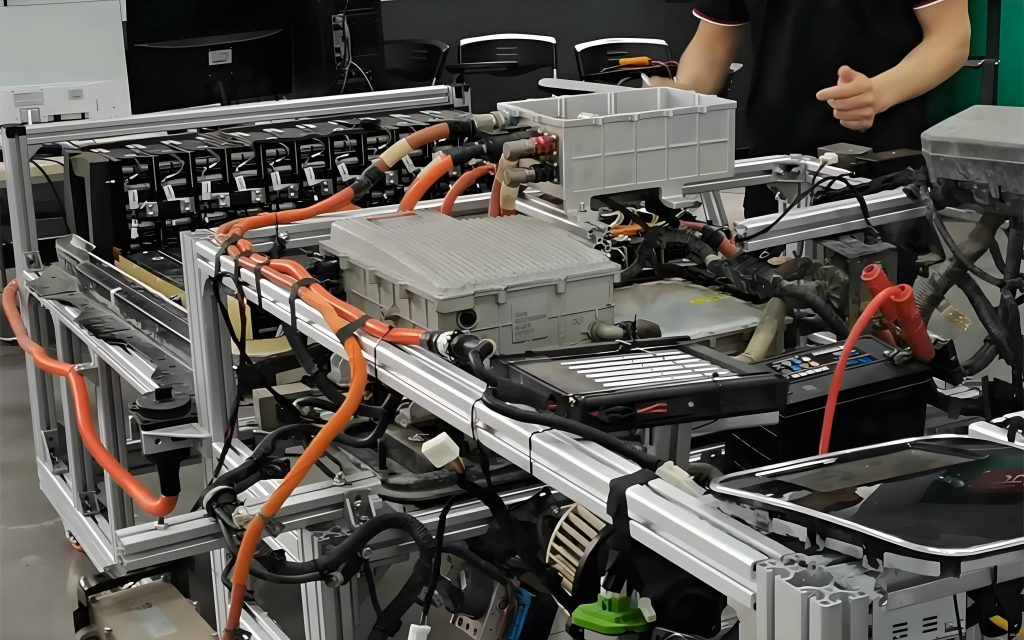
In this discussion, I will first provide an overview of electric vehicle power batteries, then analyze the primary causes of voltage difference faults, and finally detail the repair techniques that I and other professionals use in EV repair. To illustrate these points, I will incorporate tables and formulas that summarize key concepts, making it easier for technicians and enthusiasts to apply this knowledge in practical electrical car repair scenarios. The integration of these elements is vital for advancing the field of EV repair and ensuring that electric vehicles remain a viable and eco-friendly transportation option.
Overview of Electric Vehicle Power Batteries
Electric vehicles utilize complex power battery systems that are fundamentally different from traditional automotive batteries. As someone deeply involved in EV repair, I can attest that these systems are designed to store and deliver electrical energy efficiently, often using lithium-ion technology due to its high energy density and longevity. A typical power battery pack comprises numerous single cells arranged in series and parallel configurations to achieve the desired voltage and capacity. The total voltage \( V_{\text{total}} \) of a series-connected battery pack can be calculated as:
$$ V_{\text{total}} = \sum_{i=1}^{n} V_i $$
where \( V_i \) is the voltage of each single cell and \( n \) is the number of cells. Similarly, the overall capacity \( C_{\text{total}} \) in ampere-hours (Ah) for a parallel configuration is given by:
$$ C_{\text{total}} = \sum_{j=1}^{m} C_j $$
where \( C_j \) is the capacity of each parallel branch and \( m \) is the number of branches. In my experience with electrical car repair, I have seen that these configurations are prone to voltage imbalances, especially as the battery ages. For example, a common electric car might have a battery pack with 100 cells in series, each with a nominal voltage of 3.7 V, resulting in a total voltage of 370 V. However, variations in cell properties can lead to a voltage difference that, if unchecked, necessitates immediate EV repair.
To better understand the components involved, consider the following table that outlines the key elements of an electric vehicle power battery system and their functions, which are frequently addressed in EV repair:
| Component | Function | Common Issues in EV Repair |
|---|---|---|
| Single Cells | Store electrical energy; connected in series/parallel | Voltage imbalance, capacity fade, sulfation |
| Battery Management System (BMS) | Monitors and regulates voltage, temperature, and current | Sensor failures, communication errors |
| Power Distribution Copper Busbar | Connects cells and modules; facilitates current flow | Loose connections, corrosion, overheating |
| Controller | Adjusts voltage and manages battery operations | Software glitches, hardware degradation |
| Detector/Sensor | Measures parameters like voltage and temperature | Calibration drift, physical damage |
In the context of EV repair, it is essential to recognize that the battery system is not isolated; it interacts with other vehicle components such as the charger, motor, and regenerative braking system. Any fault in the power battery can cascade into broader issues, underscoring the importance of regular maintenance in electrical car repair. For instance, a voltage difference fault might initially manifest as reduced acceleration or unpredictable range, but if left unaddressed, it could lead to battery failure or thermal events. Through my work, I have developed protocols to diagnose and rectify these issues, which I will share in subsequent sections.
Causes of Power Battery Voltage Difference Faults
In my extensive involvement with EV repair, I have identified several primary causes of voltage difference faults in electric vehicle power batteries. Understanding these causes is the first step toward effective electrical car repair, as it allows technicians to target specific issues rather than applying generic solutions. The most common causes relate to the inherent design of battery packs and external factors that affect their performance.
Single Cell Series Connection Issues
One of the foremost causes of voltage difference faults is problems within the series connection of single cells. As I have seen in numerous EV repair cases, when multiple cells are connected in series, the overall performance is limited by the weakest cell. This is due to the fact that the current \( I \) flowing through the series chain is uniform, but the voltage \( V_i \) of each cell can vary due to manufacturing tolerances, aging, or environmental conditions. The total voltage imbalance ΔV can be modeled using the formula:
$$ ΔV = \max(V_i) – \min(V_i) \quad \text{for} \quad i = 1, 2, \dots, n $$
where a larger ΔV indicates a more severe fault. In practical terms, if one cell in a series string has a lower capacity or higher internal resistance, it will discharge faster than others, leading to a voltage drop that exacerbates the difference. For example, in a typical EV repair scenario, I might find that a battery pack with 96 cells has a ΔV of 0.5 V under load, whereas a healthy pack should have ΔV below 0.1 V. This often stems from sulfation—a process where sulfate crystals form on the electrodes, increasing resistance and reducing capacity. The sulfation effect can be described by the Peukert equation, which relates discharge current to capacity:
$$ C_p = I^k t $$
where \( C_p \) is the practical capacity, \( I \) is the discharge current, \( t \) is time, and \( k \) is the Peukert constant (typically >1 for lead-acid batteries, but relevant for lithium-ion under stress). In lithium-ion batteries, similar degradation mechanisms occur, necessitating precise EV repair techniques to identify and replace faulty cells.
Another aspect I frequently encounter in electrical car repair is the impact of temperature variations on cell performance. The voltage of a battery cell is temperature-dependent, as given by the Nernst equation approximation:
$$ V(T) = V_0 + \frac{dV}{dT} (T – T_0) $$
where \( V_0 \) is the reference voltage at temperature \( T_0 \), and \( \frac{dV}{dT} \) is the temperature coefficient. In a pack, if cells are exposed to uneven temperatures, their voltages diverge, increasing ΔV. This is common in EVs where cooling systems may be inefficient, highlighting the need for comprehensive electrical car repair that includes thermal management checks.
Power Distribution Copper Busbar Problems
The power distribution copper busbar plays a critical role in connecting battery modules and ensuring uniform current distribution. In my EV repair practice, I have found that faults in the busbar can directly lead to voltage difference issues. The busbar acts as a low-resistance path for current, but if connections become loose or corroded, resistance increases, causing voltage drops and imbalances. Ohm’s law governs this relationship:
$$ V = I R $$
where \( V \) is the voltage drop across the busbar, \( I \) is the current, and \( R \) is the resistance. An increase in \( R \) due to poor contact or oxidation results in a higher \( V \), which distorts the voltage readings across the pack. For instance, during an electrical car repair job, I measured a resistance increase from 0.1 mΩ to 5 mΩ in a busbar connection, leading to a voltage difference of 2 V under a 400 A load—enough to trigger fault codes in the battery management system.
Moreover, the busbar’s integrity is vital for the battery management system (BMS) to accurately monitor cell voltages. If the busbar is damaged, the BMS may receive incorrect data, failing to balance the cells properly. This is a common issue in EV repair, where I have to inspect busbars for physical damage or thermal stress signs. The following table summarizes the key busbar-related issues and their impacts on voltage difference, based on my electrical car repair experiences:
| Busbar Issue | Impact on Voltage Difference | Typical EV Repair Action |
|---|---|---|
| Loose Connections | Increased resistance; voltage drops at specific points | Tighten connections; apply anti-oxidation coating |
| Corrosion | Higher resistance; uneven current distribution | Clean or replace busbar; improve sealing |
| Overheating | Material degradation; increased voltage imbalance | Install better cooling; use higher-grade materials |
| Manufacturing Defects | Inconsistent resistance; premature failures | Replace with quality-assured components |
In addition, the busbar’s role in facilitating communication between battery modules and the controller means that any fault can disrupt the entire system. For example, in one EV repair case, a corroded busbar caused a module to report voltages 0.3 V lower than actual, leading the controller to overcharge other modules and widen ΔV. This underscores the importance of routine inspections in electrical car repair to prevent such cascading effects.
Other Contributing Factors
Beyond single cells and busbars, I have encountered other factors in EV repair that contribute to voltage difference faults. These include imbalances in cell aging, where older cells have reduced capacity and higher internal resistance. The capacity fade over time can be modeled using empirical formulas, such as:
$$ C(t) = C_0 \cdot e^{-\alpha t} $$
where \( C(t) \) is the capacity at time \( t \), \( C_0 \) is the initial capacity, and \( \alpha \) is the degradation rate. If cells age unevenly, ΔV increases, requiring balancing techniques in electrical car repair. Environmental factors like humidity and vibration also play a role; for instance, in harsh conditions, connectors may loosen, amplifying voltage differences. Furthermore, charging habits can affect ΔV; fast charging at high currents often accelerates imbalance, as per the governing equation for charge acceptance:
$$ I_{\text{charge}} = \frac{V_{\text{max}} – V_{\text{cell}}}{R_{\text{internal}}} $$
where a higher \( I_{\text{charge}} \) can cause some cells to overcharge if not managed properly. In my EV repair work, I advise users to follow manufacturer guidelines to minimize such risks.
Repair Techniques for Voltage Difference Faults
Addressing voltage difference faults in electric vehicles requires a systematic approach to EV repair, combining diagnostic tools, technical expertise, and preventive measures. As a practitioner in electrical car repair, I have developed and refined several techniques that effectively mitigate these faults, ensuring optimal battery performance and safety. Below, I detail the key repair methods, supported by formulas and tables to guide technicians in the field.
Single Cell Group Repair Technique
The single cell group repair technique is fundamental in EV repair for resolving voltage imbalances caused by faulty cells. In this method, I focus on identifying and addressing issues within individual cells or groups of cells that are connected in series. The process begins with a thorough diagnosis using a high-precision voltage meter to measure the voltage of each cell. The goal is to calculate the voltage difference ΔV and identify cells that deviate significantly from the average. For example, if the average cell voltage in a pack is 3.7 V, but one cell reads 3.5 V, ΔV is 0.2 V, indicating a problem.
Once problematic cells are identified, I proceed with capacity testing to assess their health. The capacity \( C \) of a cell can be determined by discharging it at a constant current \( I \) and measuring the time \( t \) until it reaches the cutoff voltage:
$$ C = I \cdot t $$
Cells with capacities below 80% of the nominal value are typically replaced, as they contribute to voltage differences. In some cases, reconditioning is possible through controlled charging cycles, which can help reduce sulfation. The reconditioning process involves applying a pulsed current to break down sulfate crystals, based on the equation for desulfation efficiency:
$$ η_{\text{desulfation}} = 1 – e^{-k t} $$
where \( η_{\text{desulfation}} \) is the efficiency, \( k \) is a constant dependent on the pulse parameters, and \( t \) is time. However, for lithium-ion batteries, replacement is often more reliable, as reconditioning may not fully restore performance. In my electrical car repair practice, I maintain a stock of matched cells to ensure that replacements have similar characteristics, minimizing post-repair imbalances.
To streamline this process, I use the following table as a checklist for single cell group repair in EV repair, which includes common symptoms, diagnostic steps, and actions:
| Symptom | Diagnostic Step | Repair Action |
|---|---|---|
| Reduced vehicle range | Measure individual cell voltages under load | Replace cells with ΔV > 0.1 V; balance pack |
| Inconsistent acceleration | Perform capacity test on all cells | Recondition or replace low-capacity cells |
| Battery warning lights | Check for sulfation using impedance spectroscopy | Apply pulsed charging; monitor voltage recovery |
| Overheating of specific modules | Thermal imaging to identify hot spots | Improve cooling; replace damaged cells |
After repairs, I always verify the balance by charging the pack fully and monitoring ΔV during discharge. This iterative process is crucial in EV repair to prevent recurring issues and extend battery life. Moreover, I educate clients on the importance of regular maintenance, as proactive electrical car repair can detect imbalances early, reducing the need for extensive interventions.
Controller Repair Technique
The controller, often part of the battery management system (BMS), is pivotal in regulating voltage differences, and its repair is a common task in EV repair. In my experience, controller faults can arise from software errors, hardware failures, or environmental damage, leading to inaccurate voltage monitoring and balancing. The controller works by sampling voltages from each cell via sensors and adjusting the charging/discharging rates to minimize ΔV. The balancing current \( I_{\text{balance}} \) can be expressed as:
$$ I_{\text{balance}} = \frac{V_{\text{high}} – V_{\text{low}}}{R_{\text{balance}}} $$
where \( V_{\text{high}} \) and \( V_{\text{low}} \) are the voltages of the highest and lowest cells, and \( R_{\text{balance}} \) is the balancing resistance. If the controller malfunctions, this current may not be applied correctly, exacerbating imbalances.
In electrical car repair, I start by diagnosing the controller using diagnostic tools that read error codes and real-time data. For instance, I might connect to the BMS via OBD-II port to check for faults in the voltage sampling circuits. Common issues include corrupted firmware, which requires flashing with updated software, or damaged components like voltage regulators. The regulator output voltage \( V_{\text{out}} \) is given by:
$$ V_{\text{out}} = V_{\text{ref}} \left(1 + \frac{R_1}{R_2}\right) $$
where \( V_{\text{ref}} \) is a reference voltage, and \( R_1 \) and \( R_2 \) are resistors. If these components fail, \( V_{\text{out}} \) drifts, causing sampling errors. I often replace them with high-quality parts to ensure accuracy.
Another critical aspect of controller repair in EV repair is cleaning and maintenance. Dust and moisture can cause short circuits or corrosion on the controller board, leading to erratic behavior. I recommend using purified water for cleaning, as impurities can leave residues that affect performance. After cleaning, I conduct functional tests to verify that the controller correctly balances the pack. The following table outlines typical controller issues and repair steps in electrical car repair:
| Controller Issue | Diagnostic Method | Repair Technique |
|---|---|---|
| Software glitches | Scan for error codes; check firmware version | Update firmware; reset system |
| Hardware failures | Measure voltage and resistance on board | Replace faulty ICs or sensors; solder repairs |
| Sensor drift | Compare controller readings with external meters | Recalibrate sensors; replace if necessary |
| Communication errors | Check CAN bus signals and connectivity | Repair wiring; update communication protocols |
Through consistent application of these techniques, I have successfully restored many electric vehicles to optimal performance, emphasizing the value of skilled EV repair. Additionally, I advocate for periodic controller checks as part of routine electrical car repair, as early detection of issues can prevent severe voltage differences and associated damages.
Detector Repair Technique
Detectors, or sensors, are essential for monitoring battery parameters, and their repair is a specialized area of EV repair. These devices measure voltage, temperature, and current, providing data to the controller for balance management. When detectors fail, they can report incorrect values, leading to misguided balancing actions and increased voltage differences. In my electrical car repair work, I often find that detector faults stem from physical damage, calibration errors, or connection problems.
The repair process begins with a comprehensive inspection of the detector network. I use multimeters and oscilloscopes to verify the accuracy of voltage readings. For example, if a detector reports a cell voltage of 3.6 V, but a direct measurement shows 3.7 V, there is a calibration issue. The error \( \epsilon \) can be quantified as:
$$ \epsilon = V_{\text{reported}} – V_{\text{actual}} $$
If \( |\epsilon| \) exceeds a threshold (e.g., 0.05 V), recalibration or replacement is needed. For temperature sensors, I compare readings with infrared thermometers to ensure consistency, as temperature affects voltage readings per the earlier mentioned Nernst equation.
In cases of connection issues, I inspect the wiring and connectors for looseness or corrosion. The resistance of a connection can be measured using a four-wire method to avoid lead resistance errors:
$$ R_{\text{connection}} = \frac{V_{\text{drop}}}{I} $$
where \( V_{\text{drop}} \) is the voltage drop across the connection under test current \( I \). High resistance indicates poor contact, which I remedy by cleaning or replacing connectors. This is a common fix in EV repair that directly impacts voltage difference management.
For detector recalibration, I follow manufacturer procedures, which often involve applying known voltages and adjusting detector outputs. In complex systems, I use automated tools to streamline this process, ensuring that all detectors in the pack are synchronized. The table below summarizes detector-related problems and solutions in electrical car repair, based on my hands-on experience:
| Detector Problem | Symptoms | Repair Action |
|---|---|---|
| Calibration drift | Inconsistent voltage readings; false alarms | Recalibrate using reference sources; update software |
| Physical damage | Cracked sensors; broken wires | Replace detectors; secure wiring harnesses |
| Short circuits | Erratic data; system shutdowns | Inspect insulation; replace damaged components |
| Communication failures | Missing data points; controller errors | Check network integrity; repair or replace modules |
After repairs, I conduct integration tests to ensure that detectors communicate effectively with the controller, providing accurate data for voltage balance. This holistic approach to EV repair not only resolves immediate faults but also enhances the overall reliability of the battery system. In my practice, I emphasize the importance of detector maintenance as a proactive measure in electrical car repair, reducing the likelihood of voltage difference issues over the vehicle’s lifespan.
Conclusion
In conclusion, power battery voltage difference faults are a significant challenge in the realm of EV repair, but with the right techniques, they can be effectively managed. Through my work in electrical car repair, I have demonstrated that understanding the causes—such as single cell imbalances and busbar issues—is crucial for targeted interventions. The repair techniques involving single cells, controllers, and detectors provide a comprehensive framework for maintaining battery health and performance.
As the electric vehicle industry continues to evolve, the demand for skilled EV repair will grow, necessitating ongoing education and innovation. I encourage technicians to adopt the methods discussed here, incorporating regular diagnostics and preventive maintenance into their electrical car repair practices. By doing so, we can support the widespread adoption of electric vehicles, contributing to a cleaner and more sustainable future. Remember, effective EV repair not only fixes immediate problems but also builds trust in this transformative technology.