
As the global shift toward sustainable transportation accelerates, the electric vehicle (EV) industry has experienced unprecedented growth. In this article, I will explore the intelligent transformation of inspection and maintenance technologies for electric cars, focusing on how advancements in sensors, data analytics, and predictive systems are revolutionizing the way we approach EV repair. The transition from traditional methods to smart, data-driven approaches is not just a trend but a necessity to ensure safety, efficiency, and reliability in electrical car repair. By delving into the current state, technological applications, and strategic pathways, I aim to provide a comprehensive overview that highlights the critical role of innovation in shaping the future of EV repair and maintenance.
The rapid adoption of electric vehicles, including battery electric vehicles (BEVs), plug-in hybrids (PHEVs), and fuel cell electric vehicles (FCEVs), has introduced unique challenges in inspection and maintenance. Unlike conventional internal combustion engine vehicles, EVs rely on complex systems such as high-voltage batteries, electric motors, and power electronics. These components demand specialized diagnostic tools and techniques, which traditional methods often fail to address. For instance, in electrical car repair, issues like battery degradation or motor inefficiencies require real-time monitoring and precise analysis—capabilities that are central to intelligent transformation. In my view, this shift is driven by the need to reduce downtime, lower costs, and enhance user trust in EVs. Through this discussion, I will emphasize how integrating smart technologies can transform EV repair from a reactive process to a proactive, predictive one.
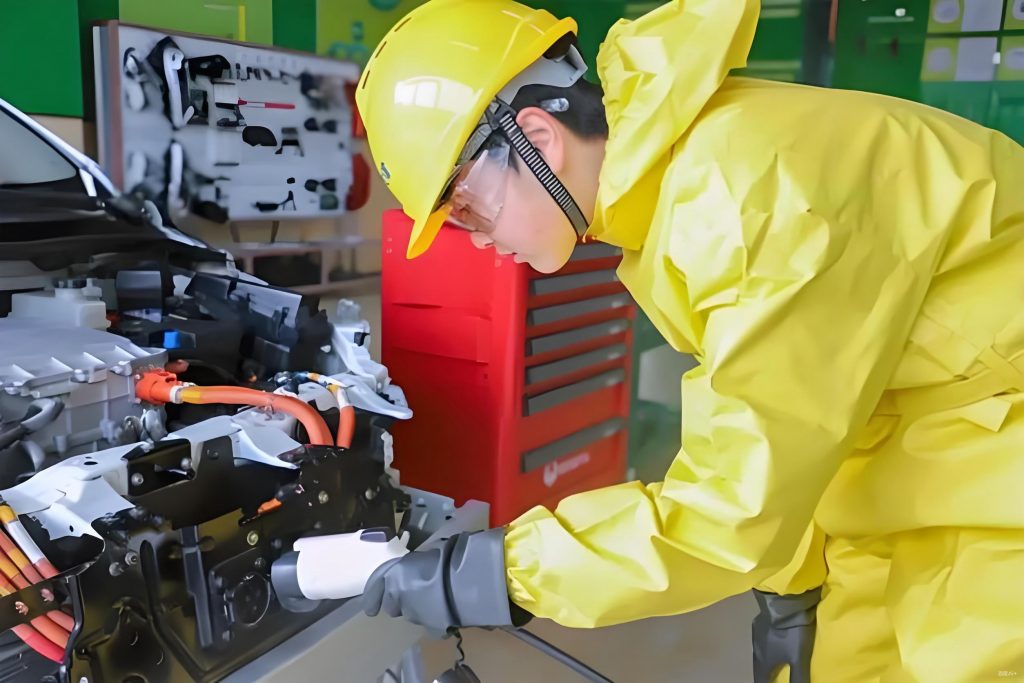
To understand the current landscape of EV repair, it is essential to recognize the technical characteristics of electric vehicles. The core components include the battery system, motor drive, and electronic control units (ECUs), each presenting distinct maintenance challenges. For example, lithium-ion batteries, common in EVs, are prone to thermal runaway and capacity fade, necessitating advanced diagnostic tools for early detection. Similarly, electric motors require monitoring for issues like bearing wear or insulation failure. In traditional electrical car repair, mechanics often rely on manual inspections and basic diagnostic codes, which can miss subtle anomalies. This limitation becomes apparent when dealing with high-voltage systems, where safety risks demand more sophisticated approaches. As I analyze these aspects, I will highlight how intelligent systems are bridging these gaps, making EV repair more accurate and efficient.
The limitations of conventional inspection and maintenance methods are a significant barrier to effective EV repair. Traditional techniques, designed for mechanical and low-voltage electrical systems, struggle with the high-precision requirements of EVs. For instance, fault diagnosis in electrical car repair often involves interpreting error codes from ECUs, but without real-time data analytics, this can lead to misdiagnosis. Moreover, standard equipment may not capture critical parameters like state of charge (SOC) or battery health accurately. A comparison between traditional and intelligent methods is summarized in Table 1, illustrating the advantages of smart technologies in EV repair.
| Aspect | Traditional Methods | Intelligent Methods |
|---|---|---|
| Fault Diagnosis | Relies on manual inspection and basic tools | Uses AI algorithms and real-time data analysis |
| Data Collection | Limited to periodic checks | Continuous monitoring via sensors and IoT |
| Predictive Capability | Reactive; issues addressed after failure | Proactive; predicts failures before occurrence |
| Cost Efficiency | Higher due to trial-and-error approaches | Lower through optimized maintenance schedules |
| Safety in Electrical Car Repair | Risks from high-voltage handling | Enhanced via automated shutdowns and alerts |
Intelligent transformation in EV repair is not merely an upgrade but a fundamental shift driven by the need for enhanced safety, cost reduction, and sustainability. In my experience, the integration of smart technologies allows for predictive maintenance, where potential failures are identified early, minimizing risks. For example, in electrical car repair, battery management systems (BMS) can use data from sensors to forecast thermal events, preventing accidents. This approach not only improves reliability but also builds consumer confidence in EVs. Furthermore, as the industry evolves, regulatory pressures and environmental goals are pushing for smarter solutions. I believe that by embracing this transformation, stakeholders can achieve significant economic and ecological benefits, making EV repair a cornerstone of the green mobility ecosystem.
Sensor technology plays a pivotal role in the intelligent diagnosis of electric vehicles. In modern EV repair, sensors are deployed to monitor a wide range of parameters, including temperature, pressure, current, voltage, and vibration. These sensors convert physical measurements into electrical signals, which are processed to detect anomalies. For instance, in battery systems, temperature sensors help prevent overheating by triggering cooling mechanisms. The data from these sensors is transmitted via networks like CAN bus or Ethernet to central processing units, where algorithms analyze it for deviations. A key formula used in such analyses is the fault detection algorithm based on statistical process control:
$$ \Delta = \frac{|X – \mu|}{\sigma} $$
where \( \Delta \) represents the deviation, \( X \) is the real-time sensor reading, \( \mu \) is the mean value under normal conditions, and \( \sigma \) is the standard deviation. If \( \Delta \) exceeds a threshold, an alert is generated for immediate EV repair. This method enhances the accuracy of electrical car repair by reducing false positives and enabling targeted interventions.
Data acquisition and processing systems form the backbone of intelligent EV repair. These systems consist of hardware components like sensors, data loggers, and network interfaces, along with software for data cleansing, normalization, and feature extraction. In electrical car repair, edge computing and cloud platforms work in tandem to handle large volumes of data. For example, raw sensor data is first filtered to remove noise, then normalized to ensure consistency. Feature extraction algorithms identify patterns indicative of faults, such as sudden voltage drops in batteries. The overall process can be modeled using a data flow equation:
$$ Y(t) = \sum_{i=1}^{n} w_i \cdot X_i(t) + \epsilon(t) $$
Here, \( Y(t) \) is the processed output at time \( t \), \( w_i \) are weights assigned to sensor inputs \( X_i(t) \), and \( \epsilon(t) \) represents error terms. This enables real-time health monitoring in EV repair, allowing for automated adjustments. For instance, if abnormal vibrations are detected in a motor, the system can recommend maintenance before a breakdown occurs, streamlining electrical car repair processes.
Fault detection and prediction technologies leverage machine learning and artificial intelligence to enhance EV repair. By analyzing historical and real-time data, these systems can identify patterns associated with common failures. In electrical car repair, techniques like clustering and neural networks are used to classify faults. For example, a recurrent neural network (RNN) can model time-series data from battery cycles to predict capacity loss:
$$ C(t) = C_0 \cdot e^{-\alpha t} + \beta \cdot \int_0^t I(\tau) \, d\tau $$
where \( C(t) \) is the battery capacity at time \( t \), \( C_0 \) is the initial capacity, \( \alpha \) and \( \beta \) are degradation coefficients, and \( I(\tau) \) is the current over time. This predictive model allows technicians to schedule replacements proactively, reducing downtime in EV repair. Additionally, anomaly detection algorithms compare real-time data against baselines to flag issues early. As I see it, these advancements are making electrical car repair more reliable and cost-effective, as demonstrated in case studies where AI-driven systems have cut diagnostic times by over 50%.
The path to intelligent transformation in EV repair involves robust research and innovation. I advocate for collaborative efforts among governments, industries, and academia to develop cutting-edge technologies. In sensor technology, for instance, investing in smart sensors with self-calibration features can improve monitoring accuracy for critical components like batteries and motors. Similarly, data processing innovations, such as federated learning, enable secure data sharing across different EV models without compromising privacy. A notable example is the use of digital twins—virtual replicas of physical vehicles—that simulate real-world conditions to predict failures. The effectiveness of such approaches can be quantified using a performance metric:
$$ P = \frac{T_p}{T_p + F_p + F_n} $$
where \( P \) is the precision, \( T_p \) is true positives, \( F_p \) is false positives, and \( F_n \) is false negatives. High precision indicates reliable fault prediction in EV repair. Furthermore, integrating blockchain with IoT ensures data integrity in electrical car repair logs, preventing tampering and enhancing trust.
Market promotion and user education are crucial for the widespread adoption of intelligent EV repair. From my perspective, a multi-channel approach combining online and offline strategies can demystify smart technologies for consumers. For example, interactive workshops and augmented reality (AR) demonstrations can showcase how AI diagnostics work in real-time electrical car repair scenarios. Additionally, developing user-friendly apps that provide self-check features empowers owners to monitor their vehicles’ health. To illustrate the impact of education, consider a scenario where users understand battery maintenance; this can extend battery life and reduce repair frequency. Table 2 outlines key strategies for promoting intelligent EV repair.
| Strategy | Description | Expected Outcome |
|---|---|---|
| Interactive Demos | Use AR/VR to simulate fault diagnosis | Increased user engagement and trust |
| Online Platforms | Develop apps for real-time monitoring and tips | Enhanced self-service in electrical car repair |
| Training Programs | Offer certifications for smart repair techniques | Skilled workforce for advanced EV repair |
| Collaborative Campaigns | Partner with manufacturers for awareness drives | Broader acceptance of intelligent systems |
Cost control and business model innovation are essential to making intelligent EV repair accessible. In my analysis, adopting a “hardware-as-a-service” model can reduce upfront investments for repair shops. For instance, leasing diagnostic equipment with pay-per-use cloud analytics lowers barriers to entry. Moreover, optimizing workflows through intelligent scheduling systems can cut labor costs and improve efficiency. A mathematical model for cost-benefit analysis in electrical car repair is:
$$ \text{Net Benefit} = \sum_{i=1}^{n} (R_i – C_i) \cdot (1 + r)^{-t} $$
where \( R_i \) is revenue from services, \( C_i \) is costs, \( r \) is the discount rate, and \( t \) is time. This helps businesses evaluate the long-term value of smart technologies. Additionally, data monetization—such as selling aggregated, anonymized insights to insurers—creates new revenue streams. For example, in EV repair, data on driving patterns can inform usage-based insurance models, fostering a circular economy around electrical car repair.
Policy and regulatory frameworks must evolve to support the intelligent transformation of EV repair. I recommend establishing standardized protocols for data security, interoperability, and safety. For instance, regulations mandating encrypted data transmission in electrical car repair can protect against cyber threats. Similarly, incentives like tax credits for research and development can spur innovation. A regulatory scorecard, as shown in Table 3, can guide policymakers in assessing the effectiveness of such measures.
| Regulatory Aspect | Current Status | Recommended Improvement |
|---|---|---|
| Data Privacy | Varied across regions | Uniform standards like GDPR for EV repair data |
| Equipment Standards | Fragmented compatibility | Mandate open APIs for diagnostic tools |
| Safety Protocols | Basic guidelines for high-voltage systems | Advanced training and certification requirements |
| Incentive Programs | Limited funding for smart tech adoption | Subsidies for AI integration in electrical car repair |
In conclusion, the intelligent transformation of EV repair is a multifaceted journey that hinges on technological innovation, strategic promotion, and supportive policies. As I have discussed, the integration of sensors, data analytics, and predictive models is redefining electrical car repair, making it safer, faster, and more economical. By fostering collaboration and continuous learning, the industry can overcome existing challenges and unlock new opportunities. Looking ahead, I am confident that advancements in AI and IoT will further elevate EV repair standards, contributing to the global transition to sustainable transportation. Ultimately, this transformation is not just about fixing vehicles but about building a resilient ecosystem where electric mobility thrives.