
As an expert in electric vehicle repair, I have dedicated my career to addressing the complexities of thermal management systems in modern electric cars. The rise of electric vehicles (EVs) has revolutionized transportation, but it has also introduced unique challenges in maintenance and repair, particularly in thermal management. Unlike traditional internal combustion engines, EVs rely heavily on batteries and electric components that are highly sensitive to temperature fluctuations. In my experience, effective EV repair requires a deep understanding of how thermal systems interact to ensure safety, efficiency, and longevity. This article delves into the composition, operation, and common faults of thermal management systems in electric vehicles, with a focus on practical diagnostic and optimization strategies for electrical car repair. I will share insights from real-world cases, incorporating tables and mathematical models to summarize key concepts, and emphasize the importance of systematic approaches in EV repair to enhance overall vehicle performance.
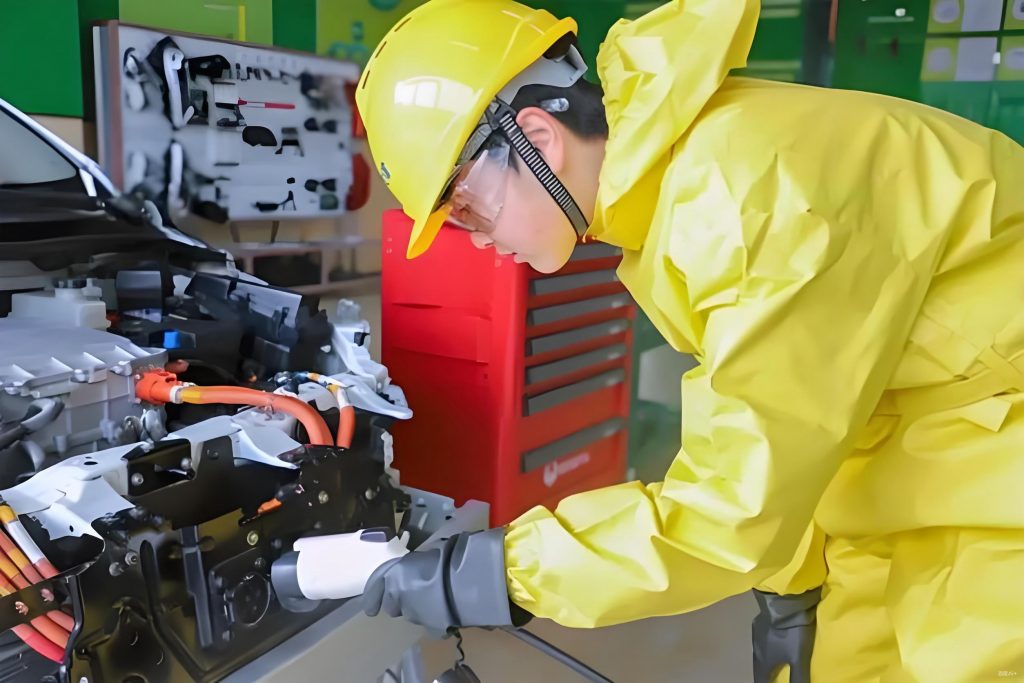
Thermal management systems in electric vehicles are integral to maintaining optimal operating conditions for various components, including the battery, electric drive, and passenger cabin. In my work on electrical car repair, I have observed that these systems consist of three primary subsystems: the passenger cabin thermal management system, the power battery thermal management system, and the electric drive system thermal management system. Each subsystem plays a critical role in regulating temperature, and failures can lead to reduced efficiency, safety hazards, or complete system breakdowns. For instance, the passenger cabin system uses an electric scroll compressor, condenser, evaporator, and expansion valve to manage cooling, while a PTC (Positive Temperature Coefficient) heater provides heating when needed. The power battery system relies on heat exchange modules to cool or heat the battery based on operational conditions, and the electric drive system uses coolant loops to dissipate heat from components like the drive motor and controllers. Understanding these interactions is essential for effective EV repair, as misdiagnosis can result in costly repairs and downtime.
To illustrate the thermal dynamics, consider the heat balance equation for a battery pack: $$ Q_{generated} = Q_{dissipated} + Q_{stored} $$ where \( Q_{generated} \) represents the heat produced during charging or discharging, \( Q_{dissipated} \) is the heat removed by cooling systems, and \( Q_{stored} \) is the heat accumulated in the battery. In EV repair, this equation helps diagnose overheating issues, such as when \( Q_{generated} \) exceeds \( Q_{dissipated} \), leading to thermal runaway. Similarly, for the electric drive system, the heat transfer rate can be modeled using: $$ \dot{Q} = h A (T_{component} – T_{coolant}) $$ where \( \dot{Q} \) is the heat transfer rate, \( h \) is the heat transfer coefficient, \( A \) is the surface area, and \( T \) denotes temperatures. These formulas are vital in electrical car repair for predicting system behavior and identifying faults.
| Subsystem | Key Components | Primary Function | Common Faults in EV Repair |
|---|---|---|---|
| Passenger Cabin | Electric scroll compressor, PTC heater, evaporator | Maintain comfortable cabin temperature | Pump failures, sensor issues |
| Power Battery | Heat exchanger, coolant loops, temperature sensors | Coolant leaks, valve malfunctions | |
| Electric Drive | Coolant pumps, radiators, fans | Dissipate heat from motor and electronics | Fan failures, circuit problems |
In my practice of EV repair, I often encounter cases where the PTC heating pump fails, leading to inadequate cabin heating and reduced battery performance in cold conditions. The diagnostic process involves systematic steps, such as using a fault code reader to retrieve error codes from the A/C controller. For example, if code P0A3F is detected, it may indicate a pump circuit malfunction. I then check the fuse EF13 for signs of melting; if fused, I inspect the wiring for short circuits and replace the fuse. Next, I measure the voltage between the ground and terminal 3 of connector CA72, which should be between 11 V and 14 V. If the resistance between the ground and terminal 1 exceeds 1 Ω, it suggests a grounding issue. Finally, I examine the control harness between the A/C controller and the PTC pump, and if necessary, replace the pump or controller. This methodical approach is crucial in electrical car repair to minimize errors and ensure reliable outcomes.
Optimizing repair procedures for components like the PTC heating pump involves several strategies. First, I develop standardized repair manuals that outline each step, from diagnosis to completion, including tool usage and safety checks. This reduces variability in EV repair and improves efficiency. Second, I implement inventory management systems for critical parts, such as PTC pumps, based on historical repair data to prevent stockouts. For instance, setting a minimum stock level of 10 units with automated alerts ensures timely replenishment. Additionally, I foster knowledge sharing through online platforms where technicians discuss common issues, such as pump failures due to corrosion, and propose solutions. This collaborative approach enhances the overall quality of electrical car repair and reduces diagnostic time.
| Step | Action | Expected Outcome | Tools Used in EV Repair |
|---|---|---|---|
| 1 | Read fault codes via diagnostic tool | Retrieve codes like U0100 for communication errors | OBD-II scanner |
| 2 | Inspect fuses SF08 and EF09 | Identify and replace blown fuses | Multimeter |
| 3 | Check power supply to cooling fan | Voltage of 11-14 V at connector CA30b | High-precision multimeter |
| 4 | Test ground connection | Resistance below 1 Ω at terminal 3 | Ohmmeter |
| 5 | Examine relays ER12 and ER05 | Confirm proper switching function | Relay tester |
| 6 | Replace faulty components | Restore fan operation | Standard toolkit |
Another common issue in EV repair involves cooling fans not operating in low-speed mode, which can cause overheating in components like the onboard charger or drive motor. The diagnostic process begins with reading fault codes from the VCU (Vehicle Control Unit). If code P0691 is present, it may point to a fan control circuit fault. I then inspect fuses SF08 and EF09 for damage and check the power supply to the fan by measuring voltage at connector CA30b. A reading outside the 11-14 V range indicates a power issue. Next, I test the ground connection for resistance below 1 Ω and examine the low-speed relay ER12 and main relay ER05 for faults. If these steps do not resolve the issue, I replace the cooling fan or VCU controller. This thorough approach is essential in electrical car repair to prevent recurring problems and ensure system reliability.
To optimize the repair of cooling fan systems, I recommend using advanced tools such as high-precision multimeters and dedicated fan motor diagnostic devices. These tools allow for accurate measurement of parameters like current draw and resistance, enabling faster fault localization. For example, the power consumption of a cooling fan can be modeled as: $$ P = I^2 R $$ where \( P \) is the power, \( I \) is the current, and \( R \) is the resistance. In EV repair, deviations from expected values can indicate motor wear or electrical faults. Additionally, I advocate for improved assembly techniques, such as ensuring proper alignment during VCU controller installation, to enhance durability. Post-repair testing is critical; I perform static checks on wiring and dynamic tests under simulated conditions, like high ambient temperatures, to verify fan performance. This comprehensive method in electrical car repair not only addresses immediate issues but also prevents future failures.
In the context of electrical car repair, preventive maintenance plays a vital role in thermal management system health. I often use predictive models based on thermal data to schedule inspections. For instance, the battery temperature trend can be analyzed using: $$ T(t) = T_0 + \frac{Q}{C} t $$ where \( T(t) \) is the temperature at time \( t \), \( T_0 \) is the initial temperature, \( Q \) is the heat generation rate, and \( C \) is the heat capacity. By monitoring these parameters, I can anticipate failures and perform proactive EV repair, reducing downtime and costs. Moreover, training programs for technicians on the latest diagnostic software and thermal imaging techniques are essential for staying updated in the rapidly evolving field of electrical car repair.
| Strategy | Description | Benefits in EV Repair | Implementation Example |
|---|---|---|---|
| Standardized Processes | Develop step-by-step repair manuals | Manual for PTC pump replacement | |
| Advanced Tooling | Use high-accuracy multimeters and diagnostic devices | Enables precise fault detection | Fan motor analyzer for current tests |
| Inventory Management | Set up automated stock alerts for parts | Prevents repair delays | Alert system for coolant valves |
| Technician Training | Conduct workshops on thermal system diagnostics | Enhances skills and efficiency | Hands-on sessions with fault simulators |
| Predictive Maintenance | Apply thermal models to forecast issues | Minimizes unexpected failures | Battery temperature monitoring software |
In conclusion, thermal management systems are cornerstone components in electric vehicles, and their effective diagnosis and repair are paramount for vehicle safety and performance. Through my experiences in EV repair, I have found that a combination of theoretical knowledge and practical application, supported by tables and mathematical models, leads to successful outcomes. Emphasizing keywords like EV repair and electrical car repair throughout this discussion highlights the importance of specialized expertise in this field. By adopting optimized repair strategies, such as standardized procedures and advanced tooling, technicians can address faults more efficiently, ensuring that electric vehicles operate reliably under various conditions. As the EV industry continues to grow, ongoing innovation in electrical car repair will be essential to meet the demands of modern transportation.