
With the rapid growth of electric vehicles (EVs) as a key component of eco-friendly transportation, the deployment of EV charging stations has accelerated significantly. However, the intermittent and fluctuating nature of charging activities at these stations can lead to substantial load peaks and valleys in the power distribution network, potentially causing instability and inefficiencies. To address this, we investigate a load coordinated control method for distributed EV charging stations that incorporates measurement uncertainty. By accurately quantifying uncertainties in charging efficiency measurements and integrating them into a dual-loop control strategy, our approach aims to balance load distribution, minimize peak-valley differences, and enhance the reliability of the grid. This study focuses on analyzing sources of uncertainty—such as repetitive measurements, instrument resolution, and environmental factors—and employs a Buck-Boost converter-based controller to regulate power flow. Experimental results demonstrate that our method effectively controls DC bus voltage and optimizes load coordination, contributing to sustainable EV charging infrastructure development.
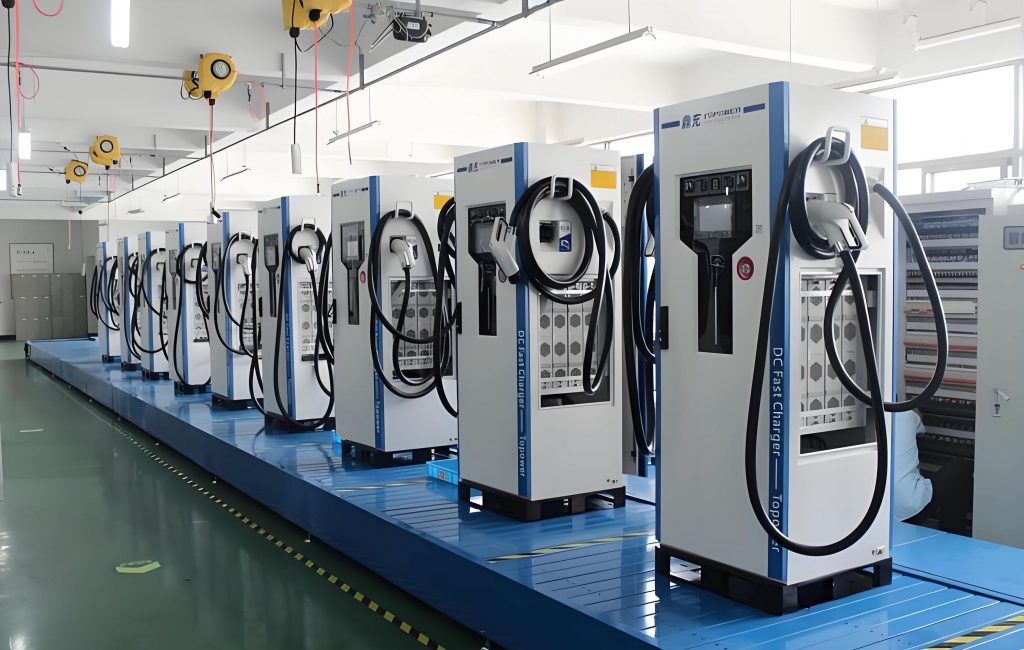
The integration of distributed EV charging stations into modern power systems presents unique challenges due to their variable load profiles. When multiple charging piles operate simultaneously, they can create significant load imbalances, leading to voltage fluctuations and reduced grid stability. Traditional control methods often overlook the inherent uncertainties in measuring charging efficiency, which can result in suboptimal performance. In this work, we propose a novel approach that accounts for measurement uncertainty in the coordination of loads across distributed EV charging stations. By leveraging advanced metering techniques and a dual-loop control framework, we ensure robust operation under diverse conditions. This not only improves the efficiency of individual EV charging stations but also supports the broader goal of integrating renewable energy sources into the grid.
To begin, we define the charging efficiency of an EV charging station as the ratio of output power to input power. For a DC charging pile, this is expressed as:
$$ \delta_P = \frac{P_{dc}}{P_{ac}} \times 100\% $$
where \( P_{ac} \) represents the input power measured by an AC energy meter, and \( P_{dc} \) denotes the output power delivered to the EV charger. The sensitivity coefficients for input and output power are derived as follows:
$$ G_1 = \frac{\partial \delta_P}{\partial P_{ac}} = -\frac{P_{dc}}{P_{ac}^2} $$
$$ G_2 = \frac{\partial \delta_P}{\partial P_{dc}} = \frac{1}{P_{ac}} $$
These coefficients are crucial for evaluating how small changes in power measurements affect the overall charging efficiency uncertainty. The measurement uncertainty in EV charging stations arises from three primary sources: repetitive measurements, instrument resolution, and other environmental factors. Each component contributes to the total uncertainty, which must be quantified for effective load control.
First, the uncertainty due to repetitive measurements is calculated using the standard deviation from multiple observations. For \( n \) measurements of charging efficiency \( \delta_P \) under rated power conditions, the standard deviation \( s(\gamma) \) is given by:
$$ s(\gamma) = \sqrt{\frac{\sum_{i=1}^{n} (x_i – \bar{x})^2}{n-1}} $$
where \( x_i \) is the individual measurement and \( \bar{x} \) is the mean value. The uncertainty component from repetitive measurements is then:
$$ r_1 = s(\gamma) $$
Second, the uncertainty caused by instrument resolution involves both the AC energy meter and the EV charger tester. Let \( r_{21} \) and \( r_{22} \) represent the resolution uncertainties for the input and output power measurements, respectively. Assuming no correlation between them, the combined uncertainty is:
$$ r_2 = |G_1| r_{21} + |G_2| r_{22} $$
Third, other factors such as environmental conditions (e.g., temperature and humidity) can introduce additional uncertainties. If the AC energy meter is affected by ±0.01% and the EV charger tester by ±0.05%, the corresponding uncertainties are:
$$ r_{31} = \frac{0.01\% \times P_{ac}}{\sqrt{3}} $$
$$ r_{32} = \frac{0.05\% \times P_{dc}}{\sqrt{3}} $$
The overall uncertainty from these factors is:
$$ r_3 = |G_1| r_{31} + |G_2| r_{32} $$
Combining all components, the combined standard uncertainty \( r \) is:
$$ r = \sqrt{r_1^2 + r_2^2 + r_3^2} $$
Finally, the expanded uncertainty \( R \), which provides a confidence interval, is obtained by multiplying by a coverage factor \( k \) (typically set to 2):
$$ R = k r $$
This comprehensive assessment of measurement uncertainty forms the foundation for our load coordination strategy in distributed EV charging stations.
For load coordination, we implement a dual-loop control system using a Buck-Boost converter as the primary controller. This converter operates in Buck mode when power flows from the grid to the EV charging station, and in Boost mode when power is fed back to the grid. The inner loop control focuses on regulating the inductor current to maintain stability. According to Kirchhoff’s voltage law, the dynamics of the inductor current \( i_s \) are described by:
$$ L \frac{di_s}{dt} = v_s – v_m $$
where \( L \) is the inductance, \( v_s \) is the source voltage, and \( v_m \) is the modulated voltage. The reference voltage for modulation is derived using a proportional-integral (PI) controller:
$$ v_{m\_ref} = v_s + \text{PI}(i_{s\_ref} – i_s) $$
Incorporating measurement uncertainty, the average modulation function \( z_d \) for the Buck-Boost converter is:
$$ z_d = R \left( \frac{v_{m\_ref}}{v_{dc}} \right) $$
where \( v_{dc} \) is the DC bus voltage. This inner loop ensures precise current control, which is vital for managing the power flow in EV charging stations.
The outer loop control manages system-level power balance by monitoring output signals and adjusting references. It assigns active power \( P_{g\_ref} \) and reactive power \( Q_{g\_ref} \) setpoints to the grid-connected converters in the EV charging station. The power reference for the storage unit \( P_{sto\_ref} \) is computed as:
$$ P_{sto\_ref} = R (P_{g\_ref} + P_{dc\_load} – P_{pv}) $$
where \( P_{dc\_load} \) is the DC load on the bus, and \( P_{pv} \) is the power from photovoltaic arrays via maximum power point tracking. To maintain DC voltage stability, a capacitor \( C \) is added, and the active power \( P_g \) provided by the PWM rectifier is expressed as:
$$ P_g = R v_{dc} i_{dc} = R \left( v_{dc} \times C \frac{dv_{dc}}{dt} \right) = \frac{1}{2} C R \frac{dv_{dc}^2}{dt} $$
The outer loop strategy uses a PI controller to generate \( P_{sto\_ref} \) based on the error between squared reference and actual DC voltages. A low-pass filter (LPF) allocates power references between batteries and supercapacitors, ensuring efficient energy management. This coordinated approach enables distributed EV charging stations to adapt to load variations while minimizing grid impact.
To validate our method, we conducted experiments on a large-scale EV charging station with 100 distributed charging piles. The input voltage was set to 650 V, and charging efficiency was measured under different output currents. The results are summarized in the table below, which illustrates the variation in efficiency across operating conditions. This data underscores the importance of considering measurement uncertainty for reliable control.
| Input Voltage (V) | Output Current (A) | AC Input Power (kW) | DC Output Power (kW) | Conversion Efficiency (%) |
|---|---|---|---|---|
| 650 | 70 | 59.54 | 57.64 | 96.81 |
| 650 | 60 | 49.52 | 46.94 | 94.79 |
| 650 | 50 | 38.64 | 36.23 | 93.76 |
| 650 | 40 | 31.52 | 29.28 | 92.89 |
| 650 | 30 | 23.84 | 21.95 | 92.07 |
| 650 | 20 | 18.56 | 16.94 | 91.27 |
| 650 | 10 | 9.25 | 8.15 | 88.11 |
Based on these measurements, we calculated the measurement uncertainty for each output current, as shown in the following table. The uncertainties were derived using the formulas outlined earlier, highlighting how they vary with operating conditions and emphasizing their role in control decisions for EV charging stations.
| Output Current (A) | Measurement Uncertainty (%) |
|---|---|
| 10 | 0.12 |
| 20 | 0.18 |
| 30 | 0.25 |
| 40 | 0.31 |
| 50 | 0.38 |
| 60 | 0.44 |
| 70 | 0.51 |
In our control experiments, the dual-loop strategy successfully maintained the DC bus voltage within a narrow range of 610 V to 670 V, with fluctuations under 3%. This stability is crucial for preventing overloading and ensuring efficient operation of EV charging stations. The supercapacitor and battery power profiles demonstrated effective coordination, with the supercapacitor handling high-frequency power variations and the battery managing low-frequency demands. The total charging and discharging power remained balanced, as summarized in the table below, which shows the power distribution over time.
| Time (s) | Supercapacitor Power (W) | Battery Power (W) | Total Power (W) |
|---|---|---|---|
| 0 | 0 | 0 | 0 |
| 1 | 30000 | 60000 | 90000 |
| 2 | 45000 | 75000 | 120000 |
| 3 | 60000 | 90000 | 150000 |
| 4 | 30000 | 60000 | 90000 |
| 5 | 15000 | 45000 | 60000 |
| 6 | 0 | 30000 | 30000 |
| 7 | -15000 | 15000 | 0 |
Furthermore, we analyzed the daily load profile of the EV charging station to assess peak shaving and valley filling. The table below presents the demand distribution, showing how our method shifts charging activities from peak to off-peak hours, such as around 6:00 AM, thereby reducing the peak-valley difference and enhancing grid stability.
| Time of Day | Demand (kVA) | Operating Charging Piles |
|---|---|---|
| 00:00 | 0.82 | 0% |
| 03:00 | 0.84 | 20% |
| 06:00 | 0.86 | 40% |
| 09:00 | 0.92 | 80% |
| 12:00 | 0.94 | 90% |
| 15:00 | 0.96 | 100% |
| 18:00 | 0.94 | 90% |
| 21:00 | 0.90 | 70% |
| 24:00 | 0.84 | 30% |
In conclusion, our method for load coordinated control in distributed EV charging stations, which incorporates measurement uncertainty, proves highly effective in managing load imbalances and supporting grid integration. By accurately quantifying uncertainties and employing a dual-loop control strategy, we achieve stable DC bus voltage, efficient power distribution, and reduced peak-valley differences. This approach not only addresses the immediate challenges of EV charging station operation but also aligns with long-term sustainability goals. Future work could explore real-time adaptation to dynamic grid conditions and the integration of additional renewable sources, further enhancing the resilience of EV charging infrastructure.