
In recent years, the rapid growth of the electric vehicle (EV) industry has revolutionized transportation, driven by global energy shifts and environmental concerns. However, as an expert in automotive technology, I have observed that the field of EV repair and electrical car repair faces significant hurdles that could hinder its progress. From my perspective, the transition from traditional internal combustion engines to electric powertrains introduces unique complexities in detection, maintenance, and repair processes. This article delves into the core issues plaguing EV repair, such as inadequate technical standards, a shortage of skilled professionals, insufficient specialized equipment, and high costs. By analyzing these challenges and proposing actionable solutions, I aim to contribute to the advancement of EV repair practices, ensuring they keep pace with technological innovations. Throughout this discussion, I will emphasize the importance of integrating data-driven approaches, including formulas and tables, to illustrate key points and foster a deeper understanding of electrical car repair dynamics.
The evolution of EVs has brought about a paradigm shift in automotive repair, moving away from mechanical systems toward high-voltage electrical components. In my experience, EV repair requires a fundamental rethinking of diagnostic methods compared to traditional vehicles. For instance, the heart of an EV—the battery pack—demands precise monitoring of parameters like state of charge (SOC) and state of health (SOH). These can be modeled using formulas such as $$ SOC = \frac{Q_{remaining}}{Q_{max}} \times 100\% $$ where \( Q_{remaining} \) is the remaining charge and \( Q_{max} \) is the maximum capacity. Similarly, SOH is often calculated as $$ SOH = \frac{C_{actual}}{C_{rated}} \times 100\% $$ with \( C_{actual} \) being the current capacity and \( C_{rated} \) the rated capacity. These metrics are crucial in EV repair for assessing battery degradation and predicting failures, yet they highlight the need for standardized approaches in electrical car repair.
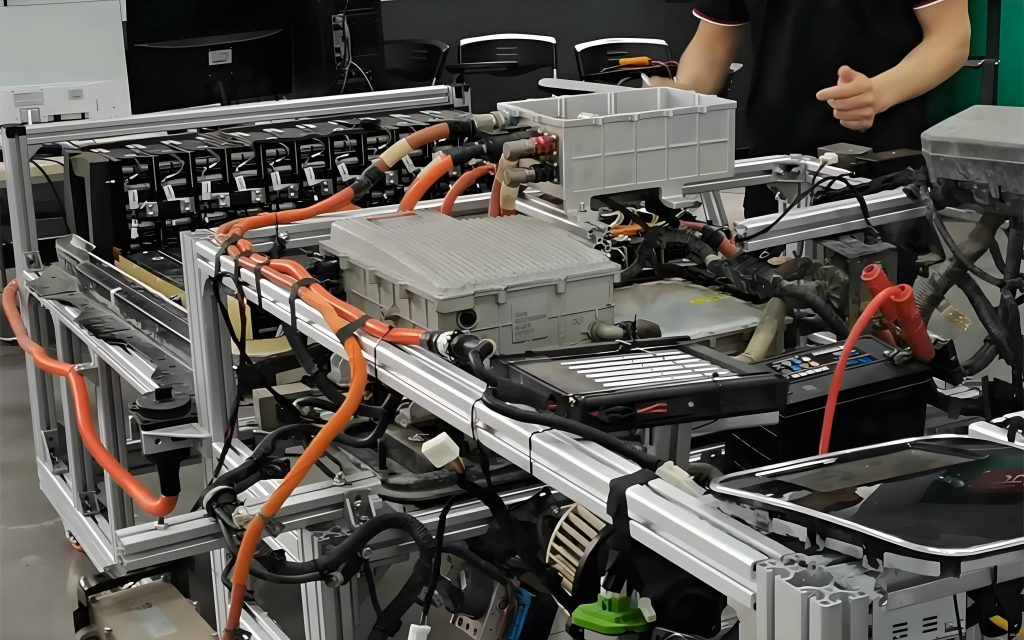
One of the primary distinctions in EV repair lies in the power systems. Traditional vehicles rely on combustion engines and low-voltage electrical circuits, whereas EVs operate with high-voltage batteries and complex control units. From my observations, this shift increases the risk of electrical faults, such as insulation failures or battery management system (BMS) errors. For example, the voltage in an EV battery can exceed 400V, compared to the 12V or 24V systems in conventional cars. This necessitates specialized safety protocols in EV repair, including the use of insulated tools and rigorous training. Moreover, the integration of software-defined features in electrical car repair adds layers of complexity; firmware updates and sensor calibrations require expertise that goes beyond mechanical know-how. As I explore these aspects, it becomes clear that EV repair is not just an extension of traditional methods but a distinct discipline demanding innovative solutions.
Currently, the EV repair sector grapples with several pressing issues. Technical standards remain fragmented, leading to inconsistencies in diagnostics and repairs. In my analysis, this lack of uniformity affects the reliability of EV repair outcomes. For instance, battery testing methods vary widely, with some focusing on capacity fade and others on thermal performance. This can be summarized in a table comparing key parameters in EV repair:
| Parameter | Traditional Focus | EV Repair Focus | Impact on Repair Accuracy |
|---|---|---|---|
| Capacity | Basic charge levels | Cycle life and degradation | High variability in results |
| Internal Resistance | Minimal emphasis | Critical for safety and efficiency | Inconsistent measurements |
| Thermal Stability | Not typically monitored | Essential for preventing failures | Lack of standardized thresholds |
As shown, the absence of cohesive standards in EV repair complicates fault diagnosis and increases repair times. Furthermore, the shortage of skilled technicians in electrical car repair exacerbates these problems. Based on industry data, the demand for EV repair professionals far outstrips supply, leading to prolonged service delays and higher costs. This imbalance is highlighted in the following table, which illustrates the gap in talent for EV repair:
| Year | Demand for EV Repair Technicians | Supply of Skilled Professionals | Deficit |
|---|---|---|---|
| 2023 | 25 | 8 | 17 |
| 2024 | 30 | 10 | 20 |
| 2025 | 35 | 12 | 23 |
From my perspective, this shortage not only affects service quality but also raises safety concerns in EV repair, as untrained personnel may mishandle high-voltage components. Additionally, the high cost of specialized equipment for electrical car repair poses a barrier for many repair shops. For example, a comprehensive battery analyzer can cost over $50,000, making it inaccessible for small businesses. This financial strain is compounded by the rapid obsolescence of tools in the fast-evolving EV repair landscape.
To address these challenges, I propose several solutions centered on standardizing EV repair practices. First, developing unified technical standards is essential. In my view, this involves collaborating with international bodies to establish protocols for battery testing, motor diagnostics, and software validation. For instance, adopting a common framework for SOH assessment in EV repair could use formulas like $$ SOH = 100 \times \left(1 – \frac{R_{internal}}{R_{initial}}\right) $$ where \( R_{internal} \) is the current internal resistance and \( R_{initial} \) is the initial value. This would enhance consistency across electrical car repair services. Second, bolstering education and training for EV repair is critical. I advocate for expanding vocational programs that integrate hands-on experience with high-voltage systems. Simulations and augmented reality tools can bridge the gap, allowing trainees to practice EV repair in a safe environment. Moreover, partnerships between academia and industry can foster innovation in electrical car repair curricula, ensuring they align with real-world demands.
Another key solution lies in optimizing equipment for EV repair. I recommend promoting the development of affordable, multi-functional diagnostic devices. For example, a universal tester for EV batteries could incorporate algorithms based on $$ V_{output} = I \times R + E_{cell} $$ where \( V_{output} \) is the output voltage, \( I \) is the current, \( R \) is the resistance, and \( E_{cell} \) is the cell EMF. Such tools would streamline electrical car repair processes and reduce costs. Additionally, implementing equipment-sharing platforms can democratize access to advanced resources, benefiting smaller EV repair shops. To tackle the issue of high repair expenses, I suggest leveraging data analytics to predict maintenance needs. By analyzing historical EV repair data, shops can pre-order parts and optimize inventory, cutting downtime and costs. For instance, predictive models using $$ P(failure) = \frac{1}{1 + e^{-(a + b \times age + c \times usage)}} $$ where \( a, b, c \) are coefficients, can forecast component failures in electrical car repair, enabling proactive interventions.
Looking ahead, the future of EV repair is poised for transformation through智能化 technologies. In my opinion, the integration of artificial intelligence (AI) and machine learning will revolutionize electrical car repair by enabling predictive maintenance and automated diagnostics. For example, AI algorithms can process vast datasets from EV sensors to detect anomalies early, using formulas like $$ Anomaly Score = \sqrt{\sum (x_i – \mu)^2} $$ where \( x_i \) are data points and \( \mu \) is the mean. This approach enhances the efficiency of EV repair by identifying issues before they escalate. Remote diagnostics will also play a pivotal role in electrical car repair; with 5G connectivity, technicians can perform real-time analyses and software updates without physical access. I envision a future where EV repair is seamlessly integrated with smart grids, allowing for dynamic energy management and reduced environmental impact. Furthermore, the adoption of green practices in electrical car repair, such as recycling batteries and using eco-friendly materials, will align with sustainability goals. For instance, repurposing used EV batteries for energy storage can be modeled with $$ E_{reused} = \eta \times E_{original} $$ where \( \eta \) is the efficiency factor, demonstrating the circular economy potential in EV repair.
In conclusion, as I reflect on the current state of EV repair, it is evident that addressing its challenges requires a multifaceted approach. By standardizing technical protocols, enhancing workforce development, and embracing technological innovations, we can elevate the standards of electrical car repair. The journey toward efficient and sustainable EV repair is ongoing, but with collaborative efforts, we can ensure that the EV industry thrives, supporting a cleaner and smarter transportation ecosystem. Through continued research and practical applications, the field of EV repair will undoubtedly evolve, paving the way for a future where electric vehicles are maintained with precision and care.