
With the rapid development of the new energy vehicle industry, EV charging stations have become a critical component of the distribution network. The widespread integration of high-density EV charging stations poses unprecedented challenges to power supply quality, including voltage stability, power quality, network losses, and reliability. In this paper, we analyze these impacts under various scenarios and propose optimization strategies to enhance distribution network performance. Our approach includes optimized planning and layout, advanced operation control, coordinated source-grid-load-storage systems, and demand-side response integration. Through simulation, we validate that these methods significantly improve power supply quality, supporting the sustainable growth of the electric vehicle sector and providing theoretical and practical guidance for network planning and management.
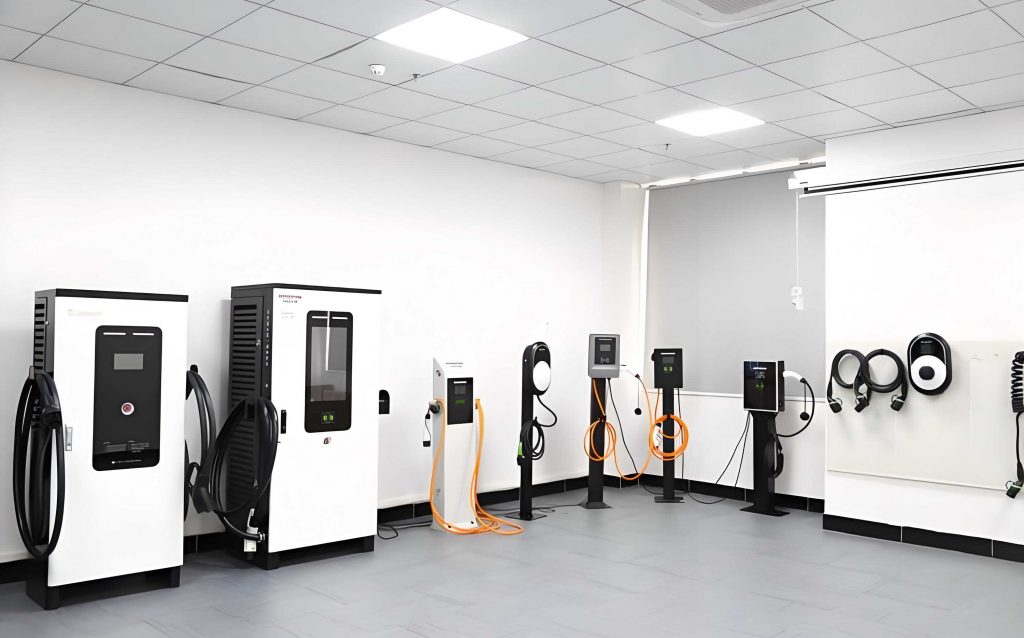
The distribution network serves as the backbone of the power system, responsible for delivering electricity from transmission networks to end-users. It comprises substations, feeders, distribution transformers, and switching devices, configured in radial, ring, or hybrid topologies. As technology advances, distribution networks are evolving towards smarter and more flexible systems to accommodate distributed energy resources and new loads like EV charging stations. Key functions include voltage regulation, reactive power compensation, and fault isolation, all of which are essential for maintaining reliability and power quality. Indicators such as voltage deviation, frequency deviation, and system average interruption duration index are critical for user experience. The integration of EV charging stations introduces dynamic loads that can strain these systems, particularly during peak periods, leading to issues like voltage sags, harmonic distortions, and increased losses.
Under different scenarios, the impact of high-density EV charging stations on distribution network power quality varies significantly. During peak hours, such as morning and evening commutes, concentrated charging activities create dual load peaks, causing voltage deviations and exceedances. Instantaneous high-power charging can lead to voltage fluctuations, while harmonic pollution from non-linear charging equipment interferes with protection systems, reduces metering accuracy, and accelerates device wear. Additionally, active and reactive power losses escalate, especially at network endpoints. To address these challenges, optimized charging strategies, energy storage systems, and harmonic suppression devices are essential. For instance, in low-permeability scenarios, the network remains stable, but high permeability alters load characteristics, necessitating mitigation measures. Regional differences also play a role; urban centers face greater load pressures, whereas suburban and industrial areas may experience milder effects but require careful planning during specific periods.
We propose several optimization methods to mitigate these impacts. First, optimizing the planning and layout of EV charging stations involves considering factors like traffic flow, land use efficiency, and grid load distribution. A key objective is to minimize voltage deviation at access points, formulated as:
$$ \min \sum_{i=1}^{n} |V_i – V_{\text{rated}}| $$
where \( n \) is the total number of EV charging stations, \( V_i \) is the voltage at access point \( i \), and \( V_{\text{rated}} \) is the rated voltage. This method employs interactive models between EV charging stations and the distribution network, incorporating power demands, charging schedules, and load characteristics. Optimization algorithms, such as particle swarm optimization, are used to iteratively determine the best layout, supported by geographic information systems for visual analysis.
Second, optimizing operation control through intelligent scheduling dynamically adjusts charging power in response to real-time grid负荷 changes. The objective function combines deviations in charging power and grid load:
$$ \min \int_{0}^{T} \left[ c_1 \sum_{i=1}^{m} |P_{\text{ch},i}(t) – P_{\text{ch},i,\text{set}}(t)| + c_2 |P_{\text{grid}}(t) – P_{\text{grid,set}}(t)| \right] dt $$
where \( T \) is the total time period, \( c_1 \) and \( c_2 \) are weight coefficients, \( P_{\text{ch},i}(t) \) is the actual charging power of EV charging station \( i \) at time \( t \), \( P_{\text{grid}}(t) \) is the actual grid load, and \( P_{\text{grid,set}}(t) \) is the set grid load. Techniques like mixed-integer linear programming and genetic algorithms handle integer constraints and global optimization, enhancing operational efficiency.
Third, source-grid-load-storage coordination optimizes the synergy between EV charging stations, the distribution network, renewable energy sources, and storage systems. A multi-objective optimization approach balances economy, reliability, and environmental factors:
$$ \min \left[ f_1(x), f_2(x), f_3(x) \right] $$
where \( f_1(x) \) represents system operating costs (e.g., maintenance of EV charging stations, storage cycling costs, and renewable generation costs), \( f_2(x) \) denotes reliability indicators like loss of load probability, and \( f_3(x) \) covers environmental metrics such as carbon emissions. Improved non-dominated sorting genetic algorithms solve this model, ensuring user needs are met while reducing costs and pollution.
Fourth, integrating demand-side response utilizes pricing and incentive mechanisms to guide users in adjusting charging behavior during peak periods. Real-time pricing or demand response signals encourage off-peak charging, while incentive-based programs offer compensation for load reduction or delay. This strategy includes direct load control and interruptible load options, designed to maintain user satisfaction while stabilizing the grid.
To validate these methods, we conducted a case study using the IEEE 33-node model of a typical urban distribution network. The network spans 10.82 km with a rated voltage of 12.66 kV and a base capacity of 100 MV·A. High-density EV charging stations with a power rating of 350 kW were integrated at key nodes, with charging durations ranging from 30 minutes to 1 hour. The layout was optimized based on traffic, land use, and load distribution. Simulation results, summarized in Table 1, show significant improvements in power quality post-optimization. Voltage stability enhanced, with all node deviations controlled within safe limits, harmonic distortion reduced below 3%, and active and reactive losses at endpoints minimized.
| Item | Before Optimization | After Optimization |
|---|---|---|
| Voltage Stability | Voltage deviation exceeded ±5% limit | All node voltage deviations controlled within safe range |
| Harmonic Pollution | Total harmonic distortion exceeded 5% | Total harmonic distortion reduced below 3% |
| Network Losses | High active and reactive losses at end nodes | Significantly reduced losses, improved operational efficiency |
The optimization strategies effectively enhanced power supply quality, ensuring high efficiency and reliability while lowering operational costs and environmental impact. However, some methods, such as those relying on intricate models and algorithms, present computational challenges and implementation complexities. The effectiveness may also be influenced by network structure and load characteristics. Despite these limitations, our findings offer a solid theoretical foundation and practical guidance for integrating EV charging stations into distribution networks, promoting the adoption of electric vehicles and sustainable energy development.
In conclusion, the integration of high-density EV charging stations introduces significant challenges to distribution network power quality, but through optimized planning, operation control, coordination, and demand-side response, these issues can be mitigated. Our simulations confirm the efficacy of these approaches in improving voltage stability, reducing harmonics and losses, and enhancing reliability. Future advancements in technology and policy support will further enable the harmonious development of distribution networks and the electric vehicle industry, driving energy transition and green sustainability. The continuous evolution of EV charging station integration will play a pivotal role in achieving these goals, underscoring the importance of ongoing research and innovation in this field.