
As an automotive engineer and industry observer, I have dedicated years to studying the transformative shift toward electrification in the transportation sector. In this comprehensive analysis, I will delve into the strategic imperatives, technological advancements, and future trajectory of pure electric vehicles (EVs) and plug-in hybrid cars within the Chinese context. The rise of the hybrid car, in particular, represents a critical bridge in this transition, merging the benefits of electric propulsion with the practicality of internal combustion. My goal is to provide a detailed examination supported by data, formulas, and comparative tables, highlighting why these vehicles are pivotal for China’s sustainable development.
The strategic importance of developing pure electric and plug-in hybrid cars cannot be overstated. Firstly, from an energy security perspective, China’s growing dependence on imported oil poses a significant national risk. The transportation sector is a major consumer of petroleum products. By transitioning to vehicles that can utilize electricity—a energy carrier that can be generated domestically from diverse sources—we can drastically reduce our reliance on foreign oil. The energy shift facilitated by the widespread adoption of electric and hybrid cars enhances national energy independence. Secondly, environmental protection is a paramount concern. Urban air pollution and greenhouse gas emissions are largely attributed to tailpipe emissions from conventional vehicles. Pure EVs produce zero direct emissions, while a well-designed hybrid car can dramatically cut CO2 and pollutant output during urban driving cycles. This aligns with global climate goals and improves public health. Thirdly, from an economic standpoint, the automotive industry is a pillar of China’s economy. Leading the charge in new energy vehicle technology, especially in hybrid car systems, ensures long-term industrial competitiveness and job creation in high-tech sectors. Finally, mastering the core technologies of electric and hybrid vehicles is the essential path to realizing the “Automotive Powerhouse” dream, moving from being the world’s largest market to a global leader in innovation and manufacturing.
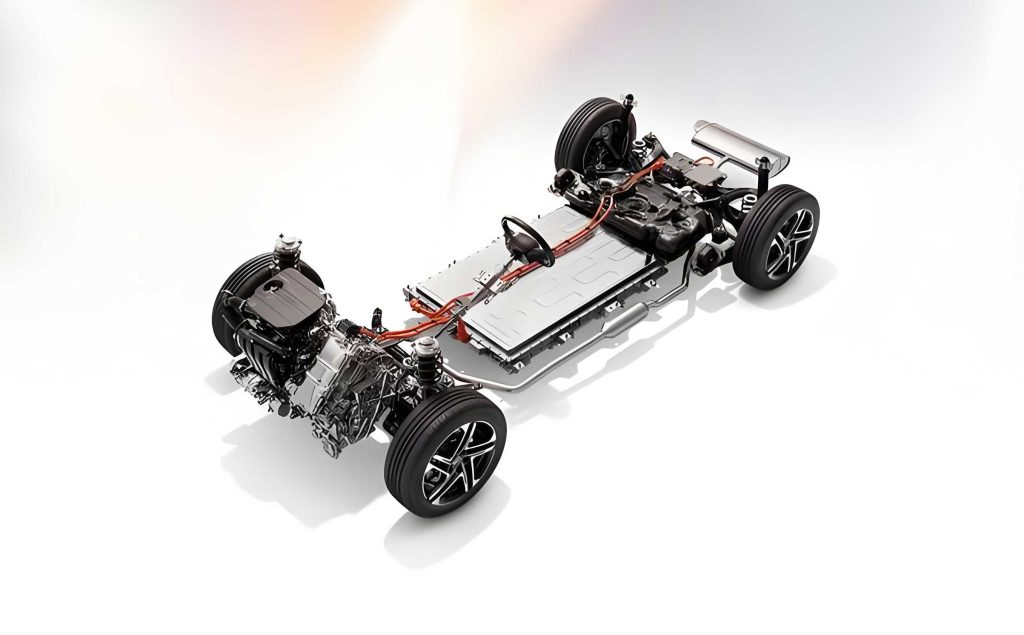
To understand our position, a comparative analysis of domestic and international development is crucial. In the realm of pure electric vehicles, international leaders like Tesla, Nissan, and BMW have established strong advantages in mass production, supply chain management, and advanced material application (e.g., carbon fiber in BMW i3). Chinese manufacturers have made remarkable progress in battery technology and vehicle models, but there remains a gap in achieving the same level of standardized, cost-effective production scale and in some advanced lightweight material applications. For plug-in hybrid cars, the gap is more pronounced in core components and system integration. International OEMs have refined their hybrid car powertrains over decades, achieving superior smoothness in mode transitions, fuel economy in real-world conditions, noise, vibration, and harshness (NVH) performance, and overall reliability. However, the Chinese industry has responded vigorously in recent years. The “14th Five-Year Plan” period has seen the launch of several next-generation dedicated hybrid platforms. Let’s examine some key domestic hybrid car technologies in a table:
| Domestic Hybrid Car Platform | Architecture Type | Key Features | Claimed NEDC Fuel Economy (L/100km) | Max Pure Electric Range (PHEV, km) |
|---|---|---|---|---|
| Wei牌 Intelligent DHT | P1+P3 Serial-Parallel with 2-speed Engine Direct Drive | High system efficiency (up to 97%), early engine engagement (~35-40 km/h), modular battery | ~4.7 (for HEV variant) | Up to 320 (announced) |
| BYD DM-i (EHS System) | Single-speed P1+P3 Serial-Parallel | Highly integrated EHS, 43% thermal efficiency dedicated engine, blade battery | As low as 3.8 (model dependent) | Varies by model (e.g., 120-200+) |
| Geely GHS 2.0 | Multi-mode Hybrid | Focus on cost-effectiveness and performance | Data pending widespread release | Data pending |
| Chery Kunpeng DHT | Multi-speed DHT | 3-speed dedicated transmission, 9 working modes | ~5.0 (for PHEV under certain conditions) | ~100 |
The efficiency of a hybrid car powertrain is a complex function of component efficiencies and energy management strategy. The overall system efficiency (η_system) can be conceptually represented as a weighted combination of the electric drive efficiency (η_electric) and the engine-generator path efficiency (η_engine_gen). For a series-parallel hybrid car during charge-sustaining operation, one might model the effective fuel consumption. A simplified formula for energy consumption per distance (E_d) in a plug-in hybrid car considering both fuel and electricity is:
$$ E_d = \frac{E_{batt} \cdot \eta_{charge}^{-1} + (D – R_{elec}) \cdot \frac{H_{lhv}}{\eta_{engine} \cdot \eta_{trans}}}{D} $$
where:
- $E_{batt}$ is the electrical energy consumed from the battery (kWh),
- $\eta_{charge}$ is the grid-to-battery charging efficiency,
- $D$ is the total distance traveled (km),
- $R_{elec}$ is the pure electric range (km),
- $H_{lhv}$ is the lower heating value of the fuel (kWh/L),
- $\eta_{engine}$ is the engine thermal efficiency,
- $\eta_{trans}$ is the transmission efficiency from engine to wheels.
This underscores the importance of high-efficiency components. The domestic breakthroughs in dedicated hybrid engines with over 43% thermal efficiency are a testament to progress. However, key component gaps persist. The following table contrasts domestic and international levels in critical subsystems for electric and hybrid cars:
| Key Component | International Advanced Level (Typical) | Domestic Current Level (Typical) | Gap / Note |
|---|---|---|---|
| Drive Motor Power Density | Peak: 3.8 kW/kg; Continuous: 2.4-2.8 kW/kg | Peak: 2.8-3.0 kW/kg; Continuous: 1.2-1.6 kW/kg | Need for improvement in materials and cooling. |
| Motor Controller / Power Electronics Integration | Highly integrated “e-Axle” or multi-in-one units, high specific power. | Often separate units for controller, OBC, DCDC; lower integration. | System integration is crucial for cost and space saving. |
| Functional Safety (ISO 26262) Application | Deeply integrated into hardware/software development lifecycle, common ASIL-D certification. | Growing awareness, but application not yet pervasive across full development process. | Critical for reliability and market acceptance, especially for autonomous features. |
| On-Board Charger (OBC) Specific Power | ~0.6 kW/L | ~0.3-0.4 kW/L | Affects packaging and weight. |
| Heat Pump Air Conditioning System | Commercialized for EVs using R134a or R1234yf. | Mostly PTC heaters; heat pump systems in R&D. | Heat pump significantly reduces winter range penalty. |
| Electro-Hydraulic Braking System for Regeneration | Widespread use of sophisticated brake blending systems. | Mostly use simpler superimposed regeneration systems. | Advanced blending maximizes energy recovery and safety. |
The development of charging infrastructure is the backbone of EV adoption and also supports plug-in hybrid car users by enabling frequent electric-only driving. The trend is toward faster, smarter, and more interconnected systems. High-power charging (HPC) stations capable of delivering over 350 kW are being deployed internationally. In China, the focus is on building a dense network and integrating with the smart grid. Wireless charging, both static and dynamic, is progressing from demonstration to commercialization. The interoperability and payment standardization across different charging networks remain areas for improvement. The ultimate vision is a seamless ecosystem where any electric or plug-in hybrid car can charge quickly and intelligently, with the vehicle acting as a mobile energy storage unit to support grid stability through vehicle-to-grid (V2G) technology. The efficiency of energy transfer in wireless charging can be modeled by the coupling coefficient (k) and the quality factors (Q) of the coils:
$$ \eta_{wireless} \approx \frac{k^2 Q_1 Q_2}{1 + k^2 Q_1 Q_2} \cdot \eta_{electronics} $$
where $Q_1$ and $Q_2$ are the quality factors of the transmitter and receiver coils, respectively, and $\eta_{electronics}$ accounts for losses in power converters. Maximizing this efficiency is a key research focus.
Analyzing future trends, the plug-in hybrid car holds a unique position. It is not merely a transitional technology but a compelling long-term solution for many consumers, especially in regions with charging anxiety or for users with diverse driving patterns. The trend in hybrid car technology is toward deeper electrification, higher integration, and smarter control. Multi-mode, multi-speed dedicated hybrid transmissions (DHTs), as seen in the new Chinese platforms, are becoming the norm to optimize efficiency across all speed ranges. The use of artificial intelligence and connectivity for predictive energy management is the next frontier. A connected hybrid car can pre-condition its battery, select the optimal powertrain mode based on real-time traffic and topography from cloud data, and coordinate with charging schedules. This intelligent management minimizes total cost of ownership and emissions. The fuel consumption of a smart hybrid car on a given route can be significantly lower than that of a conventionally managed one. We can express the optimization goal as minimizing a cost function J over a trip:
$$ J = \min_{u(t)} \int_{0}^{T} \left[ \alpha \cdot \dot{m}_{fuel}(u(t), x(t)) + \beta \cdot P_{grid}(t) \cdot I_{charge}(t) \right] dt + \gamma \cdot (SOC(T) – SOC_{target})^2 $$
subject to system dynamics $ \dot{x}(t) = f(x(t), u(t)) $ and constraints. Here, $u(t)$ represents control inputs (engine on/off, torque split, gear selection), $x(t)$ is the state (e.g., battery state-of-charge SOC), $\dot{m}_{fuel}$ is fuel flow, $P_{grid}$ is grid power price, and $I_{charge}$ is charging current. The weights α, β, γ balance fuel cost, electricity cost, and final SOC. Solving this in real-time using cloud-computed predictions is the future for every advanced hybrid car.
Looking at the broader picture, the development vision for pure electric and plug-in hybrid cars in China is multifaceted. By 2030, I envision these vehicles constituting the majority of new car sales. This mass adoption will tangibly enhance energy security by displacing millions of tons of oil imports annually. Environmentally, cities will experience a dramatic improvement in air quality, and China’s carbon footprint from transportation will peak and decline. Economically, a robust, self-sufficient supply chain for batteries, motors, and power semiconductors will have been established, making China a global export hub for electric and hybrid car technologies. The charging infrastructure will be ubiquitous, ultra-fast, and fully integrated with renewable energy sources, enabling a true synergy between the transportation and power sectors. The hybrid car, in its plug-in form, will continue to play a vital role for long-distance travelers and in commercial applications where operational flexibility is key. Ultimately, the success of this vision will cement China’s position as a definitive automotive powerhouse, not just in scale but in innovation, sustainability, and influence over global automotive standards.
In conclusion, the journey of electrification is complex and challenging, but the strategic direction is clear. The continuous innovation in battery chemistry, motor design, power electronics, and system integration for both pure EVs and plug-in hybrid cars is driving down costs and improving performance. As an engineer, I am particularly excited by the intelligentization of the hybrid car powertrain, where software and connectivity redefine efficiency boundaries. The collaborative efforts between academia, industry, and government in China are creating a fertile ground for breakthroughs. While gaps with international leaders exist in specific areas, the pace of catching up and even leapfrogging in some domains, like battery integration and dedicated hybrid platforms, is remarkable. The future of mobility in China is undoubtedly electric, with the versatile and efficient hybrid car serving as a crucial catalyst and enduring participant in this cleaner, smarter transportation ecosystem.