
Precise trajectory tracking and robust stability control are paramount for the safety and performance of autonomous driving systems. For battery electric vehicles, especially those with distributed drive configurations offering independent torque control at each wheel, these challenges present both unique difficulties and significant opportunities. Traditional control strategies, while effective under nominal conditions, often struggle with the nonlinear tire dynamics and varying operational states encountered in extreme driving scenarios, such as high-speed maneuvers or low-adhesion surfaces. This limitation can compromise both tracking accuracy and vehicular stability. To address this, we propose a novel integrated control strategy for trajectory tracking and direct yaw moment control (DYC), optimized using a hybrid Genetic-Firefly Algorithm (G-FA). This approach synergizes a feedforward-enhanced Linear Quadratic Regulator (LQR) for path following with a fuzzy PID controller for stability augmentation, specifically designed for a four-wheel-independent-drive battery electric vehicle.
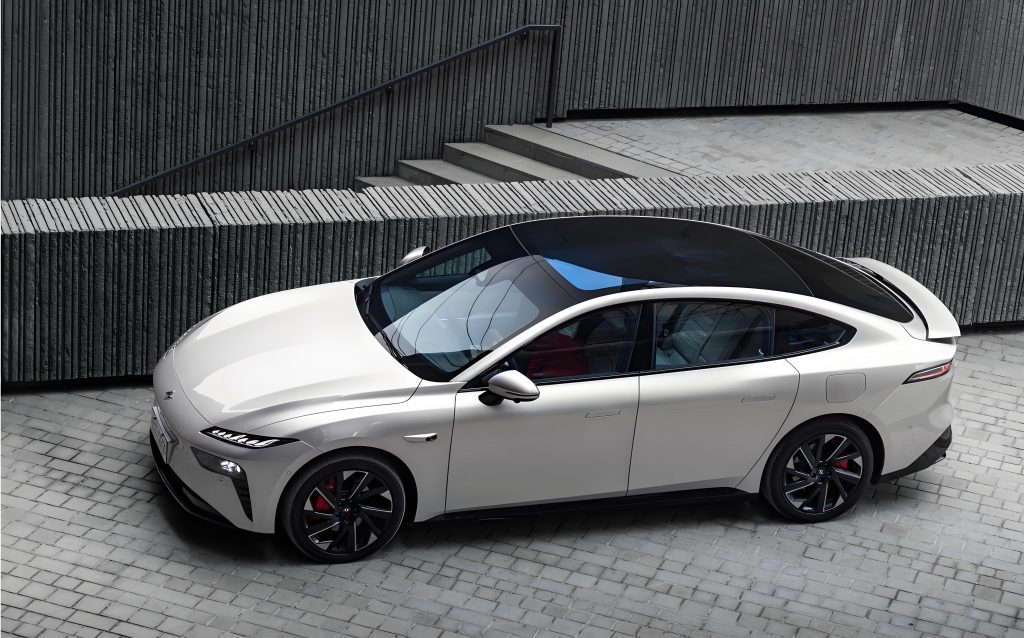
The core of our methodology begins with establishing accurate mathematical representations of the vehicle’s behavior. We utilize a classical bicycle model to capture the essential lateral and yaw dynamics of the battery electric vehicle. The model’s state-space formulation is pivotal for controller design. The equations governing this two-degree-of-freedom model are:
$$m(\dot{v} + u\omega_r) = (k_1 + k_2)\beta + \frac{1}{u}(a k_1 – b k_2)\omega_r – k_1 \delta$$
$$I_z \dot{\omega}_r = (a k_1 – b k_2)\beta + \frac{1}{u}(a^2 k_1 + b^2 k_2)\omega_r – a k_1 \delta$$
where \(m\) is the vehicle mass, \(I_z\) is the yaw moment of inertia, \(u\) and \(v\) are the longitudinal and lateral velocities, \(\omega_r\) is the yaw rate, \(\beta\) is the sideslip angle (\( \beta \approx v/u \)), \(\delta\) is the front wheel steering angle, \(a\) and \(b\) are distances from the center of gravity to the front and rear axles, and \(k_1\), \(k_2\) are the cornering stiffnesses of the front and rear axles, respectively.
From this, the state-space model is derived with the state vector \(\xi = [v, \omega_r]^T\) and control input \(U=\delta\):
$$
\begin{bmatrix}
\dot{v} \\
\dot{\omega}_r
\end{bmatrix} =
\begin{bmatrix}
\frac{k_1+k_2}{mu} & \frac{a k_1 – b k_2}{mu} – u \\
\frac{a k_1 – b k_2}{I_z u} & \frac{a^2 k_1 + b^2 k_2}{I_z u}
\end{bmatrix}
\begin{bmatrix}
v \\
\omega_r
\end{bmatrix} +
\begin{bmatrix}
-\frac{k_1}{m} \\
-\frac{a k_1}{I_z}
\end{bmatrix} \delta
$$
To effectively track a desired path, we define a tracking error model. The primary errors are the lateral distance error \(e_d\) from the vehicle’s center of gravity to the reference path and the heading error \(e_\phi\) between the vehicle’s yaw angle and the path’s tangent. The dynamics of these errors can be expressed as part of an extended state vector \(e_{rr} = [e_d, \dot{e}_d, e_\phi, \dot{e}_\phi]^T\):
$$
\dot{e}_{rr} = A e_{rr} + B U + C \dot{\theta}_r
$$
where \(\theta_r\) is the reference heading angle, and the matrices \(A\), \(B\), and \(C\) are constructed from the vehicle parameters and states. This error model forms the basis for the LQR trajectory tracking controller.
The LQR controller is designed to minimize a quadratic cost function \(J\) that penalizes both tracking errors and control effort:
$$
J = \frac{1}{2} \int_0^\infty [e_{rr}^T(t) Q e_{rr}(t) + U^T(t) R U(t)] dt
$$
Here, \(Q\) is a positive semi-definite matrix weighting the state errors, and \(R\) is a positive definite matrix weighting the control input. The solution yields an optimal state-feedback control law \(\Delta U(t) = -K e_{rr}(t)\), where the gain matrix \(K = R^{-1}B^TP\) and \(P\) is found by solving the algebraic Riccati equation \(PA + A^TP – PBR^{-1}B^TP + Q = 0\).
To eliminate steady-state error, especially during cornering, a feedforward control term \(\delta_f\) is introduced. The combined control input becomes \(U = -K e_{rr} + \delta_f\). The optimal feedforward steering angle for a path with curvature \(\rho\) is calculated as:
$$
\delta_f = \rho \left[ a+b – bK_3 – \frac{mu^2}{a+b} \left( \frac{b}{k_1} + \frac{a}{k_2}K_3 – \frac{a}{k_2} \right) \right]
$$
where \(K_3\) is the corresponding element of the feedback gain matrix \(K\).
The performance of the LQR controller is highly sensitive to the choice of the weighting matrices \(Q\) and \(R\). Traditional manual tuning is suboptimal and non-adaptive. To overcome this, we employ a hybrid Genetic-Firefly Algorithm (G-FA) to optimize the key parameters of the \(Q\) matrix (specifically, the weights \(q_1\) and \(q_3\) corresponding to the lateral and heading errors). The G-FA combines the global search capability of the Genetic Algorithm (GA) with the efficient local search ability of the Firefly Algorithm (FA). The optimization process aims to minimize a fitness function defined as the weighted sum of the average absolute lateral and heading errors:
$$
\text{Fitness} = w_1 |\bar{e}_d| + w_2 |\bar{e}_\phi|
$$
with \(w_1=0.6\) and \(w_2=0.4\). The algorithm parameters are set as follows:
| Parameter | Value | Parameter | Value |
|---|---|---|---|
| Population Size | 100 | Crossover Probability | 0.4 |
| Number of Individuals | 10 | Mutation Probability | 0.001 |
| Parameter Range | [1, 100] | Light Absorption Coefficient | 1 |
| Max Iterations | 10 | Max Attractiveness | 1 |
While the optimized LQR controller excels at spatial tracking, it does not explicitly account for the stability limits of the battery electric vehicle. Under extreme conditions, excessive sideslip can lead to loss of control. Therefore, we augment the system with a Direct Yaw Moment Control (DYC) subsystem. A fuzzy PID controller is designed to compute an additional yaw moment \(\Delta M\) required to stabilize the vehicle. The controller inputs are the error \(e_\beta\) between the actual sideslip angle \(\beta\) and a desired reference \(\beta_d\), and its derivative. The reference sideslip angle is derived from the linear vehicle model but is bounded by physical limits considering tire-road adhesion \(\mu\) and gravity \(g\):
$$
\beta_d = \min\left( \left| \frac{b + \frac{m a u^2}{k_2 L}}{L(1+Ku^2)} \delta \right|, \left| \mu g \left( \frac{b}{u^2} + \frac{ma}{k_2 L} \right) \right| \right) \cdot \text{sgn}(\delta_{lin})
$$
The fuzzy logic system dynamically adjusts the proportional (\(k_p\)), integral (\(k_i\)), and derivative (\(k_d\)) gains of the PID controller based on \(e_\beta\) and its change rate. The output yaw moment is:
$$
\Delta M(t) = k_p e_\beta(t) + k_i \int_0^t e_\beta(\tau) d\tau + k_d \frac{de_\beta(t)}{dt}
$$
This yaw moment is ultimately distributed as differential torque to the individual wheels of the battery electric vehicle.
The integrated control framework was rigorously tested using a co-simulation platform combining CarSim (for high-fidelity vehicle dynamics) and Simulink (for control algorithm implementation). The parameters of the subject battery electric vehicle are listed below.
| Parameter | Value | Parameter | Value |
|---|---|---|---|
| Vehicle Mass, \(m\) (kg) | 1412 | Rear Axle Cornering Stiffness, \(k_2\) (kN/rad) | -110 |
| Distance from CoG to Front Axle, \(a\) (m) | 1.015 | Yaw Moment of Inertia, \(I_z\) (kg·m²) | 1536.7 |
| Distance from CoG to Rear Axle, \(b\) (m) | 1.895 | Wheel Effective Radius (m) | 0.325 |
| Front Axle Cornering Stiffness, \(k_1\) (kN/rad) | -110 |
Two demanding test scenarios were evaluated: a double lane-change maneuver at 80 km/h on a surface with a friction coefficient of 0.7, and an S-curve track at 60 km/h with a friction coefficient of 0.6. Three controllers were compared: the baseline LQR (LQR), the G-FA optimized LQR (G-FA-LQR), and the full integrated G-FA optimized LQR with DYC (G-FA-LQR-DYC).
In the double lane-change scenario, the G-FA-LQR-DYC controller demonstrated superior performance. The tracking trajectory was the closest to the reference, particularly during high-curvature sections of the maneuver. The quantitative results, summarized in the table below, show significant improvements.
| Performance Metric | Baseline LQR | G-FA-LQR | G-FA-LQR-DYC | Improvement (vs. LQR) |
|---|---|---|---|---|
| Lateral Error Peak (m) | 0.5508 | 0.3806 | 0.3738 | 32.14% |
| Lateral Error RMS (m) | 0.2066 | 0.1731 | 0.1574 | 23.81% |
| Heading Error Peak (rad) | 0.0901 | 0.0874 | 0.0664 | 26.30% |
| Sideslip Angle Peak (rad) | 0.0898 | 0.0818 | 0.0668 | 25.61% |
| Yaw Rate Peak (rad/s) | 0.5549 | 0.5296 | 0.5132 | 7.51% |
The stability enhancements from the DYC subsystem are clear. While G-FA optimization alone reduced tracking errors, the integrated controller markedly suppressed the vehicle’s sideslip angle and yaw rate, indicating a more stable and controllable state for the battery electric vehicle during the aggressive maneuver.
The S-curve test further validated the controller’s effectiveness in sustained cornering. The G-FA-LQR-DYC controller drastically reduced the lateral tracking error. The results are presented below:
| Performance Metric | Baseline LQR | G-FA-LQR | G-FA-LQR-DYC | Improvement (vs. LQR) |
|---|---|---|---|---|
| Lateral Error Peak (m) | 0.6843 | 0.6733 | 0.2718 | 60.28% |
| Lateral Error RMS (m) | 0.4895 | 0.4907 | 0.2183 | 55.40% |
| Heading Error Peak (rad) | 0.0460 | 0.0437 | 0.0426 | 7.39% |
| Sideslip Angle Peak (rad) | 0.0174 | 0.0161 | 0.0156 | 10.34% |
| Yaw Rate Peak (rad/s) | 0.3646 | 0.3380 | 0.3300 | 9.49% |
In this scenario, the lateral error reduction is particularly dramatic. The synergy between the optimized trajectory tracker and the stability controller allows the battery electric vehicle to follow the path more accurately while maintaining a stable posture, even on a lower-friction road.
In conclusion, the proposed G-FA optimized cooperative control strategy successfully addresses the dual challenges of trajectory tracking and stability management for a distributed drive battery electric vehicle. The hybrid G-FA algorithm efficiently tunes the LQR controller for optimal tracking performance across specific operational domains. The incorporation of a feedforward term eliminates steady-state error, while the fuzzy PID-based DYC subsystem actively constrains the vehicle’s sideslip and yaw motion, preventing instability. Simulation results under rigorous double lane-change and S-curve conditions confirm substantial improvements in both tracking precision (reduced lateral and heading error) and dynamic stability (reduced sideslip angle and yaw rate) compared to a conventional LQR controller. This integrated approach provides a robust and effective framework for enhancing the safety and performance of autonomous battery electric vehicles in complex driving environments. Future work will focus on extending this framework to include roll stability considerations and real-time adaptive parameter optimization for even broader operational envelopes.