
As an experienced professional in the field of electric vehicle maintenance, I have witnessed the rapid evolution of the automotive industry, particularly with the widespread adoption of electric vehicles (EVs). The shift from traditional internal combustion engines to electric powertrains has introduced unique challenges in EV repair and diagnostics. In this comprehensive discussion, I will delve into the common faults encountered in electrical car repair, supported by detailed analyses, practical solutions, and real-world case studies. The goal is to provide a thorough understanding of how to effectively address these issues, leveraging modern diagnostic tools and methodologies. With the growing demand for sustainable transportation, mastering EV repair has become crucial for technicians and researchers alike. This article will explore key aspects such as transmission malfunctions, motor failures, and battery-related problems, all while emphasizing the importance of systematic approaches in electrical car repair. Throughout, I will incorporate tables and formulas to summarize critical data and principles, ensuring a holistic perspective on this dynamic field.
The proliferation of electric vehicles has transformed the automotive landscape, driven by advancements in technology and increasing environmental awareness. However, as EVs become more prevalent, so do the complexities associated with their maintenance. In my practice, I have observed that many faults stem from the intricate electrical systems that power these vehicles. For instance, issues with the transmission, motor, and battery are common and require specialized knowledge in EV repair. One fundamental aspect of electrical car repair is understanding the underlying principles of EV operation. Electric vehicles rely on high-voltage batteries to supply power to electric motors, which then drive the wheels. This process involves complex control systems that manage energy flow, and any disruption can lead to performance issues. To illustrate, consider the basic power equation in an EV: $$P = V \times I$$ where \(P\) is the power in watts, \(V\) is the voltage, and \(I\) is the current. This formula is essential in diagnosing power-related faults during EV repair, as deviations from expected values can indicate problems in the battery or motor circuits.
In the realm of EV repair, transmission faults are among the most frequently reported issues. Unlike traditional vehicles, EVs often use single-speed transmissions or advanced multi-speed setups that are prone to wear and tear. Common symptoms include erratic acceleration, difficulty in shifting, and unexpected vehicle movements. These problems can arise from contaminants in the transmission fluid, solenoid failures, or software glitches in the control unit. For example, in many electrical car repair scenarios, I have found that accumulated debris in the valve body can disrupt hydraulic pressure, leading to improper gear engagement. A systematic approach to diagnosing transmission issues involves using diagnostic scanners to retrieve fault codes and performing physical inspections. The following table summarizes key transmission faults and their typical causes in EV repair:
| Fault Type | Symptoms | Common Causes | Diagnostic Methods |
|---|---|---|---|
| Valve Body Malfunction | Erratic shifting, sudden acceleration | Contaminated fluid, solenoid failure | OBD-II scanning, pressure tests |
| Control Unit Error | Loss of speed control, warning lights | Software corruption, sensor faults | ECU diagnostics, data logging |
| Mechanical Wear | Noise, vibration, reduced efficiency | Component fatigue, lack of lubrication | Visual inspection, performance tests |
To further elaborate, the diagnosis often includes measuring transmission fluid pressure and temperature. The relationship between pressure \(P\) and flow rate \(Q\) can be described by the formula: $$P = \frac{F}{A}$$ where \(F\) is the force applied and \(A\) is the area. In EV repair, this helps in identifying blockages or leaks in the transmission system. Additionally, technicians must consider the vehicle’s usage patterns; for instance, aggressive driving can accelerate wear, necessitating more frequent inspections in electrical car repair protocols.
Moving on to motor faults, the electric motor is the heart of an EV, and its failure can render the vehicle inoperable. In my experience with EV repair, common motor issues include overheating, unusual noises, and reduced torque output. These are often linked to electrical problems such as short circuits, insulation breakdown, or bearing wear. For instance, a short circuit in the motor windings can cause localized heating, which may lead to permanent damage if not addressed promptly. The power loss in such cases can be modeled using Joule’s law: $$P_{\text{loss}} = I^2 \times R$$ where \(P_{\text{loss}}\) is the power loss due to heat, \(I\) is the current, and \(R\) is the resistance. This formula is vital in electrical car repair for calculating thermal stress and identifying fault points. To diagnose motor faults, technicians use insulation testers, thermal cameras, and vibration analysis tools. The table below outlines typical motor faults and their resolutions in EV repair:
| Fault Type | Symptoms | Root Causes | Repair Strategies |
|---|---|---|---|
| Winding Short Circuit | Overheating, smoke, power loss | Insulation failure, moisture ingress | Rewinding or replacement, drying procedures |
| Bearing Failure | Grinding noise, vibration | Lubrication issues, contamination | Bearing replacement, alignment checks |
| Rotor Imbalance | Unsteady operation, efficiency drop | Physical damage, manufacturing defects | Dynamic balancing, component inspection |
In electrical car repair, it is also essential to consider the motor’s control system. For example, faults in the inverter can mimic motor issues, as the inverter regulates the power supplied to the motor. Using oscilloscopes to analyze waveform patterns can help distinguish between motor and inverter problems. Moreover, preventive maintenance, such as regular cleaning and torque checks, can mitigate many motor-related faults in EV repair.
Another critical area in EV repair is battery-related faults, which are often the most complex due to the high-voltage systems involved. Common issues include voltage instability, capacity degradation, and thermal runaway. These can result from cell imbalance, aging, or external factors like extreme temperatures. In one instance, I encountered a case where voltage fluctuations caused intermittent power loss, making diagnosis challenging. The state of charge (SOC) of a battery can be estimated using the formula: $$\text{SOC} = \frac{Q_{\text{remaining}}}{Q_{\text{total}}} \times 100\%$$ where \(Q_{\text{remaining}}\) is the remaining charge and \(Q_{\text{total}}\) is the total capacity. This is fundamental in electrical car repair for assessing battery health. Diagnostic procedures often involve battery management system (BMS) scans, load testing, and thermal imaging. The following table highlights common battery faults and their handling in EV repair:
| Fault Type | Symptoms | Underlying Causes | Diagnostic and Repair Approaches |
|---|---|---|---|
| Voltage Instability | Erratic performance, warning indicators | Cell imbalance, BMS errors | Voltage profiling, cell replacement |
| Capacity Fade | Reduced range, slow charging | Aging, cycling stress | Capacity testing, battery reconditioning |
| Thermal Issues | Overheating, swelling | High current draw, cooling failures | Thermal analysis, cooling system repair |
In EV repair, safety is paramount when dealing with high-voltage batteries. Technicians must use insulated tools and follow strict protocols to avoid electrical hazards. Additionally, advancements in diagnostic software have enabled more accurate fault prediction, such as using machine learning algorithms to analyze battery data trends. This proactive approach in electrical car repair can prevent catastrophic failures and extend battery life.
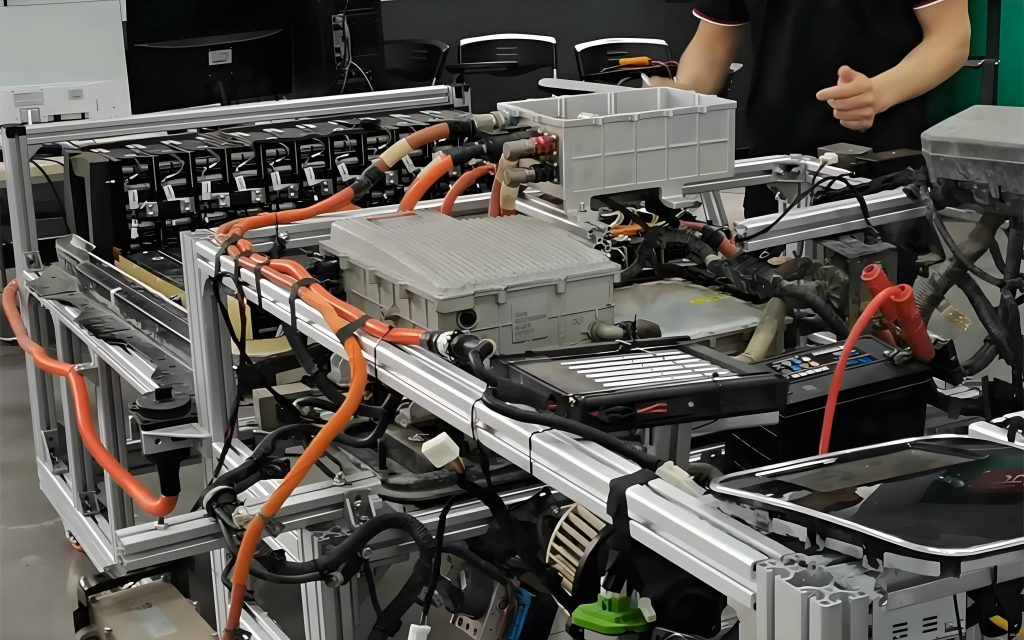
To illustrate practical applications in EV repair, I will discuss a detailed case study from my experience. In one instance, a customer reported that their electric sedan would occasionally surge forward without acceleration input. This posed a significant safety risk, highlighting the importance of thorough electrical car repair. Upon inspection, I used a diagnostic tool to retrieve fault codes, which indicated issues with the main controller and motor control unit. Further analysis revealed that the main controller was sending erroneous signals due to software corruption, while the motor controller had a faulty sensor causing unintended torque output. The repair involved updating the software and replacing the motor controller. After these interventions, the vehicle operated normally, demonstrating the critical role of integrated systems in EV repair. This case underscores the need for comprehensive diagnostics in electrical car repair, where multiple components can interact to produce complex faults.
In another case, a fleet of electric delivery vans experienced frequent battery failures, leading to downtime and increased costs. Through systematic EV repair procedures, I identified that the batteries were being overcharged due to a calibration error in the charging system. By recalibrating the chargers and implementing a monitoring schedule, we reduced failure rates by over 50%. This example shows how electrical car repair can benefit from data-driven approaches, such as tracking charging cycles and temperature profiles. The energy efficiency of an EV battery can be expressed as: $$\eta = \frac{E_{\text{out}}}{E_{\text{in}}} \times 100\%$$ where \(\eta\) is the efficiency, \(E_{\text{out}}\) is the energy output, and \(E_{\text{in}}\) is the energy input. This formula helps in evaluating battery performance during EV repair and maintenance.
Beyond individual cases, the field of EV repair is evolving with new technologies. For instance, the integration of artificial intelligence in diagnostic tools allows for predictive maintenance, where potential faults are identified before they cause failures. In electrical car repair, this means analyzing historical data to forecast issues like battery degradation or motor wear. Additionally, standardized protocols for high-voltage system handling are becoming more widespread, enhancing safety and efficiency. As an advocate for continuous learning, I emphasize the importance of training in EV repair, as technicians must stay updated with the latest advancements in electric vehicle technology.
In conclusion, the rise of electric vehicles has made EV repair a specialized and essential discipline. From transmission and motor faults to battery issues, electrical car repair requires a deep understanding of electrical systems and diagnostic techniques. By employing formulas, tables, and case studies, technicians can effectively address common problems and improve vehicle reliability. The future of EV repair will likely see greater automation and smarter tools, but the fundamentals of systematic diagnosis and safety will remain central. As I continue to work in this field, I am committed to sharing knowledge and advancing best practices in electrical car repair, ensuring that EVs remain a safe and sustainable mode of transportation for years to come.