
As the global shift toward sustainable energy accelerates, the EV charging station industry has emerged as a critical component of the electric vehicle ecosystem. However, EV charging station enterprises face significant financial challenges, including high capital expenditure, difficulties in fundraising, and prolonged return periods. In this paper, I analyze these issues and propose strategies for financial optimization, leveraging first-hand insights and empirical data. I will explore how EV charging station businesses can enhance their financial health through innovative approaches, such as asset-light transformations and dynamic pricing models. By incorporating tables and formulas, I aim to provide a comprehensive framework for improving the financial management of EV charging station operations, ensuring long-term sustainability and growth.
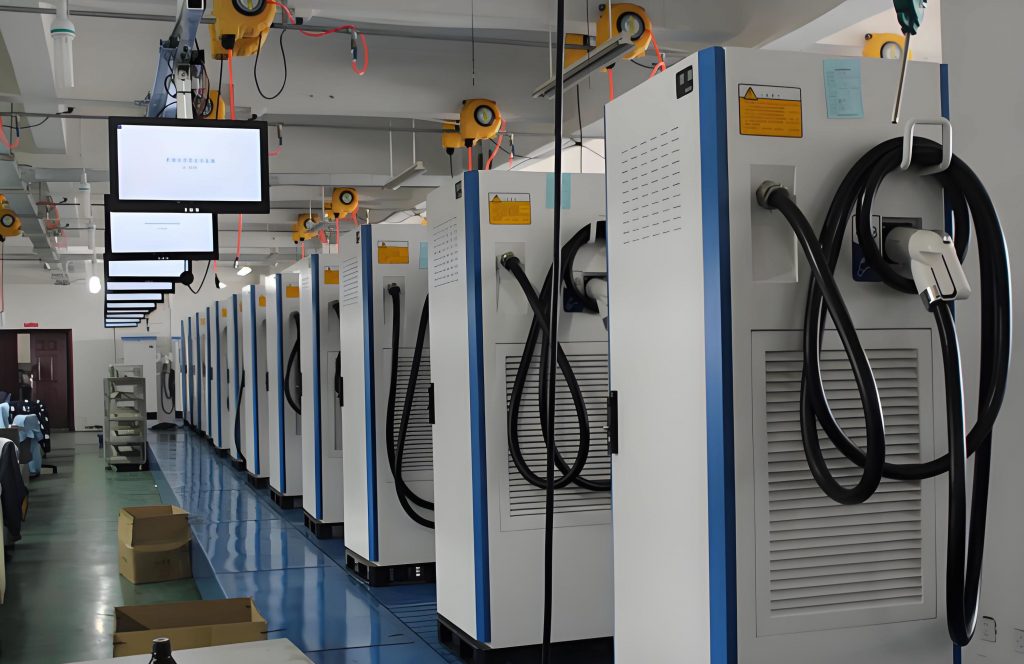
The proliferation of EV charging station networks is driven by the rapid adoption of electric vehicles, yet the financial viability of these stations remains a concern. EV charging station projects often require substantial upfront investments, and without effective financial management, companies may struggle to achieve profitability. I begin by examining the research background and significance of this topic, highlighting the importance of EV charging station development in the broader context of renewable energy infrastructure. For instance, the growth of EV charging station deployments has been supported by governmental policies, but the financial hurdles—such as controlling operational costs and securing funding—demand immediate attention. In this paper, I will address these challenges and offer actionable solutions to optimize the financial performance of EV charging station enterprises.
Research Background and Significance
The expansion of the EV charging station market is closely tied to the global push for decarbonization. According to industry reports, the number of public EV charging stations has seen exponential growth, with projections indicating a doubling of installations in the coming years. This surge is fueled by policies aimed at reducing carbon emissions and promoting electric mobility. For example, many countries have set targets for EV charging station density, such as ensuring availability within urban and rural areas. However, the financial implications for EV charging station operators are profound. High initial costs for equipment and installation, coupled with ongoing maintenance expenses, create a burdensome financial load. As an analyst, I emphasize that understanding these dynamics is crucial for developing robust financial strategies that support the scalability of EV charging station networks.
The significance of this research lies in its potential to enhance the operational efficiency of EV charging station businesses. By implementing sound financial management practices, companies can allocate resources more effectively, reduce waste, and improve asset utilization. For instance, EV charging station operators can use financial models to prioritize investments in high-traffic locations, thereby maximizing revenue. Additionally, effective cost control mechanisms can help mitigate the risks associated with fluctuating electricity prices and technological obsolescence. In the following sections, I will delve into the core financial problems faced by EV charging station enterprises and propose optimization strategies, supported by data and analytical tools.
Core Financial Challenges in EV Charging Station Operations
EV charging station enterprises encounter several financial hurdles that impede their growth and profitability. I have identified three primary issues: high investment costs, difficulties in fundraising, and extended return periods. Each of these challenges is interconnected and requires a multifaceted approach to address.
High Investment Costs
The capital expenditure for establishing an EV charging station is substantial. This includes costs for equipment procurement, installation, grid connection, and site preparation. For example, a single fast-charging EV charging station can cost between $10,000 and $15,000 upfront, with additional expenses for maintenance and upgrades. The depreciation of EV charging station equipment further exacerbates the financial strain, as technological advancements may render existing systems obsolete prematurely. To quantify this, consider the total cost of ownership (TCO) for an EV charging station network, which can be modeled using the following formula:
$$ TCO = C_c + C_i + \sum_{t=1}^{n} \frac{C_m + C_e}{(1 + r)^t} $$
Where \( C_c \) is the equipment cost, \( C_i \) is the installation cost, \( C_m \) is the annual maintenance cost, \( C_e \) is the annual electricity cost, \( r \) is the discount rate, and \( n \) is the lifespan of the EV charging station. This formula highlights the long-term financial commitment required, emphasizing the need for cost-saving measures.
Moreover, the operational costs of EV charging stations include electricity procurement, which accounts for a significant portion of ongoing expenses. The volatility of electricity prices, especially during peak demand periods, can lead to unpredictable costs. For instance, EV charging station operators may face higher tariffs when charging occurs during high-demand hours, reducing profit margins. The table below summarizes the typical cost breakdown for a standard EV charging station project, illustrating the distribution of expenses and their impact on financial planning.
| Cost Category | Percentage of Total Cost | Remarks |
|---|---|---|
| Equipment Procurement | 40% | Includes chargers and supporting hardware for EV charging station |
| Installation and Grid Connection | 25% | Costs for site preparation and electrical infrastructure |
| Maintenance and Operations | 20% | Ongoing expenses for EV charging station upkeep |
| Electricity and Utilities | 15% | Variable costs based on usage and pricing models |
Difficulties in Fundraising
Raising capital for EV charging station projects is often challenging due to perceived risks and long payback periods. While government subsidies and incentives exist, they are frequently insufficient or subject to change, leading to uncertainty for investors. Banks and financial institutions may be hesitant to lend to EV charging station ventures, preferring more established sectors like renewable energy generation. This financing gap can stifle innovation and expansion in the EV charging station industry. To illustrate, the cost of capital for an EV charging station project can be expressed as:
$$ WACC = \frac{E}{V} \cdot r_e + \frac{D}{V} \cdot r_d \cdot (1 – T_c) $$
Where \( WACC \) is the weighted average cost of capital, \( E \) is the market value of equity, \( D \) is the market value of debt, \( V \) is the total market value, \( r_e \) is the cost of equity, \( r_d \) is the cost of debt, and \( T_c \) is the corporate tax rate. A higher WACC indicates greater difficulty in securing affordable funding, which is common for EV charging station enterprises due to their nascent stage and operational risks.
Additionally, the reliance on external funding sources exposes EV charging station companies to market fluctuations and interest rate changes. For example, if a company depends heavily on debt financing, rising interest rates could increase the cost of servicing loans, further straining cash flow. The table below compares different financing options for EV charging station projects, highlighting their advantages and disadvantages in terms of cost and accessibility.
| Financing Method | Average Cost | Accessibility | Risk Level |
|---|---|---|---|
| Bank Loans | 5-8% interest | Moderate | High due to collateral requirements |
| Venture Capital | 15-25% equity stake | Low for early-stage EV charging station projects | Very high |
| Government Grants | 0-2% (subsidized) | High but competitive | Low |
| REITs | 6-8% yield | Moderate for established EV charging station portfolios | Medium |
Extended Return Periods
The return on investment (ROI) for EV charging station projects is often delayed due to low initial utilization rates and competitive pricing pressures. Revenue primarily comes from charging service fees, which are constrained by market rates and regulatory caps. As a result, EV charging station operators may experience negative cash flow in the early stages, requiring patience and additional capital injections. The ROI can be calculated as:
$$ ROI = \frac{Net Profit}{Investment Cost} \times 100\% $$
For an EV charging station, the net profit is influenced by factors such as usage frequency, pricing strategy, and operational efficiency. Typically, the payback period for an EV charging station ranges from 3 to 7 years, depending on location and demand. This extended timeline can deter investors seeking quicker returns, highlighting the need for strategies to accelerate revenue generation.
Furthermore, the uncertainty in user behavior and technological evolution adds to the financial risk. For instance, if a new, more efficient EV charging station technology emerges, existing installations may become less competitive, prolonging the return period. To mitigate this, EV charging station enterprises must adopt flexible business models and continuous innovation. The following formula models the net present value (NPV) of an EV charging station project, accounting for the time value of money and variable cash flows:
$$ NPV = \sum_{t=1}^{n} \frac{CF_t}{(1 + r)^t} – C_0 $$
Where \( CF_t \) is the net cash flow in period \( t \), \( r \) is the discount rate, \( n \) is the project duration, and \( C_0 \) is the initial investment. A positive NPV indicates a viable project, but for EV charging stations, this often requires optimistic assumptions about future growth.
Strategies for Optimizing Financial Management in EV Charging Station Enterprises
To address the financial challenges, I propose several strategies focused on asset-light transformations, improving asset turnover, and reducing financing costs. These approaches are designed to enhance the financial resilience of EV charging station businesses while supporting sustainable expansion.
Asset-Light Transformation and Cost Sharing
Adopting an asset-light model can significantly reduce the capital burden on EV charging station enterprises. For example, utilizing financing leases allows companies to spread equipment costs over time, freeing up capital for other operational needs. In a typical financing lease arrangement for an EV charging station, the lessor owns the equipment, while the lessee (the EV charging station operator) pays periodic lease payments based on usage or revenue sharing. This can be represented by the following lease payment formula:
$$ Lease Payment = \frac{P \cdot r \cdot (1 + r)^n}{(1 + r)^n – 1} $$
Where \( P \) is the principal amount (equipment cost), \( r \) is the periodic interest rate, and \( n \) is the number of periods. By using this model, EV charging station operators can reduce upfront costs and align expenses with revenue cycles.
Additionally, collaboration with property owners through profit-sharing agreements instead of fixed rents can lower operational costs. For instance, an EV charging station installed in a shopping mall might involve a revenue split with the mall owner, reducing the financial risk during low-usage periods. The table below outlines the potential cost savings from various asset-light strategies for EV charging station deployments.
| Strategy | Estimated Cost Reduction | Application Example |
|---|---|---|
| Financing Leases | 30-40% | Leasing EV charging station equipment rather than purchasing |
| Revenue Sharing with Site Owners | 20-30% | Partnering with commercial properties for EV charging station placement |
| Public Infrastructure Integration | 15-25% | Installing EV charging stations on existing municipal structures |
Moreover, controlling electricity procurement costs is crucial for EV charging station profitability. By participating in wholesale electricity markets or integrating renewable energy sources like solar panels, EV charging station operators can stabilize energy expenses. The cost savings from such measures can be quantified using the formula for levelized cost of energy (LCOE):
$$ LCOE = \frac{\sum_{t=1}^{n} \frac{I_t + M_t + F_t}{(1 + r)^t}}{\sum_{t=1}^{n} \frac{E_t}{(1 + r)^t}} $$
Where \( I_t \) is the investment cost in year \( t \), \( M_t \) is the maintenance cost, \( F_t \) is the fuel cost (e.g., electricity), \( E_t \) is the energy output, and \( r \) is the discount rate. Lowering the LCOE through efficient procurement can improve the overall financial performance of an EV charging station.
Shortening Return Periods by Enhancing Asset Turnover
Improving the utilization rate of EV charging stations is key to accelerating returns. Dynamic pricing strategies, such as time-of-use tariffs, can incentivize off-peak charging and increase overall usage. For example, an EV charging station might charge higher fees during peak hours and offer discounts during low-demand periods, optimizing revenue. The revenue per EV charging station can be modeled as:
$$ R = U \cdot P \cdot T $$
Where \( R \) is the revenue, \( U \) is the utilization rate (number of charging sessions per day), \( P \) is the average price per session, and \( T \) is the time period. By adjusting \( P \) based on demand, EV charging station operators can maximize \( R \) without significant additional investment.
Prepaid membership programs are another effective way to lock in cash flow and reduce revenue volatility. For instance, offering subscription plans for unlimited charging at a fixed monthly fee can ensure a steady income stream for EV charging station businesses. The table below demonstrates how dynamic pricing and membership models can impact the financial metrics of an EV charging station network.
| Pricing Model | Average Revenue Increase | Key Considerations |
|---|---|---|
| Time-of-Use Pricing | 15-20% | Requires smart meters and user education for EV charging station |
| Membership Programs | 10-15% | Enhances customer loyalty for EV charging station services |
| Peak-Load Pricing | 20-25% | Maximizes revenue during high-demand periods at EV charging station |
Furthermore, implementing intelligent scheduling systems can optimize the allocation of charging resources, reducing idle time for EV charging stations. By using algorithms to predict demand and guide users to available stations, operators can improve efficiency. The overall asset turnover ratio for an EV charging station portfolio can be expressed as:
$$ Asset Turnover = \frac{Revenue}{Average Total Assets} $$
A higher ratio indicates better utilization of assets, which is essential for shortening the payback period of EV charging station investments.
Reducing Financing Pressure Through Low-Cost Capital
Accessing low-cost funding sources, such as government-backed loans or infrastructure REITs, can alleviate the financial strain on EV charging station enterprises. For example, REITs allow companies to monetize their physical assets while retaining operational control, providing immediate liquidity. The yield from an EV charging station REIT can be calculated as:
$$ Yield = \frac{Annual Dividend}{Share Price} \times 100\% $$
With typical yields ranging from 6% to 8%, this option offers a competitive return for investors while reducing the cost of capital for EV charging station operators.
Additionally, leveraging policy incentives, such as tax credits or grants for green infrastructure, can lower the effective cost of EV charging station projects. By carefully documenting eligibility criteria and applying for these programs, companies can secure funding at below-market rates. The table below summarizes various low-cost financing avenues for EV charging station developments.
| Financing Avenue | Estimated Cost Reduction | Implementation Tips |
|---|---|---|
| Policy Loans and Grants | 20-30% | Apply early and align with sustainability goals for EV charging station |
| Infrastructure REITs | 15-25% | Bundle multiple EV charging station assets to attract investors |
| Green Bonds | 10-20% | Issue bonds tied to EV charging station environmental benefits |
Moreover, optimizing the capital structure by balancing debt and equity can minimize the weighted average cost of capital (WACC) for EV charging station projects. As mentioned earlier, a lower WACC enhances financial sustainability. Companies should also establish cash flow management systems to monitor liquidity and avoid shortfalls. The following formula for cash flow coverage ratio can aid in this process:
$$ Cash Flow Coverage Ratio = \frac{Operating Cash Flow}{Total Debt Service} $$
A ratio greater than 1 indicates that the EV charging station business generates sufficient cash to meet its debt obligations, reducing the risk of default.
Conclusion
In conclusion, the financial management of EV charging station enterprises requires a holistic approach that addresses high costs, funding challenges, and long return periods. By adopting asset-light models, such as financing leases and profit-sharing agreements, companies can reduce capital expenditure and improve flexibility. Enhancing asset turnover through dynamic pricing and membership programs accelerates revenue generation, while accessing low-cost capital via REITs and policy incentives lowers financing costs. These strategies, supported by quantitative analysis and practical examples, can help EV charging station businesses achieve financial stability and contribute to the broader adoption of electric vehicles.
Ultimately, the success of an EV charging station venture depends on continuous innovation and adaptive financial planning. As the industry evolves, operators must remain vigilant to market changes and technological advancements. By implementing the recommendations outlined in this paper, EV charging station enterprises can build resilient financial frameworks that support long-term growth and sustainability. The integration of these strategies will not only benefit individual companies but also foster the development of a robust EV charging infrastructure, essential for a sustainable future.