
In recent years, the rapid growth of the electric vehicle (EV) industry has placed immense focus on the development of critical components, with the EV battery pack being at the forefront. As the primary power source, the EV battery pack not only dictates vehicle performance but also ensures operational integrity. The casing of the EV battery pack plays a pivotal role in safeguarding battery modules from external impacts, contributing significantly to overall vehicle safety, lightweighting, and reliability. In this article, we explore the multi-objective development of EV battery pack casings, emphasizing the interplay between safety, lightweighting, and reliability. We delve into current industry practices, challenges, and future trends, incorporating analytical tools such as tables and formulas to summarize key insights. Throughout, the term “EV battery pack” will be frequently referenced to underscore its centrality in EV design.
The EV battery pack casing serves as a protective enclosure, shielding sensitive battery cells from mechanical, thermal, and environmental hazards. Its design directly influences crashworthiness, energy efficiency, and durability, making it a cornerstone of EV engineering. We begin by examining safety considerations, where the EV battery pack must withstand collisions without compromising battery integrity. Regulatory frameworks, such as FMVSS in the U.S. and C-NCAP in China, set stringent standards for crash testing, but evolving scenarios like pole impacts and dynamic rollovers demand continuous innovation. From a design perspective, optimizing the load path and enhancing structural rigidity are crucial. For instance, the energy absorption capacity of an EV battery pack casing can be modeled using the integral of force over deformation:
$$ E = \int F \, dx $$
where E represents absorbed energy, F is the impact force, and x is the deformation distance. This formula highlights the need for materials and geometries that maximize energy dissipation while minimizing intrusion into battery modules. Furthermore, multi-objective optimization algorithms, such as genetic algorithms, are employed to balance safety with other goals. For example, we might define an objective function that minimizes mass while constraining stress and displacement:
$$ \text{Minimize: } M = \sum_{i=1}^{n} \rho_i V_i $$
$$ \text{Subject to: } \sigma_{\text{max}} \leq \sigma_{\text{yield}}, \quad \delta_{\text{max}} \leq \delta_{\text{allowable}} $$
Here, M is total mass, ρ_i and V_i are density and volume of component i, σ_max is maximum stress, σ_yield is material yield strength, and δ_max is maximum displacement. Such approaches enable holistic development of the EV battery pack casing.
Turning to lightweighting, the EV battery pack casing contributes substantially to vehicle mass, affecting range and efficiency. Lightweight materials like aluminum alloys, high-strength steels, and composites are increasingly adopted. Below, we summarize key material properties in a table, emphasizing their impact on EV battery pack design:
| Material | Density (g/cm³) | Tensile Strength (MPa) | Specific Strength (MPa·cm³/g) | Typical Use in EV Battery Pack |
|---|---|---|---|---|
| Mild Steel | 7.85 | 250-350 | 31.8-44.6 | Lower-cost casings, phased out in premium models |
| High-Strength Steel | 7.85 | 500-1500 | 63.7-191.1 | Structural reinforcements for crash safety |
| Aluminum Alloy | 2.70 | 200-400 | 74.1-148.1 | Mainstream for casings due to balance of weight and strength |
| Carbon Fiber Composite | 1.50-1.60 | 500-1500 | 312.5-937.5 | High-end applications for extreme lightweighting |
| SMC Composite | 1.85 | 80-150 | 43.2-81.1 | Upper casings for sealing and moderate load-bearing |
This table illustrates the trade-offs: aluminum alloys offer a favorable specific strength, making them ideal for EV battery pack casings, while composites provide superior lightweighting at higher costs. Additionally, integration strategies like Cell-to-Pack (CTP) and Cell-to-Chassis (CTC) designs reduce redundant structures, further lowering mass. For instance, in CTC designs, the EV battery pack casing doubles as part of the vehicle floor, optimizing space and weight. The mass reduction ΔM can be estimated as:
$$ \Delta M = M_{\text{traditional}} – M_{\text{integrated}} $$
where M_traditional is mass of separate chassis and casing, and M_integrated is mass of the integrated structure. Such innovations are critical for achieving lightweighting targets without compromising safety.
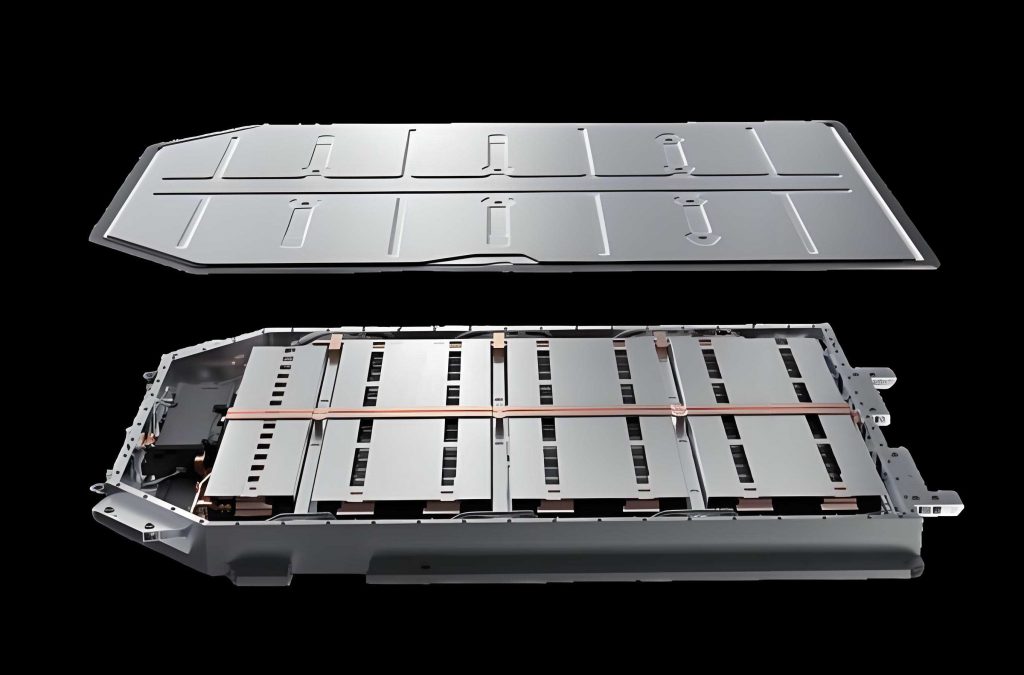
Reliability is another cornerstone of EV battery pack casing development, encompassing fatigue durability and sealing performance. Under cyclic loads from road vibrations, the casing must resist fatigue failure to ensure long-term integrity. We often employ frequency-domain methods based on Power Spectral Density (PSD) to predict fatigue life. The stress response can be characterized by the PSD function G(f), and the fatigue damage D is calculated using Miner’s rule:
$$ D = \sum_{i=1}^{k} \frac{n_i}{N_i} $$
where n_i is number of cycles at stress level S_i, and N_i is cycles to failure from the S-N curve: $$ N = k S^{-m} $$. Here, k and m are material constants derived from testing. For random vibrations, the fatigue life L in hours can be estimated as:
$$ L = \frac{C}{\int_{0}^{\infty} G(f) \cdot H(f) \, df} $$
where C is a constant dependent on material properties, and H(f) is a transfer function representing structural response. This approach allows us to simulate real-world conditions and optimize the EV battery pack casing for durability. Moreover, sealing reliability ensures protection against moisture and dust, typically targeting IP6K7 standards. The contact pressure P_seal between sealing surfaces must exceed environmental pressure differentials:
$$ P_{\text{seal}} \geq \Delta P_{\text{environment}} $$
where P_seal is a function of material compression and bolt preload. Using elastomers like EPDM with high Poisson’s ratios enhances sealing effectiveness, crucial for the EV battery pack in diverse climates.
In the realm of safety, we also face challenges such as the lack of standardized testing for extreme scenarios and the complexity of simulating battery-cell interactions. Advanced simulation tools, incorporating material fracture models, are vital. For example, the stress triaxiality η and Lode parameter μ can be used to predict ductile fracture:
$$ \eta = \frac{\sigma_m}{\sigma_{\text{eq}}}, \quad \mu = \frac{2\sigma_2 – \sigma_1 – \sigma_3}{\sigma_1 – \sigma_3} $$
where σ_m is mean stress, σ_eq is equivalent stress, and σ_1, σ_2, σ_3 are principal stresses. By integrating these into finite element models, we improve the accuracy of crash predictions for the EV battery pack. Additionally, multi-objective optimization must consider cost and manufacturability. A Pareto front can be generated to visualize trade-offs between safety, weight, and cost, guiding design decisions for the EV battery pack casing.
Lightweighting efforts extend beyond material selection to include topological optimization. Using methods like Solid Isotropic Material with Penalization (SIMP), we optimize material distribution within the EV battery pack casing to minimize mass while meeting stiffness constraints. The optimization problem can be stated as:
$$ \text{Minimize: } C(\rho) = \mathbf{U}^T \mathbf{K} \mathbf{U} $$
$$ \text{Subject to: } V(\rho) \leq V_0, \quad 0 < \rho_{\text{min}} \leq \rho \leq 1 $$
where C is compliance, ρ is material density design variable, U is displacement vector, K is stiffness matrix, V is volume, and V_0 is target volume. This results in lightweight, efficient structures for the EV battery pack. Furthermore, the future of lightweighting may see increased use of hybrid materials, such as aluminum-steel composites, to balance performance and cost. The effective modulus E_eff of a hybrid can be approximated by the rule of mixtures:
$$ E_{\text{eff}} = V_f E_f + V_m E_m $$
where V_f and V_m are volume fractions of fiber and matrix, and E_f and E_m are their moduli. Such innovations will drive the next generation of EV battery pack casings.
Reliability also hinges on robust connection designs, as weld joints are prone to fatigue. Structural stress methods assess weld life, with the stress range Δσ_weld calculated from nodal forces and moments. The fatigue life N_weld follows:
$$ N_{\text{weld}} = A (\Delta \sigma_{\text{weld}})^{-b} $$
where A and b are constants from standards like ASME. Ensuring these joints withstand vibrational loads is essential for the EV battery pack’s longevity. Additionally, thermal reliability cannot be overlooked, as temperature fluctuations induce thermal stresses. The thermal stress σ_thermal is given by:
$$ \sigma_{\text{thermal}} = \alpha E \Delta T $$
where α is coefficient of thermal expansion, E is Young’s modulus, and ΔT is temperature change. Materials with low α, such as certain composites, help mitigate this in the EV battery pack casing.
Looking ahead, we identify several key directions for EV battery pack casing development. First, regulatory frameworks must evolve to include more severe test scenarios, such as underwater immersion or high-altitude conditions, to ensure global safety standards. Second, digital twins—virtual replicas of the EV battery pack—can enhance design accuracy by integrating real-time data from sensors. This involves using machine learning algorithms to predict failure modes, with models trained on historical performance data. Third, sustainability considerations will drive the adoption of recyclable materials, like bio-based composites, reducing the environmental footprint of EV battery pack production. Fourth, standardization of testing protocols across industries will facilitate faster innovation, allowing for seamless integration of new technologies into the EV battery pack.
To summarize, the development of EV battery pack casings is a multifaceted endeavor requiring balance between safety, lightweighting, and reliability. Through advanced materials, simulation-driven design, and multi-objective optimization, we can create casings that not only protect battery cells but also enhance vehicle performance. The EV battery pack remains central to EV advancement, and its casing will continue to evolve with technological progress. As we move forward, collaboration across research, industry, and policy will be crucial to overcoming challenges and unlocking new potentials for the EV battery pack.
In conclusion, we have explored the critical aspects of EV battery pack casing development, emphasizing a holistic approach. By leveraging formulas for structural analysis, tables for material comparison, and innovative design strategies, we can achieve safer, lighter, and more reliable EV battery packs. The journey toward optimal EV battery pack solutions is ongoing, and continued investment in research and development will pave the way for next-generation electric vehicles.