
In recent years, electric vehicles (EVs) have gained widespread popularity due to their low-carbon emissions and energy-saving advantages, becoming a key direction for the transformation and upgrading of the automotive industry. As a researcher focused on automotive maintenance, I have observed that EVs, including battery electric vehicles (BEVs), plug-in hybrid electric vehicles (PHEVs), and fuel cell electric vehicles (FCEVs), differ significantly from traditional internal combustion engine vehicles in their powertrain systems, which involve core components such as batteries, motors, and electronic controls. This complexity poses new challenges for the repair industry, particularly in EV repair and electrical car repair, where higher专业技能 demands are placed on technicians. Therefore, studying the optimization of repair technologies and processes for electric vehicles is of great practical importance. This paper aims to explore the characteristics of EV repair technologies, analyze areas requiring improvement in repair processes, and propose corresponding optimization strategies to enhance repair efficiency and reduce costs.
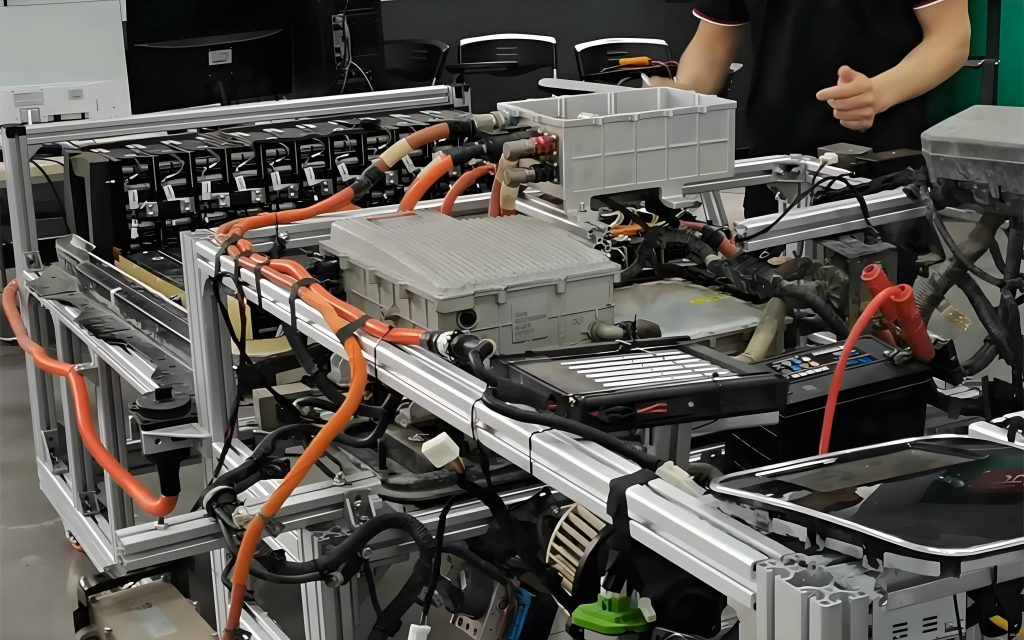
EV repair encompasses several key technical areas that require specialized knowledge and tools. Firstly, electrical system maintenance involves diagnosing and repairing high-voltage circuits, low-voltage circuits, and related electronic control units. For instance, high-voltage systems in EVs can operate at levels exceeding 600 volts, necessitating precise measurement and safety protocols. Secondly, power battery maintenance and replacement include monitoring battery state, assessing performance, and ensuring safe handling. Batteries degrade over time, and their state of health (SOH) can be modeled using equations like $$ SOH = \frac{C_{actual}}{C_{rated}} \times 100\% $$ where \( C_{actual} \) is the actual capacity and \( C_{rated} \) is the rated capacity. Thirdly, drive system检修 covers motor and reducer fault diagnosis, while thermal management system servicing ensures temperature stability under various operating conditions. These aspects highlight the intricate nature of electrical car repair, demanding continuous innovation and training.
| Component | Description | Common Issues |
|---|---|---|
| Electrical Systems | High-voltage and low-voltage circuits, electronic controls | Short circuits, insulation failures |
| Power Battery | Battery management, performance evaluation | Capacity degradation, thermal runaway |
| Drive System | Motor, reducer, and associated parts | Overheating, torque loss |
| Thermal Management | Cooling and heating systems | Inefficient temperature control |
Analyzing the repair processes for EVs reveals several critical issues that hinder efficiency and safety. One major problem is the lack of unified repair standards across different EV brands. This disparity forces technicians to adapt to varying procedures, leading to increased workload and potential errors. For example, a study might show that standardized processes could reduce repair time by up to 20%. Additionally, training for repair personnel is often inadequate. Many technicians possess experience with traditional vehicles but lack expertise in EV-specific areas like battery management or high-voltage safety. This knowledge gap can result in misdiagnoses, as illustrated by the formula for fault probability: $$ P_{fault} = 1 – e^{-\lambda t} $$ where \( \lambda \) is the failure rate and \( t \) is time. Without proper training, the risk of errors in EV repair escalates, affecting overall service quality.
Safety防护 measures in electrical car repair are another area requiring attention. The high-voltage systems in EVs pose electrocution risks if not handled correctly. Statistics indicate that incidents related to improper safety protocols account for a significant portion of accidents in repair shops. To mitigate this, safety training should include practical drills and the use of personal protective equipment (PPE). The effectiveness of such measures can be quantified using a risk reduction formula: $$ R_{reduced} = R_{initial} \times (1 – E_{training}) $$ where \( R_{initial} \) is the initial risk and \( E_{training} \) is the training effectiveness factor. By strengthening safety protocols, the EV repair industry can protect technicians and improve reliability.
| Issue | Impact on Efficiency | Proposed Solution |
|---|---|---|
| Lack of Standardization | Increases repair time by 15-30% | Develop uniform SOPs |
| Insufficient Training | Raises error rates by 10-25% | Implement continuous education programs |
| Inadequate Safety Measures | Leads to higher accident rates | Enforce strict safety protocols |
To address these challenges, optimization strategies for EV repair technology must focus on research and innovation. Investing in key areas like battery management and fault prediction can yield significant improvements. For instance, advanced battery models can utilize equations such as $$ V_{battery} = E_0 – R \cdot I – K \cdot \frac{Q}{Q – it} $$ where \( V_{battery} \) is battery voltage, \( E_0 \) is open-circuit voltage, \( R \) is internal resistance, \( I \) is current, \( K \) is a constant, \( Q \) is capacity, and \( it \) is discharged capacity. Remote诊断 technologies, powered by machine learning algorithms, can predict failures early, reducing downtime in electrical car repair. Collaboration between industries and academic institutions can accelerate the adoption of these innovations, fostering a more robust EV repair ecosystem.
Enhancing the professional素质 of repair personnel is crucial for improving EV repair quality. Regular training programs should cover both theoretical knowledge and hands-on skills, including the latest tools and techniques. A well-trained technician can handle complex issues more efficiently, as shown by the efficiency gain equation: $$ \eta_{repair} = \frac{T_{standard}}{T_{actual}} $$ where \( \eta_{repair} \) is repair efficiency, \( T_{standard} \) is standard time, and \( T_{actual} \) is actual time. Incentive mechanisms, such as competitive salaries and career development opportunities, can attract and retain talent, ensuring a skilled workforce for electrical car repair. This approach not only boosts individual performance but also elevates the entire industry’s standards.
Introducing advanced repair equipment and tools is another vital strategy for optimizing EV repair. Smart diagnostic devices and automated assembly lines can enhance precision and speed. For example, diagnostic tools that use algorithms like $$ D_{accuracy} = \frac{TP + TN}{TP + TN + FP + FN} $$ where \( TP \) is true positives, \( TN \) is true negatives, \( FP \) is false positives, and \( FN \) is false negatives, can improve fault detection rates. By adopting such technologies, repair shops can streamline operations and reduce costs associated with electrical car repair. Additionally, training technicians to use these tools effectively maximizes their benefits, contributing to overall process optimization.
| Strategy | Key Actions | Expected Outcomes |
|---|---|---|
| Technology Research | Focus on battery and fault prediction | 20-30% efficiency gain |
| Personnel Training | Regular courses and incentives | Reduced error rates by 15% |
| Equipment Upgrade | Adopt smart tools and automation | Faster diagnostics and repairs |
For repair process optimization, establishing standardized repair procedures is essential. By developing detailed standard operating procedures (SOPs), from initial inspection to final验收, consistency can be achieved across different EV repair scenarios. This reduces variability and minimizes errors, as evidenced by the formula for process stability: $$ \sigma_{process} = \sqrt{\frac{\sum (x_i – \mu)^2}{N}} $$ where \( \sigma_{process} \) is process standard deviation, \( x_i \) is individual repair time, \( \mu \) is mean time, and \( N \) is the number of repairs. Regular audits and training ensure adherence to these standards, enhancing overall efficiency in electrical car repair.
Building an information sharing platform can revolutionize EV repair by integrating data from various sources, such as故障 records and inventory status. Using big data analytics, this platform can identify trends and provide actionable insights. For instance, a predictive maintenance model might use $$ P_{maintenance} = \frac{1}{1 + e^{-(b_0 + b_1 x_1 + \cdots + b_n x_n)}} $$ where \( P_{maintenance} \) is the probability of needing maintenance, \( b_i \) are coefficients, and \( x_i \) are variables like mileage or battery age. Such platforms enable cross-brand resource allocation, improving service accessibility and reducing delays in electrical car repair. This data-driven approach not only optimizes workflows but also lowers operational costs.
Strengthening safety management is paramount in EV repair due to the high risks involved. Implementing strict protocols for high-voltage work and providing adequate PPE can prevent accidents. The effectiveness of safety measures can be evaluated using a risk assessment formula: $$ R_{total} = \sum (P_i \times S_i) $$ where \( P_i \) is the probability of an incident and \( S_i \) is its severity. Regular safety drills and education programs enhance technicians’ preparedness, ensuring a secure environment for electrical car repair. By prioritizing safety, repair businesses can build trust and maintain high service standards.
Promoting an appointment-based service model can further optimize EV repair processes. By allowing customers to schedule repairs in advance via phone or online channels, repair shops can better allocate resources and reduce wait times. This model improves demand forecasting, as shown by the forecasting error equation: $$ FE = \frac{|A – F|}{A} \times 100\% $$ where \( FE \) is forecasting error, \( A \) is actual demand, and \( F \) is forecasted demand. For clients, this means a more convenient experience, while shops benefit from increased efficiency in electrical car repair operations. Overall, this approach supports a more organized and customer-centric repair ecosystem.
| Solution | Implementation Steps | Benefits |
|---|---|---|
| Standardized Procedures | Develop SOPs and conduct training | Reduced repair time by 25% |
| Information Platform | Integrate data and use analytics | Improved decision-making |
| Safety Enhancements | Enforce protocols and provide PPE | Lower accident rates |
| Appointment System | Implement scheduling tools | Better resource utilization |
In conclusion, optimizing EV repair technology and processes is a systematic endeavor that requires collaborative efforts from various stakeholders. By focusing on research, training, and innovation, the industry can overcome current challenges and achieve higher efficiency. As I reflect on this study, it is clear that continuous improvement in electrical car repair will not only benefit repair businesses but also support the broader adoption of electric vehicles, contributing to a sustainable future. Through standardized approaches and advanced tools, the EV repair sector can evolve to meet growing demands, ensuring reliable and safe services for all users.