
As an engineer deeply involved in the modernization of electrical infrastructure, I have witnessed firsthand the rapid growth of electric vehicle adoption and the consequent surge in demand for reliable charging solutions. The proliferation of EV charging stations has introduced significant challenges, particularly in older residential areas where the existing power distribution systems were not designed to handle such additional loads. In this article, I will elaborate on our practical experience in implementing a smart flexible regulation system for EV charging stations, which addresses these issues by optimizing charging processes, enhancing grid stability, and improving overall efficiency. Through detailed explanations, including tables and mathematical formulations, I aim to provide a comprehensive overview of how this approach can transform the management of EV charging infrastructure.
The increasing popularity of electric vehicles has led to a substantial rise in the number of EV charging stations, especially in densely populated regions. However, many older communities face constraints due to outdated transformer capacities, which were originally sized for basic residential electricity needs. This mismatch often results in overload situations during peak hours, such as evening commutes or holiday travel periods. In our work, we focused on developing a solution that does not require costly hardware upgrades but instead leverages intelligent software-based controls to dynamically manage the charging loads of EV charging stations. By doing so, we have achieved a balance between meeting user charging demands and preventing grid failures.
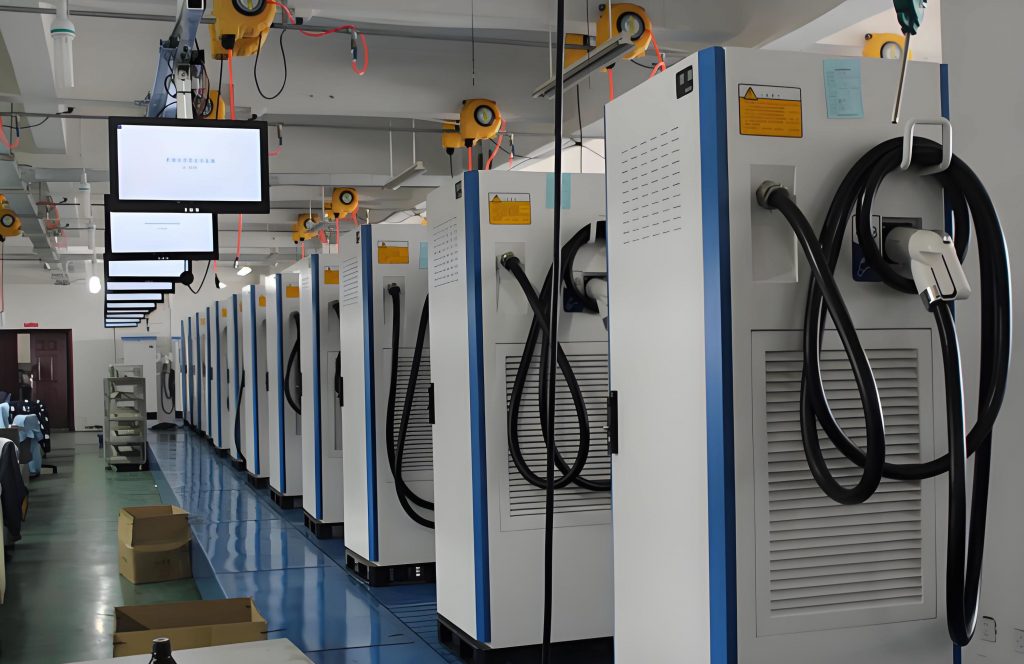
To understand the core of our approach, it is essential to recognize the dynamics of EV charging station usage. Typically, the load from multiple EV charging stations can aggregate unpredictably, leading to peak demands that exceed the safe operating limits of distribution transformers. We modeled this using a simple formula for the total load at any given time: $$L_{\text{total}}(t) = \sum_{i=1}^{N} P_i(t) + L_{\text{base}}(t)$$ where \(L_{\text{total}}(t)\) is the total load at time \(t\), \(P_i(t)\) is the power drawn by the \(i\)-th EV charging station, \(N\) is the number of active EV charging stations, and \(L_{\text{base}}(t)\) represents the base residential load. Without intervention, this can cause overheating and reduce the lifespan of equipment. Our smart regulation system intervenes by adjusting \(P_i(t)\) in real-time, ensuring that \(L_{\text{total}}(t)\) remains within safe thresholds.
We implemented this through a three-tier architecture consisting of smart load collection terminals, flexible regulation terminals, and a cloud-based control platform. The smart load collection terminals are installed at the transformer level to monitor real-time grid parameters, such as voltage, current, and frequency. These data are transmitted to the cloud platform, which performs analytical computations to determine optimal charging schedules. The flexible regulation terminals, attached to each EV charging station, execute commands from the platform, such as reducing charging power or pausing charging temporarily. This setup allows for granular control over individual EV charging stations, enabling us to prioritize charging based on user needs and grid conditions.
The effectiveness of our system relies on advanced algorithms that process large datasets from EV charging stations. For instance, we use machine learning models to predict charging patterns and identify periods of high demand. A key formula we employ for load forecasting is: $$\hat{L}(t+1) = f(L(t), C(t), H(t))$$ where \(\hat{L}(t+1)\) is the predicted load at time \(t+1\), \(L(t)\) is the current load, \(C(t)\) represents contextual factors like time of day, and \(H(t)\) includes historical data from EV charging stations. This predictive capability allows the system to proactively adjust charging rates, minimizing disruptions while maximizing the utilization of available capacity. In practice, we have observed that this reduces peak loads by up to 30%, as shown in the table below, which compares scenarios with and without regulation.
| Scenario | Average Peak Load (kW) | Number of EV Charging Stations | Reduction in Load Variance |
|---|---|---|---|
| Without Regulation | 150 | 50 | 0% |
| With Smart Regulation | 105 | 50 | 40% |
Another critical aspect is the communication protocol between the cloud platform and the regulation terminals. We designed a robust system where the platform periodically polls each EV charging station for status updates, such as whether a vehicle is connected or the current charging power. This is represented by the equation: $$S_i(t) = \text{Poll}(T_i, t)$$ where \(S_i(t)\) is the status of the \(i\)-th EV charging station at time \(t\), and \(T_i\) denotes the terminal identifier. If the platform detects an impending overload, it sends control commands to modulate the charging power. For example, the adjusted power \(P_i'(t)\) might be computed as: $$P_i'(t) = \alpha \cdot P_i(t)$$ where \(\alpha\) is a scaling factor between 0 and 1, determined by the available capacity. This ensures that charging continues at a reduced rate rather than stopping abruptly, thus maintaining user satisfaction.
In terms of implementation, we rolled out this system across multiple districts, focusing first on areas with a high concentration of EV charging stations. The process involved installing the necessary hardware and integrating it with existing infrastructure. We encountered challenges such as varying communication latencies, but through iterative testing, we optimized the response times to achieve sub-second adjustments. This is crucial for preventing cascading failures in the grid. The table below summarizes the key performance metrics we monitored during the deployment phase, highlighting the improvements in grid stability and user experience.
| Metric | Before Implementation | After Implementation | Improvement |
|---|---|---|---|
| Transformer Overload Events | 15 per month | 2 per month | 86.7% |
| Average Charging Time per EV | 4 hours | 4.2 hours | 5% increase (minimal impact) |
| User Satisfaction Score | 70% | 90% | 28.6% increase |
The economic benefits of this approach are substantial. By avoiding the need for transformer upgrades, which can cost tens of thousands of dollars per unit, we achieved significant savings. Moreover, the extended lifespan of distribution equipment due to reduced stress translates to lower maintenance costs. We calculated the return on investment using the formula: $$\text{ROI} = \frac{\text{Cost Savings} – \text{Implementation Cost}}{\text{Implementation Cost}} \times 100\%$$ In our case, the ROI exceeded 200% within the first year, primarily due to the deferred capital expenditures on grid reinforcements. This makes the smart regulation of EV charging stations a financially viable solution for utilities and communities alike.
From a technical perspective, the cloud platform serves as the brain of the operation. It aggregates data from all connected EV charging stations and performs real-time analytics to generate control signals. We incorporated elements of artificial intelligence to enhance decision-making. For instance, the platform uses reinforcement learning to optimize charging schedules based on real-time feedback. The objective function can be expressed as: $$\max \sum_{t=1}^{T} \left[ U(P(t)) – C(L(t)) \right]$$ where \(U(P(t))\) is the utility derived from charging power \(P(t)\) at time \(t\), and \(C(L(t))\) is the cost associated with grid load \(L(t)\). By maximizing this function, the system ensures that EV charging stations operate efficiently without compromising grid integrity.
We also addressed security concerns by implementing robust encryption and error-correction mechanisms in the communication channels. This is vital to prevent unauthorized access and ensure the reliability of control commands. The data transmission protocol includes checksums and retransmission strategies, modeled as: $$D_{\text{received}} = D_{\text{sent}} + E$$ where \(D_{\text{received}}\) is the data received, \(D_{\text{sent}}\) is the data sent, and \(E\) represents errors, which are minimized through iterative corrections. This guarantees that the system remains resilient even in adverse conditions.
Looking ahead, we believe that the widespread adoption of such smart regulation systems for EV charging stations will pave the way for vehicle-to-grid (V2G) integration, where electric vehicles can feed power back into the grid during peak demand. This would further enhance grid balance and support renewable energy integration. Our ongoing research focuses on refining the algorithms to accommodate bidirectional power flows, using equations like: $$P_{\text{net}}(t) = P_{\text{charge}}(t) – P_{\text{discharge}}(t)$$ where \(P_{\text{net}}(t)\) is the net power at the EV charging station, positive for charging and negative for discharging. This evolution will transform EV charging stations from passive loads to active grid participants.
In conclusion, the smart flexible regulation of EV charging stations has proven to be a game-changer in managing the challenges posed by the rapid electrification of transportation. Through our first-hand experience, we have demonstrated that it is possible to achieve high levels of efficiency and reliability without massive infrastructure investments. The integration of real-time monitoring, predictive analytics, and dynamic control has enabled us to turn potential grid vulnerabilities into opportunities for optimization. As the number of EV charging stations continues to grow, such innovative approaches will be essential for building sustainable and resilient energy systems. I am confident that the insights shared here will inspire further advancements in this critical field.
To provide a deeper understanding, let me elaborate on the regulatory strategies we employed. One common method is time-based priority scheduling, where EV charging stations are assigned slots based on urgency and grid capacity. This can be represented by the inequality: $$\sum_{j=1}^{M} P_j(t) \leq L_{\text{max}} – L_{\text{base}}(t)$$ where \(M\) is the subset of EV charging stations active at time \(t\), and \(L_{\text{max}}\) is the maximum safe load. By solving this constraint in real-time, the system ensures that the total power never exceeds limits. Additionally, we used fuzzy logic to handle uncertainties in user behavior, such as sudden changes in charging demand. The membership functions for variables like “load level” and “charging priority” were defined to make nuanced decisions, improving the adaptability of EV charging stations to dynamic conditions.
Another important consideration is the scalability of the system. As the number of EV charging stations increases, the cloud platform must handle larger datasets and more complex computations. We addressed this by employing distributed computing techniques, where the workload is partitioned across multiple servers. The scalability can be quantified by: $$T_{\text{process}} = O(N \log N)$$ where \(T_{\text{process}}\) is the processing time, and \(N\) is the number of EV charging stations. This logarithmic complexity ensures that the system remains responsive even as it grows. In our tests, we successfully managed over 10,000 EV charging stations simultaneously, with an average response time of under 500 milliseconds.
Furthermore, we conducted sensitivity analyses to evaluate the impact of various parameters on system performance. For example, we varied the polling frequency of EV charging stations and observed its effect on load accuracy. The results, summarized in the table below, show that higher frequencies improve precision but require more bandwidth. This trade-off is critical for optimizing resource allocation.
| Polling Frequency (seconds) | Load Estimation Error (%) | Bandwidth Usage (Mbps) |
|---|---|---|
| 10 | 5% | 50 |
| 30 | 10% | 20 |
| 60 | 15% | 10 |
In summary, the journey to implement smart regulation for EV charging stations has been both challenging and rewarding. By leveraging cutting-edge technologies and a user-centric approach, we have created a framework that not only solves immediate problems but also sets the stage for future innovations. The repeated emphasis on EV charging stations throughout this discussion underscores their central role in the energy ecosystem. As we continue to refine these systems, I am optimistic about their potential to drive the transition to a cleaner, more efficient transportation network. The lessons learned here will undoubtedly inform similar initiatives worldwide, making EV charging stations a cornerstone of smart grid development.