
In recent years, the automotive industry has witnessed a significant shift towards electrification, with hybrid cars emerging as a pivotal technology to reduce emissions and improve fuel efficiency. Among various configurations, the hybrid-series-parallel hybrid car combines the advantages of both series and parallel systems, offering flexibility in power distribution and enhanced drivetrain efficiency. However, the thermal management of such hybrid cars presents a complex challenge due to multiple heat sources, varying temperature zones, and dynamic thermal demands. Efficient thermal management is crucial for maintaining optimal operating temperatures of components like the engine, battery, motor, and cabin, thereby ensuring performance, safety, and energy savings. In this study, we focus on optimizing the thermal management system of a hybrid-series-parallel hybrid car using AMESim simulation software. Our goal is to develop an integrated model that addresses cooling and heating needs while proposing an innovative method to recycle cabin cold air for battery cooling, ultimately reducing energy consumption and improving overall efficiency.
The hybrid car in question features a powertrain that includes an internal combustion engine, an electric motor, a generator, and a battery pack. This configuration allows for various driving modes, such as pure electric, engine-only, and hybrid modes, depending on driving conditions. The thermal management system must accommodate these modes by managing heat from the engine, battery, motor, and cabin. Traditional systems often treat these components separately, leading to inefficiencies and higher energy use. By integrating the thermal management system and leveraging simulation tools like AMESim, we can analyze and optimize the system’s performance under diverse scenarios. Our approach involves building a one-dimensional model that encompasses all key modules, including the air conditioning system, engine cooling, battery cooling, motor cooling, cabin module, and control strategies. We then validate the model’s accuracy through dynamic simulations under standard driving cycles like the Worldwide Harmonized Light Vehicles Test Cycle (WLTC) and the New European Driving Cycle (NEDC).
To begin, we must match the powertrain parameters for the hybrid car. The hybrid car’s power requirements depend on factors such as vehicle mass, aerodynamic drag, rolling resistance, and road gradient. For instance, when the hybrid car operates in engine-only mode at maximum speed, the engine power must satisfy the demand to overcome air and rolling resistance. The driving force \( F_t \) can be expressed as:
$$ F_t = F_w + F_f + F_i + F_j = m_a \cdot g \cdot f \cdot \cos \alpha + \frac{C_D \cdot A \cdot v_a^2}{21.15} $$
where \( m_a \) is the vehicle mass, \( g \) is gravitational acceleration, \( f \) is the rolling resistance coefficient, \( \alpha \) is the road gradient, \( C_D \) is the drag coefficient, \( A \) is the frontal area, and \( v_a \) is the vehicle speed. The engine power \( P_m \) needed for steady-state cruising at maximum speed on a flat road is:
$$ P_m = \frac{\left( m_a \cdot g \cdot f + \frac{C_D \cdot A \cdot v_a^2}{21.15} \right) \cdot v_a}{3600 \cdot \eta_t} $$
Here, \( \eta_t \) represents the transmission efficiency. In pure electric mode, the motor power \( P_e \) must meet the demand for low-speed climbing, given by:
$$ P_e = \frac{\left( m_a \cdot g \cdot f + \frac{C_D \cdot A \cdot v_a^2}{21.15} + m_a \cdot g \cdot \sin \alpha \right) \cdot v_a}{3600 \cdot \eta_t} $$
During hybrid mode, where both the engine and motor contribute, their combined output should exceed the required power \( P \):
$$ P_m + P_e \geq P $$
The battery pack, typically lithium-ion for its high energy density and long cycle life, must supply sufficient power for electric driving. The battery power \( P_b \) should satisfy:
$$ P_b \geq \frac{P_{e_{\text{max}}}}{\eta_m \cdot \eta_{\text{inv}}} $$
with \( P_{e_{\text{max}}} \) as the motor’s maximum power, \( \eta_m \) as motor efficiency, and \( \eta_{\text{inv}} \) as inverter efficiency. Based on these calculations, we derive key parameters for the hybrid car, summarized in Table 1.
| Component | Parameter | Value |
|---|---|---|
| Battery Pack | Rated Capacity | 45.5 Ah |
| Rated Voltage | 220 V | |
| Rated Power | 50 kW | |
| Electric Motor | Maximum Power | 75 kW |
| Maximum Torque | 118 Nm | |
| Rated Voltage | 375 V | |
| Engine | Displacement | 1.5 L |
| Max Power (at rpm) | 103 kW at 6300 rpm | |
| Max Torque (at rpm) | 106.3 Nm at 3750 rpm |
The overall vehicle parameters are listed in Table 2. These values form the basis for our AMESim model, ensuring that the hybrid car’s dynamics align with real-world performance.
| Parameter | Value |
|---|---|
| Vehicle Mass | 1935 kg |
| Drag Coefficient | 0.29 |
| Frontal Area | 2 m² |
| Tire Effective Radius | 0.347 m |
| Wheelbase | 2.7 m |
We developed the powertrain model in AMESim using the Sketch function, incorporating submodels for the driver, engine, generator, motor, battery, transmission, and control strategy. Parameter settings were adjusted according to the physical specifications. To validate the model’s accuracy, we performed dynamic simulations under WLTC and NEDC cycles. The WLTC cycle lasts 1800 seconds and includes urban, suburban, rural, and highway segments, while the NEDC cycle spans 1180 seconds with urban and extra-urban phases. The simulation results showed excellent speed tracking, with maximum errors below 4%, confirming the model’s reliability for thermal management analysis.
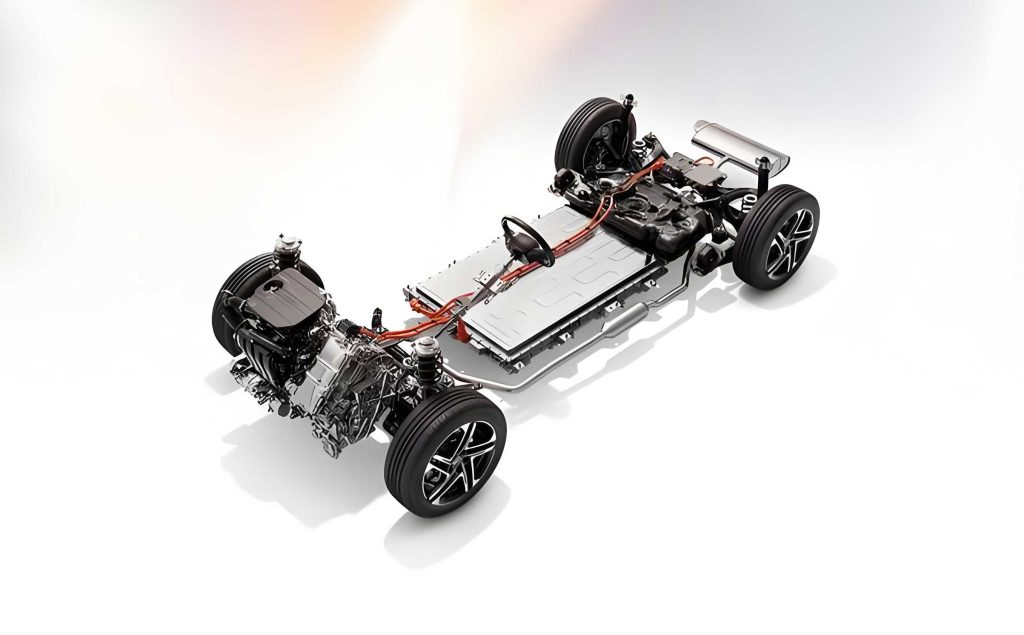
The thermal management system for this hybrid car is comprehensive, covering the engine cooling system, motor cooling system, air conditioning system, and battery cooling system. Each subsystem is designed to maintain optimal temperatures under varying loads. The engine cooling system employs a water pump, radiator, thermostat, and cooling fan, operating in small and large cycles. During cold starts, the thermostat closes to initiate a small loop, allowing coolant to warm up quickly; once the engine reaches a set temperature, the thermostat opens for the large loop, where the radiator dissipates heat. The motor and generator share a low-temperature cooling system, consisting of a pump and radiator, to manage heat from electrical components.
The air conditioning system is critical for cabin comfort and battery cooling. It comprises a compressor, condenser, expansion valve, and evaporator. Refrigerant undergoes phase changes to absorb and release heat. The condenser uses a plate-fin heat exchanger to dissipate heat to the environment, while the evaporator, a U-channel plate-fin heat exchanger, cools the cabin air. Additionally, a chiller (a heat exchanger combining evaporator and cooler functions) is integrated for battery cooling. The chiller has separate circuits for refrigerant and coolant: the refrigerant evaporates to absorb heat from the coolant, which in turn cools the battery. This setup allows for efficient thermal transfer, crucial for battery longevity and performance.
We modeled the entire thermal management system in AMESim, as shown in Figure 3 of the original text (not reproduced here due to format constraints). The system includes control modules for coordinating cooling demands. We defined three control strategies for scenarios where both the cabin and battery require cooling: Strategy 1 prioritizes cabin cooling, Strategy 2 prioritizes battery cooling, and Strategy 3 cools both simultaneously. These strategies are implemented using PID controllers to regulate temperatures. For instance, the engine cooling fan activates when coolant temperature exceeds 93°C and deactivates at 90°C. The battery cooling pump turns on at 30°C, with speed adjusted by PID based on temperature differences, and turns off below 28°C. The cabin uses PID control to maintain a target temperature of 22°C, with the compressor adjusting its speed accordingly.
To evaluate the system’s performance, we conducted simulations under six conditions, combining two ambient temperatures (30°C and 40°C) with the three control strategies. The initial cabin temperature was set to 1.6 times the ambient temperature, and the battery started at ambient temperature. The target temperatures were 22°C for the cabin and 28°C for the battery. Results under WLTC and NEDC cycles revealed consistent trends. For example, in the 30°C ambient condition, Strategy 1 achieved the fastest cabin cooling, reaching the comfort zone (±2°C around target) quickly, followed by Strategy 3 and then Strategy 2. This is because Strategy 1 allocates all compressor power to cabin cooling initially, leading to rapid temperature drop. However, after reaching the target, PID control caused minor fluctuations. Strategy 2, prioritizing battery cooling, resulted in slower cabin cooling but stable temperatures once achieved. Strategy 3 balanced both, though it took longer to enter the comfort zone due to shared resources.
The battery cooling performance varied similarly. Under Strategy 2 and Strategy 3, the battery temperature dropped to the target quickly, while Strategy 1 delayed battery cooling until cabin needs were met. At 40°C ambient, cooling times increased for all strategies due to higher thermal loads and reduced heat transfer efficiency. The battery’s internal heat generation rises with temperature, and the smaller temperature gradient with the environment slows dissipation. Thus, the cooling system required more time to achieve the target, emphasizing the need for optimization in extreme conditions.
Building on these findings, we propose an optimization method that recycles cold air from the cabin to cool the battery. In typical hybrid car operations, when the air conditioning system runs, the evaporator cools cabin air, and a portion of this cold air is expelled outside during fresh air intake. This represents wasted cooling potential. Our design modifies the system by adding a duct that connects the cabin air outlet to the battery cooling system. When the expelled air temperature is below ambient, this duct opens, directing 90% of the cold air to flow over the battery pack for air cooling, while the remaining 10% is vented outside. This approach supplements the existing liquid cooling via the chiller, enhancing overall cooling efficiency and reducing energy consumption.
The optimized thermal management model was simulated under the same six conditions to assess energy savings. We compared the energy consumption of the water pump and compressor before and after optimization. For the pump, which circulates coolant in the battery cooling system, optimization led to significant reductions. Under NEDC at 30°C, Strategy 1’s pump energy decreased by 24.1%, Strategy 2 by 2.8%, and Strategy 3 by 3.5%. At 40°C, the reductions were 33.3%, 5.5%, and 11.9%, respectively. Similar trends were observed under WLTC: at 30°C, pump energy dropped by 20.7%, 3.4%, and 5.2% for Strategies 1, 2, and 3; at 40°C, reductions were 34.6%, 6.1%, and 12.1%. Strategy 1 showed the most improvement because it prioritizes cabin cooling, allowing early reuse of cold air for battery cooling before activating the chiller pump extensively.
Compressor energy consumption, however, increased slightly after optimization due to the additional cooling load from the battery. Under NEDC at 30°C, compressor energy rose by 7.6%, 8.6%, and 11.6% for Strategies 1, 2, and 3; at 40°C, increases were 20.4%, 13.8%, and 15.9%. Under WLTC at 30°C, increases were 3.9%, 1.2%, and 1.5%; at 40°C, 13.3%, 5.9%, and 6.3%. Despite these rises, the overall system energy balance improved because the pump savings offset compressor gains. More importantly, the state of charge (SOC) of the battery increased, indicating better energy utilization. Table 3 summarizes the SOC improvements and energy savings for both driving cycles.
| Condition | Control Strategy | SOC Improvement (%) | Energy Saved (kJ) | Energy Consumption Reduction (%) |
|---|---|---|---|---|
| NEDC 30°C | Strategy 1 | 0.31 | ~300 | 6.9 |
| Strategy 2 | 0.34 | ~320 | 7.2 | |
| Strategy 3 | 0.30 | ~290 | 6.3 | |
| NEDC 40°C | Strategy 1 | 2.50 | 526 | 20.4 |
| Strategy 2 | 2.04 | ~450 | 20.2 | |
| Strategy 3 | 2.14 | ~470 | 21.5 | |
| WLTC 30°C | Strategy 1 | 1.11 | ~400 | 14.0 |
| Strategy 2 | 1.10 | ~390 | 13.8 | |
| Strategy 3 | 1.18 | ~420 | 14.6 | |
| WLTC 40°C | Strategy 1 | 4.27 | 448 | 13.3 |
| Strategy 2 | 2.82 | ~350 | 19.5 | |
| Strategy 3 | 3.08 | ~370 | 20.9 |
The SOC improvements are calculated as the increase in remaining battery charge after the driving cycle, relative to the total SOC consumed. For instance, under NEDC at 40°C, Strategy 1 boosted SOC by 2.5%, which accounts for 23.4% of the total SOC used. Similarly, under WLTC at 40°C, Strategy 1 achieved a 4.27% SOC increase, representing 26% of the consumed SOC. These gains stem from reduced pump energy and more efficient battery cooling, which minimizes parasitic losses. The energy savings in kilojoules (kJ) were derived from the net reduction in total system energy, considering both pump and compressor changes. For example, in NEDC at 40°C, Strategy 1 saved 526 kJ, while in WLTC at 40°C, Strategy 1 saved 448 kJ. The percentage reductions in energy consumption range from 6.3% to 26%, highlighting the optimization’s effectiveness across conditions.
To further illustrate the thermal dynamics, we can express the heat transfer involved in battery cooling. The heat generated by the battery \( Q_{\text{batt}} \) during operation depends on its internal resistance \( R \) and current \( I \):
$$ Q_{\text{batt}} = I^2 R $$
The cooling provided by the recycled cabin air \( Q_{\text{air}} \) can be estimated using:
$$ Q_{\text{air}} = \dot{m} \cdot c_p \cdot (T_{\text{in}} – T_{\text{out}}) $$
where \( \dot{m} \) is the mass flow rate of air, \( c_p \) is specific heat capacity, and \( T_{\text{in}} \) and \( T_{\text{out}} \) are the inlet and outlet temperatures. Combined with the chiller’s liquid cooling, the total heat removal \( Q_{\text{total}} \) is:
$$ Q_{\text{total}} = Q_{\text{air}} + Q_{\text{chiller}} $$
This integrated approach enhances the hybrid car’s thermal management by leveraging waste cold air, reducing reliance on active cooling components. The control strategies play a key role in balancing these flows. Strategy 1, for example, uses cabin cold air early, delaying chiller activation and saving pump energy. Strategy 2 and 3 integrate air cooling with liquid cooling more gradually, leading to smaller but still significant savings.
In conclusion, our study demonstrates the potential of optimizing thermal management systems for hybrid-series-parallel hybrid cars through AMESim modeling and simulation. The proposed method of recycling cabin cold air for battery cooling proves effective in reducing energy consumption and improving battery SOC under various driving conditions. The hybrid car’s thermal management system, when integrated with this optimization, maintains cabin and battery temperatures within target ranges while achieving energy savings up to 526 kJ and SOC improvements up to 4.27%. These findings underscore the importance of holistic thermal design in hybrid cars, where waste energy recovery can lead to substantial efficiency gains. Future work could explore real-world implementation and adaptive control algorithms to further enhance performance. Overall, this research contributes to the advancement of hybrid car technologies, promoting sustainability and energy efficiency in the automotive sector.