
In the era of global energy transformation and environmental sustainability, electric vehicles (EVs) have emerged as a pivotal solution for clean and efficient transportation. The widespread adoption of EVs hinges on robust charging infrastructure, where the EV charging station serves as the critical “refueling point.” The performance, safety, and reliability of EV charging stations directly influence charging efficiency, user safety, and overall experience. Consequently, comprehensive detection and evaluation of EV charging stations are imperative. However, existing detection methodologies often grapple with inefficiencies and compatibility issues, failing to keep pace with escalating market demands. This research delves into the essential aspects of EV charging station detection, encompassing necessity, core detection dimensions, and technological advancements, with a focus on enhancing the EV ecosystem.
The imperative for EV charging station detection stems from two primary facets: ensuring charging safety and guaranteeing compatibility. Firstly, EV charging stations are prone to electrical faults such as leakage, overcurrent, and overvoltage due to operational stressors. Undetected, these issues elevate risks of electrocution and fire hazards. By conducting systematic detection, key electrical parameters—including insulation performance, grounding resistance, and overcurrent protection—can be verified against standards like GB 39752-2024, mitigating potential dangers. Secondly, as EV diversity expands in brands and models, charging interfaces, protocols, and parameters must align seamlessly. Detection ensures that EV charging stations exhibit high compatibility across various EVs, fulfilling user needs and fostering industry standardization. Through rigorous evaluation, we can preempt failures, enhance user trust, and support the sustainable growth of EV adoption.
Electrical safety detection forms the cornerstone of EV charging station assessment. It involves multiple tests to preempt electrical hazards. Insulation resistance testing evaluates the integrity of insulating materials using specialized instruments, ensuring minimal current leakage. Grounding continuity testing verifies that the grounding system offers low resistance, safeguarding against fault currents. Leakage current testing measures unintended current flow to exposed parts, while withstand voltage testing applies high voltages to confirm insulation durability. These procedures collectively fortify the EV charging station against electrical failures. Table 1 summarizes key electrical safety detection parameters and methods.
| Detection Parameter | Method | Instrument | Standard Requirement |
|---|---|---|---|
| Insulation Resistance | Apply DC voltage and measure resistance | Insulation resistance tester | >100 MΩ |
| Grounding Resistance | Measure resistance between ground and earth | Grounding resistance tester | <0.1 Ω |
| Leakage Current | Monitor current under normal operation | Leakage current detector | <5 mA |
| Withstand Voltage | Apply high AC/DC voltage for duration | Withstand voltage tester | No breakdown at specified voltage |
Electrical performance detection assesses the operational efficiency of EV charging stations. Key parameters include voltage, current, power, power factor, and harmonic distortion. Using digital power analyzers, we capture real-time data to evaluate consistency and stability. For instance, the output power of an EV charging station can be expressed as: $$ P = V \times I $$ where \( P \) is power in watts, \( V \) is voltage in volts, and \( I \) is current in amperes. In AC systems, power factor correction is vital, given by: $$ \text{Power Factor} = \frac{P}{S} $$ where \( S \) is apparent power. Oscilloscopes analyze waveform integrity, while electronic loads simulate EV charging demands to test dynamic response. Harmonic distortion, quantified as Total Harmonic Distortion (THD), must adhere to limits: $$ \text{THD} = \frac{\sqrt{\sum_{h=2}^{\infty} V_h^2}}{V_1} \times 100\% $$ where \( V_h \) is the harmonic voltage and \( V_1 \) is the fundamental voltage. Table 2 outlines typical electrical performance metrics.
| Parameter | Measurement Technique | Acceptable Range |
|---|---|---|
| Output Voltage | Digital multimeter or power analyzer | ±5% of rated value |
| Output Current | Current clamp or analyzer | ±5% of rated value |
| Power Accuracy | Calculated from V and I measurements | Within 2% error |
| Power Factor | Power analyzer | >0.9 at full load |
| Harmonic Distortion | Spectrum analysis | THD < 5% |
Overload and short-circuit protection detection are critical for preventing equipment damage and fires. Overload protection testing involves applying currents beyond the rated capacity to verify automatic shutdown. The trip current \( I_{\text{trip}} \) should satisfy: $$ I_{\text{trip}} \leq k \times I_{\text{rated}} $$ where \( k \) is a safety factor (e.g., 1.1 to 1.5). Short-circuit protection testing simulates fault conditions to ensure rapid disconnection, typically within milliseconds. Instruments like overload testers and short-circuit simulators are employed, with response times measured to confirm compliance. This ensures that EV charging stations can handle abnormal scenarios without compromising safety.
Environmental adaptability testing evaluates the resilience of EV charging stations under varying conditions. High-low temperature tests use environmental chambers to simulate extremes from -40°C to 50°C, verifying operational stability. The temperature coefficient of performance parameters can be modeled as: $$ \Delta P = P_0 \times \alpha \times (T – T_0) $$ where \( \Delta P \) is the change in power, \( P_0 \) is reference power, \( \alpha \) is the temperature coefficient, and \( T \) is temperature. Damp heat tests assess moisture resistance, while IP54-rated waterproof and dustproof tests ensure外壳 integrity. Vibration tests mimic transportation stresses, checking mechanical durability. These tests guarantee that EV charging stations perform reliably in diverse outdoor environments, enhancing longevity and user confidence.
Electromagnetic compatibility (EMC) testing addresses interference and susceptibility aspects of EV charging stations. EMI (Electromagnetic Interference) testing measures emitted noise using receivers, ensuring levels stay within limits set by standards like CISPR 11. The emitted field strength \( E \) can be expressed as: $$ E = \frac{k \times I \times f}{d} $$ where \( k \) is a constant, \( I \) is current, \( f \) is frequency, and \( d \) is distance. EMS (Electromagnetic Susceptibility) testing evaluates immunity to external disturbances such as electrostatic discharge (ESD), radio-frequency fields, and surges. For instance, ESD tests apply voltages up to 15 kV to verify no malfunctions occur. This ensures that EV charging stations neither disrupt other devices nor are affected by environmental electromagnetic noise, promoting seamless integration into urban grids.
Charging performance and protection function detection focus on the dynamic interaction between EV charging stations and EV batteries. Key tests include monitoring charging voltage and current profiles to ensure adaptive control, preventing overcharging or over-discharging. The state of charge (SOC) management can be described by: $$ \text{SOC} = \frac{Q_{\text{remaining}}}{Q_{\text{total}}} \times 100\% $$ where \( Q \) represents charge capacity. Automatic stop-charging functions are verified upon full charge, and emergency stop mechanisms are tested for rapid response. Locking protection ensures connectors remain secure during operation, avoiding accidental disconnections. These aspects are vital for battery health and user safety, making them integral to EV charging station evaluations.
Communication interface compatibility testing ensures that EV charging stations adhere to standardized protocols like ISO 15118 or CHAdeMO, enabling interoperability with various EVs. Data exchange parameters, such as handshake signals and error codes, are validated to prevent communication failures. This enhances the user experience by allowing seamless connections across different EV models.
Metering accuracy detection verifies the precision of energy measurement in EV charging stations. Electricity meters are calibrated against reference standards, with errors calculated as: $$ \text{Error} = \frac{E_{\text{displayed}} – E_{\text{reference}}}{E_{\text{reference}}} \times 100\% $$ where \( E \) is energy. Tariff switching accuracy is also checked to ensure correct billing across different rate periods. Regulatory requirements, such as those in JJG 1149-2018, mandate errors within ±2% for commercial EV charging stations. This fosters trust in billing systems and supports fair trade practices.
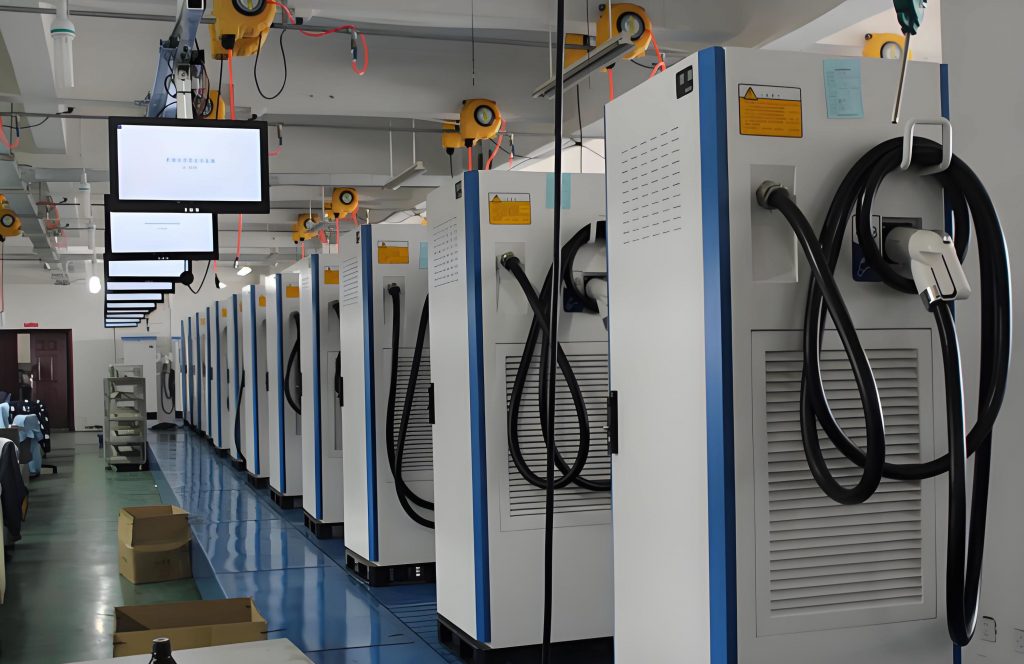
Traditional detection technologies for EV charging stations rely on manual methods and basic instruments. Laboratory-based testing involves placing EV charging stations in controlled settings to measure parameters like voltage, current, and insulation resistance using voltmeters, ammeters, and insulation testers. For example, according to JJG 1149-2018, a 120 kW DC EV charging station might be evaluated by connecting a standard load and comparing displayed values with reference instruments. This approach, while reliable, is time-consuming—often taking 0.5 hours per station for DC types—and labor-intensive, requiring multiple personnel for on-site operations. Environmental factors and equipment transport further complicate large-scale deployments, limiting scalability. Despite these drawbacks, traditional methods provide a foundation for basic performance validation, especially in settings where advanced tools are unavailable.
Modern detection technologies leverage automation, sensors, and data analytics to revolutionize EV charging station assessments. Online monitoring systems embed sensors within EV charging stations to continuously track parameters such as temperature, voltage, and current. Data is transmitted via communication modules to central platforms, where algorithms analyze trends and flag anomalies. For instance, a LabVIEW-based system can automate data acquisition, reducing human intervention and improving efficiency. Artificial intelligence (AI) techniques, including machine learning, enable predictive maintenance by modeling failure probabilities: $$ P_{\text{failure}} = f(\text{data history, operating conditions}) $$ This proactive approach minimizes downtime and enhances reliability. In practice, advanced EV charging stations like the Tesla V4 incorporate AI for multi-scenario safety protection, demonstrating high availability and smart features. Table 3 contrasts traditional and modern detection technologies.
| Aspect | Traditional Technology | Modern Technology |
|---|---|---|
| Efficiency | Low; manual processes | High; automated systems |
| Cost | High labor and time costs | Reduced via remote monitoring |
| Scalability | Limited by human resources | Easily scalable with IoT |
| Data Analysis | Basic; manual interpretation | Advanced; AI-driven insights |
| Real-Time Capability | Delayed results | Immediate feedback |
In empirical applications, traditional methods have been employed for foundational checks. For instance, in a parking lot scenario, a DC EV charging station was tested using a calibration instrument and load simulator. The process involved串联 standard meters into the circuit to compare values, identifying display errors that exceeded tolerances. After adjustments, re-testing confirmed compliance. Conversely, modern approaches, such as online monitoring, have demonstrated superiority in large networks. By integrating energy management systems (EMS), EV charging stations can be monitored 24/7, with data analytics detecting subtle deviations—like insulation degradation—before they escalate. This not only boosts detection efficiency but also aligns with smart grid initiatives, where EV charging stations act as dynamic nodes.
In conclusion, the detection of EV charging stations is a specialized and evolving field essential for the safe and efficient operation of EV infrastructure. By understanding the necessity, comprehensively addressing detection content—from electrical safety to metering accuracy—and embracing technological innovations, we can overcome existing limitations. Traditional methods provide a reliable baseline, while modern technologies offer scalable, intelligent solutions. As the EV industry expands, continuous optimization of detection strategies will be crucial to ensuring quality, safety, and compatibility, thereby supporting the global transition to sustainable transportation. Through collaborative efforts in research and standardization, EV charging stations will become more robust, fostering widespread adoption and environmental benefits.