
As an engineer specializing in electric vehicle (EV) technologies, I have always been fascinated by the potential of electric car systems to revolutionize transportation, particularly in the context of China EV market growth. In this study, I focus on designing and simulating a two-speed transmission for a pure electric car to enhance its performance and efficiency. Traditional electric car models often employ fixed-ratio transmissions, which rely solely on the motor for speed regulation, leading to limitations in handling complex driving conditions like climbing, acceleration, and high-torque demands. By developing a two-speed transmission, I aim to optimize the electric car’s powertrain, ensuring that the motor operates within its high-efficiency zones, thereby improving overall dynamics and energy economy. This approach is crucial for advancing China EV innovations, as it addresses key challenges in urban and highway driving scenarios.
The motivation for this work stems from the growing demand for electric car solutions that balance power and efficiency. In China EV industry, there is a push toward smarter, more adaptive systems that can reduce battery drain and extend driving range. Through this research, I explore how a two-speed transmission can outperform fixed-ratio setups, using ADVISOR software for comprehensive simulations. The electric car model I selected is representative of modern China EV designs, with parameters tailored to real-world applications. By integrating theoretical calculations with practical simulations, I demonstrate the benefits of this transmission system, contributing to the broader goal of sustainable electric car development in China and beyond.
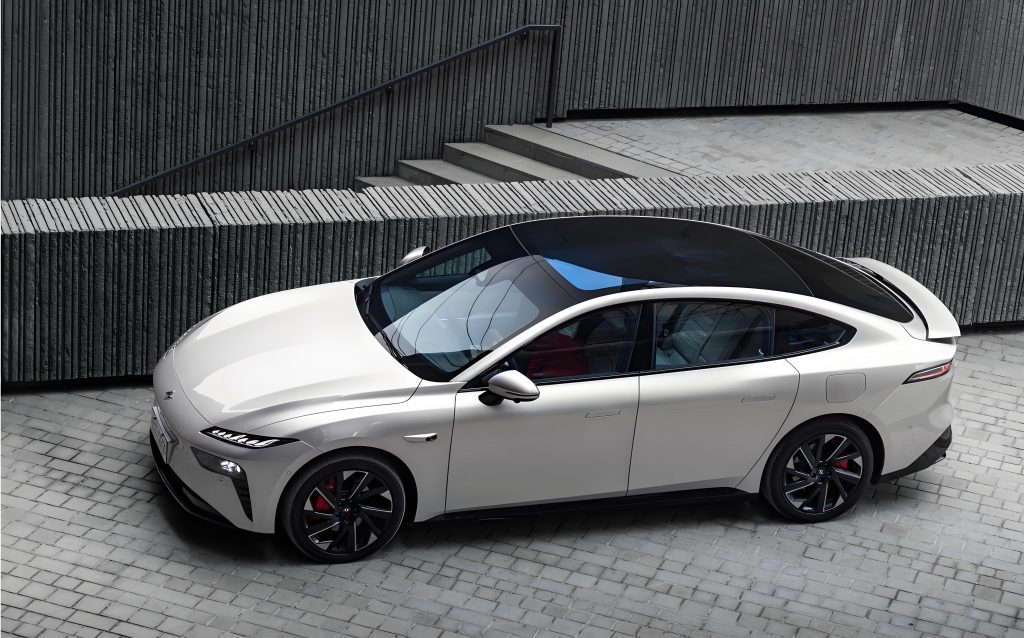
To begin, I established the fundamental parameters of the electric car, which are essential for accurate transmission design. These parameters include dimensions, mass, aerodynamic properties, and motor specifications, all typical of a standard China EV model. The table below summarizes the key inputs used in this study:
| Parameter | Value |
|---|---|
| Length × Width × Height (mm) | 4995 × 1910 × 1495 |
| Wheelbase (mm) | 2920 |
| Front/Rear Track (mm) | 1650 / 1630 |
| Curb Mass (kg) | 2100 |
| Gross Mass (kg) | 2475 |
| Drag Coefficient (CD) | 0.23 |
| Frontal Area (A, m²) | 2.2 |
| Rolling Radius (r, mm) | 400.55 |
| Rotational Mass Conversion Factor (δ) | 1.1 |
| Rolling Resistance Coefficient (f) | 0.02 |
| Mechanical Transmission Efficiency (ηT) | 0.92 |
| Rated Torque (Trated, N·m) | 130 |
| Peak Torque (Tmax, N·m) | 330 |
| Rated Speed (nrated, rpm) | 4400 |
| Maximum Speed (nmax, rpm) | 15500 |
| Maximum Vehicle Speed (vmax, km/h) | 100 |
| Maximum Gradability (%) | 30 |
These parameters form the basis for designing the transmission ratios, ensuring that the electric car meets performance criteria such as maximum speed, gradability, and acceleration. For instance, the mass and aerodynamic factors influence the force calculations, which I derived using fundamental equations of motion. The electric car’s motor characteristics, including torque and speed ranges, are critical for determining the transmission’s gear ratios, as they define the operating points where efficiency is maximized. This is particularly important for China EV applications, where urban driving cycles demand rapid acceleration and hill-climbing capabilities.
Next, I proceeded to design the two-speed transmission ratios, focusing on the first and second gears to cover low-speed high-torque and high-speed low-torque scenarios, respectively. The design process involved solving inequalities based on the electric car’s powertrain requirements. For the first gear ratio (ig1), I considered the lower bound dictated by the maximum gradability and the upper bound by the minimum stable speed during climbing. The equations are as follows:
$$ i_{g1} i_0 \geq \frac{r}{T_{\text{max}} \eta_T} \left( m g f \cos \alpha + m g \sin \alpha + \frac{C_D A v^2}{21.15} \right) $$
$$ i_{g1} i_0 \leq \frac{0.377 n_{\text{max}} r}{v} $$
Here, i0 is the final drive ratio, α is the maximum climb angle, g is gravitational acceleration (approximately 9.81 m/s²), and v is the vehicle speed. For the electric car in this China EV study, α was set based on a 30% gradability, resulting in α ≈ 16.7°. Similarly, for the second gear ratio (ig2), I used the maximum speed condition and the resistance at high speeds:
$$ i_{g2} i_0 \geq \frac{r}{T_{\text{max}} \eta_T} \left( m g f + \frac{C_D A v_{\text{max}}^2}{21.15} \right) $$
$$ i_{g2} i_0 \leq \frac{0.377 n_{\text{max}} r}{v_{\text{max}}} $$
Additionally, to prevent wheel slip, I incorporated the adhesion condition based on the road friction coefficient φ (taken as 0.7 for typical surfaces):
$$ i_g i_0 \leq \frac{m g r \varphi}{T_{\text{max}} \eta_T} $$
Furthermore, to ensure smooth gear shifts and continuous power delivery, I enforced a relationship between the gear ratios based on the motor’s speed characteristics:
$$ \frac{i_{g1}}{i_{g2}} \leq \frac{n_{\text{max}}}{n_{\text{rated}}} $$
By substituting the electric car parameters from the table into these equations, I derived preliminary ratios: i0 = 3.9, ig1 = 2.4, and ig2 = 1.6. These values were chosen to balance the trade-offs between torque amplification and speed range, essential for optimizing the China EV’s performance in diverse driving conditions. The following table summarizes the calculated transmission ratios and their constraints:
| Parameter | Value | Constraint Equation |
|---|---|---|
| Final Drive Ratio (i0) | 3.9 | Based on system packaging and efficiency |
| First Gear Ratio (ig1) | 2.4 | $$ i_{g1} i_0 \geq \frac{r}{T_{\text{max}} \eta_T} \left( m g f \cos \alpha + m g \sin \alpha + \frac{C_D A v^2}{21.15} \right) $$ |
| Second Gear Ratio (ig2) | 1.6 | $$ i_{g2} i_0 \geq \frac{r}{T_{\text{max}} \eta_T} \left( m g f + \frac{C_D A v_{\text{max}}^2}{21.15} \right) $$ |
| Ratio Relationship | $$ \frac{i_{g1}}{i_{g2}} = 1.5 $$ | $$ \frac{i_{g1}}{i_{g2}} \leq \frac{n_{\text{max}}}{n_{\text{rated}}} = 3.52 $$ |
With the transmission ratios defined, I moved to the simulation phase using ADVISOR software, a powerful tool for evaluating electric car performance. ADVISOR allows for modular input of vehicle components, such as the energy storage, motor, and transmission, enabling dynamic simulations under various driving cycles. For this China EV analysis, I configured the model by selecting the EV template and inputting the parameters from the earlier table. The simulation model included components like the battery (ESS_LI7_temp), motor (MC_AC83), wheels (WH_SMCA R), and powertrain control (PTC_EV). I set up two scenarios: one with a fixed-ratio transmission (i0 = 3.9) and another with the two-speed transmission (ig1 = 2.4, ig2 = 1.6, i0 = 3.9).
The driving cycle chosen was the Urban Dynamometer Driving Schedule (CYC_UDDS), which mimics city driving conditions common in China EV usage. This cycle consists of repetitive stops and starts, ideal for testing acceleration, regenerative braking, and energy consumption. I ran the simulations for one cycle to compare the performance metrics between the two transmission types. The key aspects evaluated included maximum speed, battery state of charge (SOC), transmission efficiency, and overall system efficiency. The results demonstrated significant improvements with the two-speed transmission, highlighting its potential for enhancing electric car economics in China EV markets.
In terms of maximum speed, the fixed-ratio transmission achieved 97 km/h, whereas the two-speed transmission reached 99 km/h, a 2.0% increase. This improvement stems from the better utilization of the motor’s speed range, allowing the electric car to operate closer to its peak power points. For battery economy, the SOC after the simulation was 0.85 for the fixed-ratio and 0.88 for the two-speed setup, indicating a 3.5% enhancement in energy retention. This is crucial for China EV adoption, as it translates to longer driving ranges and reduced charging frequency. The efficiency analysis further revealed that the two-speed transmission operated at 97% efficiency compared to 95% for the fixed-ratio, a 2% gain, while the overall system efficiency improved from 0.424 to 0.446, a 5% boost. These metrics are summarized in the table below:
| Metric | Fixed-Ratio Transmission | Two-Speed Transmission | Improvement |
|---|---|---|---|
| Maximum Speed (km/h) | 97 | 99 | 2.0% |
| Battery SOC (After Simulation) | 0.85 | 0.88 | 3.5% |
| Transmission Efficiency | 0.95 | 0.97 | 2.0% |
| System Efficiency | 0.424 | 0.446 | 5.0% |
To delve deeper into the efficiency gains, I analyzed the motor operating points during the simulation. The two-speed transmission allowed the electric car’s motor to spend more time in high-efficiency regions, reducing energy losses. This is quantified by the equation for motor efficiency ηm, which depends on torque T and speed ω:
$$ \eta_m = \frac{T \omega}{P_{\text{input}}} $$
where Pinput is the electrical power input. By shifting gears, the transmission adjusts T and ω to keep ηm high, whereas the fixed-ratio transmission often forces the motor into less efficient zones. For instance, during acceleration, the first gear provides higher torque multiplication, enabling the motor to operate near its rated torque, where efficiency is peak. In contrast, the second gear optimizes for cruising, minimizing current draw and heat generation. This adaptive behavior is vital for China EV applications, where traffic patterns vary widely.
Moreover, the two-speed transmission contributes to better thermal management and reduced component stress, extending the lifespan of the electric car’s powertrain. In China EV contexts, where durability and maintenance costs are concerns, this advantage cannot be overstated. The simulation outputs also included plots of speed versus time and SOC versus distance, which visually confirmed the superior performance of the two-speed system. For example, the electric car with two-speed transmission maintained higher average speeds and smoother acceleration profiles, reducing jerk and improving ride comfort.
In conclusion, this study underscores the benefits of a two-speed transmission for electric car systems, particularly in the evolving China EV landscape. By designing and simulating the transmission ratios using ADVISOR, I have shown that such a setup enhances both dynamic performance and energy economy. The improvements in maximum speed, battery SOC, and efficiency metrics demonstrate the potential for widespread adoption in future electric car models. As China EV industry continues to grow, innovations in transmission design will play a pivotal role in achieving sustainability goals. Future work could focus on optimizing control strategies for gear shifts, integrating artificial intelligence for predictive shifting, and exploring multi-speed transmissions for heavier electric car variants. Through these efforts, I believe that electric car technology will become even more efficient and accessible, solidifying China’s position as a leader in the global EV market.
Reflecting on this research, I am convinced that the integration of advanced transmission systems is key to unlocking the full potential of electric car platforms. The methodology I employed—combining theoretical calculations with software simulations—provides a robust framework for similar studies in China EV development. As I continue to explore electric car innovations, I aim to address challenges such as cost reduction and scalability, ensuring that these technologies benefit a broader audience. The journey toward sustainable transportation is long, but with continued focus on electric car advancements, particularly in transmission design, we can accelerate progress and make a meaningful impact on the environment and society.