
As the global adoption of electric vehicles continues to accelerate, the demand for rapid, efficient, and safe charging solutions has become increasingly critical. Traditional integrated EV charging stations are facing systemic limitations in energy conversion efficiency, thermal management capabilities, and control response rates. Modular design emerges as a pivotal approach to optimize system performance and structural adaptability, enabling decoupled upgrades in conversion efficiency, scheduling intelligence, and assembly flexibility across functional units. This approach allows EV charging stations to better accommodate diverse application scenarios and power level configurations. In this article, I explore the key technologies underpinning modular architectures for EV charging stations, focusing on four core technical aspects: power conversion, thermal management, intelligent scheduling, and interface systems. By constructing a modular design framework with distributed coordination and scalability, I aim to enhance the overall operational efficiency and engineering feasibility of EV charging stations, while addressing standardization in manufacturing processes and multi-module system integration mechanisms.
The transition toward modular EV charging stations is driven by the need to overcome inefficiencies in conventional systems. Traditional charging infrastructure often suffers from high energy losses, limited thermal dissipation, and slow adaptation to varying load conditions. Modular design not only mitigates these issues but also facilitates maintenance, upgrades, and interoperability across different EV charging station models. In the following sections, I delve into the principles, key design elements, and implementation strategies that define a modular EV charging station, supported by analytical models, tables, and formulas to provide a comprehensive understanding.
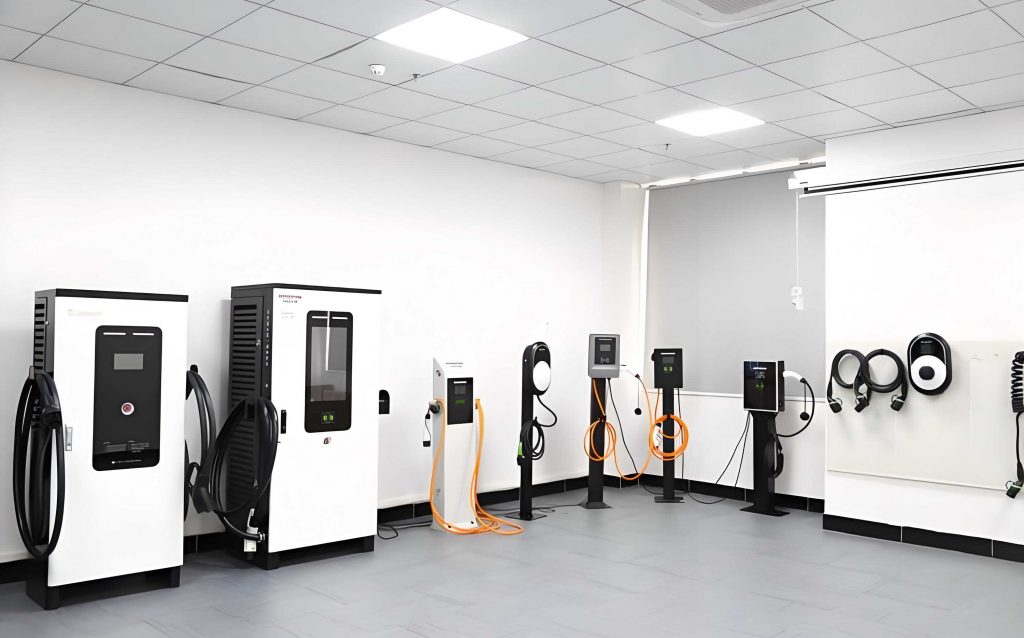
Principles of Modular Design for EV Charging Stations
The modular design of an EV charging station must be founded on clear functional decomposition and system coordination. The core principles revolve around structural decoupling, interface standardization, and closed-loop control, which can be summarized into four key aspects. First, the principle of functional independence requires each module to possess complete local operational capabilities, such as power conversion, thermal management, or scheduling control, without relying on other modules. This ensures system stability during module replacement or maintenance. Second, interface standardization mandates the use of uniform physical connectors and voltage identification protocols for electrical connections, along with mechanical features like positioning pins and error-proof coding to facilitate interoperability across different manufacturers and simplify on-site assembly. Third, the principle of scalability emphasizes the ability to horizontally combine modules in terms of power levels, signal types, and cooling methods, with reserved interface margins and expansion space to support efficient assembly under varying power densities and environmental conditions. Fourth, power closed-loop control establishes a dynamic energy flow regulation mechanism based on real-time monitoring data, ensuring load balancing among modules and enabling coordinated control for state recognition, strategy deployment, and fault isolation through intelligent algorithms, ultimately achieving global system efficiency optimization.
To illustrate these principles, consider the following table that outlines the core aspects and their implications for EV charging station design:
| Principle | Key Requirements | Impact on EV Charging Station |
|---|---|---|
| Functional Independence | Local operation without inter-module dependencies | Enhances reliability and ease of maintenance |
| Interface Standardization | Uniform connectors and protocols | Improves interoperability and reduces assembly time |
| Scalability | Modular expansion in power and cooling | Supports diverse applications and future upgrades |
| Closed-Loop Control | Real-time monitoring and adaptive algorithms | Optimizes energy efficiency and fault tolerance |
These principles collectively ensure that the EV charging station can adapt to evolving demands while maintaining high performance. For instance, in a scalable EV charging station, modules can be added or removed based on power requirements, such as in urban fast-charging hubs or residential settings. The closed-loop control principle is particularly crucial for dynamic environments, where it minimizes energy waste and prevents overheating through continuous feedback. By adhering to these guidelines, the modular EV charging station becomes a versatile and resilient component of the broader energy infrastructure.
Key Design Elements for Modular EV Charging Stations
The implementation of modular design in EV charging stations involves several critical elements that directly influence charging efficiency, safety, and adaptability. I focus on four primary components: high-efficiency power conversion, active thermal management, intelligent charging scheduling, and standardized interfaces. Each element is designed to operate independently yet synergistically within the modular framework, ensuring that the EV charging station meets the demands of high-power fast-charging scenarios.
High-Efficiency Power Conversion Module
The power conversion module is central to the performance of an EV charging station, as it governs the transformation of AC grid power to DC power suitable for electric vehicle batteries. In a modular design, this module employs wide-bandgap semiconductor devices, such as silicon carbide (SiC) MOSFETs, to achieve high-frequency energy conversion with minimal losses. The topology typically adopts a two-stage architecture: an AC/DC front-end using an active power factor correction (PFC) Boost circuit, followed by a DC/DC stage configured with an LLC resonant full-bridge structure to enable soft-switching characteristics. This reduces switching losses and electromagnetic interference, critical for the efficiency of the EV charging station.
Key parameters for the power conversion module include a switching frequency range of 100–250 kHz, with a typical on-resistance of 5.8 mΩ for 650 V SiC MOSFETs. The core transformer utilizes iron-silicon-aluminum (FeSiAl) material for the magnetic core, such as the PQ40 type, to optimize magnetic losses. The power distribution unit within the module employs busbar isolation to allow multiple output channels with independent voltage regulation and redundant switching capabilities, ensuring precise current分流 under varying load conditions. The efficiency of this module can be modeled using the following formula for power loss estimation:
$$P_{\text{loss}} = I_{\text{rms}}^2 \cdot R_{\text{ds(on)}} + f_{\text{sw}} \cdot E_{\text{sw}}$$
where \(P_{\text{loss}}\) represents the total power loss, \(I_{\text{rms}}\) is the root-mean-square current, \(R_{\text{ds(on)}}\) is the on-state resistance of the MOSFET, \(f_{\text{sw}}\) is the switching frequency, and \(E_{\text{sw}}\) is the switching energy per cycle. By minimizing these losses, the EV charging station achieves higher energy conversion efficiency, often exceeding 95% in optimized modular setups.
To further illustrate the design choices, the table below compares key components in the power conversion module:
| Component | Specification | Benefit for EV Charging Station |
|---|---|---|
| SiC MOSFET | 650 V, 5.8 mΩ Rds(on) | Reduces conduction losses and heat generation |
| Transformer Core | PQ40 FeSiAl | Minimizes magnetic losses at high frequencies |
| LLC Resonant Circuit | Soft-switching operation | Enhances efficiency and reduces EMI |
This modular approach allows for easy upgrades, such as replacing the power conversion module with advanced semiconductors as technology evolves, ensuring the EV charging station remains at the forefront of efficiency.
Active Thermal Management Module
Thermal management is a significant challenge in high-power EV charging stations, where excessive heat can degrade components and reduce lifespan. The active thermal management module in a modular design employs a liquid cooling system with a dual-path configuration: a looped liquid coolant combined with heat sinks. The working fluid is typically a fluorocarbon-based medium, with flow velocity controlled between 0.5 and 1.2 m/s to maintain optimal heat transfer. The thermal resistance design target is kept below 0.08 °C·cm²/W, ensuring efficient dissipation.
The heat exchanger utilizes a microchannel structure, with wall thickness under 0.3 mm and surface roughness ≤0.8 μm to minimize interfacial thermal resistance. Additionally, a heat pipe auxiliary unit is integrated for transient thermal response, capable of handling power step changes exceeding 70% with a response time under 5 seconds. This keeps the core power器件 temperature stable at approximately 60±2°C. The cooling plate is designed as a plug-in module, allowing for easy disassembly and maintenance without disrupting other subsystems. The liquid coolant pump employs a magnetic levitation motor for quiet operation, with vibration noise peaks below 40 dB, making it suitable for dense urban EV charging station deployments.
The thermal performance can be described by the heat transfer equation:
$$Q = h \cdot A \cdot \Delta T$$
where \(Q\) is the heat flux, \(h\) is the heat transfer coefficient, \(A\) is the surface area, and \(\Delta T\) is the temperature difference. In practice, the module’s design ensures that \(Q\) remains within safe limits even under peak loads, as summarized in the table below for typical operating conditions:
| Parameter | Value | Importance for EV Charging Station |
|---|---|---|
| Flow Velocity | 0.5–1.2 m/s | Balances cooling efficiency and pump energy use |
| Thermal Resistance | <0.08 °C·cm²/W | Prevents overheating in high-power modules |
| Response Time | <5 s for >70% load step | Ensures stability during rapid charging cycles |
By decoupling thermal management from other functions, this module enhances the reliability of the EV charging station, especially in environments with fluctuating ambient temperatures.
Intelligent Charging Scheduling Module
The intelligent scheduling module leverages artificial intelligence algorithms to optimize charging processes based on real-time data, including vehicle battery state, station load capacity, and energy consumption patterns. This module employs a dynamic current control strategy that integrates power prediction and charging path optimization. The control model is built around a PID (Proportional-Integral-Derivative) framework, where the charging current setpoint is adjusted continuously to minimize deviations from target power levels.
The current scheduling equation is defined as:
$$I(t) = I_0 + K_p \cdot e(t) + K_i \cdot \int_0^t e(\tau) \, d\tau + K_d \cdot \frac{de(t)}{dt}$$
where \(I(t)\) is the real-time charging current setpoint, \(I_0\) is the baseline current, \(e(t) = P_{\text{target}}(t) – P_{\text{actual}}(t)\) is the power error between the target and actual power, and \(K_p\), \(K_i\), and \(K_d\) are the PID coefficients. The target power \(P_{\text{target}}(t)\) is dynamically determined by the scheduling algorithm based on battery charging phases and grid load, while \(P_{\text{actual}}(t)\) is derived from voltage and current measurements at the EV charging station. The PID parameters are adaptively tuned by the algorithm to match charging characteristics, reducing overshoot and response delays.
The scheduling module also incorporates communication protocols, such as CAN-FD or Ethernet, to exchange data with central platforms, enabling features like off-peak charging prioritization and overload prevention. This can improve power utilization by 12–18% across various scenarios, as shown in the table below:
| Scheduling Feature | Mechanism | Benefit for EV Charging Station |
|---|---|---|
| Peak Shaving | Dynamic current reduction during high demand | Avoids grid overload and reduces costs |
| Valley Filling | Increased charging during low-demand periods | Enhances energy efficiency and station utilization |
| Predictive Control | AI-based load forecasting | Optimizes charging schedules for multiple vehicles |
This intelligent approach ensures that the EV charging station operates efficiently under varying grid conditions, contributing to overall energy sustainability.
Standardized Physical and Electrical Interface Module
The interface module is critical for ensuring seamless connectivity and interoperability in a modular EV charging station. It adopts a dual-layer structure: an upper layer with guide rail sliding mechanisms for mechanical positioning, and a lower layer with redundant contact pin groups for electrical connections. Contact resistance is maintained below 0.5 mΩ to minimize energy losses. The interface standards align with CCS Type 2 and GB/T 20234 protocols, utilizing resistor-based voltage identification with an error margin of less than ±1 V.
Mechanical locking mechanisms incorporate elastic forks and displacement feedback, with deviations under 0.2 mm and a lifespan exceeding 10,000 plug-unplug cycles, supporting hot-swapping capabilities. The liquid cooling interface is separately sealed using elastic ceramic gaskets, capable of withstanding pressures up to 1.5 MPa, allowing module replacements during operation. Communication ports include dual-mode options like CAN-FD and RS-485, with automatic recognition of connected module capabilities.
The interface design can be summarized with the following formula for contact reliability:
$$R_{\text{contact}} = \frac{V_{\text{drop}}}{I_{\text{load}}}$$
where \(R_{\text{contact}}\) is the contact resistance, \(V_{\text{drop}}\) is the voltage drop across the interface, and \(I_{\text{load}}\) is the load current. By keeping \(R_{\text{contact}}\) low, the EV charging station ensures efficient power transfer and reduces thermal stresses. The table below highlights key interface specifications:
| Interface Aspect | Specification | Role in EV Charging Station |
|---|---|---|
| Electrical Contact | <0.5 mΩ resistance | Minimizes power loss and heating |
| Mechanical Locking | >10,000 cycles, <0.2 mm error | Ensures durability and safe connections |
| Cooling Seal | 1.5 MPa pressure rating | Prevents leaks in liquid-cooled modules |
This standardized interface module facilitates quick integration and maintenance, making the EV charging station more adaptable to diverse operational environments.
Modular Design Implementation for EV Charging Stations
The practical deployment of a modular EV charging station involves systematic approaches to module division, manufacturing, and system integration. I outline these strategies to ensure that the design principles and key elements are effectively realized in real-world applications.
Function-Driven Module Partitioning
Module partitioning in an EV charging station follows the principles of physical decoupling, functional focus, and control closure. The system is divided into distinct layers based on energy flow and information control paths. The power conversion module handles AC-to-DC rectification and voltage stabilization, utilizing wide-bandgap devices and soft-switching topologies to enhance power density. The thermal management module employs liquid cooling and microchannel heat exchangers, with dynamic pump speed and flow rate adjustments to maintain consistent thermal resistance. The interface adapter module supports multiple standards like GBT and CCS, integrating voltage identification and fault isolation for plug-and-play functionality. Each module features uniform packaging for easy assembly and replacement.
The scheduling control module, built around MCU or FPGA units, manages state acquisition, command issuance, and mode switching. Communication links use redundant structures, such as CAN-FD or Ethernet, with fault detection and link reestablishment capabilities. All functional modules are assigned unique IDs for integration into a control grid, enabling coordinated operation. The system includes hot-swap and off-grid protection mechanisms, with boundary layers containing isolation relays, buffer capacitors, and self-recovery units to ensure bus and control continuity. Additionally, state联动 mechanisms between power and thermal modules, along with health assessment and fault prediction functions, enhance the safety and reliability of the EV charging station.
The partitioning strategy can be represented with the following formula for module interdependence:
$$C_{\text{coupling}} = \sum_{i=1}^{n} \frac{D_i}{S_i}$$
where \(C_{\text{coupling}}\) is the coupling coefficient, \(D_i\) is the dependency of module \(i\) on others, and \(S_i\) is its self-sufficiency. Minimizing \(C_{\text{coupling}}\) through functional independence improves the modularity of the EV charging station. The table below summarizes the module types and their roles:
| Module Type | Primary Function | Contribution to EV Charging Station |
|---|---|---|
| Power Conversion | AC/DC and DC/DC conversion | Core energy processing for charging |
| Thermal Management | Heat dissipation and temperature control | Prevents performance degradation |
| Scheduling Control | Dynamic current and power management | Optimizes efficiency and grid interaction |
| Interface Adapter | Physical and electrical connectivity | Ensures interoperability and ease of use |
This partitioning approach allows the EV charging station to scale from low-power units to high-power fast-charging systems without fundamental redesigns.
Manufacturing Process Design for Modular Structures
The manufacturing of modular EV charging stations employs a two-layer heterogeneous layout: the upper layer encapsulates control circuits and power conversion components, while the lower layer integrates liquid cooling channels and thermal interface materials to ensure structural compactness and thermal coupling efficiency. Each module undergoes independent manufacturing and assembly, with key processes including high-precision automatic winding, SMT soldering, power chip bonding, nano-scale thermal grease application, hot pressing, and high-voltage potting. The potting process uses high-thermal-conductivity, aging-resistant epoxy materials with volume resistivity above \(10^{12} \, \Omega \cdot \text{cm}\) and thermal conductivity of 1.5 W/(m·K) to ensure long-term insulation and thermal stability.
Liquid cooling structures are formed via laser welding into sealed channels, subjected to pressure tests at 1.8 MPa for 60 minutes without leakage. The production line implements a module-specific quality traceability system, where each sub-module has a unique ID and quality report. For instance, power modules undergo withstand voltage tests and EMI scans, thermal management modules are tested for thermal resistance and pump performance under constant power conditions, interface modules undergo plug-unplug fatigue and insulation resistance tests, and scheduling modules are validated using hardware-in-the-loop simulation for communication stability and protocol integrity. The entire process is managed by a Manufacturing Execution System (MES), with data uploaded to a central database for remote traceability and real-time parameter adjustments, ensuring consistency and performance stability in mass production.
The manufacturing workflow can be described by the following formula for quality assurance:
$$Q_{\text{score}} = \prod_{j=1}^{m} \left(1 – \frac{F_j}{T_j}\right)$$
where \(Q_{\text{score}}\) is the overall quality score, \(F_j\) is the number of failures in process \(j\), and \(T_j\) is the total tests conducted. A high \(Q_{\text{score}}\) indicates robust manufacturing for the EV charging station. The table below outlines key manufacturing steps and their criteria:
| Manufacturing Step | Quality Check | Significance for EV Charging Station |
|---|---|---|
| SMT Soldering | Visual and X-ray inspection | Ensures reliable electrical connections |
| Thermal Grease Application | Thickness and uniformity verification | Optimizes heat transfer in modules |
| Laser Welding | Leak test at 1.8 MPa | Guarantees integrity of cooling channels |
| High-Voltage Potting | Insulation resistance > \(10^{12} \, \Omega \cdot \text{cm}\) | Prevents electrical failures in harsh conditions |
This streamlined manufacturing process enables the production of reliable modules that can be assembled into various configurations of the EV charging station, from compact urban units to high-power highway installations.
System Integration and Application Strategies
System integration focuses on module compatibility, current sharing, and fault response speed, employing a master-slave control structure with distributed power scheduling capabilities. Power modules are connected in a current-loop configuration for dynamic current sharing; if any module experiences load deviation, the central controller adjusts its output duty cycle to limit bus voltage fluctuations within ±1.5 V. Thermal management modules are integrated in a series-parallel hybrid arrangement, with each pair sharing a main cooling branch and flow rates balanced between 0.8 and 1.0 m/s to prevent localized overheating due to reduced散热 efficiency at the ends.
The control module统一 manages load sensing, historical data modeling, and scheduling strategy updates, incorporating scenario recognition and parameter self-tuning to adapt to conditions like off-peak hours, high temperatures, or faults. A rapid fault isolation mechanism is embedded: if a module shows abnormal current or thermal runaway trends, the main control chip triggers an optocoupler isolation circuit to cut off its power path within 10 ms, preventing fault propagation. The system also features automatic reconfiguration, allowing it to operate in a reduced-power mode using remaining resources if some modules go offline, thus maintaining continuous charging service.
During integration, a 3D simulation platform combined with a multi-point sensor network is used for connection state calibration and real-time data synchronization verification. Before deployment, the EV charging station must pass an 8-hour stability test at 80% rated power, along with EMC, mechanical shock, and vibration stress screening tests, ensuring reliable operation under diverse conditions.
The integration efficiency can be quantified with the formula:
$$\eta_{\text{system}} = \frac{P_{\text{output}}}{P_{\text{input}}} \cdot \frac{1}{1 + \Delta V / V_{\text{nom}}}$$
where \(\eta_{\text{system}}\) is the overall system efficiency, \(P_{\text{output}}\) and \(P_{\text{input}}\) are output and input power, and \(\Delta V / V_{\text{nom}}\) is the relative voltage fluctuation. By minimizing \(\Delta V\), the EV charging station achieves higher efficiency. The table below summarizes integration metrics:
| Integration Aspect | Target Performance | Impact on EV Charging Station |
|---|---|---|
| Current Sharing | ±1.5 V bus voltage fluctuation | Ensures stable power delivery |
| Fault Response | <10 ms isolation time | Enhances safety and uptime |
| Cooling Flow Balance | 0.8–1.0 m/s velocity | Prevents hot spots in modules |
These integration strategies ensure that the modular EV charging station can deliver consistent performance across various operational scenarios, from daily commuting peaks to emergency fast-charging events.
Conclusion
The modular design of EV charging stations represents a transformative approach to addressing the challenges of high-power fast-charging scenarios. By focusing on power conversion, thermal management, scheduling control, and interface adaptation, this framework enables decoupled yet协同 operation of functional modules. The power conversion module leverages two-stage topologies and wide-bandgap devices to optimize efficiency, while the thermal management module employs liquid cooling and temperature control strategies to ensure component stability. The scheduling module integrates intelligent prediction models and communication protocols for load balancing and power closed-loop control, and the interface module defines unified standards to support system integration. Each module is structurally independent but control-wise collaborative, forming a pluggable, reconfigurable, and traceable system.
Manufacturing processes incorporate high-precision techniques and quality闭环 control, while integration phases establish current sharing and fault isolation mechanisms to achieve optimal efficiency across different scenarios. This modular architecture provides a robust engineering pathway for developing efficient, intelligent, and scalable EV charging stations, laying the foundation for future urban-scale deployments and adaptable power-level configurations in ubiquitous charging networks. As EV adoption grows, the modular EV charging station will play a pivotal role in enhancing grid stability, reducing energy waste, and meeting the evolving needs of consumers and infrastructure planners alike.