
The world of energy storage is at a pivotal juncture, and at its heart lies a technology I have devoted my career to: the solid-state battery. The narrative that this concept is new is a misconception. My own journey into this field began decades ago, at the very dawn of its inception.
In 1976, I was sent abroad for advanced studies. At the research institute I attended, the entire focus was on a single material: lithium nitride (Li3N). Coming from a crystallography background, I was deeply involved in crystal growth, and everyone was studying this particular crystal. I was perplexed and asked about its use. A colleague’s answer changed the trajectory of my research: “It’s an ionic conductor. It can be used to make solid batteries for cars.” That single sentence captivated me. If that was the case, I thought, then this is what I must learn. With the necessary approvals, I pivoted my entire focus towards solid-state batteries.
My time abroad was formative. Two individuals, a visiting professor from Stanford and a recent postdoctoral fellow, were instrumental in guiding my entry into this specialized field. By 1976, I was fully immersed. Upon returning home in 1978, I immediately submitted reports, urging national attention and investment in solid electrolyte materials. Subsequently, solid-state batteries were included as a key research topic in consecutive national scientific plans. This history shows that our starting line was not behind others; we built a foundation early on.
The rapid rise of electric vehicles hinges on solving two critical challenges: range and safety. Current lithium-ion batteries, for all their merits, present a fundamental safety concern due to the flammability of their liquid electrolytes. For both electric vehicles and grid storage, achieving true safety first necessitates addressing this flammability issue.
From the perspective of range, the solution lies in increasing energy density. Some argue that longer range isn’t energy-efficient, but this view is incomplete. It applies only when battery energy density is low. Consider a simple analogy:
| Battery Energy Density | Battery Mass for 500 km Range | Vehicle Weight & Friction | Energy Efficiency |
|---|---|---|---|
| Low (e.g., 100 Wh/kg) | Large mass required | High, increased rolling resistance | Lower |
| High (e.g., 300 Wh/kg) | ~1/3 of the mass | Significantly lower | Higher |
Mathematically, the battery mass \( m_{bat} \) needed for a target energy \( E_{req} \) is inversely proportional to the gravimetric energy density \( \rho_E \):
$$ m_{bat} = \frac{E_{req}}{\rho_E} $$
Doubling \( \rho_E \) halves the required mass, directly improving vehicle efficiency.
However, pushing the limits of conventional lithium-ion chemistry is challenging. Using high-nickel cathodes and silicon-carbon anodes may approach ~300 Wh/kg, but reaching for 500 Wh/kg or beyond becomes exceedingly difficult. This is where the solid-state battery presents a paradigm shift.
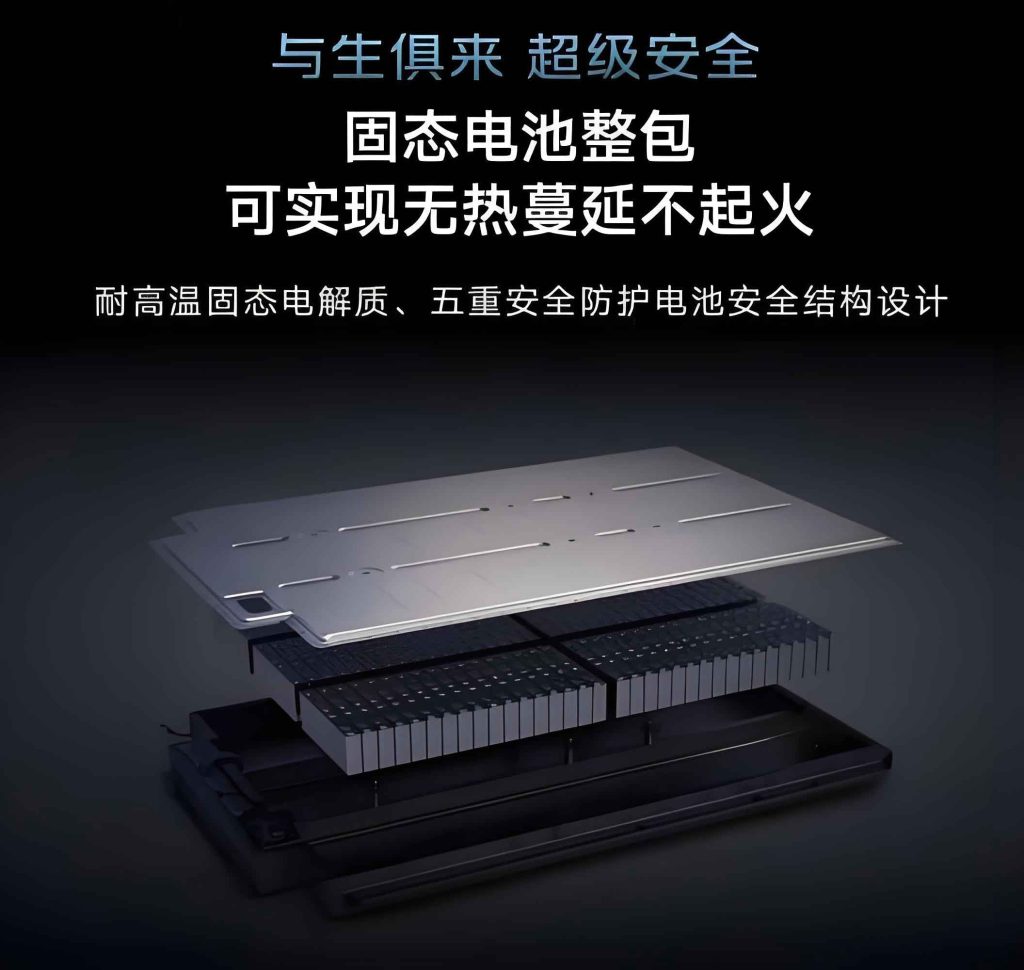
Will the solid-state battery solve these core issues? I believe it holds the key. The core of a solid-state battery is its solid electrolyte, and both electrodes are solid materials. This fundamental architecture eliminates the flammable component, thereby removing the primary risk of fire and explosion inherent to liquid electrolytes.
But is a solid-state battery with a lithium metal anode perfectly safe? It’s not that simple. Lithium remains a reactive metal. A critical challenge that requires extensive research is the phenomenon of “dendrite growth.” During charging, lithium ions move from the cathode, through the solid electrolyte, and plate onto the lithium metal anode. Ideally, this plating is uniform. However, inhomogeneities in electric field \( \vec{E} \) or local current density \( J \) can cause preferential deposition at certain spots, leading to protrusions. Once a protrusion forms, the electric field intensifies at its tip (a “tip effect”), accelerating further deposition there. This positive feedback loop can grow dendrites, needle-like structures that may eventually penetrate the solid electrolyte separator, causing a short circuit.
The growth kinetics can be influenced by local overpotential \( \eta \). A simplified view suggests deposition rate is higher where \( \eta \) is larger:
$$ \text{Growth Rate} \propto \exp\left(\frac{\alpha n F \eta}{RT}\right) $$
where \( \alpha \) is the charge transfer coefficient, \( n \) is the number of electrons, \( F \) is Faraday’s constant, \( R \) is the gas constant, and \( T \) is temperature.
The crucial advantage of the solid-state battery here is mitigation. Even if a short occurs, the absence of a flammable liquid electrolyte prevents the violent thermal runaway and combustion characteristic of today’s batteries. The solid electrolyte itself has higher thermal stability, preventing the cascade of exothermic side reactions that release toxic gases.
So, when will the solid-state battery take over? I proposed a view several years ago that industrialization would take about five years. We are now in that window. Several domestic companies dedicated to solid-state batteries have been established and are progressing towards pilot production and industrialization. It is the initial phase, but the momentum is real.
Is the solid-state battery a complete break from current technology? I believe the opposite. The most pragmatic and rapid development path is not to discard lithium-ion technology entirely, but to evolve from it. We should build upon the immense manufacturing knowledge and material science of lithium-ion batteries, incrementally replacing the liquid electrolyte with a solid one and adapting the electrodes. This hybrid or semi-solid approach is a critical stepping stone.
The global race is on. Multiple nations and their leading corporations are investing heavily in solid-state battery research, aiming for dominance in the next era of energy storage. The table below contrasts key characteristics:
| Feature | Conventional Li-ion Battery | Solid-State Battery (Target) |
|---|---|---|
| Electrolyte | Liquid Organic Solvent + Salt | Solid Ceramic/Polymer/Composite |
| Safety | Flammable, thermal runaway risk | Non-flammable, higher thermal stability |
| Anode Potential | Graphite (Limited capacity) | Lithium Metal (High capacity) |
| Energy Density | ~250-300 Wh/kg (practical limit) | >400 Wh/kg, potential for >500 Wh/kg |
| Operating Temperature | Wide range | Some require elevated T (challenge) |
| Cycle Life | Long, well-understood | Under development, dendrite challenge |
The future landscape will feature various battery types, but I am convinced the ultimate destination is the solid-state battery. Looking back offers perspective. When lithium-ion batteries were first commercialized abroad in 1991, it was a seismic event. The advanced, highly automated production lines were a revelation compared to the labor-intensive processes common elsewhere at the time. While small-scale solid-state battery prototypes existed then, they were far from industrial viability. Not embracing lithium-ion technology at that point would have left us dependent for far too long. That period of “catching up” was necessary. Most research energy shifted to lithium-ion, and work on solid-state batteries slowed for a time.
That phase, however, was part of a larger trajectory. Years later, at an industry forum, I presented an analysis of global market share trends, highlighting a critical window for advancement. The question was how to break through. The response from industry was swift and determined. Within a few years, the landscape transformed dramatically. From a position of following, the industry achieved a parallel run and then surged to a leading position in global market share for power batteries—a successful breakthrough.
Today, we are in the “parallel run” phase globally for next-generation batteries. The transition from follower to leader is a long and often non-linear journey. The road ahead for the solid-state battery will have its twists and turns, requiring sustained exploration and investment to solve materials interfaces, cost, and manufacturing scalability. However, the direction is clear. Based on the foundation built, the momentum gathered, and the strategic imperative, I am confident that the solid-state battery will not only be our future but that we will be at the forefront of realizing it. The final leap to becoming the definitive “pace-setter” in the era of the solid-state battery is within our reach.