
As the electric vehicle (EV) market continues to expand globally, the demand for supporting infrastructure, particularly EV charging stations, has surged. However, enterprises operating EV charging stations face numerous financial challenges, including high capital expenditure, difficulties in fundraising, and extended payback periods. These issues not only hinder the growth of individual companies but also impact the entire EV ecosystem. In this article, I explore the core financial problems confronting EV charging station businesses and propose actionable strategies for optimization, leveraging first-hand insights and data-driven approaches. By integrating tables and mathematical models, I aim to provide a comprehensive framework for enhancing financial performance in this sector.
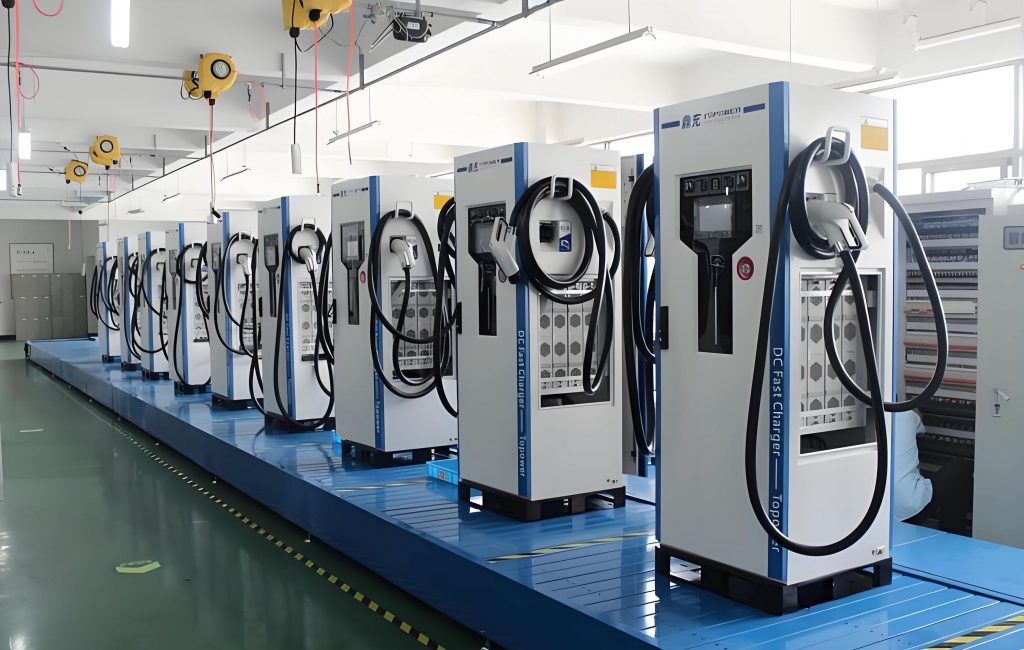
The proliferation of EV charging stations is a critical enabler for the widespread adoption of electric vehicles. According to industry reports, the global EV charging infrastructure market is projected to grow at a compound annual growth rate (CAGR) of over 30% in the coming years, driven by governmental policies and technological advancements. For instance, many countries have set targets to phase out internal combustion engine vehicles, necessitating a robust network of EV charging stations. However, the financial sustainability of businesses in this domain remains precarious. From my perspective, the high initial investment required for EV charging stations often leads to cash flow constraints, while operational inefficiencies exacerbate profitability issues. This article delves into these aspects, emphasizing the need for innovative financial management practices to ensure the long-term viability of EV charging station operations.
To contextualize the discussion, it is essential to understand the scale of investment involved. A typical fast EV charging station unit can cost between $10,000 and $15,000, inclusive of equipment, installation, and grid integration. This does not account for ongoing expenses such as maintenance, electricity procurement, and software updates. Moreover, the asset-heavy nature of EV charging station deployments means that companies must navigate complex financial landscapes, including securing loans and managing depreciation. In the following sections, I analyze the primary financial hurdles and present optimization strategies, supported by quantitative analyses and real-world examples. The recurring theme is that effective financial management can transform EV charging station projects from capital-intensive ventures into profitable enterprises.
Research Background and Significance
The rapid evolution of the EV charging station industry is fueled by both market forces and regulatory support. Globally, governments are implementing policies to accelerate the deployment of EV charging stations, such as subsidies for installation and tax incentives for operators. For example, the European Union’s Green Deal aims to install one million public EV charging stations by 2025, while similar initiatives in North America and Asia are driving growth. From a financial standpoint, this growth presents both opportunities and risks. As an industry observer, I have noted that while the demand for EV charging stations is rising, the capital intensity of these projects often leads to financial strain, especially for small and medium-sized enterprises.
The significance of optimizing financial management for EV charging stations cannot be overstated. Firstly, it enhances operational efficiency by ensuring that resources are allocated optimally. For instance, through meticulous budgeting, companies can prioritize high-utilization EV charging station sites, thereby maximizing returns. Secondly, robust financial controls help in curbing operational costs, which constitute a significant portion of total expenses. By monitoring electricity procurement and maintenance outlays, businesses can identify cost-saving opportunities. Thirdly, sound financial practices mitigate risks associated with cash flow volatility, which is common in EV charging station operations due to seasonal demand fluctuations. Lastly, strategic financial planning supports informed decision-making, such as evaluating new market entries or pricing strategies for EV charging services. In essence, financial management serves as the backbone for sustainable growth in the EV charging station sector.
To quantify the financial dynamics, consider the following equation that models the total cost of ownership (TCO) for an EV charging station:
$$ TCO = C_c + \sum_{t=1}^{n} \frac{O_t + M_t}{(1 + r)^t} $$
where \( C_c \) is the initial capital cost, \( O_t \) represents operational costs in year \( t \), \( M_t \) denotes maintenance expenses, \( r \) is the discount rate, and \( n \) is the lifespan of the EV charging station. This formula highlights the long-term financial commitment required, underscoring the need for strategies that reduce TCO.
Core Financial Challenges in EV Charging Station Enterprises
EV charging station businesses encounter several persistent financial issues that impede their profitability and scalability. Based on my analysis, these can be categorized into three main areas: high investment costs, difficulties in fundraising, and prolonged return on investment periods. Each of these challenges is interlinked, creating a complex financial environment that demands innovative solutions.
High Investment Costs
The capital expenditure associated with EV charging stations is substantial, covering equipment procurement, installation, land acquisition, and grid connectivity. For example, a single DC fast EV charging station unit may require an upfront investment of $10,000 to $15,000, while network deployments involving multiple units can escalate costs into the millions. Additionally, operational expenses such as electricity, software subscriptions, and routine maintenance add to the financial burden. The table below summarizes typical cost components for an EV charging station project:
| Cost Component | Estimated Range (USD) | Notes |
|---|---|---|
| Equipment (Charging Unit) | $5,000 – $8,000 | Varies based on power output (e.g., 50 kW vs. 150 kW) |
| Installation and Civil Works | $2,000 – $4,000 | Includes trenching, wiring, and permits |
| Grid Connection Fees | $1,000 – $3,000 | Depends on local utility policies |
| Annual Maintenance | $500 – $1,500 | Covers software updates and hardware repairs |
| Electricity Procurement (Annual) | $2,000 – $5,000 | Based on average usage and regional tariffs |
Furthermore, depreciation of EV charging station assets poses a significant financial challenge. As technology evolves, older units may become obsolete, necessitating premature replacements. The depreciation expense can be modeled using the straight-line method:
$$ D_t = \frac{C_c – S}{n} $$
where \( D_t \) is the annual depreciation, \( C_c \) is the initial cost, \( S \) is the salvage value, and \( n \) is the useful life. For an EV charging station with a 10-year lifespan and no salvage value, the annual depreciation would be $1,000 to $1,500 per unit, impacting profitability.
Difficulties in Fundraising
Raising capital for EV charging station projects is often challenging due to perceived risks and long payback periods. Traditional financial institutions, such as banks, may be hesitant to lend to EV charging station ventures, preferring more established sectors like renewable energy generation. Moreover, government subsidies, while available, are subject to policy changes and may not cover all costs. From my experience, many EV charging station startups struggle to secure debt financing, forcing them to rely on equity investments, which can dilute ownership. The following equation illustrates the cost of capital:
$$ WACC = \frac{E}{V} \cdot r_e + \frac{D}{V} \cdot r_d \cdot (1 – T_c) $$
where WACC is the weighted average cost of capital, \( E \) is equity, \( D \) is debt, \( V \) is total capital, \( r_e \) is cost of equity, \( r_d \) is cost of debt, and \( T_c \) is corporate tax rate. A high WACC for EV charging station projects indicates elevated financing costs, deterring investment.
Additionally, the table below compares common financing options for EV charging station enterprises, highlighting their pros and cons:
| Financing Method | Advantages | Disadvantages | Suitability for EV Charging Stations |
|---|---|---|---|
| Bank Loans | Lower interest rates; structured repayment | Stringent collateral requirements; lengthy approval | Moderate; depends on creditworthiness |
| Venture Capital | Access to large capital pools; expertise | Equity dilution; loss of control | High for early-stage EV charging station startups |
| Government Grants | Non-dilutive; policy alignment | Competitive; bureaucratic hurdles | High if criteria are met |
| Leasing Models | Reduces upfront costs; flexibility | Higher long-term costs; contractual obligations | Very high for asset-light expansions |
Prolonged Return on Investment Periods
The extended time required to recoup investments in EV charging stations is a major concern. Revenue streams primarily depend on charging service fees, which are influenced by utilization rates, pricing strategies, and competition. In many regions, the average utilization rate for public EV charging stations hovers around 15-20%, leading to low initial returns. The payback period can be calculated as:
$$ Payback Period = \frac{Initial Investment}{Annual Net Cash Flow} $$
For an EV charging station with an initial cost of $12,000 and annual net cash flow of $2,400, the payback period would be five years, assuming consistent revenue. However, fluctuations in demand—such as seasonal variations in EV usage—can prolong this period. Moreover, regulatory caps on service fees in some areas limit revenue potential, further stretching the ROI timeline.
To illustrate, consider the impact of utilization rates on revenue. The annual revenue \( R \) from an EV charging station can be expressed as:
$$ R = P \cdot U \cdot H \cdot 365 $$
where \( P \) is the price per kWh, \( U \) is the utilization rate (e.g., sessions per day), and \( H \) is the energy delivered per session. If \( P = \$0.10 \)/kWh, \( U = 4 \) sessions/day, and \( H = 30 \) kWh/session, then \( R = \$4,380 \) annually. With operational costs of $2,000, the net cash flow is $2,380, resulting in a payback period of approximately five years for a $12,000 investment. This simplistic model underscores the sensitivity of ROI to operational factors, emphasizing the need for strategies that boost utilization and efficiency.
Strategies for Optimizing Financial Management in EV Charging Station Enterprises
Addressing the financial challenges of EV charging station operations requires a multi-faceted approach. I propose several strategies centered on asset-light transformations, enhancing asset turnover, and reducing financing costs. These recommendations are derived from industry best practices and financial modeling, aiming to improve the economic viability of EV charging station projects.
Transitioning to Light-Asset Models and Cost-Sharing
One effective way to mitigate high capital expenditure is to adopt light-asset strategies, such as leasing and partnerships. For instance, EV charging station enterprises can utilize equipment leasing arrangements, where third-party owners finance the hardware, and the business pays periodic fees based on usage. This approach reduces upfront costs and aligns expenses with revenue generation. The net present value (NPV) of a leasing option can be compared to outright purchase:
$$ NPV = \sum_{t=1}^{n} \frac{CF_t}{(1 + r)^t} – C_0 $$
where \( CF_t \) represents cash flows under leasing, \( C_0 \) is the initial outlay (zero for leasing), and \( r \) is the discount rate. If NPV is positive, leasing is financially preferable.
Additionally, forming alliances with property owners—such as shopping malls or parking facilities—enables revenue-sharing models instead of fixed rents. For example, an EV charging station company might agree to pay a base rent plus a percentage of charging revenues, reducing fixed costs during low-utilization periods. The table below outlines potential partnership structures for EV charging station deployments:
| Partnership Type | Description | Financial Benefit | Implementation Example |
|---|---|---|---|
| Revenue-Sharing with Landowners | Split charging fees with site hosts | Lowers fixed rental costs; aligns incentives | EV charging station in a supermarket parking lot |
| Co-Investment with Utilities | Joint funding of grid upgrades and stations | Reduces capital burden; leverages utility expertise | Partnership with a local power company for grid-integrated EV charging stations |
| Municipal Collaborations | Use public infrastructure (e.g., streetlights) for installations | Minimizes land costs; enhances public service | Embedding EV charging stations in urban light poles |
Moreover, integrating distributed energy resources, such as solar panels and storage systems, can lower electricity procurement costs for EV charging stations. A hybrid “solar-plus-storage” EV charging station can generate and store energy during off-peak hours, reducing reliance on the grid and mitigating peak demand charges. The cost savings \( S_e \) from such a system can be estimated as:
$$ S_e = (E_g \cdot P_g) – (E_s \cdot P_s + C_{bat}) $$
where \( E_g \) is grid energy avoided, \( P_g \) is grid price, \( E_s \) is solar energy generated, \( P_s \) is solar cost, and \( C_{bat} \) is battery storage cost. In practice, this can cut electricity expenses by 20-30%, improving the bottom line for EV charging station operations.
Enhancing Asset Turnover to Shorten Payback Periods
Accelerating the return on investment for EV charging stations involves maximizing utilization and optimizing pricing. Dynamic pricing strategies, which adjust charging fees based on demand and time of day, can incentivize off-peak usage and increase overall revenue. For example, higher rates during peak hours (e.g., $0.15/kWh) and discounts during nights ($0.05/kWh) can smooth demand curves. The revenue impact can be modeled as:
$$ R_{dynamic} = \sum_{i=1}^{m} (P_i \cdot Q_i) $$
where \( P_i \) and \( Q_i \) are price and quantity in time segment \( i \), and \( m \) is the number of segments. Studies show that dynamic pricing can lift EV charging station revenues by 15-20%.
Furthermore, implementing membership or prepaid plans locks in cash flow and fosters customer loyalty. For instance, a subscription model offering unlimited charging for a monthly fee ensures predictable income. The customer lifetime value (CLV) for such schemes can be calculated as:
$$ CLV = \sum_{t=1}^{T} \frac{M_t \cdot r_t}{(1 + d)^t} – AC $$
where \( M_t \) is margin per period, \( r_t \) is retention rate, \( d \) is discount rate, \( T \) is customer lifespan, and \( AC \) is acquisition cost. Higher CLV indicates better financial sustainability for EV charging station businesses.
To quantify the effects of these strategies, consider the following table comparing traditional and optimized operational models for an EV charging station:
| Metric | Traditional Model | Optimized Model (with Dynamic Pricing and Partnerships) | Improvement |
|---|---|---|---|
| Average Utilization Rate | 15% | 25% | +10 percentage points |
| Annual Revenue per Station (USD) | $4,380 | $6,570 | +50% |
| Payback Period (Years) | 5.0 | 3.3 | -1.7 years |
| Net Profit Margin | 10% | 18% | +8 percentage points |
Additionally, smart charging technologies that prioritize grid stability and user convenience can enhance efficiency. For example, AI-driven systems that allocate charging slots based on real-time data can reduce idle time for EV charging stations, further boosting asset turnover.
Reducing Financing Pressure through Low-Cost Capital
Accessing affordable funding is crucial for scaling EV charging station networks. Tapping into政策性资金 (policy-driven funds), such as government-backed green bonds or infrastructure grants, can lower the cost of capital. For instance, many regions offer low-interest loans specifically for EV charging station deployments, with interest rates as low as 2-3%. The effective interest rate \( r_{eff} \) can be derived as:
$$ r_{eff} = \left(1 + \frac{r}{m}\right)^m – 1 $$
where \( r \) is the nominal rate and \( m \) is the number of compounding periods. A lower \( r_{eff} \) reduces financial burdens.
Another innovative tool is the use of Real Estate Investment Trusts (REITs) for EV charging station assets. By securitizing charging infrastructure into tradable securities, companies can monetize existing assets while retaining operational control. The expected return for investors in an EV charging station REIT might be 6-8%, which is attractive compared to traditional bonds. The cash flow from REITs can be modeled as:
$$ CF_{REIT} = Rental Income + Capital Gains – Management Fees $$
This influx of capital can be reinvested into new EV charging station projects, creating a virtuous cycle of growth.
Moreover, bundling EV charging station projects with other renewable energy assets—such as wind or solar farms—can improve loan eligibility. Banks often perceive diversified portfolios as less risky, leading to better financing terms. The table below summarizes key low-cost financing avenues for EV charging station enterprises:
| Financing Avenue | Key Features | Potential Cost Reduction | Implementation Tips |
|---|---|---|---|
| Green Bonds | Earmarked for environmentally friendly projects; tax advantages | 1-2% lower interest than conventional bonds | Issue bonds tied to EV charging station carbon savings |
| Public-Private Partnerships (PPPs) | Government co-investment; risk-sharing | Up to 30% lower capital expenditure | Collaborate with municipal agencies on EV charging station networks |
| Crowdfunding | Small investments from many individuals; marketing benefits | Minimal equity dilution if structured as debt | Use online platforms to fund local EV charging station installations |
| Infrastructure Funds | Dedicated to long-term assets; patient capital | Lower return expectations (5-7%) | Pitch EV charging station projects as essential infrastructure |
By leveraging these options, EV charging station businesses can decrease their weighted average cost of capital (WACC), as shown in the earlier equation, thereby enhancing project NPV and attractiveness to investors.
Conclusion
In summary, the financial management of EV charging station enterprises requires a strategic focus on cost reduction, efficiency improvement, and innovative financing. Through light-asset models like leasing and partnerships, companies can lower initial investments and align costs with revenues. Dynamic pricing and membership schemes accelerate asset turnover, shortening payback periods. Additionally, accessing low-cost capital through policy instruments and REITs alleviates funding pressures. The cumulative effect of these strategies is a more resilient and profitable EV charging station ecosystem.
From my perspective, the future of EV charging stations hinges on financial agility. As the industry evolves, embracing data-driven decision-making and collaborative models will be key. For instance, integrating IoT sensors for predictive maintenance can further cut costs, while blockchain-based payment systems could enhance transaction efficiency. Ultimately, by adopting the outlined approaches, EV charging station operators can not only survive but thrive in the competitive landscape, contributing to the global transition to sustainable transportation.
To encapsulate, the optimization of financial management for EV charging stations is not merely a operational necessity but a strategic imperative. It enables businesses to navigate the complexities of high capital intensity and volatile revenues, paving the way for scalable growth. As I have illustrated through tables and formulas, a methodical approach to cost control, revenue enhancement, and financing can transform EV charging station ventures into economically viable enterprises, ensuring their role in the clean energy future.