
As an experienced professional in EV repair, I have dedicated years to understanding the intricacies of electrical car repair, particularly focusing on the on-board charger (OBC) in electric vehicles. The OBC is a critical component that converts AC power from the grid to DC power for charging the vehicle’s battery, and its failure can lead to significant operational issues. In this article, I will share my insights into the systematic fault diagnosis and repair methods for OBCs, emphasizing practical approaches that enhance efficiency and safety in electrical car repair. I will incorporate tables and formulas to summarize key concepts, making this guide useful for technicians in the EV repair field. The growing adoption of electric vehicles underscores the importance of mastering these skills, as timely and accurate repairs can prevent costly downtime and ensure vehicle reliability.
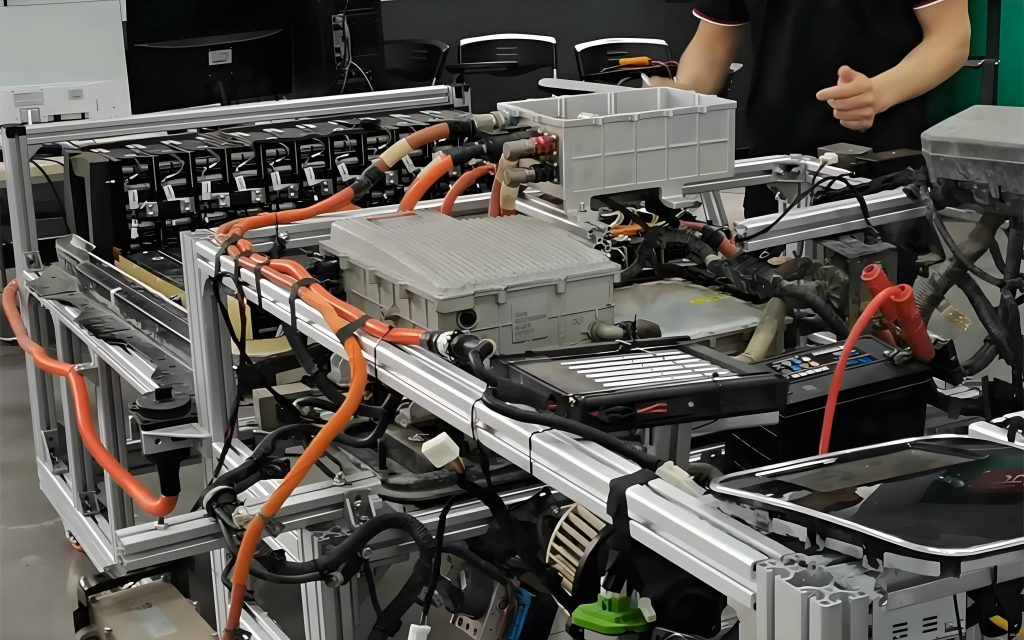
The on-board charger operates through a series of power conversion stages, including rectification, filtering, and DC/DC transformation. In my work with EV repair, I often explain that the rectification stage converts AC input to DC, which can be modeled using the formula for a full-wave rectifier: $$V_{dc} = \frac{2 \sqrt{2}}{\pi} V_{ac}$$ where \(V_{dc}\) is the average DC output voltage and \(V_{ac}\) is the RMS AC input voltage. This is followed by filtering to smooth the output, and then a DC/DC converter adjusts the voltage to match the battery’s requirements. The control circuit, typically based on a microcontroller, monitors parameters like voltage, current, and temperature to ensure safe charging. For instance, the power delivered to the battery can be expressed as $$P = V_{out} \times I_{out}$$ where \(P\) is the power in watts, \(V_{out}\) is the output voltage, and \(I_{out}\) is the output current. Understanding these principles is foundational to effective electrical car repair, as it allows technicians to pinpoint deviations from normal operation.
Common faults in on-board chargers can be categorized into power module issues, control circuit failures, and communication problems. In my experience with EV repair, I have compiled a table summarizing these fault types, their symptoms, and potential causes, which aids in quick identification during electrical car repair tasks.
| Fault Type | Symptoms | Common Causes |
|---|---|---|
| Power Module Faults | Reduced charging efficiency, overheating, no charge | Damaged IGBTs/MOSFETs, poor散热, short circuits |
| Control Circuit Faults | Abnormal parameters, protection failures | Aging components, software errors, sensor drift |
| Communication Faults | Charging interruptions, no start | Loose connectors, wiring damage, protocol issues |
For power module faults, the root cause often lies in the failure of semiconductor devices. The on-state resistance of a MOSFET, for example, can be measured using $$R_{DS(on)} = \frac{V_{DS}}{I_D}$$ where \(R_{DS(on)}\) is the drain-source resistance, \(V_{DS}\) is the drain-source voltage, and \(I_D\) is the drain current. An increase in this resistance indicates degradation, which is a common finding in EV repair. Control circuit faults may involve analog-to-digital converters (ADCs) that sample sensor data; the resolution of an ADC can be described as $$\text{Resolution} = \frac{V_{ref}}{2^n}$$ where \(V_{ref}\) is the reference voltage and \(n\) is the number of bits. Deviations here can lead to inaccurate readings, necessitating recalibration in electrical car repair.
When it comes to fault diagnosis in EV repair, I follow a structured approach that begins with visual inspection and basic measurements. This includes checking for physical damage, such as burnt components or loose connections, and using a multimeter to verify input and output voltages. For instance, the input AC voltage should be within the specified range, typically 90-264 VAC for many OBCs, and the output DC voltage should match the battery’s nominal voltage, say 400 V for a typical EV. If abnormalities are detected, I proceed to diagnostic tools. Modern electric vehicles are equipped with onboard diagnostic systems that store fault codes (DTCs). By connecting a diagnostic scanner, I can retrieve codes like P0A80 (charging system performance) or U0100 (communication bus off), which narrow down the issue. The table below outlines a typical diagnostic workflow in electrical car repair, emphasizing the step-by-step process to ensure thoroughness.
| Step | Action | Tools Used | Expected Outcome |
|---|---|---|---|
| 1 | Visual Inspection | Multimeter, visual check | Identify obvious damage or loose parts |
| 2 | Basic Electrical Tests | Multimeter, oscilloscope | Measure voltages/currents against specs |
| 3 | Fault Code Reading | Diagnostic scanner | Retrieve and interpret DTCs |
| 4 | Functional Testing | Oscilloscope, load bank | Assess waveform integrity and dynamic response |
| 5 | Component-Level Analysis | LCR meter, thermal camera | Test individual components for faults |
In functional testing, I use an oscilloscope to analyze key waveforms. For example, the PWM (Pulse Width Modulation) signal from the control circuit to the power switches should have a duty cycle defined as $$\text{Duty Cycle} = \frac{T_{on}}{T} \times 100\%$$ where \(T_{on}\) is the on-time and \(T\) is the period. A distorted waveform might indicate a faulty driver circuit. Similarly, the output current ripple can be evaluated using $$\Delta I = \frac{V_{in} – V_{out}}{L} \times D T$$ where \(\Delta I\) is the current ripple, \(L\) is the inductance, and \(D\) is the duty cycle. Excessive ripple points to filtering issues, common in EV repair scenarios. For communication faults, I check the CAN (Controller Area Network) bus signals; the dominant and recessive voltage levels should be within 1.5-3.5 V, and any deviation suggests wiring problems or node failures. This systematic approach is vital in electrical car repair to avoid misdiagnosis.
Repair methods vary based on the fault type. For power module faults in EV repair, I often replace damaged components like IGBTs or MOSFETs. When selecting a replacement, I ensure it meets or exceeds the original specifications. The power dissipation in a switch can be calculated using $$P_{diss} = I_{rms}^2 \times R_{DS(on)} + E_{sw} \times f_{sw}$$ where \(P_{diss}\) is the dissipation power, \(I_{rms}\) is the RMS current, \(E_{sw}\) is the switching energy, and \(f_{sw}\) is the switching frequency. Using a higher-rated device can improve reliability. Additionally, I address散热 issues by cleaning heat sinks and applying thermal paste with a thermal conductivity rated, for example, at 3-5 W/m·K. The table below summarizes common repair actions for different fault types, which I have refined through years of electrical car repair experience.
| Fault Type | Repair Action | Key Considerations |
|---|---|---|
| Power Module | Replace power devices, improve散热 | Match parameters, use anti-static precautions |
| Control Circuit | Replace components, update software, recalibrate | ESD protection, verify logic levels |
| Communication | Repair wiring, update protocols, reset system | Check compatibility, use bus analyzers |
For control circuit repairs in EV repair, I focus on components like microcontrollers and sensors. When replacing a voltage sensor, I recalibrate it using a reference voltage source, ensuring the output follows $$V_{out} = G \times V_{in} + O$$ where \(G\) is the gain and \(O\) is the offset. Software updates are critical; I use manufacturer tools to flash new firmware, verifying checksums to prevent corruption. In communication repairs, I test the CAN bus termination resistors, which should be 120 ohms between the high and low lines, as per the standard. Safety is paramount in all electrical car repair activities; I always wear insulated gloves and use isolated tools when working with high-voltage sections, typically above 60 VDC. After repairs, I perform comprehensive tests, including insulation resistance tests where the resistance should exceed 1 MΩ, and functional tests under load to validate performance.
In conclusion, mastering the fault diagnosis and repair of on-board chargers is essential for advancing EV repair capabilities. Through systematic approaches and the application of formulas and tables, technicians can enhance their efficiency in electrical car repair. My experience shows that a methodical process, from visual inspection to component-level analysis, reduces repair times and improves outcomes. Looking ahead, the integration of AI and predictive maintenance in EV repair could revolutionize this field, enabling early fault detection through data analytics. For instance, machine learning models could analyze historical failure data to predict component lifespan, further optimizing electrical car repair processes. As electric vehicles evolve, continuous learning and adaptation will be key to success in the dynamic world of EV repair.