
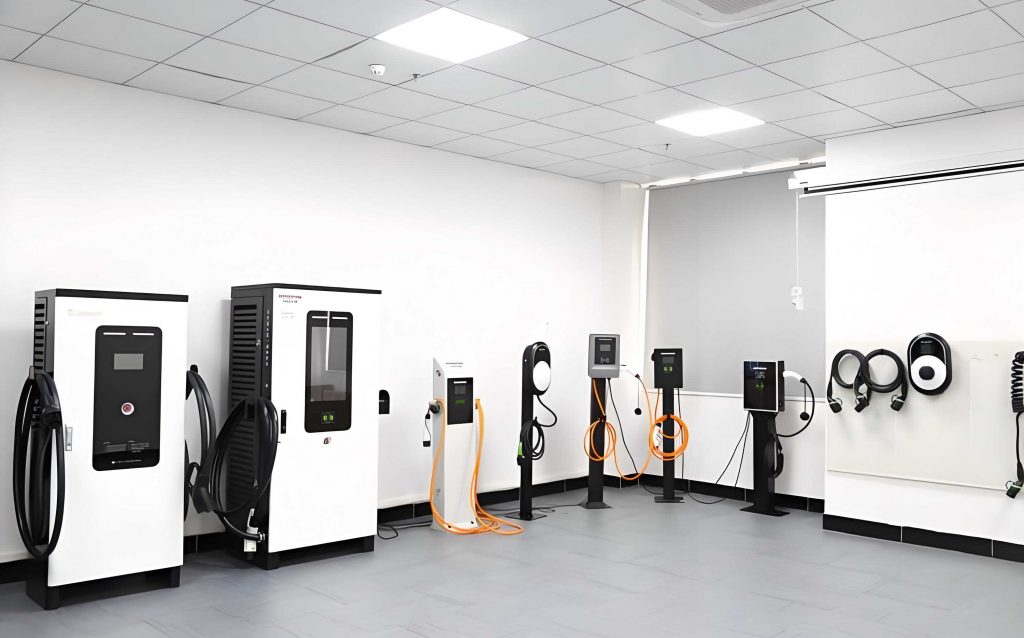
With the rapid growth in electric vehicle adoption, EV charging stations have become essential infrastructure, transitioning from quantitative expansion to qualitative enhancements. The standardization framework for EV charging stations is continuously evolving, with key specifications addressing connection interfaces, charging systems, digital communication protocols, and energy metering. However, during mandatory verification processes, numerous issues arise that impact the accuracy, reliability, and efficiency of EV charging station operations. This article examines these challenges from a metrological perspective, focusing on performance requirements, standard instrument limitations, and industry-wide regulatory gaps. Through detailed analysis, we propose actionable recommendations to improve the verification ecosystem for EV charging stations.
The proliferation of EV charging stations underscores the importance of precise energy measurement, as inaccuracies can lead to consumer disputes, financial losses, and eroded trust. Current verification regulations, such as those for AC and DC EV charging stations, outline critical requirements for error thresholds, clock synchronization, and sealing protocols. Yet, practical implementation reveals inconsistencies in manufacturing standards, instrument stability, and operator compliance. By addressing these areas, we aim to foster a robust framework that ensures the metrological integrity of EV charging stations.
Critical Issues in EV Charging Station Verification
The verification of EV charging stations involves assessing various parameters to confirm compliance with established norms. Below, we delve into the most prevalent problems encountered during this process, supported by quantitative analysis and empirical observations.
Minimum Energy Variable Discrepancies
One of the fundamental aspects of EV charging station verification is the evaluation of working error using the real-load method (Method II). This approach compares the energy output displayed by the EV charging station with the value measured by a standard calibrator. The working error is calculated as:
$$ \text{Working Error} = \frac{E_{\text{display}} – E_{\text{reference}}}{E_{\text{reference}}} \times 100\% $$
where $E_{\text{display}}$ is the energy indicated by the EV charging station and $E_{\text{reference}}$ is the reference value from the calibrator. The minimum energy variable, defined as the smallest increment in energy display, plays a crucial role. For instance, a Level 1 EV charging station with a minimum energy variable of 0.001 kW·h must satisfy the following condition for accumulated energy $E’$:
$$ \frac{0.001 \, \text{kW·h}}{E’} \leq \frac{1\%}{5} $$
Solving for $E’$ yields:
$$ E’ \geq \frac{0.001}{0.002} = 0.500 \, \text{kW·h} $$
This value represents the minimum accumulated energy required for verification. However, investigations reveal that some EV charging stations exhibit virtual digits—where the display shows 0.001 kW·h, but the actual resolution is lower. For example, if the pulse constant is labeled as 100 imp/(kW·h) instead of the required 1000 imp/(kW·h), the effective minimum energy variable becomes 0.01 kW·h. This discrepancy leads to failures in working error tests at lower preset energy values, though the EV charging station may pass at higher values. Additionally, inconsistencies between display panels and mobile applications further complicate verification.
| Parameter | Required Value | Observed Issue | Impact on Verification |
|---|---|---|---|
| Minimum Energy Variable | 0.001 kW·h | Virtual digits (always 0) | Inaccurate error calculation |
| Pulse Constant | ≥1000 imp/(kW·h) | 100 imp/(kW·h) on nameplate | Failure to meet resolution requirements |
| Accumulated Energy $E’$ | ≥0.500 kW·h | Insufficient at low preset values | Increased working error |
To mitigate these issues, we recommend standardizing the pulse constant for all EV charging stations to a minimum of 1000 imp/(kW·h). This ensures alignment with the minimum energy variable of 0.001 kW·h and enhances measurement accuracy. Furthermore, manufacturers should avoid virtual digits and ensure consistent display resolution across all interfaces, including mobile platforms.
Clock Time Synchronization Errors
Clock time accuracy is a mandatory verification item for EV charging stations, as it affects billing and operational logging. The error is defined as:
$$ \Delta t = t_{\text{station}} – t_{\text{reference}} $$
where $t_{\text{station}}$ is the time displayed by the EV charging station and $t_{\text{reference}}$ is the reference time. Permissible errors typically range from a few seconds to minutes, depending on the standard. However, many EV charging stations rely on internal clocks that are not synchronized to network time protocols. Over time, these clocks drift, leading to significant deviations. For EV charging stations without display panels, verification must be conducted via mobile applications, which introduces network latency—especially in areas with poor connectivity, such as underground parking facilities.
We propose that all EV charging stations incorporate internal clocks with a resolution of at least 1 second and automatic synchronization capabilities using network-based time servers or satellite systems like BeiDou. The synchronization process can be modeled as:
$$ t_{\text{synced}} = t_{\text{internal}} + \alpha \cdot (t_{\text{network}} – t_{\text{internal}}) $$
where $\alpha$ is a calibration factor. Regular synchronization intervals (e.g., every 24 hours) would minimize cumulative errors and ensure compliance during verification.
| Scenario | Error Magnitude | Root Cause | Proposed Solution |
|---|---|---|---|
| Unsynced Internal Clock | ≥60 seconds/day | Clock drift | Network synchronization |
| Mobile Application Delay | 5–30 seconds | Network latency | Local time caching |
| Underground Locations | Variable | Signal loss | Redundant time sources |
Internal Sealing and Structural Deficiencies
Verification regulations mandate that EV charging stations be sealed at the energy meter or metering module to prevent tampering and ensure measurement integrity. However, many EV charging stations lack accessible sealing points due to compact designs or unmarked internal components. Some units use integrated circuit boards without dedicated spaces for seals, while others have energy meters that do not accommodate physical seals. This compromises the ability to enforce metrological control and traceability.
We urge manufacturers to redesign EV charging stations with metrological requirements in mind. This includes:
- Providing clear labeling of metering modules.
- Incorporating seal holes or covers that allow for easy application and inspection.
- Implementing factory-applied seals on critical components to deter unauthorized access.
The effectiveness of sealing can be quantified using a tamper-resistance score $S_t$:
$$ S_t = \frac{N_{\text{sealed}}}{N_{\text{critical}}} \times 100\% $$
where $N_{\text{sealed}}$ is the number of sealed critical components and $N_{\text{critical}}$ is the total number of such components. A score of 100% indicates full compliance.
| Component Type | Sealing Requirement | Current Status | Improvement Target |
|---|---|---|---|
| Energy Meter | Mandatory | No seal holes | Design with seal points |
| Metering Module | Mandatory | Unmarked on PCB | Clear labeling and coverage |
| Communication Ports | Optional | Unsecured | Include in sealing protocol |
Challenges with Standard Measuring Instruments
The accuracy of EV charging station verification heavily depends on the reliability of standard measuring instruments. Two predominant types of calibrators are used, each with distinct operational issues that affect verification efficiency and outcomes.
First Type of Standard Instrument: Overheating and Component Stability
This instrument frequently experiences failure to power on, primarily due to overheating and mechanical looseness. The overheating issue arises during prolonged verification sessions, especially with DC EV charging stations. The temperature rise $\Delta T$ can be approximated by:
$$ \Delta T = P \cdot R_{\text{thermal}} $$
where $P$ is the power dissipation and $R_{\text{thermal}}$ is the thermal resistance. When $\Delta T$ exceeds the threshold (e.g., 30°C), the instrument shuts down. To address this, we recommend increasing the thermal threshold and adding insulation materials. Additionally, frequent transport leads to loose internal components, which can be mitigated by reinforcing mounting points and using shock-absorbent materials.
| Failure Mode | Frequency | Solution | Expected Improvement |
|---|---|---|---|
| Overheating | High (>10 sessions) | Adjust thermal threshold | 50% reduction in shutdowns |
| Loose Power Button | Medium | Reinforce with brackets | 90% reliability increase |
| Internal Connection Failures | Low | Secure wiring harnesses | Near-zero incidents |
Second Type of Standard Instrument: Communication and Control Issues
This instrument often faces communication protocol mismatches with DC EV charging stations, halting verification prematurely. The communication handshake process can be modeled as a state machine, where incompatibilities arise from non-standard implementations. Software updates that align with industry protocols (e.g., GB/T 27930) resolve most of these issues. Another problem is the inability to stop charging at preset energy values due to delayed cooling fan operations. The energy overshoot $\Delta E$ is given by:
$$ \Delta E = P_{\text{charge}} \cdot t_{\text{delay}} $$
where $P_{\text{charge}}$ is the charging power and $t_{\text{delay}}$ is the fan delay. Optimizing the control logic to decouple cooling from charging termination reduces $\Delta E$ to negligible levels.
| Issue | Impact on Verification | Resolution | Efficiency Gain |
|---|---|---|---|
| Protocol Mismatch | Verification abort | Software update | 80% faster setup |
| Changing Overshoot | Increased error | Control logic optimization | 95% accuracy in stop time |
| Fan Delay | Prolonged sessions | Parallel cooling activation | 30% time savings |
Regulatory and Operational Gaps in EV Charging Station Management
The absence of comprehensive metrological management standards for EV charging station operators exacerbates verification challenges. Many operators lack awareness of legal requirements, leading to non-compliance and inconsistent practices. To bridge this gap, group standards such as T/SMA 0068-2025 provide a framework for systematic management, covering:
- Documentation of metrological policies.
- Training programs for personnel.
- Maintenance schedules for EV charging stations.
- Complaint handling and resolution mechanisms.
The benefits of adopting such standards include improved measurement accuracy and enhanced consumer trust. The overall compliance score $C_o$ for an operator can be expressed as:
$$ C_o = \sum_{i=1}^{n} w_i \cdot c_i $$
where $w_i$ is the weight for each criterion (e.g., verification frequency, seal integrity) and $c_i$ is the compliance level. Higher scores correlate with reduced dispute rates and higher customer satisfaction.
| Management Aspect | Current Status | Standard Requirement | Implementation Challenge |
|---|---|---|---|
| Personnel Training | Low awareness | Regular certification | Resource allocation |
| Equipment Calibration | Inconsistent | Annual verification | Cost and scheduling |
| Record Keeping | Fragmented | Digital logs | Data integration |
Conclusion and Future Directions
The verification of EV charging stations is pivotal for ensuring fair trade and user confidence. By addressing the outlined issues—minimum energy variables, clock synchronization, sealing, standard instrument reliability, and regulatory frameworks—we can significantly enhance the metrological ecosystem for EV charging stations. We advocate for the revision of existing verification regulations to incorporate practical insights from industry stakeholders. Additionally, introducing type approval processes for EV charging stations will standardize production quality and streamline verification workflows.
Future efforts should focus on developing intelligent EV charging stations with self-diagnostic capabilities and remote verification features. This aligns with the broader trend of digitalization in metrology, where real-time data analytics and IoT integration play crucial roles. Through collaborative initiatives among manufacturers, operators, and regulatory bodies, the EV charging station infrastructure will evolve to meet the demands of a sustainable transportation future.