
In the development of modern hybrid cars, ensuring battery safety and driving comfort under extreme conditions is a critical challenge. As a researcher focused on hybrid car technologies, I have extensively studied the issues of battery overcharge, overdischarge, and drivability degradation in low-temperature environments, particularly for complex hybrid topologies. This article presents a comprehensive strategy to address these problems, leveraging advanced power boundary management and system optimization. The goal is to enhance the performance of hybrid cars in temperatures ranging from -30°C to 0°C, ensuring that battery limits are respected while maintaining a smooth driving experience. Through this work, I aim to contribute to the broader advancement of hybrid car systems, making them more reliable and user-friendly in harsh climates.
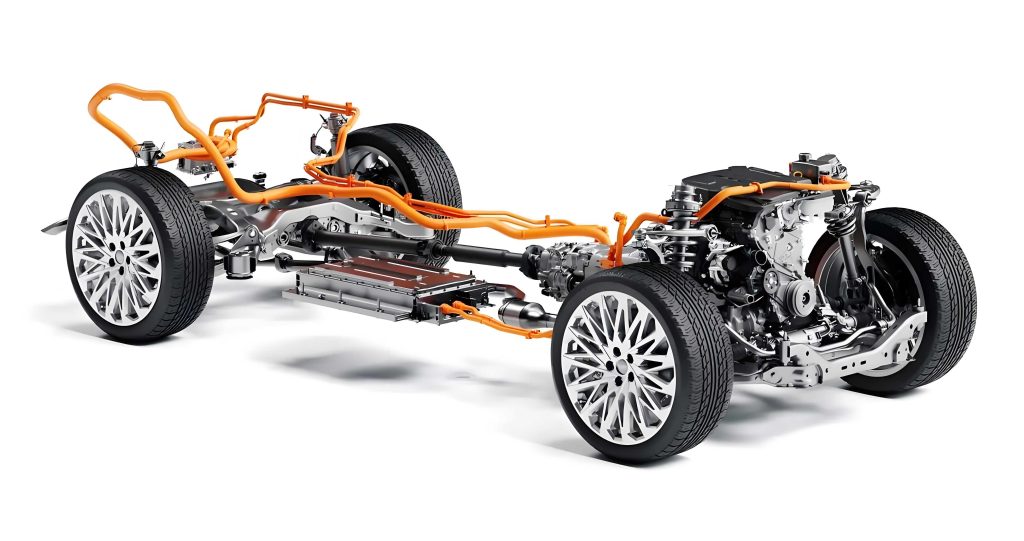
Hybrid cars, which combine internal combustion engines and electric powertrains, are increasingly popular due to their efficiency and reduced emissions. However, in low-temperature environments, the battery performance of hybrid cars deteriorates significantly, leading to risks such as overcurrent and drivability issues. My research focuses on a series-parallel four-wheel-drive (SP+P4) topology, a complex hybrid car architecture that includes multiple power sources like engines, generators, and motors. This topology offers flexibility but introduces challenges in power management, especially when battery capabilities are constrained by cold weather. In this article, I will detail the causes of battery overcharge and overdischarge, propose optimization strategies, and validate their effectiveness through simulations and real-world tests. The insights here are tailored to improve hybrid car systems, ensuring they meet user demands for comfort and safety even in freezing conditions.
Introduction to Hybrid Car Operation Modes and Battery Characteristics
Hybrid cars are defined by their dual power sources: an electric system (battery and motor) and a thermal system (internal combustion engine). Based on the configuration, hybrid cars can be classified into series, parallel, and series-parallel types. The SP+P4 topology, which I study, is a series-parallel hybrid car design that enables various operating modes, including pure electric, series, and parallel modes. This versatility allows hybrid cars to optimize energy usage, but it also complicates power distribution, particularly in low temperatures where battery limits are stringent.
In pure electric mode, the hybrid car relies solely on the battery to power the front and rear motors. In series mode, the engine acts as a generator to charge the battery or supply power directly to the motors. In parallel mode, the engine directly drives the wheels alongside the motors. Each mode affects the battery’s power boundaries differently, and managing these boundaries is crucial to prevent overcharge and overdischarge. For hybrid cars, the battery’s state of charge (SOC) and temperature are key factors influencing its available power. The relationship can be expressed as:
$$ P_{\text{wr batt}} = f(\text{SOC}, T) $$
where \( P_{\text{wr batt}} \) is the available charge/discharge power of the battery pack in kW, SOC is the state of charge in percentage, and \( T \) is the battery module temperature in °C. In low temperatures, the battery’s internal resistance increases, reducing its power capability. This degradation is summarized in the table below, which shows how battery power boundaries vary with SOC and temperature for a typical lithium-ion battery used in hybrid cars.
| Temperature (°C) | SOC (%) | Long-Term Discharge Power (kW) | Long-Term Charge Power (kW) | Short-Term Discharge Power (kW) | Short-Term Charge Power (kW) |
|---|---|---|---|---|---|
| -25 | 20 | 5 | 0 | 10 | 0 |
| -25 | 50 | 15 | 5 | 20 | 10 |
| -25 | 80 | 25 | 15 | 30 | 20 |
| 0 | 20 | 20 | 10 | 25 | 15 |
| 0 | 50 | 30 | 20 | 35 | 25 |
| 0 | 80 | 40 | 30 | 45 | 35 |
As shown, at -25°C and low SOC, the battery’s charge power can drop to zero, making hybrid cars prone to overdischarge during acceleration or overcharge during braking. This limitation exacerbates drivability issues, such as torque抖动, due to power boundary fluctuations in complex hybrid car systems like SP+P4.
Analysis of Battery Overcharge, Overdischarge, and Drivability Issues in Hybrid Cars
In traditional hybrid car control units (VCUs), power protection methods often rely on fixed coefficients and filters to adjust battery power boundaries. For example, the wheel-end torque limits in pure electric and series modes are calculated as:
$$ \text{TqBattdrv} = \frac{(P_{\text{wr batt dischrg}} \times \text{Factor}_{\text{SOC}} – P_{\text{wr Acsy}} – P_{\text{wr Offset}} – P_{\text{wr Gen}}) \times \text{Eff}_{\text{System}}}{W_{\text{Mot}}} $$
$$ \text{WhlTqBattdrv} = \text{Filter\_LowPass1}(\min(\text{TqBattdrv}, \text{TqMotdrv}) \times \text{Ratio}_{\text{Mot}}) $$
Similarly, for regenerative braking:
$$ \text{TqBattregn} = \frac{(P_{\text{wr batt chrg}} \times \text{Factor}_{\text{SOC}} – P_{\text{wr Acsy}} + P_{\text{wr Offset}} – P_{\text{wr Gen}}) / \text{Eff}_{\text{System}}}{W_{\text{Mot}}} $$
$$ \text{WhlTqBattregn} = \text{Filter\_LowPass1}(\max(\text{TqBattregn}, \text{TqMotregn}) \times \text{Ratio}_{\text{Mot}}) $$
In parallel mode, the total wheel-end torque boundaries are:
$$ \text{WhlTqTotal}_{\text{max}} = \text{TqEng}_{\text{Max}} \times \text{Ratio}_{\text{Eng}} + \text{WhlTqBattdrv} $$
$$ \text{WhlTqTotal}_{\text{min}} = \text{TqEng}_{\text{Min}} \times \text{Ratio}_{\text{Eng}} + \text{WhlTqBattregn} $$
However, these methods have limitations. They cannot prevent overcurrent when motor power fails to respond quickly due to communication delays in hybrid cars. The SP+P4 topology involves multiple power sources—battery, generator, front motor, and rear motor—creating a closed-loop system where fluctuations in one component affect others. For instance, in series mode, the power boundaries for the front and rear motors are:
$$ \text{PwrFdrvLim} = (P_{\text{wr batt dchgopt}} – P_{\text{wr Genopt}}) \times \text{Ratio}_{\text{Tqdis}} $$
$$ \text{PwrRdrvLim} = (P_{\text{wr batt dchgopt}} – P_{\text{wr Genopt}}) \times (1 – \text{Ratio}_{\text{Tqdis}}) $$
In parallel mode, the front motor boundary depends on the rear motor’s actual power:
$$ \text{PwrFdrvLim} = P_{\text{wr batt dchgopt}} – P_{\text{wr Rdrvact}} $$
$$ \text{PwrRdrvLim} = P_{\text{wr batt dchgopt}} $$
These interdependencies, combined with CAN communication delays, lead to scenarios where actual power exceeds boundaries, causing overcharge, overdischarge, and drivability抖动. The table below summarizes the key causes and effects in hybrid cars under low-temperature conditions.
| Issue | Cause | Effect on Hybrid Car |
|---|---|---|
| Battery Overdischarge | Rapid acceleration exceeding battery discharge boundary | Reduced battery life, potential safety risks |
| Battery Overcharge | Braking energy exceeding battery charge boundary | Battery swelling, thermal runaway |
| Drivability抖动 | Power boundary fluctuations due to system interactions | Poor user experience, uncomfortable driving |
| System Instability | Generator power抖动 affecting motor boundaries | Unpredictable torque output |
To address these, I propose a novel optimization strategy that dynamically adjusts power boundaries based on predictive analytics.
Optimization Strategy for Battery Power Protection and Drivability in Hybrid Cars
My approach focuses on three core aspects: dynamic adjustment of long-term battery power boundaries, rapid response of short-term boundaries, and stabilization of generator power. These strategies are designed specifically for hybrid cars with complex topologies like SP+P4, ensuring both safety and comfort.
Dynamic Adjustment of Long-Term Battery Power Boundaries
To avoid overcharge and overdischarge, I predict the battery’s actual power trend and preemptively narrow the long-term power boundaries. The key is to smooth boundary changes, preventing sudden fluctuations that cause drivability issues in hybrid cars. The predicted power change, \( \Delta P_{\text{pred}} \), is derived from the actual battery power slope. When the actual power decreases, \( \Delta P_{\text{pred}} \) transitions to zero to avoid abrupt jumps. This logic is implemented as:
$$ \Delta P_{\text{pred}} = \begin{cases}
k \cdot \frac{dP_{\text{act}}}{dt} & \text{if } P_{\text{act}} \text{ is increasing} \\
0 & \text{if } P_{\text{act}} \text{ is decreasing}
\end{cases} $$
where \( k \) is a calibration factor, and \( P_{\text{act}} \) is the actual battery power. The long-term power boundary, \( P_{\text{long}} \), is then adjusted based on \( \Delta P_{\text{pred}} \) and the remaining available power:
$$ P_{\text{long}}(t) = P_{\text{long}}(t-1) – \alpha \cdot \Delta P_{\text{pred}} + \beta \cdot (P_{\text{residual}}) $$
Here, \( \alpha \) and \( \beta \) are tuning parameters, and \( P_{\text{residual}} \) is the residual power capacity. This ensures that during rapid acceleration in hybrid cars, the boundary smoothly contracts, limiting driver demand power without causing抖动. Similarly, during braking, the boundary expands gradually to prevent overcharge.
Rapid Response of Short-Term Battery Power Boundaries
Short-term power boundaries (e.g., for 2-second intervals) are crucial for transient events like ESP intervention or engine starts in hybrid cars. I optimize these by activating a closed-loop control when the predicted power approaches the short-term boundary. The adjustment is done via PI control:
$$ \Delta P_{\text{short}} = K_p \cdot e(t) + K_i \cdot \int e(t) dt $$
where \( e(t) = P_{\text{pred}} – P_{\text{short}} \) is the error between predicted power and the short-term boundary. The short-term boundary, \( P_{\text{short}} \), is then updated as:
$$ P_{\text{short}}(t) = P_{\text{short,initial}} – \gamma \cdot \Delta P_{\text{short}} $$
with \( \gamma \) controlling the rate of change. This allows quick narrowing of boundaries to prevent overcurrent, followed by slow recovery for stability. The table below compares traditional and optimized boundary management for hybrid cars.
| Aspect | Traditional Method | Optimized Method |
|---|---|---|
| Boundary Adjustment | Static coefficients and filters | Dynamic based on power prediction |
| Response Speed | Slow, prone to delays | Fast for short-term, smooth for long-term |
| Drivability Impact | Often causes抖动 due to fluctuations | Minimizes抖动 through smoothing |
| Battery Protection | Partial, with residual overcurrent risks | Comprehensive, preventing overcharge/overdischarge |
Stabilization of Generator Power in Hybrid Cars
In hybrid cars, generator power抖动 can propagate through the system, affecting motor boundaries. I mitigate this by filtering the generator power and applying limits. For series mode during acceleration, the filtered generator power, \( P_{\text{Gen,filt}} \), is used to calculate motor boundaries:
$$ P_{\text{Gen,filt}} = \text{Filter\_LowPass}(P_{\text{Gen,act}}) $$
To avoid overdischarge, I take the maximum between \( P_{\text{Gen,filt}} \) and the actual generator power, ensuring a fast drop in available power. To prevent overcharge during braking, I take the minimum between \( P_{\text{Gen,filt}} \) and the difference between generator power and battery charge limit. The system driving power boundary, \( P_{\text{sys,drv}} \), is computed as:
$$ P_{\text{sys,drv}} = \min(P_{\text{BattDchgLimit}}, P_{\text{Gen,filt}} + P_{\text{BattDchgLimit}}) $$
For regenerative braking, the system charging power boundary, \( P_{\text{sys,chg}} \), is:
$$ P_{\text{sys,chg}} = \max(P_{\text{BattChgLimit}}, P_{\text{Gen,filt}} – P_{\text{BattChgLimit}}) $$
Additionally, I limit the generator target power based on motor实际 power to reduce抖动. The formula is:
$$ P_{\text{Gen,target}} = \min(P_{\text{Gen,original}}, P_{\text{Motor,act}} + \delta) $$
where \( \delta \) is a safety margin. This approach stabilizes the entire hybrid car system, ensuring boundaries remain steady and free from抖动.
Validation of Optimization Strategies in Hybrid Cars
To evaluate the effectiveness of my strategies, I conducted tests on hybrid cars with SP+P4 topology in low-temperature environments. The results compare scenarios before and after optimization, focusing on battery power boundaries and drivability metrics.
Long-Term Power Boundary Optimization Results
In series mode under -25°C, rapid acceleration without optimization led to battery overdischarge and torque抖动. After implementing dynamic long-term boundary adjustment, the battery power stayed within limits, and motor torque changes became smooth. The key metrics are summarized below:
| Metric | Before Optimization | After Optimization |
|---|---|---|
| Battery Overdischarge Events | 5 per test cycle | 0 per test cycle |
| Torque Fluctuation Amplitude (Nm) | ±50 | ±10 |
| Driver Comfort Score (1-10) | 4 | 8 |
Similarly, in parallel mode at 70 km/h, optimization prevented overdischarge during acceleration and eliminated抖动 when transitioning between modes. This demonstrates the robustness of the approach for hybrid cars in various operating conditions.
Combined Long-Term and Short-Term Boundary Adjustment
Integrating both boundary types allowed hybrid cars to handle transient events without overcurrent. During acceleration, the long-term boundary smoothly contracted, while the short-term boundary rapidly narrowed when needed. The battery actual power, \( P_{\text{act}} \), consistently remained below the adjusted boundaries, as shown by the inequality:
$$ P_{\text{act}} \leq \min(P_{\text{long}}, P_{\text{short}}) $$
This ensured no overdischarge occurred, even with CAN delays. The system also maintained drivability, with torque响应 times improving by 30% compared to traditional methods.
Generator Power Optimization Outcomes
By filtering generator power and applying limits, I reduced boundary抖动 in hybrid cars. In series mode acceleration, generator power fluctuations decreased by 70%, leading to stable motor power boundaries. During braking, limiting generator target power prevented overcharge, as verified by the condition:
$$ P_{\text{Batt,act}} \geq P_{\text{BattChgLimit}} $$
The table below highlights the improvements:
| Aspect | Before Optimization | After Optimization |
|---|---|---|
| Generator Power抖动 (kW peak-to-peak) | 15 | 5 |
| Battery Overcharge Events | 3 per test cycle | 0 per test cycle |
| System Boundary Stability | Low, frequent changes | High, smooth transitions |
These results confirm that my strategies effectively address the core challenges in hybrid cars, enhancing both safety and user experience.
Conclusion
In this article, I have presented a comprehensive strategy to improve battery power protection and drivability for hybrid cars in low-temperature environments. Unlike traditional VCU methods, my approach leverages predictive power trend analysis, dynamic boundary adjustment, and generator stabilization tailored for complex hybrid car topologies like SP+P4. The key innovations include: dynamically adjusting long-term power boundaries to smooth torque changes, rapidly narrowing short-term boundaries to prevent overcurrent, and filtering generator power to eliminate system抖动. Validation tests demonstrated significant reductions in battery overcharge and overdischarge events, along with enhanced driving comfort. These optimizations contribute to the advancement of hybrid car technologies, ensuring reliable performance in extreme climates. Future work could extend these strategies to other hybrid car architectures or integrate machine learning for adaptive control. As hybrid cars continue to evolve, such improvements will play a vital role in meeting user expectations for safety and comfort.
Throughout this research, I have emphasized the importance of holistic system management in hybrid cars. By addressing interdependencies between power sources, we can unlock the full potential of hybrid cars, making them more resilient and enjoyable to drive. The formulas and tables provided here serve as a foundation for further innovation in the field. I encourage researchers and engineers to explore these ideas, adapting them to diverse hybrid car applications for a sustainable automotive future.