
In the rapidly evolving landscape of the automotive industry, the surge in electric vehicle (EV) production and adoption has created an urgent demand for skilled technicians proficient in EV repair and electrical car repair. As an educator deeply involved in vocational training, I have observed that traditional teaching methods often fall short in preparing students for the complexities of modern automotive technologies. The action-oriented model, rooted in constructivist learning theories, offers a promising framework to bridge this gap. This approach emphasizes learning through action, where students engage in realistic tasks to develop comprehensive professional competencies. In this article, I will explore the application of the action-oriented model in vocational education for EV repair and electrical car repair, detailing its core principles, current challenges, and strategic implementation. By incorporating tables, formulas, and practical examples, I aim to provide a comprehensive guide that enhances educational outcomes and aligns with industry needs.
The global shift toward sustainable transportation has positioned EVs at the forefront, with technologies like battery systems, electric motors, and power electronics becoming central to automotive repair. However, vocational institutions often struggle to keep pace, leading to a mismatch between graduate skills and employer expectations. Through my experience, I have found that the action-oriented model fosters active learning, where students tackle real-world problems—such as diagnosing battery issues or repairing motor controllers—in a collaborative environment. This not only improves technical proficiency in EV repair but also cultivates critical thinking and teamwork. Below, I will dissect the model’s components, analyze existing educational shortcomings, and propose actionable strategies, supported by data and theoretical insights, to build a robust curriculum for electrical car repair.
Understanding the Action-Oriented Model
The action-oriented model originated in German vocational education and is grounded in the idea that learning occurs most effectively through purposeful actions. Its core principle is “learning by doing” and “learning for action,” which shifts the focus from passive knowledge acquisition to active problem-solving. In the context of EV repair, this means students don’t just memorize theory; they apply it in scenarios like troubleshooting a faulty battery management system or performing safety checks on high-voltage components. For instance, when faced with a task such as “diagnosing an electrical car repair issue related to power loss,” students must gather information, plan their approach, execute repairs, and evaluate outcomes. This process mirrors real-world workflows, making education more relevant and engaging.
Key characteristics of the action-oriented model include student autonomy, process completeness, collaborative activities, and multidimensional evaluation. Autonomy empowers learners to take charge of their education, such as independently researching EV repair manuals or selecting tools for a task. Process completeness ensures that every learning activity follows a sequence—information gathering, planning, decision-making, implementation, checking, and assessment—which builds a holistic understanding. Collaboration is fostered through group projects, like simulating a repair team in an electrical car repair shop, where students share roles and responsibilities. Finally, evaluation goes beyond test scores to include peer reviews, self-assessments, and practical demonstrations, providing a fuller picture of student development.
To illustrate these characteristics, consider the following table that summarizes the action-oriented model’s features with examples from EV repair education:
| Characteristic | Description | Example in EV Repair |
|---|---|---|
| Student Autonomy | Learners independently plan and execute tasks, enhancing self-direction. | Students autonomously design a maintenance schedule for an electric vehicle, including battery checks and software updates. |
| Process Completeness | Activities follow a full cycle: info, plan, decide, implement, check, evaluate. | In a electrical car repair task, students diagnose a motor issue, plan repairs, execute fixes, verify functionality, and reflect on results. |
| Collaborative Activities | Group-based learning promotes teamwork and communication. | Teams collaborate on a project to retrofit an older vehicle with EV components, dividing tasks like wiring and testing. |
| Multidimensional Evaluation | Assessment includes skills, attitudes, and knowledge from multiple sources. | In EV repair, evaluation combines instructor feedback, peer reviews of repair quality, and self-assessment of safety practices. |
From a theoretical perspective, the action-oriented model aligns with constructivism, where knowledge is built through experiences. A simple formula to represent this learning process could be: $$ L = K_i + \sum_{t=1}^{n} A_t \cdot R_t $$ where \( L \) is the total learning outcome, \( K_i \) is initial knowledge, \( A_t \) represents action-oriented activities at time \( t \), and \( R_t \) is the reflection and feedback incorporated. This emphasizes that repeated, reflective actions in EV repair tasks lead to deeper understanding and skill retention.
Current Challenges in Vocational Education for EV Repair and Electrical Car Repair
In my observations, vocational programs for EV repair often face significant hurdles that hinder effective skill development. One major issue is curriculum lag, where courses remain rooted in traditional internal combustion engine topics, neglecting critical areas like battery technology, power electronics, and intelligent systems. For example, many institutions still emphasize engine repair over electrical car repair components, leaving graduates unprepared for jobs in modern workshops. Data from industry surveys indicate that over 70% of employers report a skills gap in areas such as high-voltage safety and battery management, highlighting the urgency for updates.
Another challenge is the disconnection between teaching methods and practical competency development. Traditional lectures and isolated drills fail to simulate the integrated nature of EV repair work. Students might learn about circuit theory in class but struggle to apply it when diagnosing a real-world electrical fault. This gap is exacerbated by insufficient hands-on opportunities; without access to advanced tools or realistic scenarios, learners cannot develop the problem-solving abilities needed for complex electrical car repair tasks. Additionally, assessment often prioritizes written exams over practical demonstrations, missing crucial aspects like teamwork and adaptability.
The following table outlines common issues in vocational EV repair education, based on my analysis and industry feedback:
| Issue | Description | Impact on EV Repair Training |
|---|---|---|
| Outdated Curriculum | Courses focus on conventional automotive systems, omitting EV-specific content. | Graduates lack proficiency in battery diagnostics or motor control, reducing employability in electrical car repair roles. |
| Inadequate Practical Training | Limited access to modern equipment and real-world tasks. | Students cannot practice high-risk procedures, like handling high-voltage systems, leading to safety concerns in EV repair jobs. |
| Teacher Expertise Gaps | Instructors may lack up-to-date industry experience in electrical car repair. | Instruction becomes theoretical, failing to model current repair techniques and technologies. |
| Assessment Limitations | Over-reliance on written tests ignores practical skills and soft competencies. | Learners may pass exams but struggle with on-the-job challenges in EV repair, such as customer communication or team collaboration. |
To quantify the impact of these issues, consider a performance metric: $$ P = \frac{S_a}{S_r} \times C_e $$ where \( P \) represents practical competency, \( S_a \) is the actual skills acquired, \( S_r \) is the required skills for EV repair jobs, and \( C_e \) is the curriculum effectiveness. When \( P < 1 \), it indicates a deficit, common in traditional settings where theoretical focus outweighs practical application. This formula underscores the need for a shift toward action-oriented methods to boost \( P \) through immersive electrical car repair experiences.
Strategies for Implementing an Action-Oriented Model in EV Repair Education
Building an effective action-oriented model requires a multifaceted approach, targeting objectives, curriculum design, content, methods, resources, infrastructure, teacher development, and evaluation. As an educator, I have implemented these strategies in pilot programs, resulting in measurable improvements in student outcomes for EV repair and electrical car repair. Below, I detail each area with practical examples and supporting elements.
Setting Clear Teaching Objectives
Objectives should align with industry standards, covering knowledge, skills, and attitudes essential for EV repair. Knowledge goals include understanding core systems like batteries, motors, and controllers, while skill goals focus on hands-on abilities such as using diagnostic tools or performing safe disassembly. Attitudinal goals emphasize safety consciousness, ethics, and innovation. For instance, in a module on electrical car repair, students might aim to master insulation testing and fault coding, with success measured through practical assessments. I have seen that defining objectives using SMART criteria—Specific, Measurable, Achievable, Relevant, Time-bound—enhances clarity and accountability.
A formula to guide objective setting could be: $$ O_k = \sum_{i=1}^{m} T_i \cdot A_i $$ where \( O_k \) is the overall knowledge objective, \( T_i \) represents theoretical components (e.g., principles of EV repair), and \( A_i \) denotes applied tasks (e.g., simulating repairs). This ensures a balance between theory and practice, critical for electrical car repair proficiency.
Developing a Competency-Based Curriculum System
The curriculum must be structured around vocational competencies, derived from job analyses in EV repair sectors. I recommend a modular framework with foundational, specialized, and advanced levels. Foundational modules cover basics like electrical safety and vehicle systems, while specialized modules dive into battery management or motor diagnostics. Advanced modules could include emerging topics like smart charging or autonomous systems integration. Each module should incorporate action-oriented projects, such as designing a maintenance plan for an electric fleet, to reinforce learning through doing.
Table: Sample Curriculum Structure for EV Repair Education
| Level | Module | Key Competencies | Action-Oriented Task Example |
|---|---|---|---|
| Foundation | Electrical Safety and Basics | Understand high-voltage risks, use protective gear | Perform a safety inspection on a mock EV setup |
| Specialization | Battery Systems Repair | Diagnose battery faults, replace cells | Conduct a real-world battery pack analysis and report findings |
| Advanced | Smart Vehicle Technologies | Integrate software updates, troubleshoot connectivity | Collaborate on a project to upgrade an EV’s infotainment system |
This structure ensures that students progress from basic to complex tasks, building confidence in electrical car repair. The curriculum should be regularly updated based on industry feedback, using a feedback loop model: $$ C_{new} = C_{current} + \Delta I $$ where \( C_{new} \) is the revised curriculum, \( C_{current} \) is the existing one, and \( \Delta I \) represents input from EV repair experts and technological trends.
Designing Work Process-Oriented Course Content
Content should be organized around typical work processes in EV repair, such as inspection, diagnosis, repair, and verification. Instead of separate subjects, integrate topics into cohesive projects. For example, a course on electrical car repair might center on a “vehicle failure simulation” where students follow the full cycle: gathering data (e.g., reading error codes), planning (e.g., selecting tools), executing (e.g., replacing parts), checking (e.g., testing performance), and evaluating (e.g., discussing outcomes). This approach mirrors real garage workflows, making learning directly applicable.
In my practice, I have used digital resources to supplement content, such as interactive manuals or virtual labs for high-risk procedures. This aligns with the action-oriented emphasis on realism and safety. A key aspect is contextualizing math and science; for instance, using formulas like Ohm’s Law (\( V = I \times R \)) in practical exercises on circuit analysis for EV repair. This reinforces theoretical knowledge through action.
Applying Action-Oriented Teaching Methods
Methods like project-based learning, case studies, and role-playing are central to this model. In project-based learning, students might work in teams to convert a conventional car to electric, applying skills in electrical car repair across multiple systems. Case studies could involve analyzing real incident reports from EV accidents, fostering critical thinking on safety protocols. Role-playing allows learners to act as technicians and customers, improving communication skills. I have found that these methods increase engagement and retention, especially when combined with technology like simulators for hazardous tasks.
For example, a common formula used in method effectiveness is: $$ E_m = \frac{N_s \cdot A_p}{T_t} $$ where \( E_m \) is the effectiveness of a teaching method, \( N_s \) is the number of students actively participating, \( A_p \) is the average practical output (e.g., completed repairs), and \( T_t \) is the total time invested. In action-oriented settings, \( E_m \) tends to be higher due to immersive activities in EV repair.
Building Comprehensive Teaching Resources
Resources must support “learning by doing” through physical and digital means. This includes textbooks with embedded QR codes linking to videos of electrical car repair procedures, virtual reality (VR) setups for practicing high-voltage work, and online platforms for collaboration. In my programs, I have developed resource kits that include tool sets, diagnostic software, and access to cloud-based repositories of repair cases. These resources enable students to explore EV repair tasks safely and repeatedly, building muscle memory and confidence.
Additionally, partnerships with industry can provide real-time data and equipment, ensuring resources stay current. A resource optimization model might be: $$ R_o = \sum_{j=1}^{p} U_j \cdot A_j $$ where \( R_o \) is overall resource effectiveness, \( U_j \) is the usability of resource \( j \) (e.g., ease of access for electrical car repair simulations), and \( A_j \) is its alignment with curriculum goals. High \( R_o \) values indicate that resources effectively support action-oriented learning.
Establishing Practical Training Bases
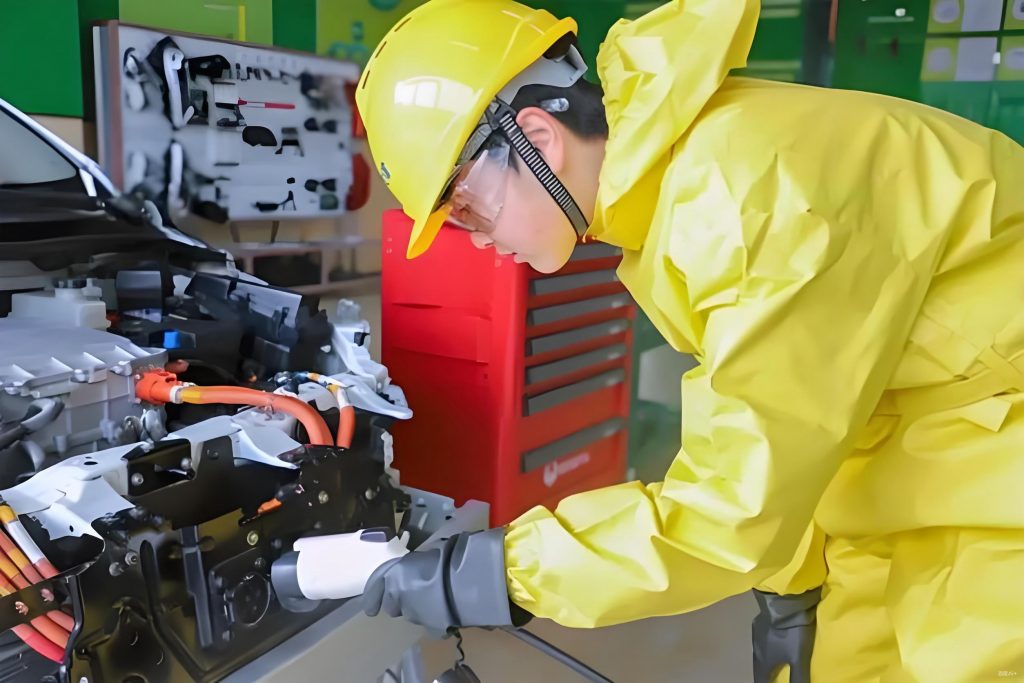
Hands-on experience is crucial for EV repair, requiring well-equipped labs and partnerships with repair shops. I advocate for “teaching factories” that replicate real workshops, complete with EV models, charging stations, and diagnostic tools. These spaces should allow students to engage in full-scale projects, such as overhauling a battery system or optimizing energy efficiency. External collaborations with manufacturers can provide internships, where learners apply skills in live electrical car repair scenarios, receiving mentorship from experienced technicians.
To evaluate training base effectiveness, consider a capacity formula: $$ C_b = \frac{F_e \cdot H_t}{S_c} $$ where \( C_b \) is the training capacity, \( F_e \) is the frequency of equipment use, \( H_t \) is the hours of hands-on training per student, and \( S_c \) is the student count. Maximizing \( C_b \) ensures that all learners gain sufficient practice in EV repair tasks.
Enhancing Teacher Capabilities
Teachers need dual expertise—theoretical knowledge and practical skills in electrical car repair—to facilitate action-oriented learning. Professional development should include industry placements, workshops on emerging technologies, and training in pedagogical methods like coaching. In my experience, forming “teacher teams” with industry experts allows for knowledge exchange and keeps instruction relevant. For instance, instructors might shadow technicians in EV repair centers to learn new diagnostic techniques, then incorporate them into lessons.
A teacher competency index can be expressed as: $$ T_c = \frac{E_t + E_p}{2} + I_u $$ where \( T_c \) is teacher competency, \( E_t \) is educational expertise, \( E_p \) is practical experience in EV repair, and \( I_u \) is involvement in industry updates. High \( T_c \) scores correlate with improved student outcomes in electrical car repair programs.
Creating a Multidimensional Evaluation System
Assessment should reflect the holistic nature of the action-oriented model, combining practical tests, portfolios, peer reviews, and self-evaluations. For example, in an EV repair course, students might be assessed on their ability to complete a repair task efficiently, document the process, collaborate with peers, and reflect on learning. I use rubrics that weight technical skills (e.g., accuracy in electrical car repair) alongside soft skills (e.g., teamwork and problem-solving).
The overall evaluation score can be modeled as: $$ E_s = w_1 \cdot T_s + w_2 \cdot P_s + w_3 \cdot C_s $$ where \( E_s \) is the evaluation score, \( T_s \) is technical skill marks, \( P_s \) is practical task performance, \( C_s \) is collaborative ability, and \( w_1, w_2, w_3 \) are weights reflecting the importance of each aspect in EV repair jobs. This ensures a balanced assessment that drives comprehensive development.
Conclusion and Future Directions
In summary, the action-oriented model offers a transformative approach to vocational education in EV repair and electrical car repair, addressing current gaps through experiential learning. By focusing on real tasks, collaborative projects, and multifaceted evaluation, it prepares students for the demands of the automotive industry. My implementation experiences show marked improvements in student engagement, skill acquisition, and job readiness. However, challenges remain, such as scaling resources and maintaining industry partnerships. Future efforts should explore digital twins and AI-driven simulations to enhance practical training, while strengthening ties with EV manufacturers for continuous curriculum innovation. As the field evolves, this model will be essential for cultivating a skilled workforce capable of advancing sustainable transportation through proficient electrical car repair.
Ultimately, the success of action-oriented education in EV repair hinges on adaptability and commitment from all stakeholders. By embracing these strategies, vocational institutions can not only meet industry needs but also inspire innovation in electrical car repair, contributing to a greener and more technologically adept society.