
The electronic control system (ECS) of special-purpose vehicles, such as construction machinery, fire trucks, and utility service vehicles, faces significantly greater complexity and criticality demands compared to standard passenger cars. Its performance directly dictates the vehicle’s operational efficiency, safety, and reliability under demanding, specialized conditions. My research, grounded in extensive industry analysis, identifies profound limitations within conventional ECS integration paradigms. These limitations necessitate a fundamental re-architecture to meet evolving requirements for intelligence, connectivity, and stringent functional safety.
Traditional architectures are predominantly federated-distributed. In this model, discrete electronic control units (ECUs) are dedicated to specific functions: the engine control unit (ECU) manages combustion, the transmission control unit (TCU) handles gear shifts, the anti-lock braking system (ABS) module controls wheel slip, and numerous other modules govern body functions, steering, and auxiliary equipment. These discrete modules communicate via Controller Area Network (CAN) buses, forming a distributed network. While offering certain advantages in terms of incremental development and supplier sourcing, this architecture suffers from critical systemic flaws:
- Low Modularity and High Coupling: Software and hardware are tightly intertwined within each dedicated motor control unit. The interfaces between different functional modules are often proprietary and non-standardized. This makes individual module upgrades, replacements, or functional expansions exceptionally difficult, stifling innovation and leading to vendor lock-in.
- Severe Redundancy and Resource Inefficiency: Each dedicated motor control unit incorporates its own microcontroller, power supply, and communication interfaces. This leads to significant hardware duplication, increased weight, wiring harness complexity, and higher overall cost. Computational resources within a simple motor control unit are often underutilized or overwhelmed, lacking the flexibility to share load.
- Poor Real-Time Performance: As feature sets expand, the number of electronic control units and the volume of inter-ECU communication on the CAN bus explode. The limited bandwidth and non-deterministic arbitration mechanism of CAN buses create communication bottlenecks and unpredictable latency. Critical control loops competing for bus access with non-critical data can experience jitter, jeopardizing the deterministic response required for vehicle dynamics and safety functions.
- Inadequate Safety Isolation: In a federated system, a failure in a non-critical module (e.g., an infotainment motor control unit) can potentially disrupt the CAN bus, interfering with the communication of safety-critical modules like the brake or steering motor control unit. There is a lack of robust hardware and software mechanisms to enforce strict isolation between functions of differing Automotive Safety Integrity Levels (ASIL).
An alternative, the centralized monolithic architecture, consolidates all functions into a single, powerful central computer. This solves the communication bottleneck and reduces hardware variety but introduces a single point of catastrophic failure and presents immense challenges in software complexity, certification, and thermal management. It is generally unsuitable for the diverse and safety-critical nature of special vehicles.
Therefore, a new integration optimization strategy is imperative. My proposed solution is a holistic approach centered on a Domain-Based E/E Architecture with supporting innovations in software design, real-time computing, and safety assurance. This strategy directly targets the shortcomings listed above, aiming to create a system that is modular, scalable, deterministic, and inherently safe.
1. A Novel Domain Controller-Centric Architecture
The cornerstone of my optimization proposal is the transition from dozens of distributed ECUs to a few high-performance Domain Controllers (DCs). This architecture organizes the vehicle’s functions into logical “domains” based on operational synergy and safety criticality. Typical domains for a special vehicle include:
- Powertrain Domain: Integrates the engine control unit, transmission control unit, and potentially hybrid/electric drive control.
- Chassis Domain: Consolidates braking (ABS, ESC), steering (EPS), suspension, and stability control functions.
- Body Domain: Manages lighting, windows, doors, climate control, and other comfort/convenience features.
- Auxiliary & Working Domain: A critical domain for special vehicles, controlling the hydraulic system, crane arm, mixer drum, fire pump, or other specialized equipment.
- Automated Driving Domain (if applicable): Hosts perception, localization, planning, and decision-making for automated functions.
Each domain is governed by a powerful Domain Controller—a high-performance, multi-core computing platform. This domain controller acts as the master for its domain, directly interfacing with sensors and actuators or coordinating simpler, localized smart actuators or zone I/O modules. Crucially, the domain controller subsumes the functionality of the traditional, dedicated motor control units within its domain. For instance, the Powertrain Domain Controller executes the software tasks previously performed by the separate engine and transmission motor control units.
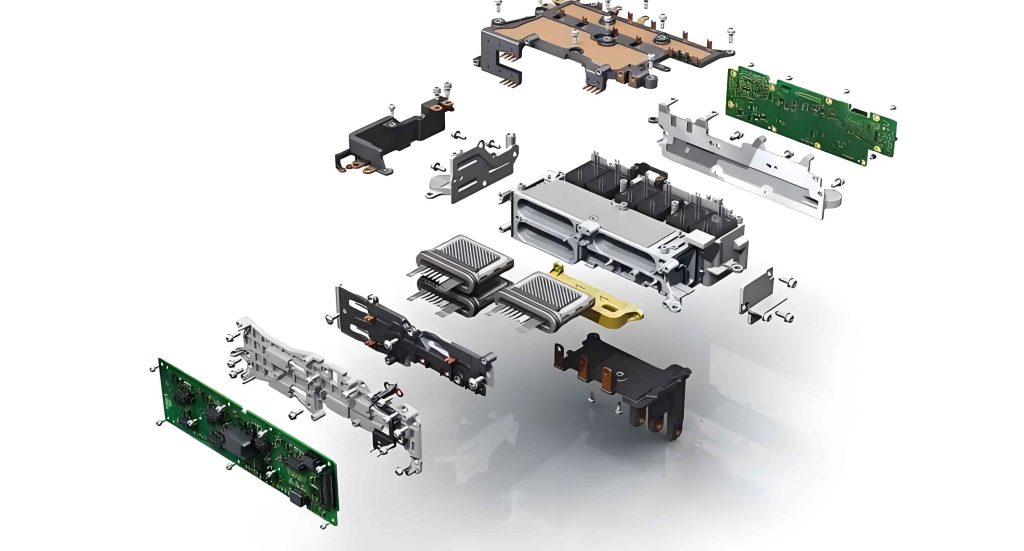
The interconnection between domain controllers shifts from low-bandwidth CAN buses to a high-speed, deterministic Ethernet backbone (e.g., Automotive Ethernet with TSN – Time-Sensitive Networking). This provides the necessary bandwidth and enables precise timing control for synchronized cross-domain functions.
The benefits of this architectural shift are transformative, as summarized in Table 1.
| Feature | Federated/Distributed Architecture | Domain-Centric Architecture |
|---|---|---|
| Core Component | Dedicated Motor Control Unit per function (e.g., ECU, TCU, ABS module) | High-Performance Domain Controller per functional domain |
| Connectivity | CAN, LIN, FlexRay networks | Automotive Ethernet backbone (with TSN) + legacy buses for edge nodes |
| Modularity | Low (HW/SW coupled in each motor control unit) | High (Centralized compute, software-defined functions) |
| Hardware Efficiency | Low (High redundancy, underutilized resources in each motor control unit) | High (Resource pooling and sharing within a domain controller) |
| Data Bandwidth | Limited (<1 Mbps per CAN channel) | Very High (100 Mbps to 1 Gbps+ per Ethernet link) |
| System Scalability | Difficult (Adding functions requires new ECUs and wiring) | Easier (New functions often just require software on existing domain controller) |
| Fault Containment | Poor (Bus failure can affect multiple motor control units) | Better (Domain isolation; Ethernet switch provides network segmentation) |
2. Service-Oriented Software Design for Decoupling
The new hardware architecture enables a revolutionary software paradigm: Service-Oriented Architecture (SOA) within the vehicle. The goal is to achieve complete hardware-software decoupling. In traditional systems, the software for the engine motor control unit is compiled for its specific microcontroller and cannot run on the transmission motor control unit.
In an SOA approach, vehicle functionality is decomposed into reusable, self-contained “services.” A service, such as “Vehicle Speed Provision,” “Brake Torque Request,” or “Pump Pressure Control,” exposes a standardized interface (typically using an automotive middleware like SOME/IP or DDS) regardless of its internal implementation or physical location. The software that once resided in a dedicated motor control unit is now refactored into a set of interoperable services.
These services can be deployed dynamically on any capable domain controller. The Chassis Domain Controller might host the “Brake Control” service, while the Auxiliary Domain Controller hosts the “Pump Control” service. Crucially, services communicate via the Ethernet network using their standard interfaces, not through low-level hardware dependencies. This offers profound advantages:
- Software Reusability: A certified “ABS Control” service can be used across different vehicle platforms without modification.
- Upgradability: A single service can be updated over-the-air (OTA) without needing to reflash an entire motor control unit or replace hardware.
- Flexibility: Functional integration becomes a matter of service composition and network configuration, not hardware rewiring. Adding a new feature may simply involve instantiating a new service on an underutilized domain controller.
The relationship between hardware, middleware, and services can be modeled. Let $S$ represent a set of software services, $H$ represent the set of hardware computational nodes (domain controllers), and $M$ represent the middleware mapping function. The deployment is given by:
$$ M: S \rightarrow H $$
The condition for successful deployment is that for each hardware node $h_i \in H$, the sum of resource demands (CPU $C$, memory $Mem$) of all mapped services does not exceed its capacity:
$$ \forall h_i \in H, \sum_{s_j \in M^{-1}(h_i)} C(s_j) \leq C_{max}(h_i) $$
$$ \forall h_i \in H, \sum_{s_j \in M^{-1}(h_i)} Mem(s_j) \leq Mem_{max}(h_i) $$
This model highlights the resource management flexibility afforded by decoupling.
3. Multi-Core Heterogeneous Computing and Real-Time Operating System
The domain controller’s role as a consolidation platform demands a leap in computational capability. To meet the diverse requirements of real-time control, high-level planning, and connectivity concurrently, I propose the use of Multi-Core Heterogeneous System-on-Chips (SoCs). A typical architecture for a safety-critical domain controller might include:
- Lockstep Cores: Dual cores executing the same code in lockstep for ASIL-D functions (e.g., core aspects of braking), providing inherent fault detection.
- High-Performance Application Cores: ARM Cortex-A series cores for complex, less time-critical algorithms (e.g., perception fusion, path planning in the automated driving domain).
- Real-Time Microcontroller Cores: ARM Cortex-R or dedicated DSP cores with precise timing guarantees for hard real-time control loops (e.g., executing the core control logic formerly in a dedicated motor control unit).
- Specialized Accelerators: GPUs, NPUs, or FPGA fabrics for parallel processing tasks like image recognition or cryptographic operations.
Managing this complex hardware and ensuring deterministic execution for safety-critical tasks requires a robust Real-Time Operating System (RTOS) or a hybrid OS approach (e.g., AUTOSAR Adaptive alongside an RTOS on different cores). The RTOS provides key mechanisms:
- Deterministic Scheduling: Using priority-based preemptive schedulers (e.g., Rate Monotonic Scheduling – RMS) to guarantee that tasks meet their deadlines. For a set of $n$ periodic tasks, RMS schedulability is tested using the Liu and Layland bound:
$$ U = \sum_{i=1}^{n} \frac{C_i}{T_i} \leq n(2^{1/n} – 1) $$
where $C_i$ is the worst-case execution time and $T_i$ is the period of task $i$. For large $n$, the bound approaches $ln(2) \approx 0.693$. - Memory Protection: Isolating tasks and services in separate memory partitions to prevent fault propagation.
- Predictable Inter-Task Communication: Offering mechanisms with bounded latency.
The integration of multiple functions, including those from legacy motor control units, onto a shared multi-core platform under RTOS management dramatically improves resource utilization and reduces the latency jitter that plagues distributed CAN-based systems. The overall system latency $L_{sys}$ for a critical control loop now comprises the sensor read time, the intra-domain controller computation time (dictated by RTOS scheduling), and the actuator write time, largely removing the non-deterministic network arbitration delay.
4. Safety and Security Isolation Mechanisms
Consolidation of mixed-criticality functions onto shared hardware necessitates rigorous isolation to prevent interference. My scheme employs a layered, defense-in-depth approach:
- Hardware Virtualization & Trust Zones: Modern heterogeneous SoCs feature hardware virtualization extensions and TrustZone technology. This allows the creation of separate “worlds” (e.g., Safe World, Normal World) or virtual machines. The most critical functions, such as the core braking algorithm derived from the legacy ABS motor control unit, can be placed in a hardware-isolated environment, completely inaccessible to less critical software.
- RTOS and Hypervisor Support: The RTOS or a Type-1 hypervisor enforces spatial (memory) and temporal (CPU time) partitioning at the software level. A malfunctioning infotainment service cannot corrupt the memory or monopolize the CPU core allocated to the steering control service.
- Network Segmentation: The Ethernet switch in the backbone can implement VLANs and TSN shaping/policing functions. Critical control traffic (e.g., between chassis and powertrain domain controllers) can be placed on a separate virtual network with guaranteed bandwidth and priority, isolated from bulk data traffic like camera feeds.
The overall safety of the integrated system can be analyzed probabilistically. For a traditional system with $n$ independent motor control units in series for a function, the system failure rate $\lambda_{system}$ is roughly the sum of individual failure rates. In the new architecture, with consolidation, the failure rate of a domain controller $\lambda_{DC}$ becomes critical. However, with strong internal isolation, the probability of a cascading failure from a non-critical to a critical partition ($P_{cascade}$) can be made exceedingly small. The effective failure rate for a safety-critical function hosted on a domain controller is a complex function:
$$ \lambda_{effective} \approx f(\lambda_{DC}, P_{cascade}, \lambda_{sensors}, \lambda_{actuators}) $$
The design goal is to make $P_{cascade}$ several orders of magnitude smaller than the hardware failure rate $\lambda_{DC}$, ensuring the integrated system meets or exceeds the reliability of the federated system.
5. Experimental Validation and Performance Analysis
To quantitatively validate the proposed optimization scheme, a prototype system was developed and compared against a baseline federated architecture on a simulated special vehicle platform (e.g., a fire truck simulator).
5.1 Prototype Implementation:
The prototype consolidated functions from five key ECUs—Engine Motor Control Unit, Transmission Motor Control Unit, ABS Motor Control Unit, Body Control Module, and Auxiliary Pump Controller—into two domain controllers:
- Powertrain/Chassis DC: Based on an SoC with dual Cortex-R5F cores (lockstep) and a Cortex-A53 cluster. Ran an AUTOSAR Classic-based RTOS on the R5 cores for time-critical control and a POSIX-based OS on the A53 for management.
- Body/Auxiliary DC: Based on a SoC with Cortex-A cores. Ran a high-level OS with an SOA middleware.
Services like “Engine Torque Control,” “Wheel Slip Control,” and “Pump Pressure Regulation” were implemented. Communication used a 100BASE-T1 Ethernet backbone with a TSN-capable switch.
5.2 Performance Metrics Comparison:
The following tables summarize the key performance improvements observed during standardized test cycles (e.g., acceleration, braking, steady pumping while maneuvering).
| Control Loop Metric | Baseline (Federated ECUs via CAN) | Optimized (Domain Controllers via Ethernet TSN) | Improvement |
|---|---|---|---|
| Throttle Response Latency (95th percentile) | 152 ms | 38 ms | ~75% reduction |
| Brake Command to Torque Build-up Latency | 85 ms | 22 ms | ~74% reduction |
| Closed-Loop Pump Pressure Control Jitter (σ) | ±0.25 bar | ±0.08 bar | ~68% reduction |
| Network Metric | Baseline (CAN Bus Load ~75%) | Optimized (Ethernet TSN) | Improvement |
|---|---|---|---|
| Cross-Domain Signal Latency (Avg/Max) | 12 ms / 45 ms | 2 ms / 5 ms | Avg: 83% reduction |
| Data Bandwidth Available for Diagnostics/Updates | > 50 Mbps | > 1000x increase | |
| Time Synchronization Accuracy (for coordinated control) | > 1 ms | < 1 µs (via IEEE 802.1AS) | > 1000x improvement |
| Attribute | Baseline (Federated) | Optimized (Domain-Centric) |
|---|---|---|
| Number of Primary ECUs/Computing Nodes | 18 | 3 (2 DCs + 1 Gateway) |
| Estimated Wiring Harness Mass | 100% (Baseline) | ~70% (Estimated reduction) |
| Fault Diagnosis & Isolation Time (to faulty module) | Multiple seconds via CAN diag | Sub-second via centralized logs & service health monitoring |
| Software Update Scope (for a new feature) | Flash multiple specific motor control units | Deploy/update a service on one Domain Controller |
5.3 Analysis of Results:
The data unequivocally demonstrates the superiority of the proposed integrated architecture. The drastic reduction in control loop latency and jitter (Table 2) stems from moving communication from a contended, non-deterministic CAN bus to a scheduled Ethernet TSN network and executing control algorithms with low RTOS scheduling jitter on a powerful core, free from interference by other tasks. This directly translates to improved vehicle drivability and operational precision.
The network performance leap (Table 3) is foundational for future capabilities. The high bandwidth enables detailed system health monitoring and rapid diagnostics, moving beyond the limited parameter data available from a traditional motor control unit. The microsecond-level synchronization is essential for coordinating actions across domains, such as synchronizing the engine motor control unit’s torque reduction with the brake motor control unit’s intervention for stability control.
The consolidation (Table 4) leads to tangible benefits in weight, cost, and maintenance complexity. While the domain controller hardware is more complex than a single motor control unit, the elimination of dozens of smaller ECUs, their associated housings, connectors, and large sections of wiring, results in net positive system-level economics.
6. Conclusion and Future Perspectives
This research presents a comprehensive and validated pathway for optimizing the electronic control system integration of special-purpose vehicles. By transitioning from a federated architecture of dedicated motor control units to a domain-centric architecture powered by multi-core heterogeneous domain controllers, and by adopting service-oriented software design, real-time operating systems, and hardware-enforced safety isolation, the fundamental limitations of traditional systems are overcome.
The proposed scheme delivers transformative improvements in modularity, real-time performance, resource efficiency, and safety assurance. It provides the essential computational backbone and network infrastructure for the next generation of intelligent, connected special vehicles.
Future Work:
- AI Integration: Exploring the deployment of lightweight deep learning models on the heterogeneous cores of domain controllers for advanced perception (e.g., worksite object detection) and predictive control of the working apparatus, moving beyond the rule-based logic of traditional motor control units.
- Vehicle-Cloud-Edge Collaboration: Developing frameworks where the on-board domain controllers (the vehicle edge) collaborate with roadside units (RSUs) and cloud platforms. The cloud could train large models for fleet optimization, which are then distilled and deployed to the domain controllers, enabling coordinated fleet operations.
- Advanced Security: Implementing a full-stack security solution spanning hardware TrustZones, secure hypervisors, authenticated service communication, and intrusion detection systems tailored for the consolidated domain controller architecture.
- Standardization and Tooling: Contributing to the development of open standards and tools for service description, deployment, and lifecycle management for the mixed-criticality, multi-vendor software environment running on automotive domain controllers.
The evolution from isolated motor control units to integrated domain controllers is not merely an incremental step but a necessary paradigm shift, unlocking new levels of performance, functionality, and efficiency for the demanding world of special vehicles.