
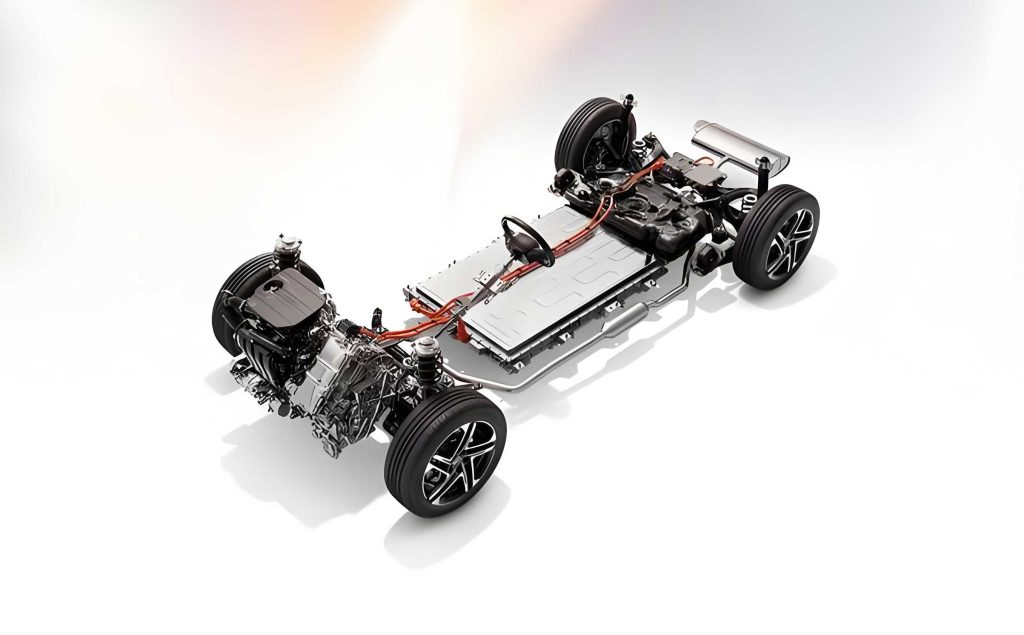
The development of modern hybrid vehicles, particularly the extended-range hybrid car architecture, presents a unique set of thermal management challenges. In such a vehicle, an internal combustion engine (the range extender) operates intermittently, primarily to recharge the battery, while electric motors provide the primary propulsion. This operational duality results in two distinct cooling circuits—one for the engine and one for the electric motor and power electronics—each with highly dynamic thermal loads. The cooling system, comprising components like coolant pumps and radiator fans, is a significant auxiliary load. In a conventional hybrid car with mechanically driven components, this power draw is often inefficient, as pumps and fans run at speeds coupled to the engine, regardless of the actual cooling demand. This research focuses on developing an intelligent control strategy for the cooling system of an extended-range hybrid car, aiming to minimize the total electrical power consumption of the cooling auxiliaries—the pump and fan—while strictly maintaining the operational temperature limits of both the engine and the electric drive unit. For a hybrid car, optimizing such parasitic loads directly translates to improved overall energy efficiency and extended electric range.
The core objective is to move from a reactive, rule-based cooling logic to an optimized, demand-based control system. The fundamental premise is that for a given required heat dissipation from the engine or motor, and under a specific vehicle speed (which creates a ram air effect), multiple combinations of electric coolant pump speed ($N_w$) and electric fan speed ($N_a$) can achieve the necessary cooling, defined by keeping the outlet coolant temperature ($T_{out}$) within a target band. However, each combination consumes a different amount of total electrical power ($P_{total}$). The challenge, therefore, is to dynamically identify the specific $(N_w, N_a)$ pair that yields the minimum $P_{total}$ for every instantaneous operating condition of the hybrid car.
Mathematical Foundation: Cooling System Power Analysis
The total power consumed by a cooling circuit’s active components is the sum of the pump power and the fan power. We can express this by first defining the individual component consumptions.
The hydraulic power required from the coolant pump is given by the product of the volumetric flow rate and the pressure rise it must provide. Expressed in terms of mass flow rate for consistency:
$$ P_w = \frac{q_{m,w} \cdot \Delta p_w}{\eta_w} $$
where $q_{m,w}$ is the coolant mass flow rate (kg/s), $\Delta p_w$ is the total pressure loss across the engine/motor block and the cooling circuit (Pa), and $\eta_w$ is the overall efficiency of the pump and its drive motor.
Similarly, the power required by the cooling fan to move air through the radiator is:
$$ P_a = \frac{q_{m,a} \cdot \Delta p_a}{\eta_a} $$
where $q_{m,a}$ is the air mass flow rate through the radiator (kg/s), $\Delta p_a$ is the total air-side pressure drop (Pa), and $\eta_a$ is the overall fan system efficiency. The air-side pressure drop $\Delta p_a$ is primarily the sum of the radiator core resistance ($p_R$) and the ducting losses ($p_L$), often related as $p_L = a \cdot p_R$, where $a$ is a vehicle-specific coefficient typically between 0.4 and 1.1.
Therefore, the total cooling system power draw for the hybrid car’s thermal management is:
$$ P_{total} = P_w + P_a = \frac{q_{m,w} \cdot \Delta p_w}{\eta_w} + \frac{q_{m,a} \cdot (1+a) \cdot p_R}{\eta_a} $$
The control variables in this equation are effectively $q_{m,w}$ and $q_{m,a}$, which are directly and non-linearly influenced by the pump speed $N_w$ and the fan speed $N_a$, respectively. The pressure losses $\Delta p_w$ and $p_R$ are also complex functions of their respective flow rates. This interdependence creates a multi-dimensional optimization space for the hybrid car’s control unit to navigate.
System Modeling and Simulation Approach
To solve this optimization problem, detailed one-dimensional thermal-fluid models of both the engine and motor cooling circuits for the subject extended-range hybrid car were built using GT-SUITE software. The engine cooling system model included the engine block (as a heat source), a thermostat, a water pump, a main radiator, auxiliary heat exchangers (e.g., for oil cooling), and an expansion tank. The electric drive cooling system model was simpler, consisting of the motor/controller heat source, a pump, and a radiator. Crucially, both models included calibrated representations of the pump and fan performance maps, relating speed to flow rate and pressure, as well as the thermal resistance characteristics of the radiators.
The heat rejection profiles for both systems were derived from vehicle simulation. For the range-extender engine, operating in a charge-sustaining mode, the heat dissipation was characterized by three primary levels during a charging cycle: 12.1 kW, 20.4 kW, and 30.9 kW. For the traction motor in a New European Driving Cycle (NEDC), the heat load varied dynamically between 0 and approximately 5.8 kW, with key levels of 2 kW, 4 kW, and 6 kW selected for study. Vehicle speed ($V_{veh}$) was treated as the effective frontal air speed (assuming zero wind) for the radiator, varying from 0 to 120 km/h. The control targets were to maintain engine coolant outlet temperature between 90°C and 95°C, and the motor coolant outlet temperature below 40°C.
Control Strategy Development: Mapping the Minimum Power Frontier
The core of the strategy is a pre-computed, multi-dimensional look-up table, or “minimum power map.” For each cooling circuit (engine and motor), the following process was executed offline via a Design of Experiments (DoE) campaign within the GT-SUITE models:
- For a fixed heat rejection value ($Q$) and a fixed vehicle speed ($V_{veh}$), a wide range of pump speeds ($N_w$) and fan speeds ($N_a$) were simulated.
- From all simulations, only the $(N_w, N_a)$ combinations that resulted in an outlet temperature $T_{out}$ meeting the precise control target (e.g., 93°C for the engine) were filtered.
- Among these valid combinations, the one that yielded the lowest sum of simulated $P_w$ and $P_a$ was identified as the optimal operating point for that specific ($Q$, $V_{veh}$) condition.
This process reveals a fundamental trade-off. At a given $Q$ and $V_{veh}$, increasing the pump speed improves coolant-side heat transfer but increases $P_w$. This might allow the fan speed to be reduced, saving $P_a$. The optimal point is where the marginal increase in pump power equals the marginal decrease in fan power (or vice-versa). The following table exemplifies the results for the engine cooling system at a vehicle speed of 40 km/h, showing how the power distribution shifts with heat load.
| Heat Load, Q (kW) | Pump Power, P_w (kW) | Fan Power, P_a (kW) | Total Power, P_total (kW) | Optimal Pump Speed, N_w (rpm) | Optimal Fan Speed, N_a (rpm) |
|---|---|---|---|---|---|
| 12.1 | 0.08 | 0.20 | 0.28 | 1974 | 2115 |
| 20.4 | 0.35 | 0.74 | 1.09 | 2921 | 3408 |
| 30.9 | 1.15 | 0.95 | 2.10 | 4900 | 4082 |
The results demonstrate that at lower heat loads (e.g., 12.1 kW), the strategy favors a higher relative fan speed and a lower pump speed, as the ram air and fan can effectively reject heat with a moderate coolant flow. At very high heat loads (e.g., 30.9 kW), the radiator’s capacity becomes limiting; thus, the optimal solution requires a significantly higher pump speed to increase the coolant-side heat transfer coefficient and flow rate, while the fan speed increase is less pronounced. The potential savings are substantial. Compared to the worst-case (maximum power) combination at the same cooling effect, the optimized strategy reduced total cooling power by up to 84% for the 12.1 kW case.
This DoE process was repeated for a matrix of heat loads and vehicle speeds. The complete set of optimal points forms the control map for the hybrid car’s thermal manager. The following comprehensive tables summarize the optimal operating parameters and the achievable minimum power for the two systems across key operational scenarios.
| Vehicle Speed (km/h) | Optimal Pump Speed, N_w (rpm) | Optimal Fan Speed, N_a (rpm) | Minimum Total Power, P_min (kW) | ||||||
|---|---|---|---|---|---|---|---|---|---|
| Q=12.1kW | Q=20.4kW | Q=30.9kW | Q=12.1kW | Q=20.4kW | Q=30.9kW | Q=12.1kW | Q=20.4kW | Q=30.9kW | |
| 20 | 1913 | 2921 | 4959 | 2069 | 3408 | 4178 | 0.30 | 1.12 | 2.29 |
| 40 | 1974 | 2921 | 4900 | 2115 | 3408 | 4082 | 0.28 | 1.09 | 2.10 |
| 60 | 1732 | 2806 | 4998 | 2194 | 3415 | 4048 | 0.26 | 1.05 | 2.04 |
| 80 | 1901 | 2806 | 4912 | 2077 | 3415 | 4016 | 0.24 | 0.99 | 1.91 |
| 100 | 1900 | 2806 | 4556 | 2211 | 3415 | 4001 | 0.23 | 0.96 | 1.70 |
| 120 | 1587 | 2904 | 4001 | 2647 | 3305 | 4556 | 0.18 | 0.94 | 1.63 |
| Vehicle Speed (km/h) | Optimal Pump Speed, N_w (rpm) | Optimal Fan Speed, N_a (rpm) | Minimum Total Power, P_min (kW) | ||||||
|---|---|---|---|---|---|---|---|---|---|
| Q=2kW | Q=4kW | Q=6kW | Q=2kW | Q=4kW | Q=6kW | Q=2kW | Q=4kW | Q=6kW | |
| 20 | 390 | 932 | 2482 | 0 | 1243 | 1657 | 0.0003 | 0.122 | 0.228 |
| 40 | 300 | 740 | 1436 | 0 | 1356 | 1842 | 0.0001 | 0.118 | 0.207 |
| 60 | 290 | 711 | 1327 | 0 | 1594 | 1871 | 0.0001 | 0.097 | 0.152 |
| 80 | 290 | 631 | 1185 | 0 | 1815 | 1853 | 0.0001 | 0.092 | 0.116 |
| 100 | 290 | 650 | 1074 | 0 | 0 | 2116 | 0.0001 | 0.001 | 0.107 |
| 120 | 290 | 600 | 998 | 0 | 0 | 2586 | 0.0001 | 0.001 | 0.074 |
The tables reveal critical insights for the hybrid car’s energy management. For the motor cooling system, at low heat loads (2 kW) or high vehicle speeds (>100 km/h for 4 kW load), the optimal fan speed is zero. The ram air alone is sufficient for cooling, and only minimal pump power is needed to circulate coolant. This highlights a major energy-saving opportunity absent in traditional systems. For the engine system, higher vehicle speeds consistently reduce the minimum required power across all heat loads due to the enhanced ram air cooling effect.
Implementation and Simulation Results
The derived optimal maps were implemented as the core of a control strategy in a Simulink environment. This controller acts as the supervisory thermal manager for the hybrid car. During vehicle simulation, the controller receives real-time signals for heat rejection ($Q$) from the engine or motor and the vehicle speed ($V_{veh}$). It uses these as indices to interpolate the pre-stored optimal maps and outputs the target pump speed ($N_{w,opt}$) and fan speed ($N_{a,opt}$) commands, which are then sent to the low-level actuators in the GT-SUITE plant model.
The performance of this optimized strategy was compared against a baseline strategy representative of traditional hybrid car systems, where the pump and fan speeds are proportional to the engine or motor shaft speed. For the engine, the baseline ratios were $N_w / N_{eng} = 1.4$ and $N_a / N_{eng} = 1.3$. For the motor cooling, the ratios were $N_w / N_{motor} = 0.8$ and $N_a / N_{motor} = 0.3$.
The results from a simulated engine charging cycle showed that the optimized strategy significantly reduced auxiliary speeds, especially during low-to-medium heat rejection phases. Crucially, the engine outlet temperature was maintained within the tighter band of 90.1°C to 95.8°C, avoiding the overcooling and wider temperature swings observed in the baseline. The energy saving was calculated by integrating the instantaneous power draw over the entire cycle. The optimized engine cooling system consumed 5,136.51 kJ, compared to 5,682.88 kJ for the baseline, representing a 9.51% reduction in cooling system energy consumption during a typical range-extender operation.
For the electric drive system over a complete NEDC, the savings were even more dramatic. The optimized control frequently commanded zero fan speed, relying on ram air, and kept the pump at very low speeds. While the outlet temperature profile was slightly warmer than the baseline, it remained well under the 40°C limit. The total energy consumed by the optimized motor cooling system was 17.89 kJ, compared to 24.06 kJ for the baseline, achieving a 25.64% energy saving over the driving cycle. This is a direct gain for the hybrid car’s battery range.
Conclusion
This study successfully developed and validated a model-based, optimal control strategy for the thermal management system of an extended-range hybrid car. By formulating the cooling problem as a dynamic minimization of total pump and fan power subject to temperature constraints, and by pre-computing optimal operating maps via detailed system simulation, significant energy savings were achieved. The strategy intelligently exploits the cooling contribution of vehicle ram air, often allowing the fan to be switched off entirely for the motor cooling circuit and optimized to low speeds for the engine circuit. The implementation demonstrated a 9.51% energy saving for the engine cooling during a generation cycle and a 25.64% saving for the motor cooling over a standard driving cycle. These savings directly reduce the parasitic load on the hybrid car’s electrical system, thereby improving the overall energy efficiency and extending the usable range of the vehicle. The methodology is broadly applicable to the design of efficient thermal management systems in various hybrid and electric vehicle architectures, representing a critical step towards maximizing the performance and sustainability of modern hybrid cars.