
In my extensive experience with EV repair, the electric air conditioning compressor stands as a pivotal component in modern electric vehicles. As the adoption of electric cars accelerates globally, the performance and reliability of their climate control systems have become critical concerns. The electric compressor not only ensures passenger comfort but also plays a vital role in maintaining battery thermal management, directly impacting vehicle range and safety. Unlike traditional internal combustion engine vehicles, where the compressor is mechanically driven, electric compressors in EVs rely on high-voltage electrical systems and sophisticated control logic. This shift introduces unique challenges in electrical car repair, necessitating a deep understanding of both mechanical and electronic subsystems. In this comprehensive guide, I will delve into the structure, operation, and common failure modes of electric compressors, providing actionable diagnostic protocols and repair strategies that I have refined through hands-on practice.
The electric scroll compressor, commonly used in EVs, consists of a fixed scroll and an orbiting scroll that work in tandem to compress refrigerant. Its operation hinges on three cyclic phases: intake, compression, and discharge. During intake, low-pressure gaseous refrigerant at approximately 0 °C and 0.15–0.2 MPa is drawn into the compression chamber. The compression phase involves the eccentric motion of the orbiting scroll, which progressively increases the refrigerant’s temperature and pressure, channeling it toward the center of the fixed scroll. Finally, discharge occurs when the highly compressed gas, now at 70–80 °C and 1.5 MPa, is expelled through the central orifice. This process can be modeled using thermodynamic principles. For instance, the adiabatic compression work can be estimated with the formula: $$ W = \frac{\gamma}{\gamma – 1} P_1 V_1 \left[ \left( \frac{P_2}{P_1} \right)^{\frac{\gamma – 1}{\gamma}} – 1 \right] $$ where \( \gamma \) is the specific heat ratio, \( P_1 \) and \( P_2 \) are initial and final pressures, and \( V_1 \) is the initial volume. Such equations help in evaluating compressor efficiency during EV repair diagnostics.
| Phase | Temperature Range (°C) | Pressure Range (MPa) | Key Processes |
|---|---|---|---|
| Intake | ~0 | 0.15–0.2 | Refrigerant吸入 |
| Compression | Rising to 70–80 | Up to 1.5 | Orbital motion, pressure increase |
| Discharge | 70–80 | ~1.5 | Expulsion via central orifice |
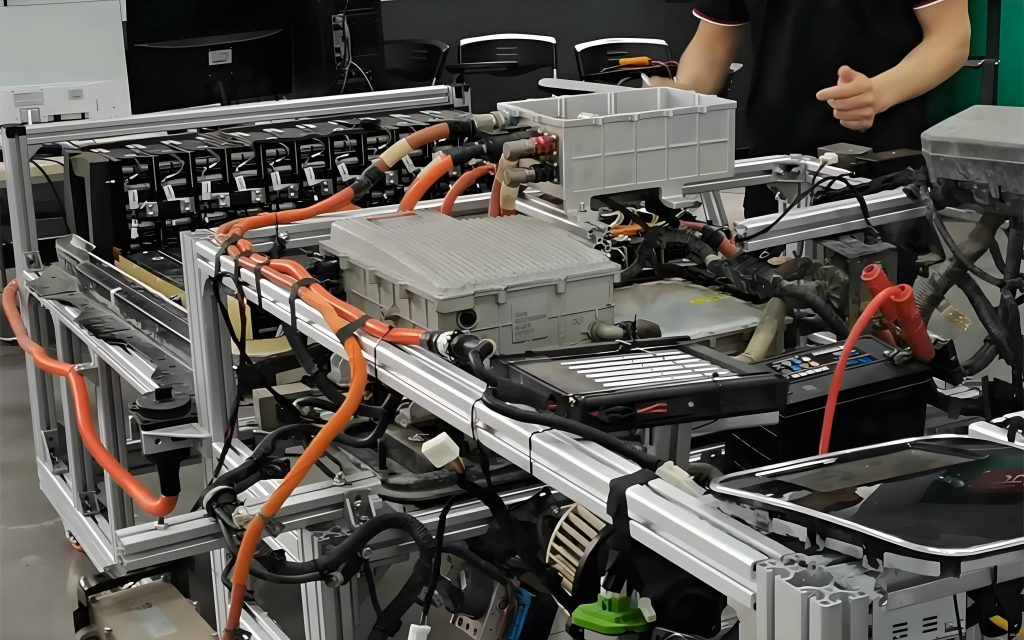
The electrical architecture of an EV’s compressor system is multifaceted, comprising high-voltage supply circuits, low-voltage control circuits, sampling and protection circuits, and an electronic control unit (ECU). In electrical car repair, it is crucial to recognize that the high-voltage circuit includes components like the power distribution box, high-voltage harnesses, filtering circuits, and insulated-gate bipolar transistors (IGBTs), which convert DC from the battery to three-phase AC for the compressor motor. The low-voltage circuit, powered by the 12 V battery or a DC-DC converter, ensures stable operation of control modules and communication via LIN/CAN buses. Sampling circuits monitor current, voltage, and temperature through sensors, while the ECU processes these inputs to regulate compressor activity. For example, the power in the high-voltage circuit can be expressed as: $$ P = V_{\text{dc}} \times I_{\text{dc}} \times \eta $$ where \( V_{\text{dc}} \) is the DC voltage (typically 200–400 V), \( I_{\text{dc}} \) is the current (around 9 A), and \( \eta \) is the efficiency factor. This highlights the importance of electrical parameters in EV repair diagnostics.
| Circuit Type | Key Components | Primary Function | Typical Parameters |
|---|---|---|---|
| High-Voltage Supply | IGBT, Filter, Harness | Provide safe high-voltage power | Voltage: 200–400 V, Current: ~9 A |
| Low-Voltage Control | 12 V Battery, CAN/LIN | Enable stable control signals | Voltage: 12 V, Communication: CAN bus |
| Sampling & Protection | Current, Temp, Voltage Sensors | Monitor operational status | Temp range: -40 °C to 85 °C |
| ECU | Microprocessor | Process data and control IGBT | Signal frequency: PWM controlled |
For an electric compressor to operate, several conditions must be met, which I always verify during EV repair procedures. The vehicle must be in READY or OK mode, with the battery state of charge (SOC) exceeding a threshold—often 12% or higher. High-voltage supply must be within specified ranges, and the compressor’s temperature must remain between -40 °C and 85 °C to prevent thermal shutdown. Additionally, the evaporator temperature sensor should read above 3 °C to avoid frost formation, and the air conditioning high-pressure sensor must not indicate abnormalities due to refrigerant leaks or blockages. The blower motor must also function correctly. These prerequisites can be summarized using logical conditions: $$ \text{Compressor Active} \iff (\text{SOC} > 0.12) \land (V_{\text{high}} \in [200, 400]) \land (T \in [-40, 85]) \land (T_{\text{evap}} > 3) $$ Neglecting these in electrical car repair often leads to misdiagnosis and unnecessary part replacements.
When diagnosing electric compressor failures in EVs, I follow a systematic workflow to enhance efficiency in EV repair. Initially, I check if the compressor is running by listening for operational vibrations or using a stethoscope. If inactive, I assess the working conditions, including high-voltage availability, SOC, and sensor inputs. For instance, using a diagnostic scanner, I retrieve fault codes such as those related to high-voltage interlock (HVIL) or sensor anomalies. If high-voltage is absent, I inspect the battery system and insulation resistance, calculated as: $$ R_{\text{insulation}} = \frac{V_{\text{test}}}{I_{\text{leakage}}} $$ where \( V_{\text{test}} \) is the test voltage and \( I_{\text{leakage}} \) is the leakage current. Should high-voltage be present but the compressor unresponsive, I measure voltages at low-voltage connectors and check for signal integrity. This methodical approach prevents erroneous compressor replacements, a common pitfall in electrical car repair.
| Step | Action | Tools Required | Expected Outcome |
|---|---|---|---|
| 1 | Verify compressor operation | Stethoscope, Visual inspection | Confirm running status or silence |
| 2 | Check working conditions | Diagnostic scanner, Multimeter | Validate SOC, voltage, temperature |
| 3 | Inspect high-voltage circuit | Insulation tester, HV probe | Ensure 200–400 V availability |
| 4 | Test low-voltage signals | Multimeter, Oscilloscope | Confirm 12 V supply and CAN signals |
| 5 | Evaluate refrigerant system | Pressure gauges, Leak detector | Rule out leaks or blockages |
High-voltage interlock (HVIL) faults are a frequent issue I encounter in EV repair, often manifesting as compressor inactivity despite normal high-voltage presence. HVIL circuits use low-voltage signals to monitor the integrity of high-voltage connections, ensuring safety by disconnecting power before physical disconnection occurs. In one case, a vehicle exhibited limited power and illuminated warning lights, with diagnostic codes pointing to HVIL faults in the compressor circuit. To resolve this, I disconnected the 12 V battery, performed insulation checks, and sequentially tested HVIL loops by shorting interlock terminals with jumper wires. The resistance in an HVIL loop can be modeled as: $$ R_{\text{total}} = \sum_{i=1}^{n} R_{\text{component}_i} $$ where each \( R_{\text{component}} \) represents the resistance of a connected module. By isolating faults to specific connectors—such as loosened or corroded terminals—I restored compressor function without part replacement, underscoring the value of thorough electrical car repair techniques.
Another common scenario in electrical car repair involves compressor-related cooling failures due to electrical issues. For example, if the compressor does not activate despite meeting all conditions, I focus on the control circuitry. After securing the vehicle and donning personal protective equipment, I disconnect high and low-voltage connectors, short the HVIL terminals to simulate connection, and use a multimeter to measure voltages at the compressor’s low-voltage port. The expected values include a stable 12 V supply and PWM signals from the ECU. If these are correct but the compressor remains inactive, I conclude an internal fault, such as a burned-out IGBT or motor winding failure. The power dissipation in an IGBT can be calculated using: $$ P_{\text{loss}} = I_{\text{collector}}^2 \times R_{\text{on}} + E_{\text{sw}} \times f_{\text{sw}} $$ where \( R_{\text{on}} \) is the on-state resistance, \( E_{\text{sw}} \) is the switching energy, and \( f_{\text{sw}} \) is the switching frequency. This emphasizes the need for precise measurements in EV repair to avoid unnecessary component swaps.
In conclusion, mastering electric vehicle air conditioning compressor diagnostics is essential for effective EV repair. By integrating thermodynamic principles, electrical engineering knowledge, and structured workflows, technicians can efficiently resolve issues ranging from HVIL faults to refrigerant problems. The formulas and tables presented here, such as those for compression work and circuit parameters, serve as practical tools in electrical car repair. Emphasizing a condition-based approach—verifying SOC, voltage, temperature, and sensor inputs—not only accelerates fault isolation but also reduces wasteful expenditures on functional components. As EV technology evolves, these methodologies will remain cornerstone practices, ensuring reliability and safety in modern automotive maintenance.