
I remember the moment it clicked for me. It wasn’t in a lab, surrounded by complex equipment, but rather in the quiet certainty of a product announcement. The promise I had studied for years—a battery that could store immense energy without the lurking danger of fire, a battery that could finally unlock the true potential of electric mobility and a clean grid—was no longer a theoretical exercise. It was being manufactured. The solid-state battery, the perennial “battery of the future,” had decisively stepped out of research journals and into the factory floor. The transition I had anticipated is no longer a question of “if,” but of “how quickly.” The evidence is everywhere, from the miniaturized power in our wearables to the massive gigafactories being constructed for electric vehicles. This shift represents more than an incremental improvement; it is a fundamental re-architecting of how we store and use energy, promising to make our devices more enduring, our cars safer and longer-ranged, and our infrastructure cleaner and more resilient.
To appreciate the magnitude of this shift, we must understand the journey. For over two centuries, the basic blueprint of a battery remained largely unchanged since Volta’s pile: an anode, a cathode, and an electrolyte medium that facilitates the flow of ions. The evolution was in the materials, seeking better performance, rechargeability, and safety.
| Era | Key Development | Core Chemistry/Feature |
|---|---|---|
| 1799 | First True Battery (Voltaic Pile) | Zinc (Anode), Copper (Cathode), Brine-soaked cloth (Electrolyte) |
| 1859 | First Rechargeable Battery (Lead-Acid) | Lead (Anode), Lead Dioxide (Cathode), Sulfuric Acid (Liquid Electrolyte) |
| 1887 | First Dry Cell | Paste-like electrolyte, enabling portable, leak-resistant designs. |
| 1970s | Concept of Rechargeable Lithium Batteries | Lithium-metal anode, liquid organic electrolyte. High energy density but severe safety risks. |
| 1980 | Critical Cathode Breakthrough | Lithium Cobalt Oxide cathode, enabling higher voltage and stability. |
| 1991 | Commercial Lithium-ion Battery | Carbon-based anode replaces lithium metal, using liquid electrolyte. Safer, commercially viable. |
| 2000s-Present | Dominance & Refinement of Li-ion | Continuous improvement in energy density and cost reduction, but inherent limitations in safety and energy ceiling remain. |
The lithium-ion battery’s reign has been transformative, powering the portable electronics revolution and igniting the electric vehicle era. Its cost trajectory is a testament to manufacturing scale and innovation, plummeting by over 97% in three decades. We can model this cost decline approximately with an exponential decay function:
$$ C(t) = C_0 \cdot e^{-kt} $$
Where \( C(t) \) is the cost per kWh at time \( t \), \( C_0 \) is the initial cost, and \( k \) is the decay constant. This dramatic cost reduction made technologies feasible. However, the foundational chemistry presents intrinsic ceilings and risks. The flammable liquid electrolyte is a vulnerability, and the energy density is constrained by the materials and the need for bulky protective systems. This is where the solid-state battery paradigm breaks the mold.
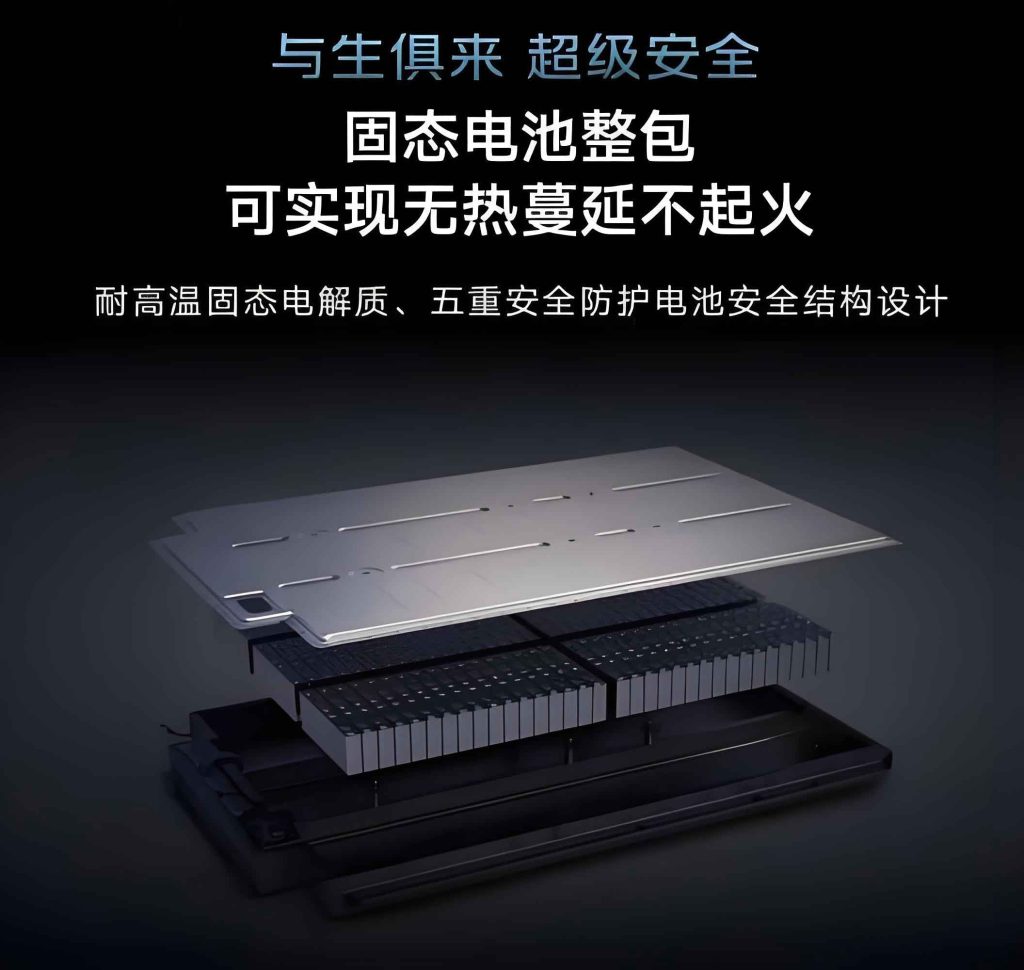
The core innovation is deceptively simple: replace the liquid or gel electrolyte with a solid one. This single change cascades into a multitude of advantages. A solid electrolyte is inherently non-flammable, dramatically reducing fire risk. It can be much thinner, allowing for more compact cell designs or space for more active material. Crucially, it opens the door to using a pure lithium metal anode, the “holy grail” for energy density. In a liquid system, lithium metal forms dangerous dendrites; a solid electrolyte can potentially suppress this growth. The theoretical energy density leap is significant. We can express the practical energy density \( E \) of a cell as:
$$ E = \frac{ V \times Q }{ m } $$
Where \( V \) is the average discharge voltage, \( Q \) is the charge capacity, and \( m \) is the mass. By enabling a lithium metal anode (high \( Q \)) and allowing higher-voltage cathodes (higher \( V \)) due to stability, the solid-state battery pushes \( E \) far beyond liquid Li-ion limits. The safety aspect cannot be overstated. The risk \( R \) associated with thermal runaway in a battery can be conceptually framed as a function of electrolyte flammability \( f \), operational temperature \( T \), and defect probability \( p \):
$$ R \propto f(T) \cdot p $$
By setting \( f(T) \approx 0 \) (non-flammable solid), the solid-state battery fundamentally minimizes \( R \), even if \( p \) (manufacturing defects) exists.
The journey from lab to market is being paved with concrete milestones. The strategy is brilliantly pragmatic: start small, prove the technology, then scale. We are now witnessing this exact playbook in action. Major breakthroughs in ceramic-based solid-state batteries for micro-electronics have been achieved, with energy densities reported to reach 1000 Wh/L. This makes them perfect, rechargeable successors to disposable button cells in wearables and medical devices. The manufacturing learning from these small cells is invaluable. The key challenge in scaling up is maintaining uniform, defect-free layers over a larger area—a problem of materials science and process engineering that is now being actively solved.
However, the true societal impact will be measured on the road. The limitations of current EVs—range anxiety, charging time, and rare, but catastrophic, fire incidents—are all addressable by the solid-state battery. The automotive industry’s commitment is the strongest signal of imminent change. Global automakers and their partners are not just researching; they are building supply chains and gigafactories with targeted start dates for mass production within this decade. The focus is on developing crack-resistant ceramic electrolytes and novel cell architectures that definitively solve the dendrite problem. One promising approach uses a ceramic separator with a solid electrolyte on one side, creating a hybrid system that blocks dendrites while maintaining excellent ion conductivity. The anticipated performance leap is transformative: potential range increases of 50% or more, charging times slashed to minutes, and a safety profile that should erase consumer concerns. We can model the anticipated improvement in driving range \( D \) as a function of battery pack energy \( E_{pack} \) and vehicle efficiency \( \eta \):
$$ D = \eta \cdot E_{pack} $$
If the solid-state battery increases \( E_{pack} \) by 50-100% for the same volume/weight, \( D \) increases proportionally, fundamentally altering the EV value proposition.
| Application Sector | Key Advantage of Solid-State Battery | Current Status & Near-Term Goal |
|---|---|---|
| Consumer Electronics (Wearables, IoT) | Ultra-high energy density, safety, rechargeability. | Commercial production begun for micro-batteries. Scaling to smartphones/ laptops. |
| Electric Vehicles | Longer range, faster charging, eliminate fire risk, enable new vehicle designs. | Prototype validation & gigafactory construction. Target for first production vehicles: 2027-2030. |
| Grid Energy Storage | Superior safety for dense installations, longer calendar life, wider temperature operation. | Early pilot manufacturing lines established. Focus on scaling and cost reduction for utility-scale deployment. |
| Aviation & Specialized Transport | High specific energy (Wh/kg) is critical for electrification of planes, heavy trucks. | R&D and early prototyping phase. Dependent on maturity of automotive-scale production. |
Beyond transportation, the solid-state battery is poised to be the linchpin for a renewable-powered grid. Solar and wind are intermittent. Large-scale Battery Energy Storage Systems (BESS) are the solution, but today’s lithium-ion farms come with non-trivial safety oversight and longevity concerns. A solid-state battery BESS would be inherently safer, could last significantly longer with less degradation, and might operate efficiently in a wider temperature range. The economic equation for grid storage factors in not just the upfront cost per kWh, but the Levelized Cost of Storage (LCOS), which includes lifetime, efficiency, and maintenance. The formula for LCOS is:
$$ LCOS = \frac{ \text{Total Lifetime Cost} }{ \text{Total Lifetime Energy Discharged} } $$
A solid-state battery with a longer cycle life \( N \) and higher round-trip efficiency \( \epsilon \) directly reduces the denominator and improves the numerator, driving down LCOS and making renewable integration more economical. Companies are already patenting novel manufacturing processes designed explicitly to produce large-format solid-state cells for grid storage at competitive costs, moving away from lab-scale batch methods to continuous, scalable processes.
As we look to the horizon, the innovation cycle is accelerating, not slowing. The first-generation commercial solid-state batteries will likely use established lithium-ion cathode materials paired with a solid electrolyte and lithium metal anode. But the research frontier is already exploring more radical, sustainable, and high-performance ideas. We are seeing prototypes of silicon-based anodes in solid-state configurations that promise astonishingly fast charging. Perhaps even more revolutionary is the exploration of lithium-free solid-state batteries, using abundant mineral-based solid electrolytes to shuttle other ions. This could alleviate material sourcing concerns and lead to even cheaper, more sustainable storage. The ionic conductivity \( \sigma \) of a solid electrolyte is the key parameter, governed by the Arrhenius equation:
$$ \sigma T = A \exp\left(-\frac{E_a}{k_B T}\right) $$
Where \( A \) is a pre-exponential factor, \( E_a \) is the activation energy for ion hopping, \( k_B \) is Boltzmann’s constant, and \( T \) is temperature. The global research quest is to find materials with high \( A \) and low \( E_a \) that are also cheap, stable, and environmentally benign. Every new discovery adds to the toolkit.
The narrative has irrevocably shifted. For decades, the solid-state battery was a tantalizing prospect perpetually a decade away. Today, the evidence is overwhelming: it is being built. The path from laboratory curiosity to industrial commodity is complex, fraught with engineering and supply chain hurdles, but the direction is clear. The convergence of material science breakthroughs, unprecedented levels of investment, and a clear market pull from multiple industries has created a critical mass. We are at the inflection point. The solid-state battery will not just replace its liquid-electrolyte predecessor; it will enable applications we are only beginning to imagine, powering a future that is not only more efficient but fundamentally safer and more sustainable. The future of energy storage is solid.