
As a professional in the field of electric vehicle maintenance, I have observed that the technological architecture of new energy buses differs fundamentally from traditional fuel-powered buses. This divergence introduces unique challenges in EV repair, particularly for electric buses, which dominate the public transport sector in many cities. The complexity of systems like battery management, drive motors, high-voltage electrical insulation, and onboard networks demands specialized approaches to electrical car repair. In this article, I will explore common faults, case analyses, and advanced strategies for maintaining electric buses, emphasizing the critical role of data-driven and non-destructive testing methods. Throughout, I will highlight the importance of EV repair and electrical car repair in ensuring safety, reliability, and efficiency.
One of the most frequent issues in electric bus maintenance involves the Battery Management System (BMS). As the core control unit, the BMS monitors parameters, balances cell voltages, and safeguards battery operation. However, data anomalies in BMS are common, leading to inaccurate performance assessments or even false fault reports that disrupt vehicle operation. Key causes include sensor accuracy degradation, data transmission interference, algorithm mismatches, and software vulnerabilities. For instance, sensors are prone to environmental factors, mechanical vibrations, and electrochemical corrosion over time, reducing their precision. Data transmission issues arise from electromagnetic interference, causing packet loss, errors, or delays. Battery health monitoring, which relies on metrics like internal resistance and capacity decay rate, is particularly challenging. The internal resistance measurement, for example, is affected by contact resistance, polarization resistance, and instrument accuracy, making it difficult to obtain reliable values. Capacity decay rate calculation requires long-term data on charge-discharge cycles, but factors like driving habits, temperature, and charging methods complicate this. Accurately assessing battery health is vital for preventing early failure and optimizing maintenance schedules in EV repair.
To summarize BMS-related challenges, consider the following table that outlines common faults, causes, and impacts in electrical car repair:
| Fault Type | Primary Causes | Impact on Vehicle |
|---|---|---|
| BMS Data Anomalies | Sensor degradation, electromagnetic interference | Reduced range, false fault alarms |
| Battery Health Misestimation | Inaccurate internal resistance and capacity calculations | Premature battery failure, safety risks |
In terms of mathematical representation, the internal resistance \( R_{\text{internal}} \) can be modeled as a function of various factors: $$ R_{\text{internal}} = R_{\text{contact}} + R_{\text{polarization}} + \Delta R_{\text{environment}} $$ where \( R_{\text{contact}} \) is the contact resistance, \( R_{\text{polarization}} \) accounts for electrochemical effects, and \( \Delta R_{\text{environment}} \) represents environmental influences. Similarly, the capacity decay rate \( C_{\text{decay}} \) over time \( t \) can be expressed as: $$ C_{\text{decay}} = \frac{C_{\text{initial}} – C_{\text{current}}(t)}{C_{\text{initial}}} \times 100\% $$ where \( C_{\text{initial}} \) is the initial capacity and \( C_{\text{current}}(t) \) is the current capacity at time \( t \). These formulas are essential in EV repair for diagnosing and predicting battery issues.
Another critical area in electrical car repair is the drive motor system, where efficiency decline and electromagnetic compatibility (EMC) issues are prevalent. Drive motor efficiency directly affects energy consumption, range, and performance. Common causes of efficiency drop include winding aging, permanent magnet demagnetization, bearing wear, and cooling system failures. EMC problems arise from high-frequency switching in motor controllers, electromagnetic radiation from windings, and coupling in electrical circuits, leading to interference that can disrupt other electronic devices. For example, improper switch frequencies can generate harmonics that propagate via power or signal lines. The efficiency \( \eta \) of a drive motor can be calculated as: $$ \eta = \frac{P_{\text{output}}}{P_{\text{input}}} \times 100\% $$ where \( P_{\text{output}} \) is the mechanical output power and \( P_{\text{input}} \) is the electrical input power. In EV repair, monitoring this efficiency helps identify wear and tear early.
High-voltage electrical insulation faults are also a major concern in EV repair. The high-voltage system, comprising components like cables, connectors, relays, and distribution boxes, is susceptible to insulation degradation due to environmental exposure, mechanical stress, and electrical aging. For instance, cables endure vibration, bending, and stretching, leading to insulation cracks, while connectors may allow moisture ingress, compromising safety. The insulation resistance \( R_{\text{insulation}} \) can be described by: $$ R_{\text{insulation}} = \frac{V_{\text{test}}}{I_{\text{leakage}}} $$ where \( V_{\text{test}} \) is the test voltage and \( I_{\text{leakage}} \) is the leakage current. Regular testing of this parameter is crucial in electrical car repair to prevent electrical hazards.
Onboard network security risks add another layer of complexity to EV repair. Communication faults, such as network delays, data packet loss, or interruptions, can limit vehicle functionality. These are often caused by poor network topology, device bottlenecks, software incompatibilities, or electromagnetic interference. Data security threats are even more critical, as connected vehicles handle sensitive information like location, trajectories, and control commands. Unauthorized access or malware infiltration can lead to privacy breaches or accidents. In electrical car repair, implementing robust encryption and intrusion detection systems is essential to mitigate these risks.
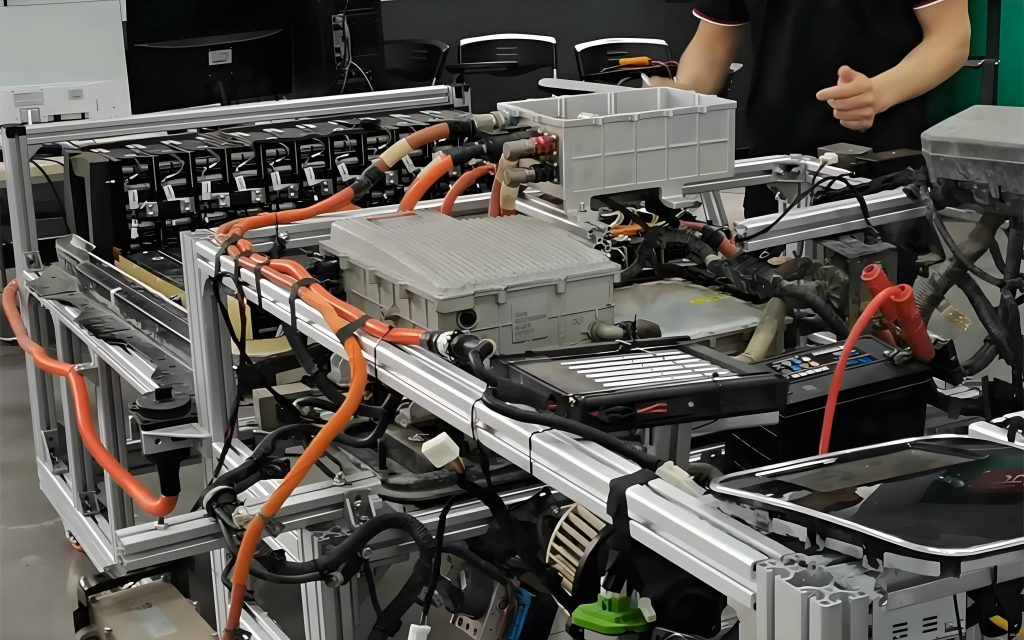
In my experience with EV repair, case analyses provide valuable insights. For BMS faults, a system-level diagnostic approach is often employed. For example, when a vehicle exhibits a significant drop in range, we first analyze the range achievement rate and compare BMS data on voltage, current, and temperature. In one instance, sensor accuracy decline was identified as the root cause, leading to inaccurate voltage readings and flawed state-of-charge estimates. This highlights the importance of proactive monitoring in electrical car repair to ensure reliable operation.
Drive motor faults, such as efficiency loss and increased noise, require comprehensive inspections. In a case involving a plug-in hybrid electric bus, visual checks ruled out mechanical damage, but specialized testing revealed minor winding shorts. Repair involved addressing the short circuits and performing balance tests, which restored motor efficiency and reduced noise. This case underscores the technical expertise needed in EV repair for core components.
High-voltage insulation issues demand meticulous testing in electrical car repair. In another scenario, insulation performance degradation was detected through systematic tests, pinpointing weak spots in cables. Reinforcement measures were applied to enhance sealing and insulation, emphasizing the need for regular inspections to maintain safety in EV repair.
To address these challenges, we have adopted innovative strategies in EV repair. Establishing data analysis ledgers is a key practice. By implementing a three-level vehicle management system, we collect and analyze fault data monthly, covering types, occurrence times, models, mileage, and symptoms. This enables a closed-loop management process from fault detection to resolution and knowledge sharing, significantly improving electrical car repair standards.
Another advancement in EV repair is the promotion of non-destructive testing technologies. Leveraging big data, AI, and IoT, we deploy onboard smart monitoring terminals to track real-time parameters like battery voltage, current, motor temperature, and speed. Cloud computing and data analytics help identify potential faults early, allowing for preventive maintenance. This approach not only extends vehicle lifespan but also enhances safety and reliability in electrical car repair. The following table summarizes the benefits of non-destructive testing in EV repair:
| Technology | Application | Benefits |
|---|---|---|
| IoT Sensors | Real-time monitoring of battery and motor parameters | Early fault detection, reduced downtime |
| AI Analytics | Data pattern recognition for predictive maintenance | Improved accuracy in electrical car repair |
Mathematically, predictive models in EV repair can use regression analysis to forecast battery life. For example, the remaining useful life \( L_{\text{remaining}} \) might be estimated as: $$ L_{\text{remaining}} = a \cdot \ln(t) + b \cdot C_{\text{decay}} + c $$ where \( a \), \( b \), and \( c \) are coefficients derived from historical data, \( t \) is time, and \( C_{\text{decay}} \) is the capacity decay rate. Such models are integral to modern electrical car repair practices.
In conclusion, the evolution of EV repair and electrical car repair is pivotal for the widespread adoption of electric buses. By addressing common faults through data-driven approaches and advanced technologies, we can enhance reliability and safety. As innovations continue to emerge, the field of EV repair will undoubtedly become more efficient, supporting sustainable urban transportation. My firsthand involvement in these efforts reinforces the critical role of continuous learning and adaptation in electrical car repair.