
As a professional in the field of automotive technology, I have observed the rapid growth of new energy vehicles (NEVs) worldwide, driven by global energy shortages and environmental concerns. The electronic control system, often referred to as the “brain” of an NEV, plays a critical role in managing functions such as vehicle control, battery management, and motor operations. However, with the increasing complexity of these systems, fault diagnosis and repair have become paramount to ensure safety, reliability, and efficiency. In this article, I will delve into the significance of fault diagnosis and repair for NEV electronic control systems and propose comprehensive strategies to address these challenges. The field of EV repair and electrical car repair is evolving rapidly, and it is essential to adopt advanced methodologies to keep pace with technological advancements. Through this discussion, I aim to highlight how effective diagnostic and maintenance practices can enhance the overall performance and longevity of electric vehicles, ultimately contributing to a sustainable automotive future.
The importance of fault diagnosis and repair in NEV electronic control systems cannot be overstated. Firstly, it ensures the safe and reliable operation of the vehicle. The electronic control system directly influences critical functions like braking, acceleration, and energy management. Any malfunction can lead to severe consequences, including accidents or system failures. For instance, a fault in the battery management system might cause overheating or even fires, posing risks to passengers and the environment. Therefore, implementing robust diagnostic mechanisms is a cornerstone of EV repair, enabling early detection and mitigation of potential hazards. Secondly, efficient diagnosis and repair improve the usage efficiency and extend the lifespan of NEVs. Over time, components in the electronic control system may degrade due to factors like temperature fluctuations, vibration, and electromagnetic interference, leading to reduced performance and increased energy consumption. By employing systematic electrical car repair techniques, such as real-time monitoring and predictive maintenance, we can optimize system operations, minimize downtime, and maximize the vehicle’s operational life. Thirdly, these practices help in reducing operational costs. A well-structured diagnostic framework allows for proactive maintenance, preventing minor issues from escalating into major repairs. This not only saves on repair expenses but also enhances the economic viability of NEVs by maintaining optimal energy efficiency and reducing unnecessary part replacements.
To illustrate the key aspects of fault diagnosis and repair, I have summarized the core benefits in Table 1. This table provides a clear overview of how different factors contribute to the overall effectiveness of EV repair and electrical car repair processes.
| Benefit Category | Description | Impact on EV Repair |
|---|---|---|
| Safety Assurance | Prevents accidents by detecting faults early in critical systems like braking and battery management. | Reduces risk factors and enhances reliability in electrical car repair. |
| Efficiency Improvement | Optimizes energy usage and system performance through continuous monitoring and maintenance. | Extends vehicle lifespan and supports sustainable EV repair practices. |
| Cost Reduction | Minimizes repair frequency and expenses by addressing issues before they worsen. | Lowers total cost of ownership, making electrical car repair more economical. |
In the realm of EV repair, mathematical models play a vital role in understanding system behavior and predicting failures. For example, the failure rate of electronic components can be modeled using an exponential distribution, which is common in reliability engineering. The probability density function for the time to failure can be expressed as: $$ f(t) = \lambda e^{-\lambda t} $$ where \( \lambda \) is the failure rate, and \( t \) is time. This formula helps in estimating the likelihood of component failures, allowing for proactive scheduling of electrical car repair activities. Additionally, the overall system reliability \( R(t) \) can be calculated as: $$ R(t) = e^{-\int_0^t \lambda(s) \, ds} $$ which indicates the probability that the system will function without failure up to time \( t \). By integrating such models into diagnostic tools, technicians can prioritize maintenance tasks and optimize resource allocation in EV repair operations.
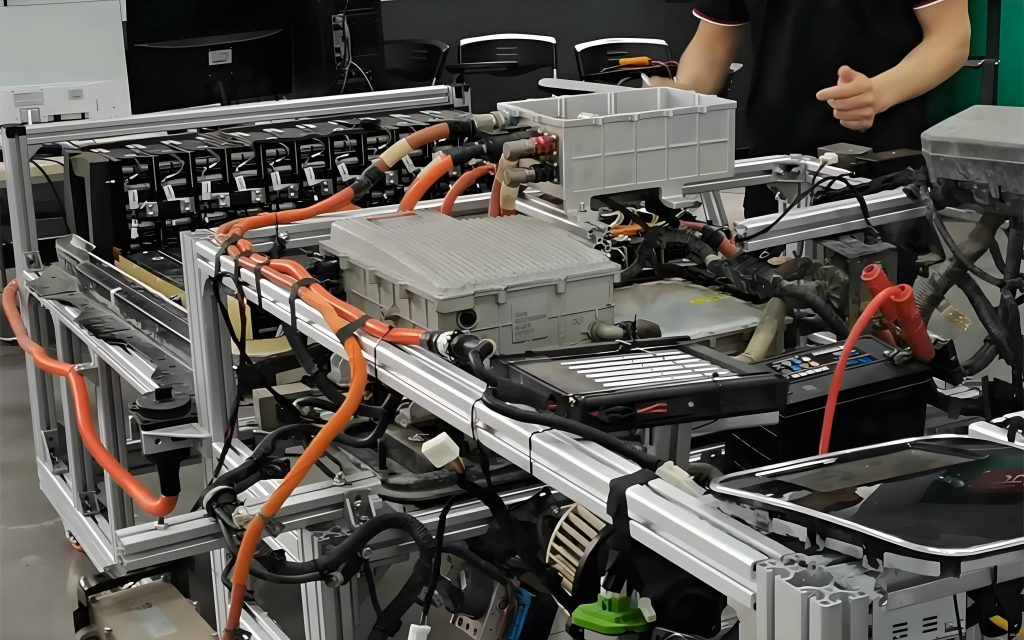
Moving on to the strategies for fault diagnosis and repair, the first approach involves establishing a comprehensive diagnostic and maintenance system. This system should integrate real-time monitoring, remote diagnostics, and data analytics to create a holistic framework for EV repair. For instance, by setting up standardized protocols for fault classification and detection, we can ensure consistent and accurate identification of issues across different vehicle models. This is particularly important in electrical car repair, where variations in system designs can complicate diagnostics. A key element of this strategy is the development of a centralized knowledge base that aggregates fault data from multiple sources. This enables the identification of common failure patterns and the formulation of best practices for repair. Moreover, collaboration between manufacturers, service centers, and technology providers is essential to foster innovation and standardization in the EV repair industry. By leveraging cloud computing and IoT technologies, we can create a seamless flow of information, facilitating faster and more efficient electrical car repair processes.
The second strategy focuses on developing intelligent fault diagnosis and预警 technologies. With the advent of artificial intelligence and machine learning, it is now possible to implement self-learning systems that can predict failures before they occur. For example, deep learning algorithms can analyze historical data to identify subtle patterns indicative of impending faults. This proactive approach is revolutionizing EV repair by reducing unplanned downtime and enhancing safety. One practical application is the use of neural networks for fault classification. The output of such a network can be represented as: $$ y = \sigma(Wx + b) $$ where \( y \) is the predicted fault class, \( \sigma \) is the activation function, \( W \) is the weight matrix, \( x \) is the input feature vector, and \( b \) is the bias term. By training these models on large datasets, we can achieve high accuracy in diagnosing complex issues in electrical car repair. Additionally, remote diagnostic capabilities allow experts to assess vehicle conditions from a distance, providing guidance to on-site technicians. This not only speeds up the repair process but also ensures that even rare faults are handled effectively, making electrical car repair more accessible and reliable.
To further elaborate on the intelligent diagnosis strategy, I have compiled Table 2, which outlines the key technologies and their applications in EV repair and electrical car repair. This table emphasizes how advanced tools can enhance diagnostic accuracy and efficiency.
| Technology | Description | Application in EV Repair |
|---|---|---|
| Machine Learning | Uses algorithms to predict faults based on historical data patterns. | Improves precision in electrical car repair by enabling early warnings. |
| Remote Diagnostics | Allows real-time monitoring and analysis via cloud-based systems. | Facilitates quick response and reduces on-site EV repair time. |
| Sensor Networks | Deploys multiple sensors to collect comprehensive system data. | Enhances data accuracy for effective electrical car repair decisions. |
The third strategy involves optimizing the hardware design and redundancy configuration of the electronic control system. From a design perspective, it is crucial to select high-reliability components and simplify the system architecture to minimize points of failure. This approach directly impacts the frequency and complexity of EV repair tasks. For example, by incorporating redundant components for critical functions like steering or braking, we can ensure that if one part fails, a backup takes over seamlessly. The reliability of a redundant system can be modeled using parallel reliability concepts. For a system with two redundant components, the overall reliability \( R_s(t) \) is given by: $$ R_s(t) = 1 – (1 – R_1(t))(1 – R_2(t)) $$ where \( R_1(t) \) and \( R_2(t) \) are the reliabilities of the individual components. This equation demonstrates how redundancy enhances system robustness, reducing the need for frequent electrical car repair. Furthermore, modular design principles allow for easier replacement of faulty parts, streamlining the repair process. By integrating these hardware optimizations, we can build more resilient electronic control systems that require less maintenance and offer higher performance, ultimately advancing the field of EV repair.
In addition to these strategies, it is important to consider the economic and environmental implications of fault diagnosis and repair. For instance, the total cost of ownership for an NEV can be significantly reduced through efficient maintenance practices. A cost-benefit analysis can be performed using formulas such as the net present value (NPV) of repair investments: $$ NPV = \sum_{t=0}^{T} \frac{C_t}{(1 + r)^t} $$ where \( C_t \) represents the cash flows associated with electrical car repair at time \( t \), \( r \) is the discount rate, and \( T \) is the time horizon. This helps in evaluating the long-term savings from proactive diagnostics compared to reactive repairs. Similarly, life cycle assessment models can quantify the environmental benefits of extended vehicle lifespans through effective EV repair, contributing to sustainability goals.
In conclusion, the fault diagnosis and repair of NEV electronic control systems are essential for ensuring safety, efficiency, and cost-effectiveness in the evolving automotive landscape. By establishing comprehensive diagnostic systems, developing intelligent technologies, and optimizing hardware designs, we can address the challenges associated with EV repair and electrical car repair. The integration of mathematical models, data analytics, and redundancy mechanisms provides a solid foundation for advancing these practices. As the industry continues to grow, collaboration among stakeholders will be key to driving innovation and standardization. I am confident that with continued efforts, we can achieve a future where NEVs are not only environmentally friendly but also highly reliable and easy to maintain. The journey toward mastering EV repair and electrical car repair is ongoing, and it holds great promise for transforming transportation on a global scale.