
In recent years, driven by energy scarcity and increasing environmental pressures, the automotive industry has rapidly pivoted towards New Energy Vehicles (NEVs). This shift has intensified market competition, where the Noise, Vibration, and Harshness (NVH) quality of an electric drive unit has emerged as a core competitive differentiator. In pure electric mode, the absence of internal combustion engine noise unmasks the acoustic signature of the electric drive system, making its whines, whirs, and high-frequency sounds particularly prominent and often objectionable. Therefore, addressing the noise from the electric drive unit has become a common and critical challenge across the industry.
While significant research exists on individual components—such as motor electromagnetic noise, inverter switching noise, and gear whine from the reducer—a holistic, system-level approach targeting the integrated electric drive unit is less common. In this article, I will detail a comprehensive project undertaken to diagnose and solve the unacceptable noise issues of a specific electric drive unit in a dual-mode vehicle. Through a blend of experimental testing, CAE simulation, and iterative design changes, we implemented a multi-pronged strategy that led to a substantial improvement in overall NVH performance.
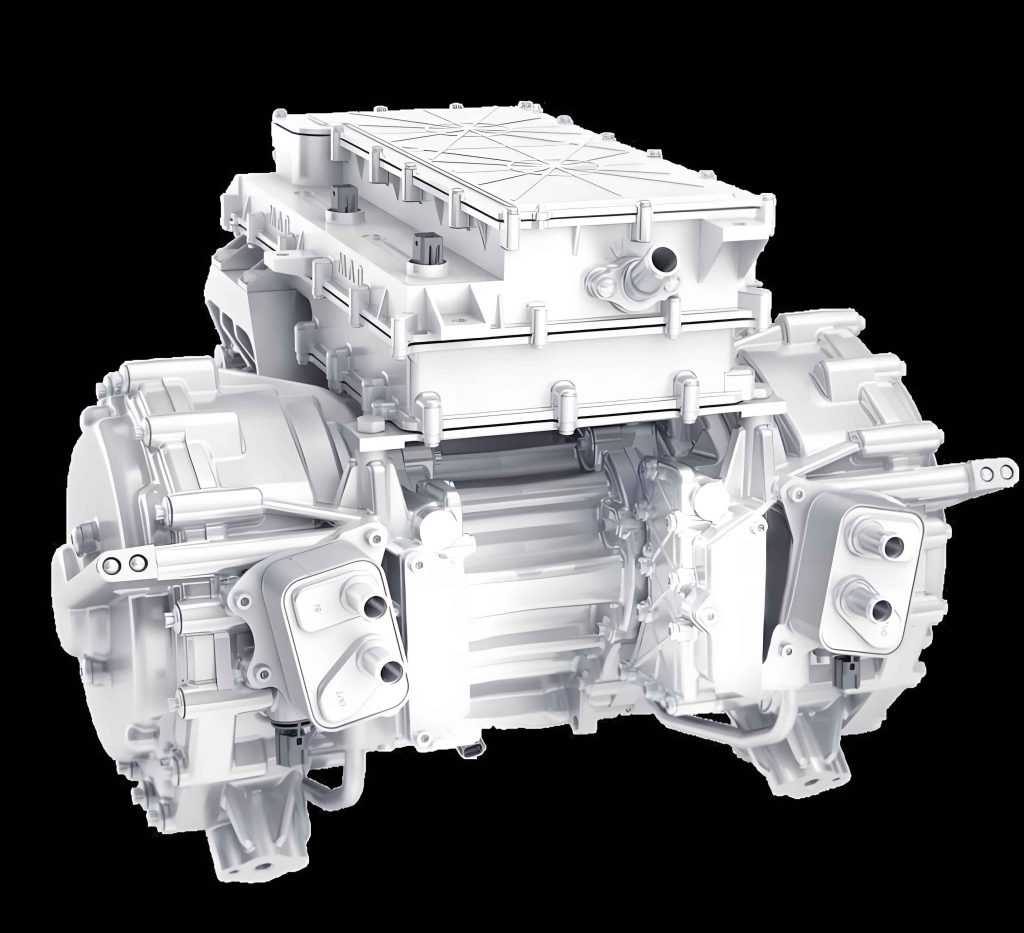
1. Problem Identification and Noise Source Characterization
The electric drive unit in question served as the rear drive assembly. Under pure electric operation, during wide-open-throttle acceleration and coast-down conditions, the unit produced pronounced, sharp, and harsh noises subjectively rated at 5.75 on a 10-point scale, which was deemed unacceptable. The initial hypothesis pointed to three primary sources: motor electromagnetic noise, reducer gear whine, and high-frequency noise from the power electronics.
To pinpoint the issues, we conducted extensive testing. Vibration acceleration was measured on the motor cylindrical housing, reducer bearing caps, and the inverter cover. Near-field acoustic measurements and in-cabin noise at driver and rear passenger ear locations were also captured. Order analysis of this data was crucial for isolating contributions from rotating components. The key findings are summarized in the table below:
| Noise Source | Problematic Order(s) | Dominant Frequency Range | Critical Operational Condition |
|---|---|---|---|
| Motor Electromagnetic Noise | 24th & 48th order (relative to motor RPM) | ~50 Hz – 1.6 kHz (depending on RPM) | Acceleration, especially launch phase |
| Reducer Gear Whine | 27th & 54th order (1st stage gear mesh & harmonic) | ~900 Hz – 2.7 kHz | Coast-down (60-20 km/h) |
| Inverter Switching Noise | Broadband “umbrella” orders from PWM carrier | ~7.3 kHz and harmonics | All conditions, radiating from inverter cover |
The 24th and 48th order motor noises were especially severe during launch. The 27th order gear whine was clearly identifiable during regenerative coasting. The inverter noise manifested as distinct, carrier-frequency-based tonal content. Having identified these core issues, we developed a systematic plan targeting the excitation source, control strategy, structural transfer path, and acoustic encapsulation.
2. A Systematic Optimization Framework for the Electric Drive Unit
Resolving the complex NVH behavior of an integrated electric drive unit requires interventions at multiple levels. The following sections detail the specific measures we implemented, their theoretical basis, and their quantified effectiveness.
2.1 Enhancing Structural Integrity: Stiffness and Modal Improvements
The housing and casing of an electric drive unit act as a primary radiator for internally generated vibrations. Weak areas or low natural frequencies can lead to significant amplification of force inputs. Our CAE analysis identified opportunities for structural reinforcement across the unit:
- Motor Housing: Ribs were added to the cylindrical body and end caps to increase global stiffness and raise shell mode frequencies.
- Reducer Housing: Targeted ribbing was applied to the reducer casing, particularly around bearing bosses and mounting points, to improve local dynamic stiffness.
- Mounting Points: The stiffness at the interface between the electric drive unit and its vehicle mounts was enhanced to reduce vibration transmission.
The effect of reducer housing reinforcement is powerfully demonstrated in the acceleration noise colormap. The optimized structure led to a dramatic reduction in the 24th and 27th order noise in the 700-1400 Hz band (2000-3000 RPM), with notable improvements also seen for the 48th and 81st orders at other speed ranges. The governing principle here is that increasing the structural impedance reduces the vibrational response to a given force input. The relationship between force $F$, velocity $v$, and impedance $Z$ is:
$$ F = Z \cdot v $$
For a structure, a higher impedance $Z$ results in lower velocity $v$ for the same force $F$, thereby reducing radiated sound power, which is proportional to vibrational velocity squared.
2.2 Motor Excitation Source Reduction: Skewed Rotor Design
Electromagnetic noise originates from radial electromagnetic forces acting on the stator core. These forces, particularly at lower spatial orders, can excite structural modes of the stator and housing. A key design parameter to mitigate this is rotor or stator skew. We implemented a 4-segment skewed rotor design.
The principle is that skewing introduces a phase shift in the electromagnetic force wave along the axial length of the motor. This spatial averaging effect reduces the magnitude of the net radial force. The effectiveness of a skew can be evaluated by a attenuation factor. For a skew angle $\alpha_{skew}$ (in electrical degrees) corresponding to a spatial force order $r$, the reduction factor $k_{skew}$ is given by:
$$ k_{skew} = \frac{\sin(r \cdot \alpha_{skew} / 2)}{r \cdot \alpha_{skew} / 2} $$
Our 4-segment step-skew was optimized to target the force waves responsible for the prominent 48th order (8th electrical order) noise. Post-optimization results showed a significant reduction in both the 48th order cabin noise and the corresponding vibration on the electric drive unit housing, confirming a successful reduction at the source.
| Modification | Targeted Noise Source | Primary Mechanism | Measured Improvement |
|---|---|---|---|
| Housing Reinforcement | Structure-Borne Noise (All Orders) | Increased Dynamic Stiffness & Higher Modes | ~5-10 dB reduction for 24th, 27th orders |
| Rotor Skew (4-segment) | Motor 48th Order Electromagnetic Noise | Spatial Averaging of Radial Electromagnetic Forces | >10 dB reduction in 48th order vibration & noise |
| Gear Micro-Geometry Optimization | Reducer 27th Order Gear Whine | Improved Load Distribution & Reduced Transmission Error | >10 dB reduction in 27th order; ~5 dB in 54th |
| Increased PWM Carrier Frequency | Inverter Switching Noise | Shifting Tonal Energy to Less Sensitive Frequency Range | Subjective elimination of audible whine; >5 dB reduction |
2.3 Gear Whine Mitigation: Micro-Geometry Optimization
The 27th order whine was traced to the transmission error (TE) of the first-stage reduction gear pair. TE is the deviation between the theoretical and actual positions of the driven gear, and it is the primary excitation for gear noise. We employed gear micro-geometry modifications—involute profile and lead crown corrections—to optimize the contact pattern under load, ensuring even pressure distribution and minimizing TE fluctuations.
Additionally, lightweight holes were added to the gear web. This serves a dual purpose: reducing rotational inertia and, more importantly for NVH, altering the gear body’s modal characteristics to detune it from the meshing excitation frequency. The optimization was a balancing act, ensuring improvements in the problematic coast-down condition without degrading performance in other drive scenarios. The result was a dramatic reduction of over 10 dB in the 27th order whine, with the 54th order harmonic also showing significant improvement above 3000 RPM.
2.4 Control Strategy Optimization: A Software-Based Acoustic Tuning Lever
The noise signature of an electric drive unit is not solely determined by its hardware. The software control strategies offer powerful, often cost-effective, levers for NVH refinement.
2.4.1 PWM Carrier Frequency Adjustment: The inverter’s Insulated-Gate Bipolar Transistors (IGBTs) switch at a high carrier frequency (e.g., 8-12 kHz) to synthesize the AC waveform for the motor. This switching creates strong harmonic content at the carrier frequency and its multiples, which can mechanically excite the inverter’s heatsink and housing. We increased the carrier frequency from 7.3 kHz to 8 kHz. The governing relationship for the sound pressure level (SPL) reduction from such a change, assuming a constant switching loss, can be approximated by considering the reduction in component vibration amplitude. The force from switching losses can induce vibration. Raising the frequency often moves the excitation away from structural resonances and reduces the amplitude per harmonic. The colormap comparison clearly showed the “umbrella” of switching noise shifting upward in frequency and reducing in amplitude, leading to a much-improved subjective impression.
2.4.2 Torque Ramp Rate Optimization at Launch: The offensive low-frequency “groan” during initial acceleration was linked to the rapid buildup of torque. The high torque ramp rate excited the motor’s low-order structural modes. We strategically reduced the initial torque loading rate from 360 N·m/s to 194 N·m/s. This softer launch profile directly reduced the excitation energy injected at the problematic frequencies (50-145 Hz), yielding a clear improvement in the 24th and 48th order noise during launch, with a manageable trade-off in perceived dynamic response.
2.5 Transfer Path Isolation: Breaking the Structural Bridge
Even with optimized sources, vibrations can travel from the electric drive unit to the passenger cabin via structural paths, primarily through the mounting system. Our transfer path analysis identified a weak link: the front mount’s passive-side (chassis-side) dynamic stiffness was insufficient, particularly in specific directions, leading to poor isolation. CAE root-cause analysis traced this to local modes of the mount bracket and a cross-member in the subframe. By reinforcing these components, we raised their natural frequencies and increased dynamic stiffness. This improved the mount’s isolation performance in the low-to-mid frequency range, attenuating the transmission of residual forces from the electric drive unit to the body structure.
2.6 Acoustic Encapsulation: The Final Barrier
As a complementary measure to address airborne noise, we designed and applied an acoustic encapsulation package around the electric drive unit. This package typically consists of multi-layer materials: a dense barrier mass layer (e.g., constrained layer damped metal or heavy foam) to block sound transmission, and a porous decoupler/absorber layer (e.g., soft foam) to absorb sound and prevent the barrier from being short-circuited by direct contact with the housing. The effectiveness of such a package in reducing radiated noise is given by its Insertion Loss (IL). For a double-wall system with an air gap, the mass-law and resonance effects govern performance. Our application resulted in a broadband noise reduction, with up to 8 dB attenuation in critical high-frequency bands and an overall cabin noise reduction of approximately 3 dB during acceleration. This solution, while highly effective, must be carefully engineered to not compromise thermal management, serviceability, or cost targets.
3. Integrated Results and Conclusion
The systematic application of these targeted solutions transformed the NVH character of the electric drive unit. The table below summarizes the final achieved improvements for the key identified issues:
| Noise Component | Key Order | Improvement | Subjective Outcome |
|---|---|---|---|
| Motor Electromagnetic Noise | 24th order | ~8 dB reduction | Eliminated prominent whine |
| Motor Electromagnetic Noise | 48th order | ~5 dB reduction | Significantly reduced high-frequency content |
| Reducer Gear Whine | 27th order | >10 dB reduction | Whine virtually eliminated during coast-down |
| Inverter Switching Noise | Carrier & Harmonics | >5 dB reduction, frequency shift | High-frequency “buzz” became inaudible |
| Overall System | All Contributions | ~3 dB(A) overall cabin noise reduction in key conditions | Subjective score improved from 5.75 to 6.75 |
This project underscores that optimizing the NVH performance of a modern electric drive unit is a multi-disciplinary challenge requiring a system-level perspective. Relying on a single “silver bullet” is insufficient. A successful strategy must intelligently combine:
- Source Control: Minimizing excitations at their origin through electromagnetic design (skew), gear micro-geometry, and inverter switching strategy.
- Path Management: Fortifying the structural integrity of the unit and its mounting system to reduce vibration response and transmission.
- Receiver Treatment: Applying acoustic encapsulation as a final barrier against airborne noise.
The journey from an unacceptable, harsh-sounding electric drive unit to one with best-in-class NVH refinement was achieved through this rigorous, iterative process of test-CAE-analysis-optimization. The lessons learned provide a validated framework for the systematic noise development of future electric drive units, where excellence in acoustic comfort is paramount to brand perception and market success.