
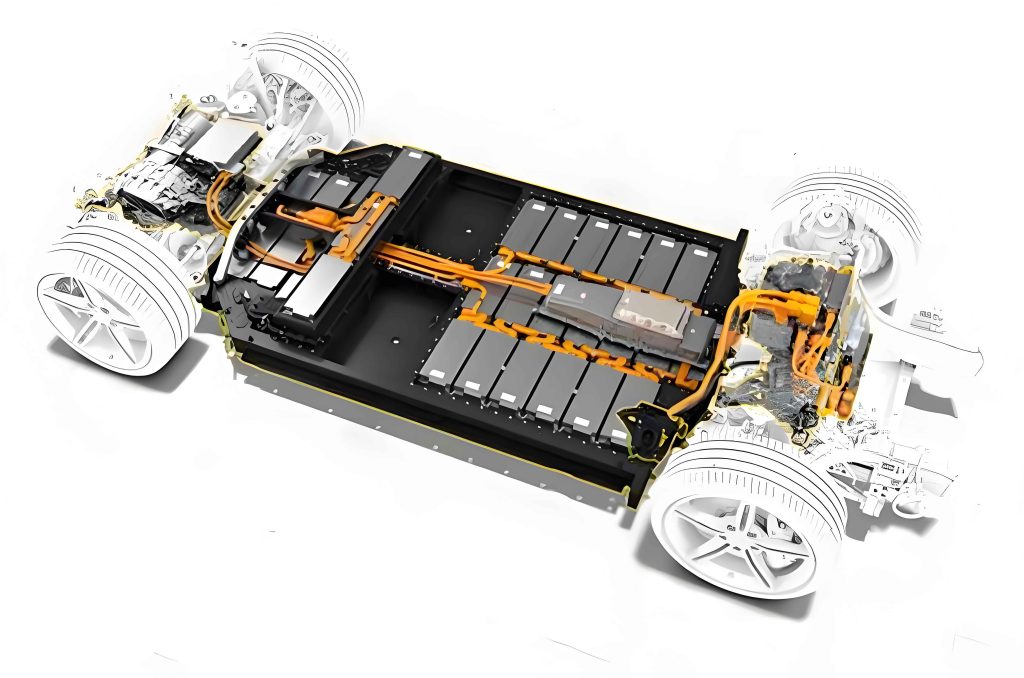
The electric drive system is the heart of a New Energy Vehicle (NEV), performing the critical function of converting electrical energy into precise mechanical motion. At the core of this conversion process lies a remarkable semiconductor device: the Insulated Gate Bipolar Transistor, or IGBT. In my analysis of modern powertrains, I find that the IGBT is not merely a component; it is the fundamental actuator that governs the efficiency, performance, and reliability of the entire electric drive system. It acts as the high-speed, high-power switch responsible for the vital AC-DC and DC-AC conversions, directly controlling the rate of power delivery to the motor and, consequently, the vehicle’s acceleration, regenerative braking, and overall energy efficiency.
The significance of the IGBT becomes clear when we consider the architecture of a typical electric drive system. High-voltage DC power from the battery pack must be converted into variable-frequency, variable-amplitude AC power to drive the traction motor. Conversely, during regenerative braking, AC from the motor must be rectified back to DC for battery charging. This bidirectional power flow is managed by the inverter, a power electronics unit whose performance is dictated by its switching devices. This is where the IGBT excels. It combines the best attributes of two other transistor families: the high-input-impedance, voltage-driven control of a Metal-Oxide-Semiconductor Field-Effect Transistor (MOSFET) and the high-current, low-saturation-voltage capability of a Bipolar Junction Transistor (BJT). This hybrid nature makes it uniquely suited for the demanding environment of an electric vehicle’s inverter, where it must handle hundreds of volts and amps while switching thousands of times per second.
To appreciate its function, let’s summarize the key roles of the IGBT within the vehicle’s electrical ecosystem:
| Subsystem | Function of IGBT | Key Impact on Electric Drive System |
|---|---|---|
| Traction Inverter | Converts DC from the battery to three-phase AC for the motor. Controls frequency and voltage via Pulse Width Modulation (PWM). | Directly determines torque, speed, and efficiency of the primary propulsion unit. |
| On-board Charger (OBC) | Acts as a power factor correction (PFC) switch and in the DC-DC stage during AC charging. | Enables efficient grid-to-battery energy transfer, replenishing the energy source for the electric drive system. |
| DC Fast Charging Station | Used in the AC-DC rectification and high-frequency DC-DC conversion stages. | Provides the high-power, efficient rectification needed for rapid battery replenishment. |
| Auxiliary Systems (e.g., HVAC) | Inverts DC to AC to run the compressor motor. | Manages thermal loads, impacting overall vehicle energy balance and electric drive system range. |
The physical construction of an IGBT is a marvel of semiconductor engineering. It is a four-layer, three-terminal device (PNPN structure), which can be understood as a functional integration of a MOSFET and a BJT. A simplified cross-section reveals the following regions, from top to bottom: the Emitter (E) contact, the P-body region, an N- drift region, a P+ substrate/collector region, and the Collector (C) contact. The Gate (G) is isolated from the silicon body by a thin oxide layer, forming the “insulated gate.” The wide, lightly doped N- drift region is key to its ability to block high voltages when off. The equivalent circuit is often represented as a MOSFET driving a PNP BJT in a Darlington-like configuration, which explains its hybrid behavior. In practical application, multiple IGBT chips and their companion anti-parallel freewheeling diodes are packaged together onto a ceramic substrate to form an IGBT module, capable of handling the multi-kilowatt power levels required by the electric drive system.
The operational principle of the IGBT hinges on the modulation of a conductive channel by an electric field, followed by conductivity modulation of the drift region. The sequence can be described in states:
- Cut-off State: When the gate-emitter voltage $V_{GE}$ is below a threshold voltage $V_{GE(th)}$, no inversion layer forms under the gate oxide. The device is in a high-impedance state, blocking the collector-emitter voltage $V_{CE}$.
- Active/Saturation State (Turning On): Applying $V_{GE} > V_{GE(th)}$ creates an electron channel connecting the N+ emitter to the N- drift region. Electrons flow into the drift region. This influx of electrons lowers the potential of the drift region, forward-biasing the P+ collector/N- drift junction. This injects a large number of holes into the drift region. The resulting plasma of electrons and holes dramatically reduces the resistivity of the wide drift region—a process called conductivity modulation. The device enters a low-impedance state, and a high collector current $I_C$ can flow with a relatively low saturation voltage $V_{CE(sat)}$. The relationship in this saturated state is often approximated by:
$$ I_C \approx g_{fs} \cdot (V_{GE} – V_{GE(th)}) $$
where $g_{fs}$ is the forward transconductance. - Conduction Losses: The power dissipated during conduction is given by $P_{cond} = I_C^2 \cdot R_{CE(on)} + I_C \cdot V_{CE0}$, where $V_{CE0}$ is the built-in junction voltage and $R_{CE(on)}$ is the on-state resistance.
Switching an IGBT is not instantaneous and involves losses critical to the electric drive system’s efficiency. The turn-on and turn-off transitions involve charging and discharging various capacitances and the movement of stored charge.
- Turn-on Loss ($E_{on}$): Occurs as $V_{CE}$ falls while $I_C$ rises.
- Turn-off Loss ($E_{off}$): Occurs due to the “current tailing” effect, where the minority carrier stored in the N- drift region takes time to recombine or be swept out, causing current to persist as voltage rises.
The total switching energy loss per cycle is $E_{sw} = E_{on} + E_{off}$. The average switching power loss at a switching frequency $f_{sw}$ is:
$$ P_{sw} = (E_{on} + E_{off}) \cdot f_{sw} $$
Therefore, the total power loss in an IGBT within the inverter is:
$$ P_{total} = P_{cond} + P_{sw} $$
Minimizing $P_{total}$ is paramount for maximizing the electric drive system’s efficiency and managing thermal loads.
Given its critical role, ensuring the health of IGBT modules is essential. I employ a multi-step diagnostic procedure, which can be summarized systematically:
| Step | Purpose | Method & Expected Result | Fault Indication |
|---|---|---|---|
| 1. Pin Identification | To locate Gate (G), Collector (C), and Emitter (E). | Using a multimeter in resistance mode. The pin showing infinite resistance ($\infty$) to both other pins is G. Between C and E, one direction shows a diode drop (0.3-0.7V), the other shows $\infty$. | If no pin exhibits this behavior, the module may be damaged. |
| 2. Static Diode Test | To check the integrated freewheeling diode and basic junction health. | Using diode mode. Measure across C-E (inverter phase leg). A healthy reading shows a forward diode drop in one polarity and open circuit in the other. | Short circuit (0V both ways) or open circuit (OL both ways). |
| 3. Dynamic Conductivity Test | To verify the IGBT can be turned on by a gate signal. | Apply a 9-15V gate drive voltage (through a current-limiting resistor) between G and E. Measure C-E in diode mode. It should show a low forward voltage drop (e.g., ~0.34V). | No change in C-E measurement indicates a failed IGBT (open gate or broken channel). |
| 4. Gate Capacitance & Leakage | To assess gate integrity and rule out short circuits. | With device off, measure resistance between G-E and G-C. Should be very high (M$\Omega$ range). | Low resistance indicates gate oxide failure or contamination. |
| 5. Thermal Cycling & Monitoring | To predict failure due to solder fatigue or bond wire lift-off. | Monitor junction temperature $T_j$ via thermal sensor or calibrated $V_{CE(on)}$. Analyze changes in thermal resistance $R_{th(j-c)}$ over time. $$ \Delta T_j = P_{total} \cdot R_{th(j-c)} $$ |
A steady increase in $T_j$ for constant $P_{total}$ indicates degrading thermal interface, a common failure precursor. |
Beyond basic testing, research in IGBT technology for electric drive systems is intensely focused on pushing performance boundaries. Key areas include:
- Wide Bandgap (WBG) Competition: Silicon Carbide (SiC) MOSFETs and Gallium Nitride (GaN) HEMTs offer superior characteristics: higher switching speeds, lower losses, and higher temperature operation. Their adoption is accelerating, particularly in 800V architectures for premium electric drive systems. However, IGBTs retain a cost advantage for mainstream applications.
- Advanced IGBT Designs: To compete, new IGBT generations like the “Field-Stop” or “Trench-Gate” designs reduce $V_{CE(sat)}$ and switching losses ($E_{on}$, $E_{off}$). The trade-off curve between conduction loss and switching loss is continuously being optimized.
- Packaging Innovation: New module designs aim to reduce parasitic inductance $L_s$, which causes voltage overshoot during switching:
$$ V_{peak} = V_{DC} + L_s \cdot \frac{di_c}{dt} $$
Low-inductance packages and direct liquid cooling are essential for next-generation high-power density inverters. - Digital Twin and Prognostics: Advanced health monitoring uses real-time data and models to predict remaining useful life (RUL), moving from preventive to predictive maintenance for the electric drive system.
The application spectrum of the IGBT extends far beyond the automotive electric drive system. It is a cornerstone of modern power electronics. The comparative analysis below highlights its position:
| Application Domain | Key Requirement | Why IGBT is Suited |
|---|---|---|
| Industrial Motor Drives | Robustness, high current, medium frequency. | Excellent current density and short-circuit withstand capability. |
| Uninterruptible Power Supplies (UPS) | High efficiency, reliability. | Low conduction losses at typical load factors improve system efficiency. |
| Renewable Energy Inverters (Solar/Wind) | High voltage blocking, grid synchronization. | Ability to handle high DC-link voltages (e.g., from solar strings) and synthesize clean AC output. |
| Welding Equipment | Controlled high-current output. | Precise PWM control allows for fine adjustment of welding current and arc characteristics. |
| Induction Heating | High-frequency switching at high power. | Modern high-speed IGBTs can operate in the 20-100 kHz range for these applications. |
In conclusion, my exploration into the IGBT solidifies its status as a pivotal technology enabler. Within the electric vehicle’s electric drive system, it performs the indispensable function of intelligent power conversion, a task that directly defines vehicle performance, range, and responsiveness. While emerging wide-bandgap semiconductors present a compelling future, the IBT, through continuous innovation in materials, cell design, and packaging, remains highly competitive and ubiquitous. Its operational principles—a elegant synthesis of field-effect control and bipolar conduction—and its associated loss mechanisms form the critical foundation for modeling and optimizing inverter performance. The rigorous methodologies for testing and characterizing IGBTs are therefore not just maintenance procedures but essential practices for ensuring the reliability and efficiency of the entire electric drive system. As the world transitions towards electrification, the continued research and development of power semiconductor devices like the IGBT will remain at the forefront of advancing cleaner and more efficient transportation and energy infrastructure.