
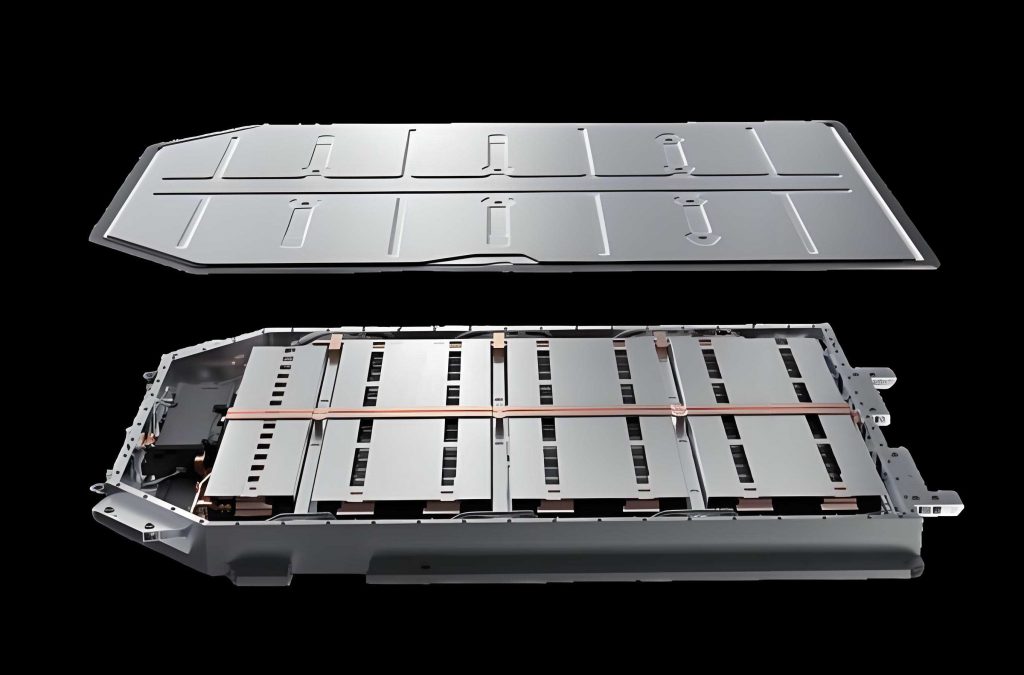
In the rapidly evolving landscape of electric vehicles (EVs), electromagnetic compatibility (EMC) stands as a critical共性 technology, ensuring the reliable operation of complex electronic systems. The EV battery pack, a core component of the powertrain, presents a particularly challenging electromagnetic environment due to its dense integration of high-voltage components and sensitive electronics. Within the EV battery pack, high-voltage harnesses carry currents with high-frequency harmonics generated by inverter IGBT switching. These currents can radiate electromagnetic interference (EMI), potentially disrupting nearby sensitive devices such as the cell monitoring unit (CMU), battery disconnect unit (BDU), and battery radio frequency module (BRFM). This interference risk is exacerbated in modern wireless communication architectures that demand high bandwidth, real-time performance, and reliability. Therefore, proactive EMC design and analysis during early development phases are essential to mitigate failures. In this study, we establish a comprehensive simulation framework to analyze EMI radiation from high-voltage harnesses inside an EV battery pack and evaluate the electromagnetic susceptibility (EMS) of internal electronic components. Furthermore, we investigate the shielding effectiveness of high-voltage shielded cables by varying key parameters, providing engineering insights for optimal shielding selection.
The internal structure of an EV battery pack is complex, featuring numerous metallic and non-metallic components. To efficiently simulate electromagnetic behavior, we first simplify the 3D CAD model of the EV battery pack. Simplification rules are applied: retaining metallic parts, removing non-metallic elements, eliminating small features like bolts and holes, and preserving mid-surface properties for sheet metal parts. This reduces computational complexity while maintaining electromagnetic accuracy. Following simplification, meshing is performed using the Method of Moments (MoM) algorithm in simulation software. The mesh strategy depends on the frequency range of interest. For instance, for frequencies below 220 MHz, 2D triangular elements are generated with constraints on inner angles and edge lengths. The number of mesh elements directly impacts simulation accuracy and resource usage. Table 1 summarizes the meshing strategy for different frequency bands.
| Frequency Range | Element Type | Min Triangle Angle | Max Edge Length (mm) | Approx. Element Count | Solver Method |
|---|---|---|---|---|---|
| < 220 MHz | 2D Triangle | 20° | 120 | < 60,000 | MoM |
| 220–400 MHz | 2D Triangle | 20° | 120 | < 60,000 | MLFMM |
| 400 MHz – 1 GHz | 2D Triangle | 15° | 75 | < 80,000 | MLFMM |
| 1–2 GHz | 2D Triangle | 10° | 37.5 | < 80,000 | MLFMM |
| 2–3 GHz | 2D Triangle | 5° | 25 | < 80,000 | MLFMM |
High-voltage harness routing within the EV battery pack is critical for EMI analysis. In our model, the harness connects multiple battery modules in series. For simplicity, we assume the busbar harness above modules and the central main harness are continuous without segmentation, both modeled as unshielded cables. The high-potential and low-potential ports are located at the rear of the EV battery pack. Grounding conditions are meticulously defined: the harness shield (if present) is grounded at both ends, and the low-potential conductor is grounded, while the high-potential conductor is connected to a voltage excitation port. This setup mirrors real-world grounding practices in EV battery packs.
Excitation signals for EMI simulation are derived from measured high-frequency currents in the EV battery pack during operation. Using a current probe, we capture time-domain signals at the pack’s input port, which are then transformed into frequency-domain data. The frequency range of interest is 150 kHz to 30 MHz, with 10 sample points. Alternatively, excitation can be estimated from circuit models of the inverter-motor system or empirical formulas related to IGBT switching characteristics. In this study, we use measured data to ensure accuracy. The current amplitude varies with frequency, as shown in Figure 5 of the original text, but here we represent it mathematically: let $$I(f)$$ be the current amplitude at frequency $$f$$, obtained from measurements. The excitation is applied to the high-potential port in the simulation circuit model.
With the electromagnetic model established, we proceed to analyze EMI radiation. The electric field strength is computed at specific locations corresponding to sensitive electronic components, such as CMUs and BRFM, inside the EV battery pack. For a given frequency, say 13.41 MHz, the 3D electric field distribution around these components is visualized. The CMU, with dimensions 0.24 m × 0.06 m × 0.005 m, is discretized into field points (10 × 5 × 2), while the BRFM (0.2 m × 0.1 m × 0.03 m) uses 10 × 5 × 3 points. The maximum electric field strength at CMU locations can reach up to 45 V/m near harness ports, whereas BRFM locations, being farther, exhibit lower fields. To comprehensively assess risk, we extract electric field values across multiple frequencies. For instance, at CMU positions, the field strength peaks at 13.41 MHz, with CMU5 showing the highest susceptibility and CMU4 the lowest. This frequency-dependent behavior highlights resonant effects within the EV battery pack structure.
The EMS of electronic components is evaluated against corporate EMC standards, which define immunity levels (e.g., Level 1 and Level 2). By comparing simulated electric field strengths with these thresholds, we identify EMC failure risks. For example, at CMU5, the electric field exceeds limits at 3.47 MHz and 13.42 MHz under the given excitation. This indicates that the unshielded harness in the EV battery pack poses a significant interference threat, necessitating shielding measures.
Shielding effectiveness (SE) is a key metric for evaluating shielded cables. It is defined as the ratio of field strengths without and with shielding, expressed in decibels (dB):
$$SE = 20 \log_{10} \left( \frac{E_1}{E_2} \right)$$
where $$E_1$$ is the electric field strength without shielding, and $$E_2$$ is with shielding. A higher SE indicates better shielding performance. High-voltage shielded cables in EV battery packs typically feature a multi-layer structure: an outer rubber jacket, a metallic braided shield, an insulation layer, and conductive cores. The shield’s braiding pattern is characterized by the braid angle $$\psi$$, the number of circumferential bundles $$m$$, and the number of metal filaments per bundle $$n$$. Optimizing these parameters enhances SE.
We investigate three factors affecting shielding performance: shield material, thickness, and braiding pattern. For material analysis, we consider copper, aluminum, silicon steel, and stainless steel, each with distinct electrical conductivity and permeability. Shield thickness is varied from 0.25 mm to 1.0 mm, and braiding patterns are tested with different $$m$$ and $$n$$ combinations. Each factor is analyzed independently while holding others constant, following a single-variable approach. The simulation setup includes grounding the shield at both ends and applying the same excitation as in the unshielded case.
The results demonstrate that shielding significantly reduces radiation from high-voltage harnesses in the EV battery pack. For material comparison, copper provides the best SE across the 150 kHz to 30 MHz range, followed by stainless steel, aluminum, and silicon steel. This is attributed to copper’s high conductivity, which minimizes ohmic losses and reflection losses. Table 2 quantifies the SE for each material at a representative frequency (e.g., 13.41 MHz), showing that copper achieves over 34 dB reduction in electric field strength.
| Material | $$E_2$$ (V/m) at 13.41 MHz | Shielding Effectiveness SE (dB) | Notes |
|---|---|---|---|
| Copper | 4.7 | 34.3 | High conductivity, optimal for EMI suppression |
| Aluminum | 6.8 | 31.0 | Lightweight but lower SE than copper |
| Silicon Steel | 10.7 | 27.1 | Magnetic properties, useful for low-frequency shielding |
| Stainless Steel | 5.3 | 33.2 | Good balance of strength and SE |
Shield thickness analysis reveals that increasing thickness improves SE, but with diminishing returns. For instance, moving from 0.25 mm to 0.5 mm yields a substantial SE gain, whereas further increases to 0.75 mm and 1.0 mm offer minor improvements. This is due to the skin effect, where high-frequency currents concentrate near the shield surface, making interior material less effective. The relationship between SE and thickness $$t$$ can be approximated by $$SE \propto \log(t)$$ for conductive shields. Table 3 summarizes SE values for different thicknesses, indicating that 0.5 mm is a cost-effective choice for EV battery pack applications.
| Shield Thickness $$t$$ (mm) | $$E_2$$ (V/m) at 13.41 MHz | Shielding Effectiveness SE (dB) | Trend Analysis |
|---|---|---|---|
| 0.25 | 10.3 | 27.4 | Baseline, moderate shielding |
| 0.50 | 4.7 | 34.3 | Optimal trade-off between performance and weight |
| 0.75 | 3.9 | 35.8 | Marginal improvement over 0.5 mm |
| 1.00 | 3.3 | 37.3 | Highest SE but increased cost and mass |
Braiding pattern optimization focuses on the parameters $$m$$ and $$n$$. A tighter braid (higher $$m$$ and $$n$$) generally enhances SE by reducing gap sizes, but excessive tightness may compromise flexibility. We test four patterns: $$m=15, n=4$$; $$m=12, n=5$$; $$m=10, n=6$$; and $$m=7.5, n=8$$. The last pattern, with fewer but thicker bundles, demonstrates the highest SE, achieving nearly 38 dB. This suggests that braid geometry influences electromagnetic leakage paths; a pattern with larger filaments per bundle may better cover the underlying insulation. Table 4 compares the SE for these braiding forms, emphasizing that $$m=7.5, n=8$$ is superior for EV battery pack harnesses.
| Braiding Pattern ($$m$$, $$n$$) | $$E_2$$ (V/m) at 13.41 MHz | Shielding Effectiveness SE (dB) | Interpretation |
|---|---|---|---|
| (15, 4) | 4.7 | 34.3 | Standard braid, good coverage |
| (12, 5) | 8.6 | 29.0 | Reduced SE due to larger gaps |
| (10, 6) | 16.9 | 23.1 | Poor performance, insufficient shielding density |
| (7.5, 8) | 3.2 | 37.6 | Optimal pattern, maximized SE for given parameters |
The integration of shielded harnesses into the EV battery pack model shows a dramatic reduction in EMI. After replacing unshielded cables with shielded ones (using copper, 0.5 mm thickness, and $$m=7.5, n=8$$ braiding), the electric field strengths at CMU and BRFM locations drop below immunity thresholds across all frequencies. This validates the shielding optimization approach. Moreover, we can derive a comprehensive SE model incorporating material properties, thickness, and braiding. For instance, the overall SE for a braided shield can be expressed as:
$$SE_{\text{total}} = SE_{\text{material}} + SE_{\text{thickness}} + SE_{\text{braid}}$$
where each component depends on frequency and geometric factors. Empirical formulas from transmission line theory may apply, such as $$SE_{\text{material}} \approx 20 \log_{10} \left( \frac{Z_w}{4 Z_s} \right)$$ for plane waves, where $$Z_w$$ is wave impedance and $$Z_s$$ is shield impedance. However, in the near-field region of an EV battery pack, more complex models are needed.
Beyond harness shielding, other EMC mitigation strategies for EV battery packs include filtering, grounding optimization, and layout changes. For example, adding ferrite cores to harnesses can suppress common-mode currents, while strategic placement of sensitive electronics away from high-voltage lines reduces coupling. Simulation tools enable virtual prototyping of these measures, saving time and cost. The EV battery pack’s metallic enclosure also contributes to shielding, but apertures and seams can leak radiation; thus, sealing gaskets and conductive coatings are often used.
Future work in EV battery pack EMC could involve multi-physics simulations combining thermal, structural, and electromagnetic aspects. As EV voltage levels rise (e.g., 800V systems), higher slew rates and switching frequencies will intensify EMI challenges. Advanced materials like nanocrystalline alloys or conductive polymers may offer improved shielding with lightweight designs. Additionally, machine learning algorithms could optimize harness routing and shielding parameters based on simulation data, accelerating development cycles.
In conclusion, our study establishes a robust methodology for EMC analysis of high-voltage harnesses within an EV battery pack. By simulating EMI radiation and EMS thresholds, we identify interference risks in early design stages. Shielding optimization through material selection, thickness adjustment, and braiding pattern tuning proves effective in mitigating these risks. The EV battery pack, as a critical subsystem, benefits from such proactive EMC measures, ensuring compliance with standards and enhancing overall vehicle reliability. As EVs evolve, continuous refinement of these techniques will be vital to address emerging electromagnetic challenges in automotive environments.