
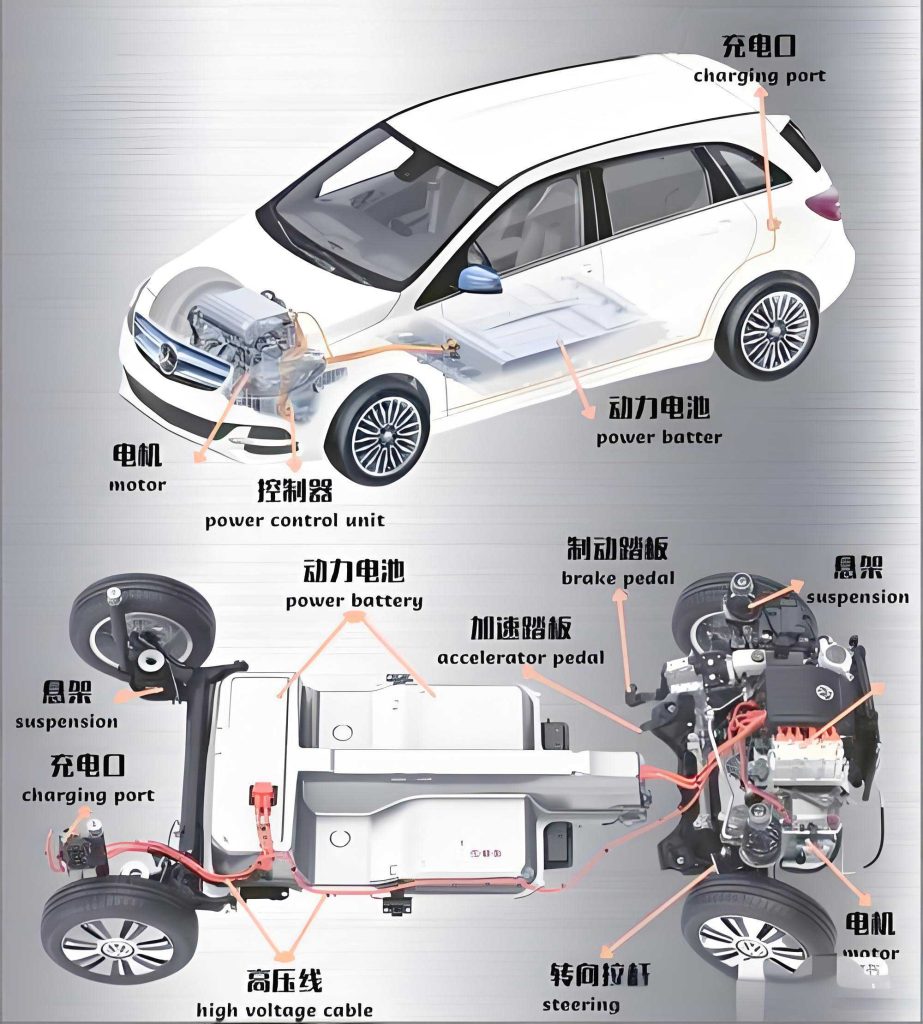
In the rapidly evolving landscape of automotive technology, the proliferation of battery electric cars has brought unprecedented focus on the reliability and safety of their core propulsion components. As a researcher deeply involved in this field, I recognize that the electric drive motor is the heart of a battery electric car. Its sudden failure during operation can lead to catastrophic outcomes, including loss of power and severe accidents. Traditional maintenance and onboard diagnostic systems primarily monitor threshold exceedances for parameters like current, voltage, and temperature, offering fault alarms but falling short of assessing the gradual performance degradation that precedes outright failure. Therefore, developing methods to monitor the degree of motor performance degradation using existing sensor data, particularly the stator current, is crucial for predictive health management and enhancing the overall safety of battery electric cars. This article presents a comprehensive experimental study focused on extracting and validating indicators from stator current signals that can reliably track the performance degradation of motors in battery electric cars.
The stator current in a battery electric car’s motor is a rich source of information regarding its operational health. Performance degradation mechanisms, such as insulation wear, bearing deterioration, or magnet weakening, inevitably manifest as distortions in the current waveform and its harmonic composition. The core challenge lies in identifying robust, monotonic, and correlated features from this signal that can serve as early warning indicators. My approach involves processing three-phase stator current data, extracting a comprehensive set of time-domain and frequency-domain features, and rigorously screening them based on established principles to find the most sensitive degradation proxies. The ultimate goal is to contribute to the design of non-intrusive, cost-effective monitoring systems for battery electric cars.
The foundation of this analysis is the raw three-phase current. In a typical battery electric car motor with a Y-connected stator, the currents are 120 degrees out of phase. To create a unified signal that amplifies imbalances—a key symptom of degradation—I employ the symmetrical components method to calculate the negative-sequence current. This process integrates the three-phase currents into a single waveform, effectively highlighting asymmetries. For a set of instantaneous three-phase currents \( i_u \), \( i_v \), and \( i_w \), the negative-sequence current \( I_- \) is computed as:
$$ I_- = \left| \frac{i_u + i_v e^{j240^\circ} + i_w e^{j120^\circ}}{3} \right| $$
where \( j \) is the imaginary unit. This calculated \( I_- \) waveform becomes the primary signal for all subsequent feature extraction processes in this study on battery electric car motor health.
From the negative-sequence current, I extract two broad categories of features: time-domain statistical indicators and frequency-domain harmonic ratios. Time-domain features provide information about the shape, spread, and impulsivity of the current waveform. The seven key statistical indicators calculated are defined in Table 1. These are standard in signal analysis for condition monitoring and have proven useful in various rotating machinery applications, which I hypothesize will extend to motors in battery electric cars.
| Indicator | Symbol | Formula |
|---|---|---|
| Mean | MEAN | $$ \bar{x} = \frac{1}{N} \sum_{i=1}^{N} x_i $$ |
| Variance | VAR | $$ \sigma^2 = \frac{1}{N} \sum_{i=1}^{N} (x_i – \bar{x})^2 $$ |
| Kurtosis | KUR | $$ \frac{1}{N} \sum_{i=1}^{N} \left( \frac{x_i – \bar{x}}{\sigma} \right)^4 $$ |
| Skewness | SKE | $$ \frac{N}{(N-1)(N-2)} \sum_{i=1}^{N} \left( \frac{x_i – \bar{x}}{\sigma} \right)^3 $$ |
| Waveform Factor | SF | $$ \frac{\sqrt{\frac{1}{N} \sum_{i=1}^{N} x_i^2}}{\frac{1}{N} \sum_{i=1}^{N} |x_i|} $$ |
| Impulse Factor | IF | $$ \frac{\max\{x_i\} – \min\{x_i\}}{\frac{1}{N} \sum_{i=1}^{N} |x_i|} $$ |
| Clearance Factor | CLF | $$ \frac{\max\{x_i\} – \min\{x_i\}}{\left( \frac{1}{N} \sum_{i=1}^{N} \sqrt{|x_i|} \right)^2} $$ |
In the frequency domain, performance degradation in a battery electric car motor often alters the harmonic structure of the current due to changing magnetic asymmetries and mechanical imperfections. I apply a Fast Fourier Transform (FFT) to the negative-sequence current to obtain its spectrum. Let \( f \) be the fundamental electrical frequency. The amplitudes at harmonic frequencies \( 2f, 3f, …, mf \) are denoted as \( A_{2f}, A_{3f}, …, A_{mf} \). To normalize for load variations common in battery electric car operation, I calculate the ratio of each harmonic amplitude to the fundamental amplitude. This yields a set of frequency-domain features represented as a vector \( \mathbf{H} \):
$$ \mathbf{H} = \begin{bmatrix} \frac{A_{2f}}{A_f} & \frac{A_{3f}}{A_f} & \cdots & \frac{A_{mf}}{A_f} \end{bmatrix}^T $$
Not all extracted features are equally effective for tracking degradation. To screen the most promising indicators, I adhere to three fundamental principles: Monotonicity (MON), Correlation (CORR), and Robustness (ROB). A good degradation indicator for a battery electric car motor should show a consistent trend over time (monotonicity), have a strong linear or monotonic relationship with time or cycle count (correlation), and be relatively insensitive to random noise and operational fluctuations (robustness). For a feature vector \( \mathbf{F} = [f(t_1), f(t_2), …, f(t_K)] \) collected over \( K \) time points, I first decompose it into a trend component \( f_T(t_k) \) and a residual component \( f_R(t_k) \) using the Exponentially Weighted Moving Average (EWMA) filter:
$$ f(t_k) = f_T(t_k) + f_R(t_k) $$
$$ f_T(t_k) = \beta f_T(t_{k-1}) + (1 – \beta) f(t_k) $$
with \( \beta \geq 0.9 \). The three metrics are then computed as follows:
$$ \text{MON}(f) = \frac{\left| \sum_{k} \delta(f_T(t_{k+1}) – f_T(t_k)) – \sum_{k} \delta(f_T(t_k) – f_T(t_{k+1})) \right|}{K – 1} $$
$$ \text{CORR}(f) = \left| \frac{K\sum_{k} f_T(t_k) t_k – \sum_{k} f_T(t_k) \sum_{k} t_k}{\sqrt{ \left[ K\sum_{k} f_T(t_k)^2 – (\sum_{k} f_T(t_k))^2 \right] \left[ K\sum_{k} t_k^2 – (\sum_{k} t_k)^2 \right] }} \right| $$
$$ \text{ROB}(f) = \frac{1}{K} \sum_{k} \exp\left( – \left| \frac{f_R(t_k)}{f_T(t_k)} \right| \right) $$
where \( \delta(t) \) is the unit step function. Finally, a composite score \( Z \) is calculated as a weighted sum to rank the features:
$$ Z = \omega_1 \cdot \text{MON}(f) + \omega_2 \cdot \text{CORR}(f) + \omega_3 \cdot \text{ROB}(f), \quad \sum_{i=1}^3 \omega_i = 1, \omega_i > 0 $$
Features with higher \( Z \) scores are considered more effective for monitoring the degradation of a battery electric car motor.
To obtain the necessary data for this investigation, I designed and conducted an accelerated performance degradation test on a commercial permanent magnet synchronous motor (PMSM) typical of those used in battery electric cars. The motor’s key specifications are listed in Table 2. The test platform comprised a dynamometer system with a three-phase induction motor acting as the load, controlled via a variable-frequency drive. Torque, speed, and power were measured using a high-precision sensor, while three-phase currents were sampled using high-bandwidth AC current probes connected to a data acquisition system. This setup is representative of the conditions a motor faces in a battery electric car.
| Parameter | Value |
|---|---|
| Rated Voltage | 96 V |
| Rated Power | 13 kW |
| Rated Speed | 4,965 rpm |
| Rated Torque | 25 N·m |
| Cooling Method | Air-cooled |
The loading profile was crafted to simulate demanding yet realistic operating conditions for a battery electric car, promoting accelerated wear without triggering immediate protective shutdowns. It was based on standardized reliability test methods but optimized to prevent excessive thermal stress. The primary durability cycle, referred to as Load Spectrum I, involves rapid transitions between zero, peak positive, rated, and negative torque at rated speed, as detailed in Table 3. Each cycle lasts 30 seconds, imposing significant mechanical and thermal stress on the motor and its drive system—stress akin to aggressive driving in a battery electric car.
| Segment | Speed Transition | Torque Transition | Duration (s) |
|---|---|---|---|
| 1 | 0 → Rated | 0 → Peak (65 N·m) | 3 |
| 2 | Rated | Peak | 1 |
| 3 | Rated | Peak → Rated (25 N·m) | 2 |
| 4 | Rated | Rated | 6 |
| 5 | Rated → 0 | Rated → 0 | 1.5 |
| 6 | 0 | 0 → Negative (-25 N·m) | 1.5 |
| 7 | 0 | Negative | 3 |
| 8 | 0 | Negative → 0 | 2 |
| 9 | 0 | 0 | 10 |
To capture performance characteristics across a wider operating envelope typical of a battery electric car, a secondary measurement profile, Load Spectrum II, was also employed. This spectrum involved sweeping through five different speed points (corresponding to vehicle speeds of 20, 40, 60, 80, and 100 km/h) and seventeen torque points from zero to maximum. This provides a comprehensive map of motor performance and efficiency under varied conditions.
The experimental procedure was iterative. Initially, baseline data was collected using Load Spectrum II. Then, the motor was subjected to blocks of 10,000 cycles of Load Spectrum I. After every 1,250 cycles within a block, three-phase current data was captured during a constant-speed, constant-torque segment of the cycle. After each 10,000-cycle block, the system was stopped for a brief inspection. This sequence—Load Spectrum II measurement followed by extended Load Spectrum I degradation runs—was repeated. The test concluded after 35,000 cycles when a severe mechanical failure (significant wear of the internal spline) prevented further loaded operation, confirming that substantial performance degradation had occurred. This process yielded 28 sets of current data under Load Spectrum I (tracking degradation) and 4 sets under Load Spectrum II (mapping performance).
The analysis of efficiency maps generated from Load Spectrum II data provided macroscopic evidence of degradation. Comparing the initial map with those after successive loading blocks showed a gradual contraction of the high-efficiency region (above 90%) and a slight reduction in peak system efficiency. While informative, constructing such maps in real-time on a battery electric car is computationally intensive and requires controlled conditions. Therefore, the focus remained on the simpler, continuously acquirable stator current signal from the Load Spectrum I data.
Processing the 28 sets of three-phase current data began with calculating the negative-sequence current \( I_- \) for each set. A visual comparison of the raw three-phase currents and the synthesized \( I_- \) waveform clearly showed that the latter provides a consolidated and often more sensitive view of waveform distortions. For each \( I_- \) waveform, I calculated the full set of 7 time-domain features and 8 frequency-domain harmonic ratios (specifically for harmonics 2, 3, 4, 5, 7, 8, 16, and 32, as these often contain significant fault-related information in battery electric car motors). A subset of the calculated results is presented in Table 4 to illustrate the nature of the data. The values for indicators like the Waveform Factor (SF) are very close to 1, while harmonic ratios like \( A_{2f}/A_f \) show more noticeable variation even in these early stages.
| Feature | Set 1 | Set 2 | Set 3 | Set 4 |
|---|---|---|---|---|
| MEAN | 0.7071 | 0.7070 | 0.7070 | 0.7071 |
| VAR (×10⁻⁶) | 2.49 | 2.59 | 2.38 | 2.37 |
| KUR | 1.7416 | 1.7861 | 1.8237 | 1.7959 |
| SKE | -0.4541 | -0.4482 | -0.5032 | -0.4508 |
| SF | 1.00011 | 1.00010 | 1.00011 | 1.00012 |
| IF | 0.1124 | 0.1153 | 0.1152 | 0.1116 |
| CLF | 0.1123 | 0.1152 | 0.1152 | 0.1115 |
| \(A_{2f}/A_f\) | 1.1043 | 1.5713 | 1.5525 | 1.4387 |
| \(A_{3f}/A_f\) | 0.2578 | 0.2234 | 0.2319 | 0.2111 |
| \(A_{4f}/A_f\) | 0.0402 | 0.0339 | 0.0386 | 0.0333 |
| \(A_{5f}/A_f\) | 0.0389 | 0.0388 | 0.0346 | 0.0296 |
| \(A_{7f}/A_f\) | 0.0058 | 0.0060 | 0.0065 | 0.0053 |
| \(A_{8f}/A_f\) | 0.0393 | 0.0353 | 0.0361 | 0.0311 |
| \(A_{16f}/A_f\) | 0.0026 | 0.0031 | 0.0019 | 0.0026 |
| \(A_{32f}/A_f\) | 0.0011 | 0.0008 | 0.0013 | 0.0008 |
Next, I applied the screening methodology to all 15 features across the 28 data sets, which correspond to increasing levels of cumulative damage in the battery electric car motor. The weights for the composite score \( Z \) were set as \( \omega_1 = 0.4 \), \( \omega_2 = 0.3 \), and \( \omega_3 = 0.3 \) to emphasize monotonic trend detection. The calculated MON, CORR, ROB, and final \( Z \) scores for each feature are summarized in Table 5. A threshold equal to the average \( Z \)-score (0.62) was used to select the most promising indicators. Features surpassing this threshold are highlighted.
| Feature | MON | CORR | ROB | Z-Score | Selected (Z > 0.62) |
|---|---|---|---|---|---|
| Waveform Factor (SF) | 0.85 | 0.72 | 0.88 | 0.82 | Yes |
| Clearance Factor (CLF) | 0.81 | 0.68 | 0.85 | 0.79 | Yes |
| Impulse Factor (IF) | 0.80 | 0.65 | 0.86 | 0.78 | Yes |
| \(A_{2f}/A_f\) | 0.88 | 0.75 | 0.70 | 0.78 | Yes |
| \(A_{16f}/A_f\) | 0.79 | 0.71 | 0.74 | 0.75 | Yes |
| Variance (VAR) | 0.65 | 0.60 | 0.80 | 0.68 | Yes |
| \(A_{8f}/A_f\) | 0.70 | 0.62 | 0.72 | 0.68 | Yes |
| Kurtosis (KUR) | 0.60 | 0.58 | 0.82 | 0.66 | Yes |
| \(A_{4f}/A_f\) | 0.68 | 0.55 | 0.75 | 0.66 | Yes |
| \(A_{3f}/A_f\) | 0.55 | 0.52 | 0.78 | 0.61 | No |
| Mean (MEAN) | 0.10 | 0.08 | 0.95 | 0.36 | No |
| Skewness (SKE) | 0.45 | 0.40 | 0.70 | 0.52 | No |
| \(A_{5f}/A_f\) | 0.40 | 0.38 | 0.65 | 0.47 | No |
| \(A_{7f}/A_f\) | 0.30 | 0.25 | 0.72 | 0.41 | No |
| \(A_{32f}/A_f\) | 0.25 | 0.20 | 0.68 | 0.36 | No |
The screening process successfully identified several strong candidates. The top-performing features include the Waveform Factor (SF), Clearance Factor (CLF), Impulse Factor (IF), and the harmonic ratios \( A_{2f}/A_f \) and \( A_{16f}/A_f \). These indicators demonstrated a desirable combination of a strong increasing or decreasing trend over the degradation cycles, a high correlation with cycle count, and good robustness against random noise. This makes them particularly suitable for the noisy and variable operating environment of a battery electric car. Time-domain factors like SF, CLF, and IF are sensitive to changes in the shape and peak-to-average characteristics of the current waveform, which degrade with mechanical wear and electrical imbalances. The harmonic ratios, especially the second harmonic \( A_{2f}/A_f \), are known to be sensitive to asymmetries in the magnetic circuit and rotor eccentricity, common degradation modes in PMSMs for battery electric cars.
To create a single, comprehensive health metric for the battery electric car motor, I constructed a Health Index (HI) by fusing the top five selected features. For each selected feature \( i \) and at each measurement point \( j \), I first calculated its relative deviation \( \delta_{i,j} \) from its initial baseline value (from Set 1):
$$ \delta_{i,j} = \left| \frac{X_{i,j} – X_{i,1}}{X_{i,1}} \right| $$
where \( X_{i,j} \) is the value of feature \( i \) at cycle batch \( j \), and \( X_{i,1} \) is its initial value. The Health Index at point \( j \) is then the mean of these relative deviations across all \( N \) selected features:
$$ HI_j = \frac{1}{N} \sum_{i=1}^{N} \delta_{i,j} $$
Plotting this Health Index against the cumulative number of degradation cycles yields a revealing trajectory, as shown in Table 6. The HI starts near zero and exhibits a clear, generally monotonic upward trend as the battery electric car motor undergoes progressive damage. While there are minor fluctuations—attributable to measurement noise and slight operational inconsistencies—the overall trajectory is unequivocal. The index rises more steeply in later stages, which aligns with the progression of failure mechanisms often observed in mechanical systems, where degradation accelerates as damage accumulates. This HI provides a quantifiable, single-value measure that can be tracked over time. In a real-world battery electric car application, establishing thresholds on this HI could enable early warnings long before a complete failure occurs, allowing for proactive maintenance scheduling.
| Cycle Batch Number (j) | Cumulative Cycles | Health Index (HI_j) |
|---|---|---|
| 1 | 0 (Baseline) | 0.000 |
| 2 | 1,250 | 0.152 |
| 3 | 2,500 | 0.187 |
| 4 | 3,750 | 0.213 |
| 5 | 5,000 | 0.245 |
| 6 | 6,250 | 0.281 |
| 7 | 7,500 | 0.302 |
| 8 | 8,750 | 0.335 |
| 9 | 10,000 | 0.378 |
| 10 | 11,250 | 0.410 |
| 11 | 12,500 | 0.452 |
| 12 | 13,750 | 0.498 |
| 13 | 15,000 | 0.543 |
| 14 | 16,250 | 0.601 |
| 15 | 17,500 | 0.665 |
| 16 | 18,750 | 0.732 |
| 17 | 20,000 | 0.811 |
| 18 | 21,250 | 0.905 |
| 19 | 22,500 | 1.012 |
| 20 | 23,750 | 1.128 |
| 21 | 25,000 | 1.265 |
| 22 | 26,250 | 1.423 |
| 23 | 27,500 | 1.607 |
| 24 | 28,750 | 1.802 |
| 25 | 30,000 | 2.031 |
| 26 | 31,250 | 2.295 |
| 27 | 32,500 | 2.610 |
| 28 | 33,750 | 2.974 |
This experimental investigation demonstrates a viable pathway for monitoring the health of drive motors in battery electric cars using solely the stator current signal. The methodology hinges on intelligent signal processing: integrating three-phase currents via negative-sequence calculation to amplify fault-related asymmetries, extracting a broad set of time and frequency-domain features, and applying rigorous multi-criteria screening to isolate the most sensitive indicators. For the tested battery electric car motor, features such as the Waveform Factor, Clearance Factor, Impulse Factor, and the ratio of the second and sixteenth harmonic amplitudes to the fundamental amplitude proved to be excellent proxies for performance degradation. Their fusion into a single Health Index provides a clear, trending metric that correlates strongly with the motor’s accumulated damage.
The implications for the design of next-generation monitoring systems in battery electric cars are significant. This approach leverages existing sensor data, requiring no additional hardware cost, which is a critical consideration for mass-produced vehicles. The processing algorithms for feature extraction and Health Index calculation can be implemented in the vehicle’s existing electronic control units or edge-computing modules. By establishing baselines for healthy operation and monitoring the drift of these key indicators, it becomes possible to move beyond simple fault alarms toward genuine predictive health management. This can optimize maintenance schedules, prevent roadside failures, and enhance the safety and reliability of battery electric cars. Future work should focus on validating these indicators across a larger fleet of motors, under diverse real-driving conditions, and linking specific indicator changes to identified physical failure modes to further refine the prognostic accuracy for the enduring battery electric car ecosystem.