
In the pursuit of reducing fuel consumption and mitigating environmental impact, hybrid cars have emerged as a pivotal solution in the automotive industry. As a researcher focused on energy efficiency, I have developed an adaptive equivalent fuel consumption minimization strategy tailored for hybrid cars. This approach leverages real-time optimization and driving condition recognition to enhance fuel economy. The core idea is to dynamically adjust control parameters based on varying driving patterns, ensuring optimal energy distribution between the internal combustion engine and electric motor in a hybrid car. Throughout this article, I will delve into the system modeling, optimization framework, and adaptive mechanisms, emphasizing the role of hybrid cars in sustainable transportation.
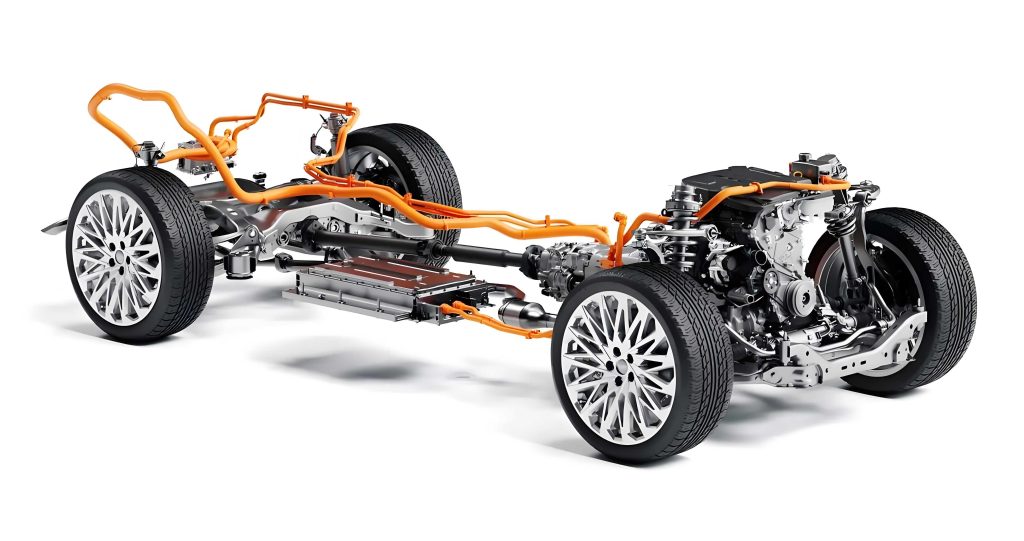
The structure of the hybrid powertrain under consideration is integral to understanding the energy management strategy. A typical hybrid car employs a configuration that includes an engine, a clutch, an Integrated Starter Generator (ISG) motor, and a Continuously Variable Transmission (CVT). This setup enables multiple operational modes, each critical for efficient performance in a hybrid car. The modes include pure electric driving, pure engine driving, hybrid driving, driving charging, and regenerative braking. By switching between these modes, the hybrid car can optimize energy usage based on real-time demands. For instance, during low-speed operation, the hybrid car operates in pure electric mode to avoid inefficient engine operation, while during high demand, both power sources combine in hybrid mode. This flexibility is a key advantage of hybrid cars, allowing for significant fuel savings.
To implement effective control, a real-time simulation model of the hybrid car is essential. This model encompasses several sub-models: the engine model, motor model, battery model, CVT model, vehicle dynamics model, and driver model. Each component is mathematically represented to capture the dynamic behavior of the hybrid car. For the engine, the steady-state torque output is a function of throttle opening and engine speed, given by: $$ T_e = f_1(\alpha, n_{\text{eng}}) $$ where \( T_e \) is the steady-state torque, \( \alpha \) is the throttle opening, and \( n_{\text{eng}} \) is the engine speed. The dynamic torque accounts for hysteresis and is expressed as: $$ T_{\text{eng}} = \frac{e^{-\tau s}}{k_{\tau} s + 1} T_e $$ where \( \tau \) is the hysteresis time, \( k_{\tau} \) is the inertia coefficient, and \( s \) is the Laplace operator. The fuel consumption rate \( b_e \) is obtained via two-dimensional interpolation: $$ b_e = f_2(n_{\text{eng}}, T_{\text{eng}}) $$ leading to the total fuel consumption: $$ m_f = \frac{1}{3.6 \times 10^6} \int_0^t b_e P_{\text{eng}} \, dt $$ with \( P_{\text{eng}} = \frac{T_{\text{eng}} n_{\text{eng}}}{9550} \). This model ensures accurate representation of engine behavior in a hybrid car.
The motor model describes the electric drive system. When discharging, the motor power is: $$ P_{\text{bat}} = \frac{T_{\text{mot}} n_{\text{mot}}}{9550 \eta_{\text{mot}}} $$ where \( T_{\text{mot}} \) is motor torque, \( n_{\text{mot}} \) is motor speed, and \( \eta_{\text{mot}} \) is motor efficiency. During charging, the power is: $$ P_{\text{bat}}’ = \frac{T_{\text{mot}} n_{\text{mot}} \eta_{\text{mot}}}{9550} $$ The efficiency \( \eta_{\text{mot}} \) is derived from experimental data: $$ \eta_{\text{mot}} = f_3(T_{\text{mot}}, n_{\text{mot}}) $$ For the battery, an internal resistance model (Rint model) is used. The battery current \( I_b \), efficiency \( \eta_{\text{bat}} \), and State of Charge (SOC) are given by: $$ I_b = \frac{U_{\text{oc}} – \sqrt{U_{\text{oc}}^2 – 4R_{\text{in}}P_b}}{2R_{\text{in}}} $$ $$ \eta_{\text{bat}} = \begin{cases} \frac{U_{\text{oc}} + \sqrt{U_{\text{oc}}^2 – 4R_{\text{in}}P_b}}{2U_{\text{oc}}}, & P_b \geq 0 \\ \frac{2U_{\text{oc}}}{U_{\text{oc}} + \sqrt{U_{\text{oc}}^2 – 4R_{\text{in}}P_b}}, & P_b < 0 \end{cases} $$ $$ \text{SOC}(t) = \text{SOC}(t_0) – \int_{t_0}^t \frac{I_b(\tau) \eta_{\text{bat}}}{Q_c} \, d\tau $$ where \( U_{\text{oc}} \) is open-circuit voltage, \( R_{\text{in}} \) is internal resistance, \( P_b \) is battery power (positive for discharge), and \( Q_c \) is nominal capacity. These equations are fundamental for managing energy flow in a hybrid car.
The CVT model accounts for transmission efficiency: $$ \eta_{\text{cvt}} = f_4(T_{\text{in}}, i_{\text{cvt}}), \quad T_{\text{out}} = i_{\text{cvt}} T_{\text{in}} \eta_{\text{cvt}} $$ where \( \eta_{\text{cvt}} \) is efficiency, \( f_4 \) is a fitting function, \( i_{\text{cvt}} \) is the CVT ratio, and \( T_{\text{out}} \) is output torque. The vehicle dynamics model uses Newton’s second law: $$ \frac{T_{d1}}{r} = \frac{C_D A}{21.15} (3.6v)^2 + mgf \cos \alpha + mg \sin \alpha + \delta m \frac{dv}{dt} $$ where \( T_{d1} \) is the torque applied to the vehicle, \( r \) is wheel radius, \( C_D \) is air drag coefficient, \( A \) is frontal area, \( v \) is velocity, \( m \) is mass, \( g \) is gravity, \( f \) is rolling friction coefficient, \( \alpha \) is road slope, and \( \delta \) is rotational mass factor. For a hybrid car, \( T_{d1} \) depends on the operating mode, combining engine and motor torques. The driver model employs PID control to track target speed: $$ e(t) = v_{\text{tar}} – v_{\text{act}}, \quad T_{d2} = K_p e(t) + K_i \int e(t) \, dt + K_d \frac{de(t)}{dt} $$ where \( T_{d2} \) is the torque demand. These models collectively form the real-time control framework for the hybrid car.
Energy management in a hybrid car is formulated as an optimization problem aimed at minimizing fuel consumption over a driving cycle. The performance index is: $$ J = \int_{t_0}^{t_f} \dot{m}_f(x(t), u(t), t) \, dt $$ where \( \dot{m}_f \) is the fuel consumption rate, \( u(t) = [i_{\text{cvt}}(t), SF(t)]^T \) is the control vector (CVT ratio and motor torque分配系数), and \( x(t) = S(t) \) is the state variable (battery SOC). The state equation is: $$ \dot{x}(t) = -\frac{\eta_{\text{bat}} I_{\text{bat}}(t)}{Q_c} = f(x(t), u(t), t) $$ Applying Pontryagin’s Minimum Principle, the Hamiltonian is constructed: $$ H(x(t), u(t), \lambda(t), t) = \dot{m}_f(x(t), u(t), t) – \lambda^T(t) \cdot f(x(t), u(t), t) $$ where \( \lambda(t) \) is the co-state. The optimal control \( u^*(t) \), state \( x^*(t) \), and co-state \( \lambda^*(t) \) satisfy: $$ \dot{\lambda}(t) = \frac{\partial H}{\partial x} = 0, \quad \dot{x}(t) = \frac{\partial H}{\partial \lambda} = f(x(t), u(t), t) = 0 $$ This framework underpins the real-time optimization for the hybrid car.
To address the hybrid nature of the powertrain, the Equivalent Fuel Consumption Minimization Strategy (EFCMS) is employed. It converts electrical energy consumption into an equivalent fuel consumption using an equivalence factor. The modified Hamiltonian becomes: $$ H(x(t), u(t), t) = \dot{m}_f(x(t), u(t)) + s(t) \cdot \frac{P_b(x(t), u(t))}{Q_{\text{lhq}}} $$ where \( s(t) \) is the equivalence factor and \( Q_{\text{lhq}} \) is the lower heating value of fuel. The equivalence factor plays a critical role in balancing fuel and electricity usage in a hybrid car. If \( s(t) \) is too high, the hybrid car倾向于用油, increasing fuel consumption; if too low, it倾向于用电, potentially degrading battery life. Thus, adaptive tuning of \( s(t) \) is vital for hybrid car efficiency.
Multi-objective optimization is incorporated to prevent undesirable effects like frequent engine starts-stops and excessive CVT ratio changes. The extended Hamiltonian includes penalty terms: $$ H(x(t), u(t), t) = \dot{m}_f(x(t), u(t)) + s(t) \cdot \frac{P_b(x(t), u(t))}{Q_{\text{lhq}}} + \alpha \cdot C(E_{\text{ss}}(0 \to 1)) + \beta (|\Delta i_{\text{cvt}}| > I) $$ where \( \alpha \) and \( \beta \) are weights, \( C() \) is a counting function for engine state transitions \( E_{\text{ss}} \), and \( I \) is a threshold for CVT ratio change. Through simulation tests on standard driving cycles, optimal values are determined, such as \( \alpha = 0.3 \), to balance fuel economy and component wear in a hybrid car. This multi-objective approach enhances the practicality of the hybrid car control strategy.
Driving condition recognition is pivotal for adapting the equivalence factor in a hybrid car. Feature parameters are extracted from driving cycles to characterize patterns. These include average speed \( v_m \), maximum speed \( v_{\max} \), average acceleration \( a_m \), maximum acceleration \( a_{\max} \), maximum deceleration \( d_{\max} \), average deceleration \( d_m \), idle time ratio \( r_i \), acceleration time ratio \( r_a \), deceleration time ratio \( r_d \), constant speed time ratio \( r_c \), and idle frequency \( f_i \). To augment sample size, an overlapping sampling method is used: segments of 120 seconds are sampled every 30 seconds from standard cycles. This yields sufficient data for training a Learning Vector Quantization (LVQ) neural network, which serves as an intelligent driving condition recognizer for the hybrid car.
The LVQ network consists of an input layer, a competitive layer, and an output layer. Given input feature vector \( (x_1, x_2, \dots, x_n) \), weights \( w_{ij} \), and output labels \( (o_1, o_2, \dots, o_l) \), the network operates as follows. First, the distance between input and competitive neurons is computed: $$ d_j = \sqrt{\sum_{i=1}^n (x_i – w_{ij})^2} $$ The neuron with minimum distance is selected, and its label \( L_i \) is compared to the actual label \( L_x \). Using LVQ1 learning rule, weights are updated: if \( L_i = L_x \), $$ w_{ij}(t+1) = w_{ij}(t) + \eta (x_i – w_{ij}(t)) $$ if \( L_i \neq L_x \), $$ w_{ij}(t+1) = w_{ij}(t) – \eta (x_i – w_{ij}(t)) $$ where \( \eta \) is the learning rate. The network is trained on features from standard cycles like MANHATTAN, UDDS, US06, and WVUINTER. After training, it achieves high accuracy in identifying driving conditions, enabling context-aware control for the hybrid car.
The equivalence factor \( s(t) \) is made adaptive based on recognized driving conditions and battery SOC. The adaptive formula is: $$ s(t) = s_0(t) + f_p(\text{SOC}(t)) $$ where \( s_0(t) \) is the baseline equivalence factor obtained via offline shooting method, and \( f_p(\text{SOC}) \) is a penalty function for SOC boundary constraints. The shooting method iteratively adjusts \( s_0 \) to achieve \( \Delta \text{SOC} = \text{SOC}(t_f) – \text{SOC}(t_0) = 0 \) for given cycles and initial SOC. For instance, under NYCC and MANHATTAN cycles, optimal \( s_0 \) varies with SOC, as summarized in the table below:
| Driving Cycle | Initial SOC | Optimal \( s_0 \) |
|---|---|---|
| NYCC | 0.55 | 2.8 |
| NYCC | 0.70 | 3.0 |
| MANHATTAN | 0.60 | 2.9 |
| MANHATTAN | 0.75 | 3.2 |
The penalty function \( f_p(x) \) with \( x = \text{SOC}(t) \) is defined to keep SOC within bounds \( [x_{\text{low}}, x_{\text{high}}] \): $$ f_p(x) = \begin{cases} K_p (x_{\text{high}} – x(t)), & x(t) \in [x_{\text{high}} + \Delta x, +\infty) \\ -a (x_{\text{high}} – x(t))^2, & x(t) \in (x_{\text{high}} – \Delta x, x_{\text{high}} + \Delta x) \\ 0, & x(t) \in [x_{\text{low}} + \Delta x, x_{\text{high}} – \Delta x] \\ a (x_{\text{low}} – x(t))^2, & x(t) \in (x_{\text{low}} – \Delta x, x_{\text{low}} + \Delta x) \\ -K_p (x_{\text{low}} – x(t)), & x(t) \in (-\infty, x_{\text{low}} – \Delta x] \end{cases} $$ where \( K_p > 0 \), \( a > 0 \), and \( \Delta x = K_p/(4a) \). This function ensures smooth transitions and prevents SOC violations, crucial for battery health in a hybrid car. When SOC nears the upper bound, \( f_p \) becomes negative, reducing \( s(t) \) to promote electric usage; conversely, near the lower bound, \( f_p \) increases \( s(t) \) to favor fuel consumption. This adaptive mechanism allows the hybrid car to maintain optimal energy distribution across varying conditions.
Simulation验证 is conducted to evaluate the proposed adaptive EFCMS for hybrid cars. The hybrid car parameters are listed in the table below, covering vehicle specs and powertrain components. These parameters are essential for modeling the hybrid car’s behavior.
| Parameter | Value | Parameter | Value |
|---|---|---|---|
| Vehicle Mass | 1550 kg | Motor Max Power | 26 kW |
| Wheel Radius | 0.304 m | Motor Rated Power | 15 kW |
| Frontal Area | 2.160 m² | Motor Max Torque | 88.7 Nm |
| Rolling Resistance | 0.014 | Engine Max Power | 30 kW |
| Air Drag Coefficient | 0.330 | Engine Max Speed | 6000 rpm |
| Final Drive Ratio | 6.580 | Engine Max Torque | 141 Nm |
| Transmission Efficiency | 0.970 | Battery Max Power | 30 kW |
| Max Speed | ≥145 km/h | Battery Capacity | 10 Ah |
| 0-100 km/h Time | ≤14 s | Battery Voltage | 144 V |
| Max Gradeability | ≥30% | CVT Ratio Range | [0.442, 2.432] |
A comprehensive driving cycle, TestCycle, composed of FTP, HWFET, NYCC, and US06 segments, is used for simulation. The cycle spans 7000 seconds with varying speeds, representing realistic conditions for a hybrid car. The LVQ-based recognizer accurately identifies driving modes, with minor misclassifications during rapid transitions. The adaptive equivalence factor \( s(t) \) adjusts dynamically, as shown in simulations, maintaining SOC within bounds while optimizing fuel use. Engine operating points are analyzed, and most fall within the high-efficiency region, demonstrating the effectiveness of the strategy for a hybrid car.
Comparative analysis is performed against existing strategies: intelligent rule control from literature and model predictive control. The fuel consumption results are summarized in the table below, highlighting the benefits of the adaptive EFCMS for hybrid cars.
| Control Strategy | Fuel Consumption (L/100 km) | Equivalent Fuel Consumption (L/100 km) |
|---|---|---|
| Intelligent Rule Control | 6.02 | 6.04 |
| Model Predictive Control | 5.85 | 5.98 |
| Adaptive EFCMS | 5.56 | 5.67 |
The proposed adaptive EFCMS reduces fuel consumption by 7.64% compared to intelligent rule control and by 4.96% compared to model predictive control. Similarly, equivalent fuel consumption decreases by 6.13% and 5.18%, respectively. These improvements underscore the efficacy of the adaptive approach in enhancing the fuel economy of a hybrid car. The strategy ensures that the hybrid car operates efficiently across diverse driving patterns, leveraging real-time optimization and condition recognition.
In conclusion, the adaptive equivalent fuel consumption minimization strategy presented here offers a robust solution for energy management in hybrid cars. By integrating Pontryagin’s Minimum Principle, equivalent fuel consumption concepts, and intelligent driving condition recognition, the strategy dynamically optimizes power split in a hybrid car. The use of LVQ networks for工况识别 and adaptive equivalence factors based on SOC constraints ensures applicability to complex, real-world driving scenarios. Simulation results confirm significant fuel savings, demonstrating the potential of this approach to advance the sustainability of hybrid cars. Future work may explore integration with connected vehicle technologies or further refinement of the penalty functions. Overall, this research contributes to the ongoing evolution of hybrid car technologies, emphasizing efficiency and adaptability.
Throughout this article, the focus has been on hybrid cars, their modeling, optimization, and adaptive control. The repeated emphasis on hybrid cars highlights their centrality in modern transportation systems. The mathematical formulations and tables provide a comprehensive framework for implementing such strategies. As the automotive industry moves towards electrification, hybrid cars will continue to play a crucial role, and advanced energy management strategies like the one described will be key to maximizing their benefits. The adaptive EFCMS ensures that hybrid cars can achieve optimal performance regardless of driving conditions, making them more fuel-efficient and environmentally friendly.