
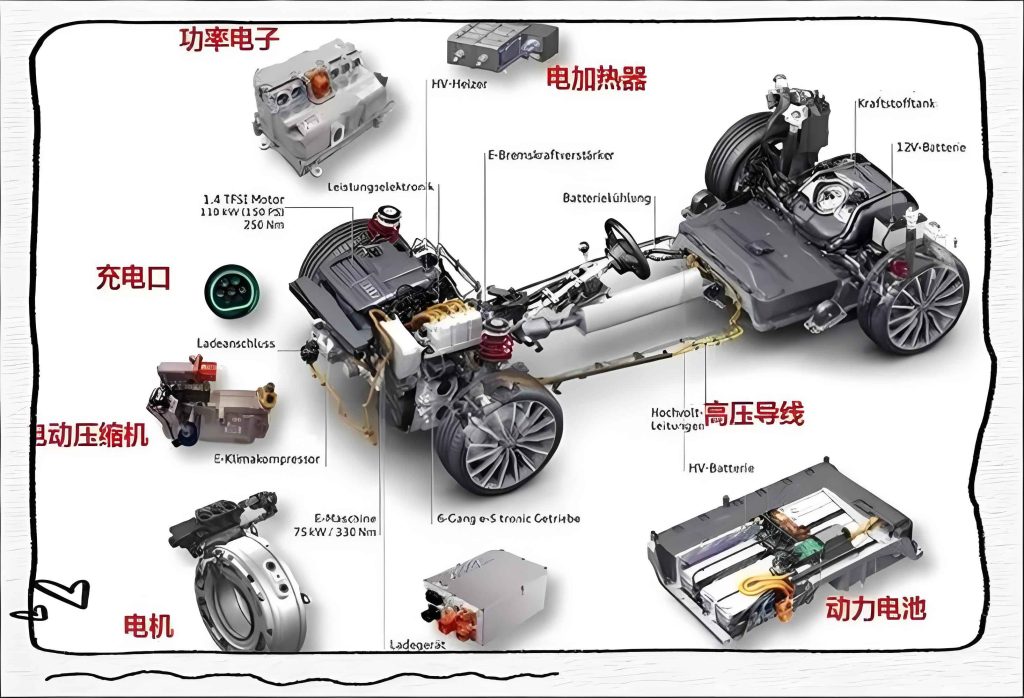
The rapid global transition towards sustainable transportation has positioned New Energy Vehicles (NEVs), particularly Electric Vehicles (EVs), at the forefront of automotive innovation. The core of an EV’s powertrain is its electric drive system, a sophisticated assembly typically comprising a high-voltage traction motor, power electronics inverter, and associated control units. While enabling zero tailpipe emissions, the high-power switching frequencies and rapid current transients inherent in electric drive system operation generate significant electromagnetic interference (EMI). This EMI poses a critical challenge for Electromagnetic Compatibility (EMC), potentially disrupting both the vehicle’s own sensitive electronics (e.g., sensors, infotainment) and external radio services. Consequently, comprehensive EMC assessment is a mandatory prerequisite for vehicle homologation and market release.
National and international standards, such as China’s GB/T 18387-2017, define the limits and methods for measuring electromagnetic field emissions from electrically propelled vehicles. A fundamental challenge for automotive OEMs lies in ensuring consistency between component-level EMC tests of the electric drive system and the final whole-vehicle certification test. Discrepancies often arise because standard component test setups (e.g., per GB/T 18655) do not fully replicate the physical and electrical installation conditions found in the actual vehicle. A key, frequently overlooked, factor in these setups is the mechanical integration, specifically the drive shafts or axle system connecting the motor to the wheels. This article presents a detailed investigation into the influence of the shaft system’s physical length on the radiated emission profile of an electric drive system, aiming to bridge the gap between subsystem and vehicle-level EMC validation.
1. Introduction and Literature Context
The electromagnetic environment within a modern EV is exceptionally complex. The electric drive system acts as a potent source of conducted and radiated emissions spanning a broad frequency spectrum. These emissions originate primarily from the Pulse-Width Modulation (PWM) signals used to control the motor, with harmonic content extending well into the High Frequency (HF) range. EMC standards for vehicles are designed to ensure this electromagnetic “pollution” remains below levels that would cause malfunction or interference.
The regulatory framework is multi-layered. For whole-vehicle radiated emissions in China, the compulsory standard is GB/T 18387-2017, “Limits and measurement methods of electromagnetic field emission intensity for electrically powered vehicles,” covering the 150 kHz to 30 MHz range. Component-level testing for subsystems like the electric drive system often follows standards like GB/T 18655, “Vehicles, boats and internal combustion engines – Radio disturbance characteristics – Limits and methods of measurement for the protection of on-board receivers.” A critical research and engineering problem is the “test correlation gap”: a drive system may pass its standalone component test but still cause the full vehicle to exceed limits during homologation testing, or vice-versa. This gap leads to costly redesign loops late in the development cycle.
Prior research has identified several factors contributing to this discrepancy: differences in grounding impedance, harness routing and length, load simulation, and the presence of adjacent vehicle body structures. However, the role of the mechanical power transmission elements—specifically the metallic drive shafts—as unintentional radiating antennas or as elements that modify ground current return paths has received less systematic attention. The shaft system is a primary conductive connection between the motor’s housing (often the reference ground for the inverter) and the vehicle’s chassis via the wheel hubs and bearings. Its geometry directly influences the characteristics of common-mode and antenna-mode currents responsible for radiated fields. This study hypothesizes that the physical length of the conductive shaft segment is a decisive parameter affecting the resonance frequencies and amplitudes of radiated emissions from the electric drive system.
2. Theoretical Framework: Shafts as Radiating Structures
The emission mechanism can be modeled by considering the electric drive system and its attached shaft as a compound radiating structure. High-frequency common-mode voltages, \( V_{CM} \), are generated at the motor terminals due to the high \( dv/dt \) of the PWM inverter. These voltages drive common-mode currents, \( I_{CM} \), which flow through parasitic capacitances (e.g., motor stator windings to frame, \( C_{WF} \)) to the motor housing and subsequently seek a return path to the battery/drive inverter negative terminal.
A significant portion of this return current flows through the mechanical connection of the motor housing to the vehicle chassis. In a test bench setup simulating a rear-drive configuration, a primary path is via the drive shafts to the simulated “wheel-end” grounding point on the test bench’s ground plane. The shaft, therefore, becomes part of a large, unintended loop antenna or a monopole/ dipole-like structure.
The resonant frequency of a simple straight conductor acting as a monopole antenna over a ground plane is approximately given by the quarter-wavelength condition:
$$ f_{res} \approx \frac{c}{4 \cdot L_{eff}} $$
where \( c \) is the speed of light (\( 3 \times 10^8 \) m/s) and \( L_{eff} \) is the effective electrical length of the shaft. For a shaft length of 0.66 meters, the predicted fundamental resonant frequency is:
$$ f_{res, 0.66m} \approx \frac{3 \times 10^8}{4 \times 0.66} \approx 113.6 \text{ MHz} $$
This is above the 30 MHz range of GB/T 18387. However, in practice, the resonance occurs at much lower frequencies because:
- The effective electrical length \( L_{eff} \) is increased by the presence of attached components, harnesses, and the fact that current paths are not confined solely to the shaft.
- The structure is not a perfect monopole; it is part of a complex, coupled network of conductors (motor housing, cooling lines, high-voltage cables) forming larger loops. Radiation in the 10-30 MHz band is typically dominated by magnetic field emissions from such current loops.
The radiated field strength from a small loop area \( A \) carrying a current \( I \) at frequency \( f \) is proportional to:
$$ H \propto \frac{A \cdot I \cdot f^2}{r} $$
where \( r \) is the distance. Changing the shaft length alters the geometry of the dominant current loop(s), effectively changing the loop area \( A \) and the distribution of \( I \). More importantly, the shaft length impacts the impedance of the common-mode current path at specific frequencies, leading to series or parallel resonances that can significantly amplify or attenuate the emitted noise. Therefore, an accurate bench test must replicate the shaft length to capture the correct resonant behavior of the integrated electric drive system.
3. Test Methodology and Setup Design
The core objective was to compare radiated electric field emissions under three configurations: the complete vehicle, the isolated electric drive system on a test bench with a “long” shaft, and the same system with a “short” shaft. All measurements were aligned with the spirit of GB/T 18387-2017 for methodological consistency, though the bench tests were necessarily adaptations.
3.1. Whole-Vehicle Test Configuration
The vehicle, a rear-wheel-drive EV, was tested on a chassis dynamometer inside a semi-anechoic chamber (SAC). The test followed GB/T 18387-2017 strictly.
| Parameter | Specification |
|---|---|
| Standard | GB/T 18387-2017 |
| Frequency Range | 150 kHz – 30 MHz |
| Antenna | 1m Monopole, Vertical Polarization |
| Measurement Distance | 3 m from vehicle rear |
| Vehicle Load Condition | Running on dynamometer at 70 km/h |
| Receiver Settings | Peak Detector, 9 kHz BW, 5 kHz Step |
The monopole antenna was placed 3.0 m ± 0.03 m behind the vehicle’s rear bumper, on the ground plane. Emissions were measured while the vehicle’s driving wheels rotated on the dynamometer at a steady speed of 70 km/h, simulating a relevant driving condition that activates the electric drive system under load.
3.2. Electric Drive System Bench Test Configuration
The electric drive system (integrated motor and inverter) was mounted on a test bench inside a different SAC. The setup aimed to replicate the vehicle’s rear-axle installation as closely as possible. Key aspects included:
- Power & Load: The system was powered by a battery simulator at the nominal DC link voltage (350 V). A programmable dynamometer provided the mechanical load to achieve the equivalent wheel-edge speed (570 rpm) and torque (240 Nm) corresponding to the 70 km/h vehicle condition.
- Grounding & Layout: The motor housing was connected to the chamber’s ground plane via a low-inductance strap, simulating the vehicle chassis connection. High-voltage and low-voltage cables were routed with lengths and paths approximating the vehicle installation.
- Measurement: A 1m monopole antenna was placed 3.0 m from the geometric center of the motor assembly, aligning with the vehicle test’s rear measurement position. This critical step moves beyond the typical 1m distance used in component tests to match the vehicle test geometry.
The independent variable was the length of the conductive shaft section. Two custom shaft assemblies were engineered:
| Configuration ID | Total Conductive Metal Shaft Length | Description |
|---|---|---|
| Long Shaft (LS) | 87 cm | Extended metal shaft, significantly longer than the vehicle’s original equipment. |
| Short Shaft (SS) | 66 cm | Metal shaft length closely approximating the original vehicle’s half-shaft length, with an insulated block simulating the wheel hub. |
In both cases, the shaft was connected to the motor’s output flange on one end and to an insulated coupling/loading interface on the other. The conductive shaft was thus electrically “floating” at the load end but capacitively and inductively coupled to the ground plane, mimicking the real vehicle’s condition where the wheel bearing provides a complex HF grounding path.
4. Results, Analysis, and Discussion
The radiated electric field (peak detector) results for the three test configurations are summarized below, focusing on the critical 15-30 MHz band where significant resonances and limit exceedances were observed.
4.1. Whole-Vehicle Test Result
The whole-vehicle test established the baseline “real-world” emission signature. A distinct resonance peak was observed at approximately 26.0 MHz, exceeding the GB/T 18387 limit by +2.59 dBμV/m. Another notable, though compliant, resonance was visible near 19 MHz. This profile represents the integrated emission from all vehicle sources, with the electric drive system being a dominant contributor in this frequency range.
4.2. Electric Drive System Bench Test Results
The results from the isolated electric drive system tests revealed a clear dependency on shaft length.
| Test Configuration | Primary Resonance 1 | Primary Resonance 2 | Max. Exceedance vs. Limit | Proximity to Vehicle Result |
|---|---|---|---|---|
| Whole Vehicle | ~19.0 MHz | ~26.0 MHz (Exceedance) | +2.59 dBμV/m | Baseline |
| Drive System (Long Shaft, 87cm) | ~17.0 MHz | ~20.0 MHz (Exceedance) | ~+4.0 dBμV/m | Poor. Resonance frequencies shifted lower. |
| Drive System (Short Shaft, 66cm) | ~20.6 MHz | ~25.6 MHz (Marginal) | Close to limit, < +1 dBμV/m | Good. Resonance frequencies closely match vehicle. |
4.3. Detailed Analysis of Shaft Length Impact
The data conclusively demonstrates that the Short Shaft (66 cm) configuration yields an emission profile far more representative of the whole-vehicle result than the Long Shaft (87 cm) configuration. The key resonant peak shifts from ~20 MHz (LS) to ~25.6 MHz (SS), the latter aligning closely with the vehicle’s 26.0 MHz peak. The relationship between length and resonance frequency follows an inverse proportionality, consistent with antenna and transmission line theory.
Let \( L_{LS} \) and \( L_{SS} \) be the effective electrical lengths for the long and short shaft configurations, and \( f_{LS} \) and \( f_{SS} \) their corresponding primary high-frequency resonance points (~20 MHz and ~25.6 MHz). The ratio is:
$$ \frac{f_{SS}}{f_{LS}} \approx \frac{25.6}{20.0} = 1.28 $$
The inverse length ratio is:
$$ \frac{L_{LS}}{L_{SS}} \approx \frac{87}{66} = 1.32 $$
The proximity of these ratios (\( 1.28 \approx 1/1.32 \)) strongly supports the model that the shaft system is a primary determinant of the resonant structure. The shift can be explained by considering the shaft and motor housing as a composite radiating element. Increasing the shaft length increases the total effective electrical length \( L_{eff} \) of this structure, which lowers its fundamental resonant frequency according to the general relation:
$$ f_{res} \propto \frac{1}{L_{eff}} $$
Furthermore, a longer conductive shaft alters the impedance and geometry of the dominant common-mode current return path. This can change the loop area \( A \) in the magnetic dipole radiation model and affect the distribution of standing waves along the structure. The bench test with the shorter, vehicle-representative shaft better replicates the impedance network and hence the current distribution present in the actual vehicle, leading to correlated resonance frequencies and emission amplitudes.
4.4. Discussion on Test Correlation
While the Short Shaft configuration showed greatly improved correlation, perfect alignment with the whole-vehicle result was not achieved. The residual differences can be attributed to several factors inherent to any subsystem-level test:
- Grounding and Chassis Impedance: The test bench uses a simple, low-inductance ground strap. A real vehicle chassis is a complex, distributed network of interconnected metal panels with varying HF impedance, affecting ground current distribution.
- Cable Harness and Peripheral Integration: Despite efforts to replicate cable lengths, the exact routing, proximity to other components (battery, DC-DC converter), and coupling to the vehicle body are difficult to fully emulate on a bench.
- Presence of Other Sources and Absorbers: In the whole vehicle, emissions from the electric drive system may be attenuated or enhanced by other metallic structures (absorption, reflection, cavity resonances) and may combine with noise from other components.
Nevertheless, this study identifies the shaft system length as a primary and controllable factor in achieving subsystem-to-vehicle EMC test correlation for the electric drive system. A standard component test using an arbitrary or overly long shaft can produce misleading “pass” or “fail” results, as it assesses the system at the wrong resonant frequencies. For predictive R&D testing, the mechanical interface—specifically the length of the drive shafts—must be treated as an integral part of the EMC test setup for the electric drive system.
5. Conclusion and Engineering Implications
This investigation systematically analyzed the influence of the drive shaft system on the radiated electromagnetic emissions of an electric vehicle’s electric drive system. Through comparative testing of a complete vehicle and the isolated drive system with two distinct shaft lengths, a definitive causal link was established.
The central finding is that the physical length of the conductive shaft segment is a critical parameter that directly governs the resonant frequencies of radiated emissions in the HF band (e.g., 15-30 MHz). A bench test configuration utilizing a shaft length that deviates significantly from the vehicle’s original equipment can produce emission profiles with resonant peaks shifted by several megahertz, leading to incorrect assessments of compliance risk. Conversely, a test setup that incorporates a shaft length representative of the vehicle installation yields resonance behavior and emission amplitudes that correlate much more closely with final whole-vehicle test results.
The practical engineering implication is clear: for EMC development and validation testing of an electric drive system, the test specification must mandate the use of vehicle-representative mechanical interfaces, particularly the drive shafts or a validated electrical equivalent that replicates the transmission line characteristics. This approach transforms the subsystem test from a mere compliance check into a powerful predictive tool. By accurately capturing the resonant behavior imposed by the vehicle’s mechanical integration, engineers can identify and mitigate potential EMC issues related to the electric drive system much earlier in the development cycle, reducing the need for costly and time-consuming fixes during vehicle-level homologation. As EV architectures evolve towards integrated e-axles and higher power densities, the precision of such correlated subsystem testing will become increasingly vital for ensuring robust electromagnetic compatibility.