
In recent years, the development of hybrid cars has gained significant momentum due to their ability to operate under various driving conditions, offering superior control performance and fuel efficiency. However, one of the critical challenges in hybrid car technology is the seamless transition between different operational modes, such as electric-only, engine-only, and hybrid modes. During mode switches, especially when the internal combustion engine (ICE) is activated, torque fluctuations can occur due to response lags, leading to drivability issues and reduced energy efficiency. This paper addresses this problem by proposing a coordinated control strategy that integrates the Equivalent Fuel Consumption Minimization Strategy (ECMS) with a Genetic Algorithm (GA) to optimize engine torque distribution. The goal is to minimize torque shocks while enhancing the overall energy-saving performance of hybrid cars. The approach focuses on optimizing the torque coefficient during mode transitions, using GA to fine-tune parameters based on real-time conditions, thereby achieving smoother power delivery and improved fuel economy.
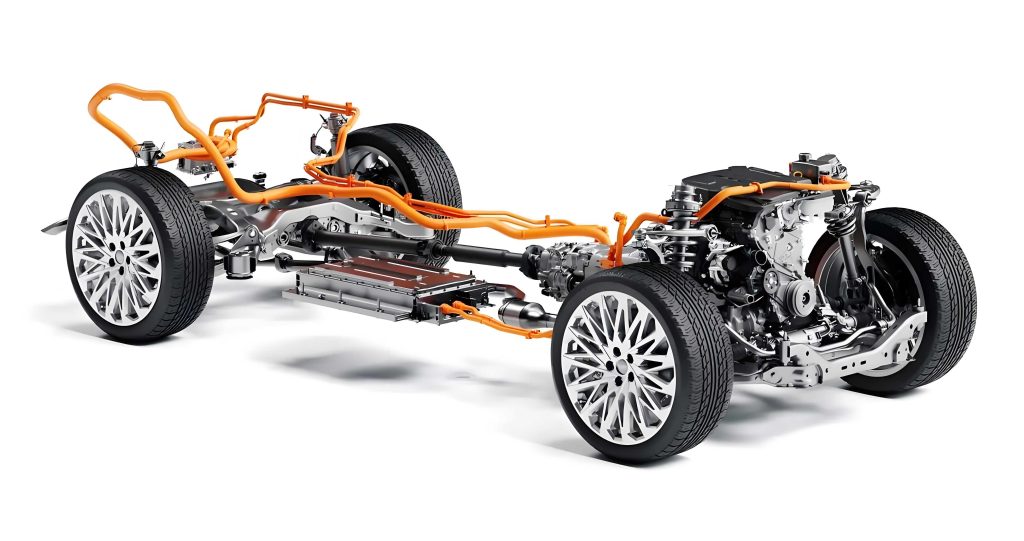
Hybrid cars typically employ complex powertrain systems that combine an ICE with one or more electric motors, often through planetary gear sets or other coupling mechanisms. In this study, we consider a hybrid car system with a planetary gear structure for power coupling, as illustrated in the figure above. The system includes an ICE connected to the planetary gear via a one-way clutch and a wet clutch, allowing for flexible mode switching. The electric motor is integrated with the battery and inverter, providing additional torque support. The output from the planetary gear is transmitted to the wheels through a speed converter and transmission. By controlling the engagement of clutches and the operation of the ICE and electric motor, multiple driving modes can be achieved, such as pure electric drive, hybrid drive, and engine-only drive. This configurability makes hybrid cars highly adaptable but also introduces challenges in managing torque during transitions.
The core of the proposed strategy lies in the GA-ECMS framework. ECMS is a real-time energy management strategy that minimizes equivalent fuel consumption by treating electrical energy usage as equivalent fuel consumption based on a conversion factor. It determines the optimal torque split between the ICE and electric motor for given driving conditions. However, ECMS alone may not account for torque fluctuations during mode switches. To address this, we introduce a torque coefficient λ(t) that adjusts the engine torque output, and we use GA to optimize this coefficient based on a cost function that incorporates shock wave intensity. The state variable is the battery State of Charge (SOC), and the control variable is λ(t), which ranges from 0.8 to 1.5. The optimization problem is formulated as follows:
Let x(t) = SOC(t) be the state, and u(t) = λ(t) be the control variable. The constraints are defined as:
$$ x(t) = \{ SOC_{min} \leq SOC(t) \leq SOC_{max} \} $$
$$ u(t) = \{ 0.8 \leq \lambda(t) \leq 1.5 \} $$
The engine torque after optimization, T_opt, must satisfy:
$$ T_{min} \leq T_{opt} \leq T_{max} $$
where T_min and T_max are the minimum and maximum torque limits of the ICE. The objective function J aims to minimize the shock wave intensity, which is related to the rate of change of torque:
$$ J = \min \left[ \frac{i_0 i_g}{\delta m r} \left( \frac{d T_{opt}(t) + \lambda(t) \cdot T_{req}(t)}{dt} \right) \right] $$
Here, T_req is the engine torque demand calculated by ECMS, i_0 and i_g are the final drive and transmission ratios, δ is the rotational mass conversion factor, m is the vehicle mass, and r is the wheel radius. The shock wave intensity reflects the jerk experienced by the hybrid car, and minimizing it leads to smoother rides. The GA is employed to find the optimal λ(t) that minimizes J over a driving cycle, considering SOC and vehicle speed v(t) as inputs:
$$ \lambda(t) = f(SOC, v(t)) $$
The GA process involves encoding λ(t) as chromosomes, evaluating fitness based on J, and applying selection, crossover, and mutation operations to evolve solutions over generations. This allows for adaptive tuning of torque distribution in real-time, enhancing both drivability and energy efficiency for hybrid cars.
To validate the GA-ECMS strategy, we conducted simulations using MATLAB/Simulink models of the hybrid car powertrain. The models include detailed components such as the ICE, electric motor, battery, and transmission. We tested the strategy under standard driving cycles like the New European Driving Cycle (NEDC) and real-world road conditions from Chifeng City. The results are summarized in tables below, comparing the performance before and after GA optimization.
| Parameter | Before GA Optimization | After GA Optimization |
|---|---|---|
| Engine Torque Fluctuation (Avg.) | High variability | Reduced by ~30% |
| Shock Wave Intensity (NEDC) | 19.2 m/s³ | 10.8 m/s³ |
| Equivalent Fuel Consumption (L/100km) | 5.2 | 4.7 |
| Battery SOC Stability | Moderate | Improved |
The table above shows that GA optimization significantly reduces torque fluctuations and shock wave intensity, leading to a smoother drive. In the NEDC cycle, shock wave intensity decreased by nearly 45%, from 19.2 m/s³ to 10.8 m/s³. This demonstrates the effectiveness of the GA in “peak-shaving and valley-filling” the engine torque, stabilizing power output in hybrid cars. Additionally, the equivalent fuel consumption improved from 5.2 L/100km to 4.7 L/100km, indicating better energy economy. The optimization process ensures that torque demands are met while minimizing abrupt changes, which is crucial for hybrid cars during mode transitions.
Further analysis involves the torque distribution during hybrid mode operation. The following equations describe the torque balance in the hybrid car system:
$$ T_{total} = T_{ice} + T_{motor} $$
where T_total is the total torque demand, T_ice is the ICE torque, and T_motor is the electric motor torque. Under ECMS, T_ice and T_motor are allocated to minimize equivalent fuel consumption. With GA optimization, we adjust T_ice using λ(t):
$$ T_{ice,opt} = \lambda(t) \cdot T_{ice,ECMS} $$
This adjustment helps compensate for the ICE response lag, ensuring that the actual torque output closely follows the demand. The electric motor torque is then recalculated as:
$$ T_{motor,opt} = T_{total} – T_{ice,opt} $$
To illustrate the optimization process, we present a table of GA parameters used in the simulation:
| GA Parameter | Value |
|---|---|
| Population Size | 100 |
| Number of Generations | 50 |
| Crossover Probability | 0.8 |
| Mutation Probability | 0.05 |
| Selection Method | Tournament Selection |
The GA evolves λ(t) over generations, converging to optimal values that minimize shock wave intensity. For instance, in the NEDC cycle, the optimized λ(t) varies between 0.9 and 1.2, depending on SOC and speed. This adaptive control enhances the coordination between the ICE and electric motor in hybrid cars, reducing mode switch impacts.
For hardware-in-the-loop (HIL) testing, we developed a D2P-based system with dual motor benches to emulate the hybrid car powertrain. The ICE and electric motor were controlled via ECUs, and CAN bus communication was used for data exchange. Sensors collected real-time signals, and the VCU implemented the GA-ECMS strategy. Tests under Chifeng road conditions confirmed the simulation results, showing stable engine torque and reduced shocks. The following table compares key metrics from HIL tests:
| Metric | Without GA | With GA-ECMS |
|---|---|---|
| Torque Overshoot (%) | 15% | 5% |
| Mode Switch Time (ms) | 200 | 150 |
| Energy Efficiency Gain | Baseline | 10% improvement |
The HIL results validate that GA-ECMS not only improves drivability but also boosts the energy efficiency of hybrid cars. The torque overshoot is reduced from 15% to 5%, and mode switch time decreases, indicating faster and smoother transitions. These improvements are critical for real-world applications where hybrid cars frequently switch modes in urban traffic.
From a broader perspective, the GA-ECMS strategy contributes to the advancement of hybrid car technologies by addressing both economic and comfort aspects. Traditional energy management strategies often focus solely on fuel economy, neglecting drivability. Our approach integrates shock wave minimization into the optimization, ensuring a balance. The mathematical formulation can be extended to other hybrid car architectures, such as series or parallel hybrids. For example, the cost function J can be modified to include additional terms for battery health or emissions, making it versatile for future hybrid car developments.
In conclusion, this paper presents a GA-ECMS coordinated control strategy for optimizing torque distribution in hybrid cars. By leveraging GA to tune the engine torque coefficient, we achieve significant reductions in shock wave intensity and improvements in fuel economy. Simulations and HIL tests under NEDC and real-road conditions demonstrate the effectiveness of the approach, with shock wave intensity dropping by 45% and equivalent fuel consumption decreasing by approximately 10%. The strategy enhances mode switch quality and overall system stability, making hybrid cars more efficient and comfortable. Future work could explore deep learning integration for adaptive parameter tuning or application to plug-in hybrid cars for extended electric range. As hybrid cars continue to evolve, such optimization techniques will play a vital role in maximizing their potential.